The way most chiefs try to prep for boards is broken. You cannot “just study harder” on top of a 60–80 hour leadership job and expect to survive, let alone pass.
This is not about motivation. If you made it to chief resident or administrative lead, you’re already motivated. The problem is physics: limited cognitive bandwidth, long days, constant interruptions, and everyone else’s emergencies becoming your emergencies.
Here’s how you manage board prep in that specific reality—not the fantasy where you have evenings free, perfect weekends, and control over your schedule.
1. First, Get Brutally Honest About Your Situation
You are not a typical PGY-3/PGY-4 studying for boards.
You’re dealing with:
- Schedule changes and coverage fires
- Angry emails from attendings and nursing leadership
- Residents with crises (illness, pregnancy, burnout, professionalism issues)
- Meetings that multiply like bacteria
- Service demands that somehow always “need a chief”
So your first move is not “buy a Qbank.” Your first move is assessment:
- What are your exam dates and true deadlines?
- What is your realistic weekly baseline schedule as chief?
- What’s your mental baseline: fried or functional?
I’ve watched chiefs make the same mistake every year: they build a study plan as if they’re still a PGY-2 on a cushy elective. Then three weeks in, the whole thing explodes, they feel like failures, and then they avoid the material because shame has now joined the party.
You need a “chief-adjusted” plan.
2. Build a Chief-Adjusted Study Blueprint (Not a Fantasy Calendar)
Start with a simple question: On a bad, chaotic week, what’s the minimum study time you can still hit?
Not your ideal. Your worst-consistent.
For many chiefs, that’s 30–45 minutes on weekdays and 2–3 hours total on the weekend. Yes, that sounds low. Good. That means it might actually happen.
Then structure it.

| Step | Description |
|---|---|
| Step 1 | Know exam date |
| Step 2 | Set minimum weekly hours |
| Step 3 | Choose primary Qbank |
| Step 4 | Block daily micro sessions |
| Step 5 | Protect 1 weekly long session |
| Step 6 | Review and adjust monthly |
Pick one primary resource. One.
If you’re chief, you do not get three Qbanks, two video series, and a textbook. That’s fantasy.
You choose:
- For IM: UWorld or MKSAP Qbank as primary
- For EM: Rosh or EM Board Review
- For Peds: PREP
- For Anesthesia, Surgery, Psych, etc.: your specialty’s main Qbank (not the 4th-best one someone mentioned on Reddit)
Then you add at most one supporting resource (flashcards, a concise review book, or high-yield videos).
If you’re juggling more than:
- 1 primary Qbank
- 1 secondary (cards or quick review)
you’re setting yourself up to fail.
Design your weekly structure like this
Baseline target for a busy chief:
| Day | Study Type | Time (Approx) |
|---|---|---|
| Mon–Thu | Micro Qbank blocks | 30–45 min/day |
| Fri | Light review/cards | 20–30 min |
| Sat or Sun | Long session | 2–3 hours |
That’s roughly 5–7 hours/week. Sustained. Not heroic one-off marathons that blow up your sleep.
3. Weaponize Short Windows: How to Actually Study on a Chief Schedule
Boards prep as chief is a game of micro-opportunities. You will not get long, quiet evenings consistently. You will get 10–25 minute chunks between crises.
You either weaponize those, or you lose.
Micro-strategy 1: The 15–20 Question Rule
Every weekday, your non-negotiable is:
- 15–20 Qbank questions (or the equivalent in mixed blocks)
You can split that:
- 10 questions at lunch
- 10 questions at the end of the day before you go home
- Or 5–7 between meetings, three times a day
Do not wait for “when I have an hour.” That hour is a myth.
Micro-strategy 2: Review on the fly, not at home
You do the questions and the bulk of the explanation review at the hospital:
- Waiting for a meeting to start? Two explanations.
- Residents are 10 minutes late for noon conference? One or two more.
- Sitting outside an office waiting for your PD? Open the app.
You should leave the hospital with most of the day’s cognitive heavy lifting already done. Home time is not for starting your questions. It’s for light review, not cerebral deep dives after 12 hours of chaos.
Micro-strategy 3: Phone-first setup
If your primary Qbank does not work fluidly on your phone, you need a workaround or a different resource.
Your reality:
- Laptop access is sporadic.
- Wi-Fi may be garbage in certain floors.
- You’re constantly being paged, texted, or called.
Set up:
- Qbank app logged in and pinned on your home screen.
- Speed dial mental routine: open → timed or tutor block → 10 questions → explanations until next interruption.
- Decks app (Anki or similar) set up with offline card packs.
4. Protect One Weekly “Anchor” Session
You still need at least one longer, deeper session per week where you:
- Do a larger mixed block (40–60 questions) or
- Systematically hit a weak topic with focused questions + quick review
This is usually 2–3 hours, either:
- One protected half-day on an easier weekend, or
- Two 75–90 minute blocks (early morning + later afternoon)
You’re chief. You can carve this out if you’re intentional and slightly selfish.
How to protect it in real life
Put it on your calendar as an actual event. Not “study.” Something like:
“Board review – do not book/cover unless patient dying.”Tell the right people:
- Co-chief: “I’m offline Saturday 9–12 for dedicated board prep, can you field non-urgent texts?”
- Spouse/partner: “This block is what keeps me from failing boards and repeating a year; I’ll be a human again after noon.”
Decide the content before the block:
- “Mixed 40-question block, then review all endocrine misses”
- “Cardiology: 40 questions + 1-hour focused review from board review book”
Do not sit down for your long session and then spend 20 minutes deciding what to do. That’s how you end up “organizing” instead of studying.
5. Use Your Chief Power to Engineer Better Study Time
You have more control than you think—if you’re willing to use it.
Create “board-friendly” rotations and schedules
You’re in the room (or at least on the email) when block schedules and services are assigned. Be strategic:
- Place yourself on at least 1–2 lighter months (clinic-heavy, elective, admin block) leading up to your exam.
- Do not load your own schedule with back-to-back ICU + heavy wards in the 2–3 months right before the test if there is any alternative.
- Avoid being the primary chief on-call for program crises in the final 4 weeks before boards if that’s remotely negotiable.
This is not selfish. It’s survival. Failed boards hurt the program too.
Batch your admin work
Your enemy is scatter: 40 emails, 7 texts, 4 in-person questions, all bleeding into your supposed study time.
So you batch:
- Email/admin blocks twice a day (e.g., 9–9:30, 3–3:30).
- Slack/WhatsApp checks at defined times, not every 90 seconds.
- Non-urgent resident asks: “I’ll handle this after noon conference; send me an email with the details.”
Every time you protect a 20–30 minute slice from random tasks, that’s a mini-study window you can reclaim when the moment appears.
6. Coordinate With Your PD Early (Not When You’re Drowning)
One of the dumbest common patterns: chiefs hiding their board stress from the program director until they’re 6 weeks from the exam, behind on Qbank, and barely functional.
Do this early, ideally near the start of the year:
Show them a simple, honest plan:
- Rough weekly hours
- Target Qbank completion timeline
- Months you’re aiming to be lighter
Say this out loud:
“I want to be a strong chief AND pass boards on the first try. To do that, I need some protected bandwidth in X and Y months.”
Most PDs will work with you if you frame it like that. They do not want a chief who fails boards; it reflects badly on them and the program.
If your PD is not helpful or dismissive? Fine. You still document the conversation and then you and your co-chiefs quietly adjust schedules where you can. Use whatever levers exist.
7. Manage Your Brain Like a Limited Resource (Because It Is)
You don’t get infinite focus. Chief work fries your executive function: constant decision-making, emotional labor, multitasking.
If you try to stack cognitively intense board prep on top of a maxed-out nervous system without guardrails, you burn out and retention plummets.
Two non-negotiables
- Sleep: You cannot compress this below 6 hours chronically and expect to learn. Pulling exam-prep all-nighters as chief is a bad joke.
- One genuine off-block per week: At least half a day with no boards, no schedules, no email.
Yes, I mean it: no boards that half-day. Your recall improves when you’re not constantly churning.
Don’t chase “perfect recall” on explanations
As chief, you must accept “good enough” learning:
- Read the explanation.
- Capture 1–2 key learning points (mentally or via flashcards).
- Move on.
You do not have time to read 3 textbook chapters because one question went sideways. That perfectionism is how you end up 40% through your Qbank with 2 weeks left.
8. Time Tracking and Progress Reality Checks
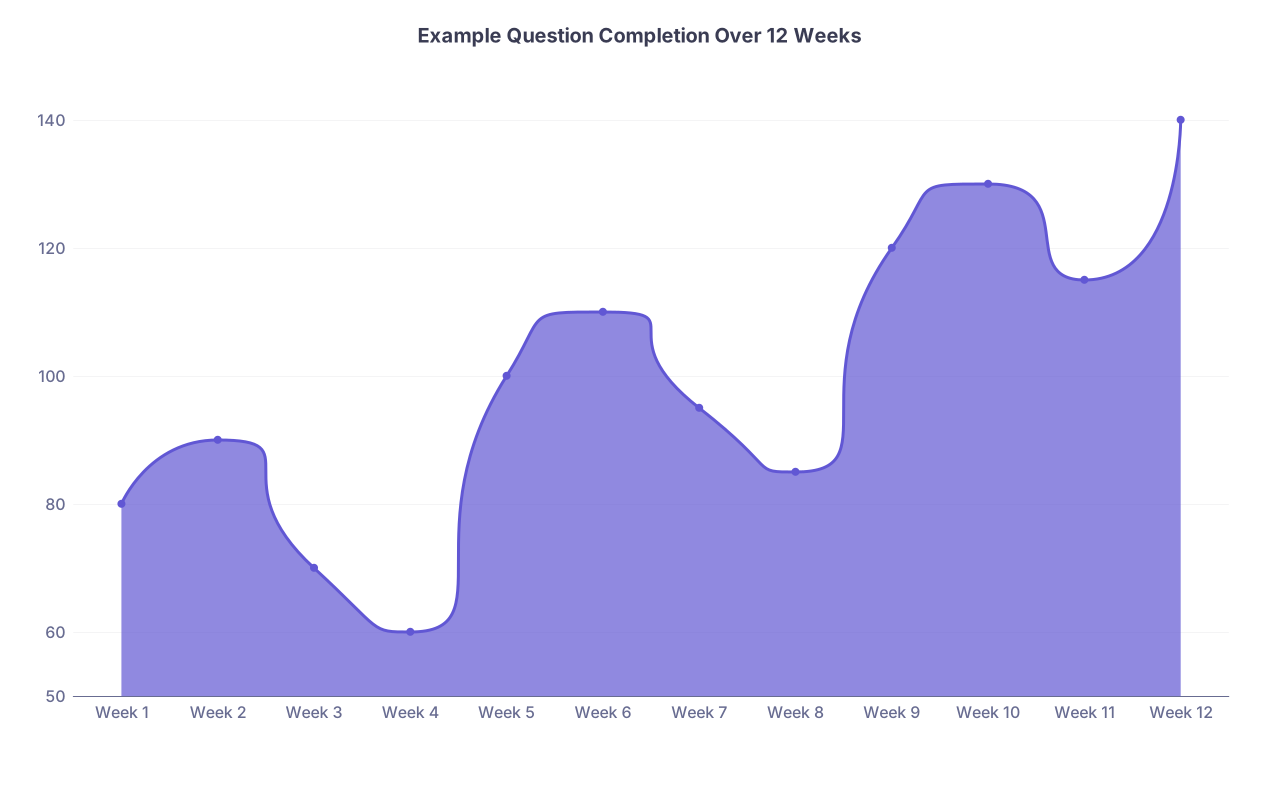
Your perception of what you’re accomplishing as chief is often completely off. You feel like you’re “studying all the time,” but when you actually track, it’s 3 hours a week and 100 unfocused flashcards.
Do a hard, objective check every 2–4 weeks:
- How many Qbank questions completed?
- What’s your cumulative performance trending at?
- How many total hours of study did you actually log?
| Category | Value |
|---|---|
| Week 1 | 80 |
| Week 2 | 90 |
| Week 3 | 70 |
| Week 4 | 60 |
| Week 5 | 100 |
| Week 6 | 110 |
| Week 7 | 95 |
| Week 8 | 85 |
| Week 9 | 120 |
| Week 10 | 130 |
| Week 11 | 115 |
| Week 12 | 140 |
You don’t need a fancy system. A note in your phone is enough:
- “Week of Jan 7: 110 questions, 68% correct, 5.5 hours.”
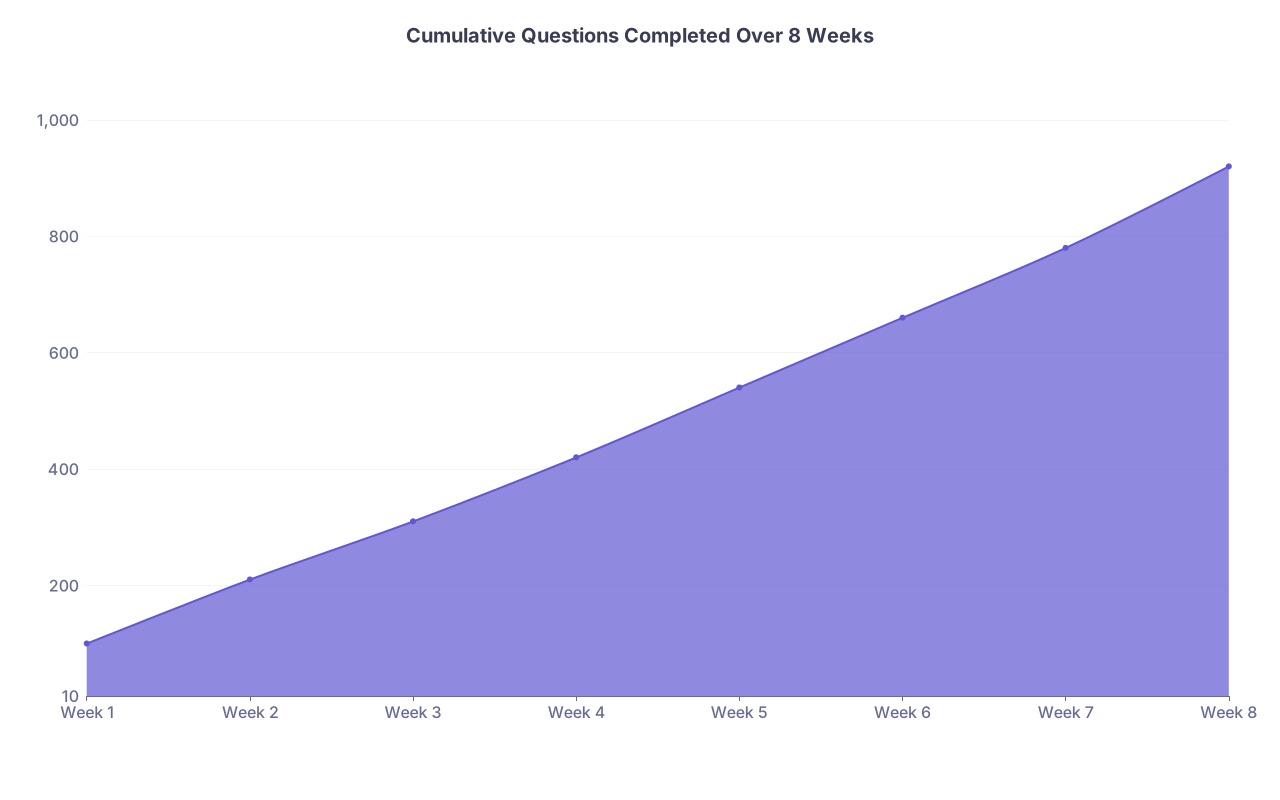
If your completion rate suggests you’ll finish only 60% of your Qbank by the exam, that’s a signal. Not to panic, but to adjust:
- Increase micro-blocks.
- Strip away secondary resources you aren’t actually using.
- Use your lighter months more aggressively.
9. Handling When Things Go Off the Rails
They will. Someone will go on leave. A service will implode. Leadership will hand you some absurd “urgent” curriculum project.
When (not if) a week or two gets torched:
Do not “restart” your plan. Just resume.
Compress expectations for the lost weeks instead of trying to pay everything back.
Use a triage mindset:
- Must do: Daily 10–15 questions, even in disaster weeks.
- Nice to do: Extra blocks, long session.
- Optional: Cards, videos, anything beyond core Qbank.
Nobody passes boards on the strength of two perfect weeks. It’s the cumulative grind.
10. Leverage Your Position to Study With Residents
You’re already teaching, rounding, and giving conferences. Fold board prep into what you’re doing anyway.
Examples:
- Noon conference cases built off your missed Qbank questions.
- Morning reports where you quietly emphasize your weak systems.
- Chief teaching sessions where you use board-style questions and discuss them out loud.
When you teach something from a question you missed last week, it sticks. You’re also converting “chief duties” into stealth board prep. That’s how you win.

11. A Quick Word on Resentment and Guilt
Almost every chief in this position hits the same emotional wall:
- Resentful that chief duties are cannibalizing study time
- Guilty when they say “no” to people needing help
- Ashamed when progress lags
You need to internalize this: Passing your boards is not optional. It’s not a “nice to have.” It’s a core, non-negotiable professional obligation.
So when you block time and people push back—“But we really need you at this meeting,” “Can you cover this last-minute shift?”—you are allowed to say:
- “I can’t take that on; I already have a fixed board prep commitment during that time.”
- “I’m at capacity this week. Let’s find another solution.”
Will some people grumble? Sure. They’ll get over it. The same people will be far more upset if you fail your boards and have to repeat or delay your career.
12. Putting It All Together: A Sample 4-Week Snapshot
Here’s what a reasonably managed month might look like for a busy chief 3–4 months out from boards:
| Week | Questions Target | Long Session Focus | Specialty Example |
|---|---|---|---|
| 1 | 100–120 | Cardio mixed block + review | IM boards |
| 2 | 90–110 | Endocrine & renal | IM boards |
| 3 | 80–100 (busy) | Mixed systems | Post-ICU chief week |
| 4 | 120–140 | Full 60-question simulation | Day off before exam-2 |
And a typical “busy” day:
- 7:00–7:30 – Pre-round chaos, triage chief issues
- 12:15–12:35 – Lunch + 10 questions
- 3:30–3:45 – Waiting outside PD office, review 3–4 explanations
- 5:30–5:50 – Before heading home, 5–10 more questions
- 9:15–9:30 – On couch, light review of marked questions or 15 flashcards
Not glamorous. But over weeks, it adds up.
| Category | Value |
|---|---|
| Week 1 | 100 |
| Week 2 | 210 |
| Week 3 | 310 |
| Week 4 | 420 |
| Week 5 | 540 |
| Week 6 | 660 |
| Week 7 | 780 |
| Week 8 | 920 |

FAQ (Exactly 5 Questions)
1. I’m behind on my Qbank as chief. Should I start guessing or skipping explanations to finish in time?
No. Random guessing your way to 100% completion is theater, not prep. Better to complete 70–80% of a Qbank well than 100% with superficial understanding. Prioritize mixed blocks, focus on your weak systems, and actually read explanations—even if briefly. If you’re really behind, cut secondary resources, not the depth of your primary one.
2. Is it realistic to take a full week of vacation right before boards as chief?
It depends on your program, but it’s often possible if you plan it early. You’re more likely to get that week if you: (a) communicate your plan months in advance, (b) trade for less desirable weeks earlier in the year, and (c) don’t repeatedly ask for last-minute favors. That final week is best used for full-length practice blocks and targeted review, not learning brand-new content.
3. My co-chief is not studying at all and wants to dump more work on me. What do I do?
Set a boundary. You’re not obligated to sacrifice your exam performance because someone else mismanaged their role. Be direct: “I need to protect some time for boards. I can’t take additional recurring duties, but I can help problem-solve how we divide things more fairly.” If necessary, loop your PD in with a calm, factual description—not drama, just workload reality.
4. Are dedicated board review courses worth it if I’m already stretched thin?
Only if: (1) the course timing aligns with a lighter period in your schedule, and (2) you’re the kind of learner who actually focuses in structured sessions. A 5-day course during your ICU chief month is pointless. And if attending the course means you do fewer Qbank questions overall, skip it. For chiefs, Qbank completion + targeted review usually beats passive lectures.
5. How do I handle the guilt of studying while my residents are drowning on the wards?
Welcome to leadership. You will always feel pulled between your responsibilities to others and to yourself. But passing boards is not selfish; it’s required for you to progress and keep helping future residents and patients. You can support your team by improving systems, advocating for adequate staffing, and being present when you’re on. That does not mean sacrificing your own exam and career.
Key takeaways:
- Build a chief-adjusted study plan around micro-sessions, one primary Qbank, and one protected weekly anchor block.
- Use your role—scheduling power, teaching time, and proximity to leadership—to quietly engineer better study conditions instead of just “being a hero.”
- Treat your brain and time as finite resources: protect sleep, track progress, and accept “good enough but consistent” over perfect and unsustainable.