The way most programs handle residents coming back from leave is lazy and unsafe. “Glad you’re back. Here’s your schedule. Oh, and your boards are in six months.” That is how people fail.
You need a plan that assumes no one else will protect your board readiness. Because they won’t.
You’re coming back from a leave of absence (LOA)—maybe for health, burnout, family, visa, pregnancy, disciplinary stuff, whatever. It does not matter why. The system will treat you as “back to 100%” the second your badge works again.
So here’s what you actually do, step by step, to rebuild your board readiness without crashing yourself in the process.
Step 1: Stabilize First, Study Second
If your life is on fire, you do not start with board questions.
You start with: can I actually function?
Here’s a basic checklist for your first 2–4 weeks back. Do not skip this.
- Sleep: Can you get 5–6 hours consistently, even on busy weeks?
- Mental health: Do you have follow-up with therapy/psych/PCP if that was part of your leave?
- Meds: If you’re on any, are they stable, refilled, and not making you foggy?
- Home logistics: Childcare, transportation, food, finances. Are the basics covered?
If the answer is “no” to multiple items, your first “board prep” task is not UWorld. It is reducing chaos so you can later sustain a study routine.
You’re not a med student anymore. You’re a resident with real patients and less cognitive bandwidth. You need stability first, then intensity.
Step 2: Have the Hard Conversation With Your Program
Don’t trust vibes. Get specifics.
You need one structured conversation with:
- Your PD (Program Director), or
- Associate PD, and
- Ideally your program coordinator present (they remember logistics better than anyone)
Your agenda is precise:
Clarify your board timeline.
- Exact year and expected exam window
- Any deadlines tied to promotion or graduation
- Whether they expect you to take “on time” or if they support a delay
Clarify your clinical ramp-up.
Ask: “For the first 3–6 months back, what flexibility do I have with rotation choices, calls, and nights?”Clarify expectations.
Use sentences like:- “Given my time away, I want to be proactive about board readiness. What are your expectations for in-training exam performance this year?”
- “Would you support scheduling a dedicated light rotation or elective before my exam?”
You’re trying to avoid this classic disaster: “Welcome back, here’s your ICU month and a night float block. Oh, and your boards are in eight weeks, good luck.”
Push—politely—for at least one of the following near your board date:
| Support Type | Ideal Timing |
|---|---|
| Light elective | 4–8 weeks pre-exam |
| Reduced calls | 4–6 weeks pre-exam |
| Study elective | 3–4 weeks pre-exam |
| Shift swaps allowed | 2–4 months pre-exam |
| Protected didactics | Entire year |
If your PD is vague, pin it down in an email summary afterward. Short, respectful, factual. Documentation matters when people “forget” what they agreed to.
Step 3: Get Your Baseline – But Don’t Start With a Full-Length
You’ve been off. Your brain is rusty. Don’t start by nuking your confidence.
I recommend this 7–10 day re-entry diagnostic phase:
Day 1–3: Small-dose questions
- Pick your main Qbank (UWorld, TrueLearn, Rosh, AMBOSS, etc.).
- Do 10–20 questions per day, timed, in tutor mode OFF.
Subject mix: broad, not just your favorite system.
Your goal isn’t score. It’s feel:
- How’s your stamina?
- Can you read long stems?
- Do you remember basic frameworks?
Track but don’t obsess over the percentage. Just write down:
- Date
- Number of questions
- Percentage correct
- How drained you feel after (0–10)
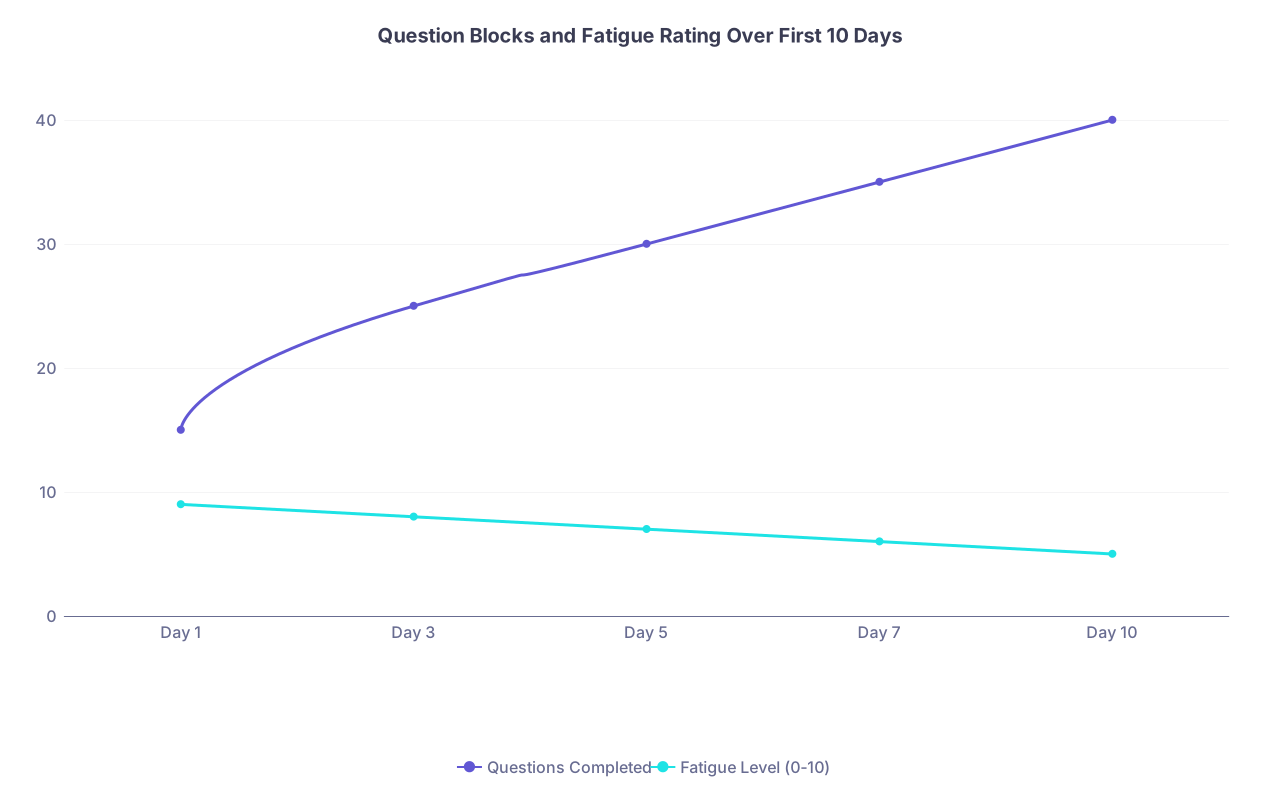
| Category | Questions Completed | Fatigue Level (0-10) |
|---|---|---|
| Day 1 | 15 | 9 |
| Day 3 | 25 | 8 |
| Day 5 | 30 | 7 |
| Day 7 | 35 | 6 |
| Day 10 | 40 | 5 |
Day 4–7: Structured small blocks
- Move to 20–30 questions per session, 3–4 days.
- Timed, mixed or by system you feel weakest in.
- Start a miss notebook or digital log:
- Topic
- Why you missed (knowledge gap vs. misread vs. second-guess)
- One key takeaway
Only after a week of this do you decide: How far off are you?
- If you’re below ~40–45% on Qbank, you need extended ramp-up and maybe timeline adjustment for the exam.
- If you’re 45–60%, you’re rusty but salvageable with good structure.
- If you’re 60%+ this early, you’re in better shape than you feel. You’ll still need discipline but not panic.
Do NOT take a full NBME/COMSAE/ITE-style practice exam yet. You’ll waste a form just to prove you’re deconditioned. Save those for when the trajectory matters.
Step 4: Build a Realistic Weekly Study Framework
You cannot study like a dedicated Step 1 summer again. You’re a resident. Your time is chopped up.
Design your study around your rotation types. They’re predictable enough to plan around.

Classify your rotations
Break your next 3–6 months into three buckets:
- Heavy: ICU, night float, ED, trauma, busy inpatient months, Q3–Q4 call.
- Moderate: Regular wards, outpatient with some call, consult services.
- Light: Electives, research, admin, clinic-only with predictable hours.
Then set minimum viable study targets:
| Rotation Type | Daily Target | Weekly Total |
|---|---|---|
| Heavy | 10–20 Qs | 70–100 Qs |
| Moderate | 20–30 Qs | 120–160 Qs |
| Light | 40–60 Qs | 200–300 Qs |
Notice I’m not saying “2 hours a day.” Your life does not work in perfect hours. Questions are more concrete.
Rule: Questions > passive reading, always, once you’re past the first 1–2 weeks back.
You can combine:
- Weekdays: small daily block (10–20 questions).
- One or two “anchor sessions” on days off: 40–60 questions + 1–2 hours of review.
You’re aiming for sustainable weekly volume, not perfect daily discipline.
Step 5: Pick Your Core Resources and Ruthlessly Ignore the Rest
After an LOA, people overcompensate. They buy everything.
Do not do that. You need fewer moving parts, not more.
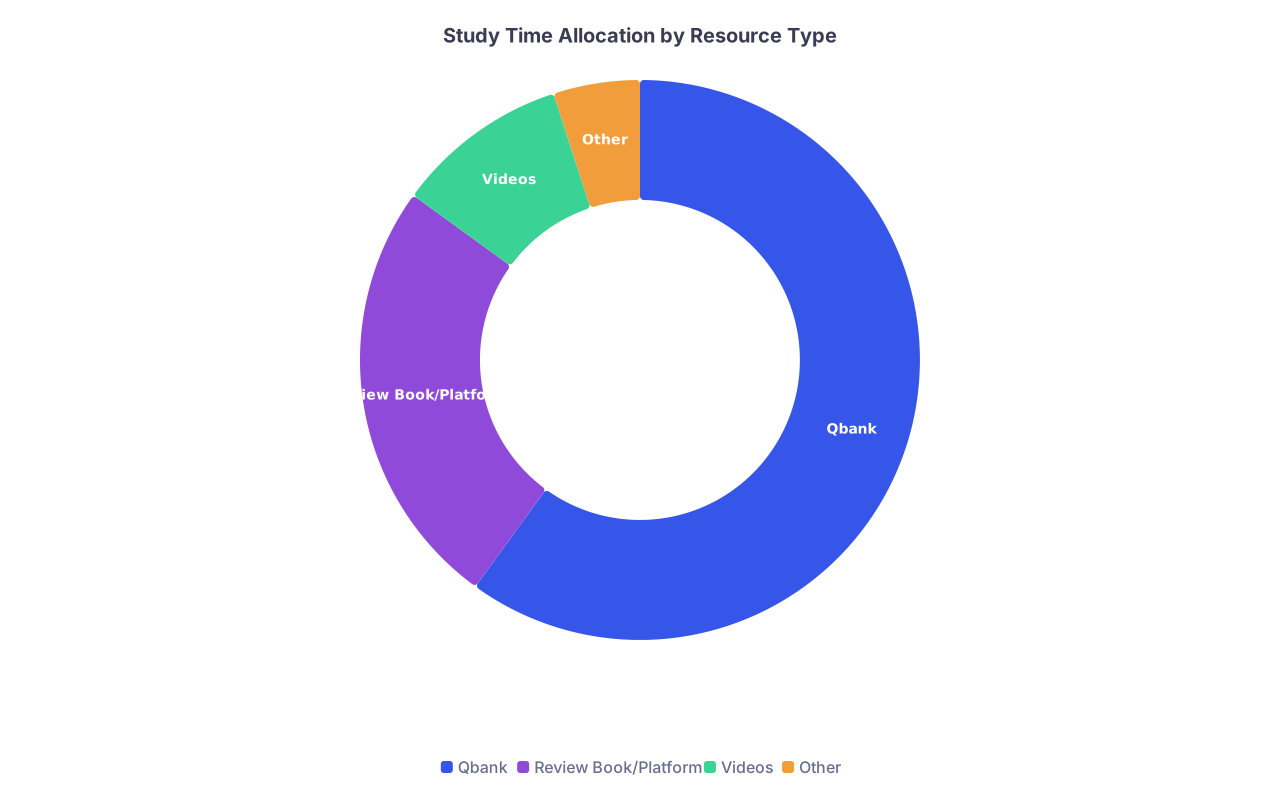
You basically need:
- One primary Qbank
- One core reference / review text or platform
- Optional: one video/lecture resource for your weakest area
Examples:
- IM boards:
- Qbank: UWorld + maybe TrueLearn
- Core: MKSAP or Board Basics
- Internal medicine resident taking Step 3:
- Qbank: UWorld Step 3
- Core: UWorld + CCS cases; some use AMBOSS as wrap-up
- Surgery boards:
- Qbank: SESAP or TrueLearn
- Core: SCORE modules
| Category | Value |
|---|---|
| Qbank | 60 |
| Review Book/Platform | 25 |
| Videos | 10 |
| Other | 5 |
If any resource does not clearly move the needle on your understanding or your question performance, drop it.
You have limited time and limited RAM.
Step 6: Rebuild Content, Not Just Test-Taking Stamina
Coming back from LOA, your problem is usually both knowledge erosion and stamina. Most residents focus only on stamina (doing more questions) and hope the knowledge magically reappears.
You need a two-layer approach:
Layer 1: Daily Questions (the spine)
- Stick to your weekly question targets.
- Do them timed. The boards will not wait for you.
- Review each block with intention:
- For correct questions: just skim to confirm you really understood.
- For incorrect questions:
- Identify if it’s:
- Pure recall gap (“I forgot the diagnostic criteria”)
- Conceptual misunderstanding
- Silly error (misread, rushed, changed answer)
- Only log the first two. You don’t need an essay on “read the question more carefully.” You know that.
- Identify if it’s:
Layer 2: Focused “patch” blocks
Patterns will show up in your misses. Maybe:
- Vent management is a dumpster fire.
- OB emergencies are fuzzy.
- EKGs all look like “something with ST maybe” to you.
Pick 1–2 weak themes per week.
For each theme:
- Spend 30–60 minutes with a focused resource (chapter, video, or outline).
- Immediately do 10–15 questions on that topic only.
- Write down 3–5 key rules/algorithms somewhere visible.
This is how your studying becomes additive, not just repetitive suffering.
Step 7: Work With, Not Against, Your Clinical Reality
Use your clinical work as stealth board prep. You’re surrounded by test questions in real life.
Examples:
- Mic drop habit: For every admission or consult you handle, silently ask:
“If this were a board question, what would they be testing?”
Diagnosis? First-line treatment? Next best step? Most appropriate test? - One case → one mini-lesson:
After sign-out or charting, take 3–5 minutes to read a concise pearls section on that disease. Put 1–2 facts into your miss log.

If your program has conferences, morbidity & mortality, or board review sessions:
- Show up.
- Ask yourself, not out loud: “How would this show up as a multiple-choice stem?”
- When attendings ask “pimp” questions, use them as recall checks, not ego tests.
You’re rebuilding the reflex, not just the knowledge.
Step 8: Protect Your Exam Window Early
The biggest mistake I see: people wait until 4–6 weeks before their exam to realize their schedule is brutal. By then, it’s too late to fix.
As soon as you have a tentative exam month:
Email your PD and coordinator early.
“I’m currently planning to sit for boards in [Month]. Is it possible to schedule a lighter rotation or elective during the 4 weeks before that?”Trade smart.
If you need to take a busier rotation earlier to free up a lighter month later, do it.Create a “blackout” week if possible.
Even 3–5 days off pre-exam helps.
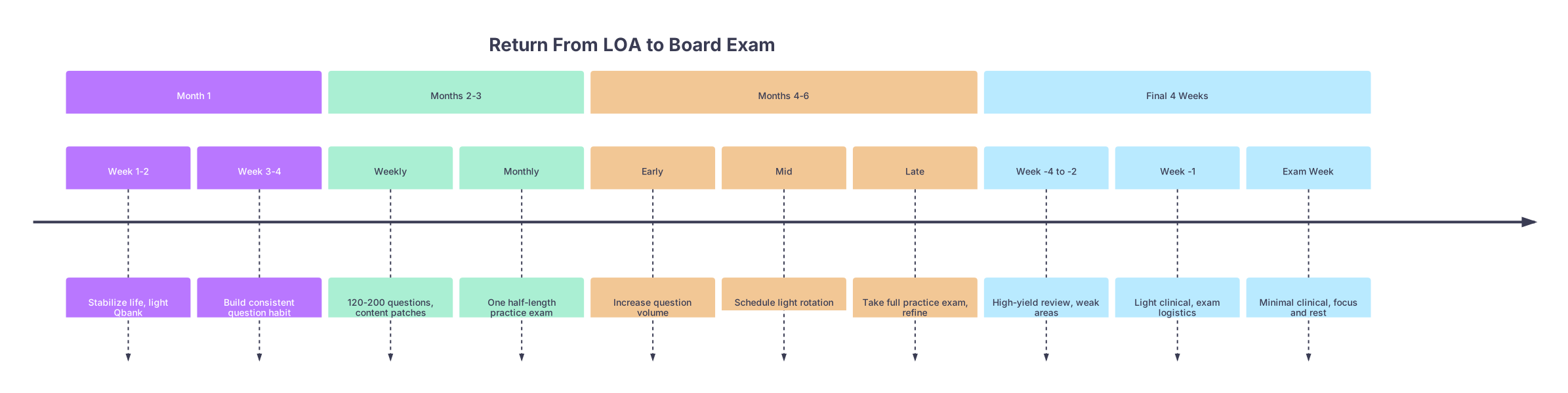
| Period | Event |
|---|---|
| Month 1 - Week 1-2 | Stabilize life, light Qbank |
| Month 1 - Week 3-4 | Build consistent question habit |
| Months 2-3 - Weekly | 120-200 questions, content patches |
| Months 2-3 - Monthly | One half-length practice exam |
| Months 4-6 - Early | Increase question volume |
| Months 4-6 - Mid | Schedule light rotation |
| Months 4-6 - Late | Take full practice exam, refine |
| Final 4 Weeks - Week -4 to -2 | High-yield review, weak areas |
| Final 4 Weeks - Week -1 | Light clinical, exam logistics |
| Final 4 Weeks - Exam Week | Minimal clinical, focus and rest |
If your program pushes back with “We treat everyone the same,” translate that in your head to: “We don’t want the admin hassle.” Advocate anyway. You’re not asking for special treatment; you’re asking for competent scheduling.
Step 9: Use Practice Exams Strategically, Not as Self-Punishment
You should not be taking full practice tests every other weekend. You’re not a pre-med with summer off.
Use them as checkpoints.
For a 4–6 month ramp:
- Month 2:
- One half-length or light-timed exam (e.g., 2 blocks). Just to feel format and see where you stand.
- Month 3–4:
- First real full-length (or near full-length) practice test.
- Evaluate:
- Can you finish all blocks on time?
- Is performance tanking in later blocks?
- Month 4–5:
- Another full-length from a different source or form.
- Final 2–3 weeks:
- One last practice exam, then stop.
- The last week is for consolidation, sleep, logistics.
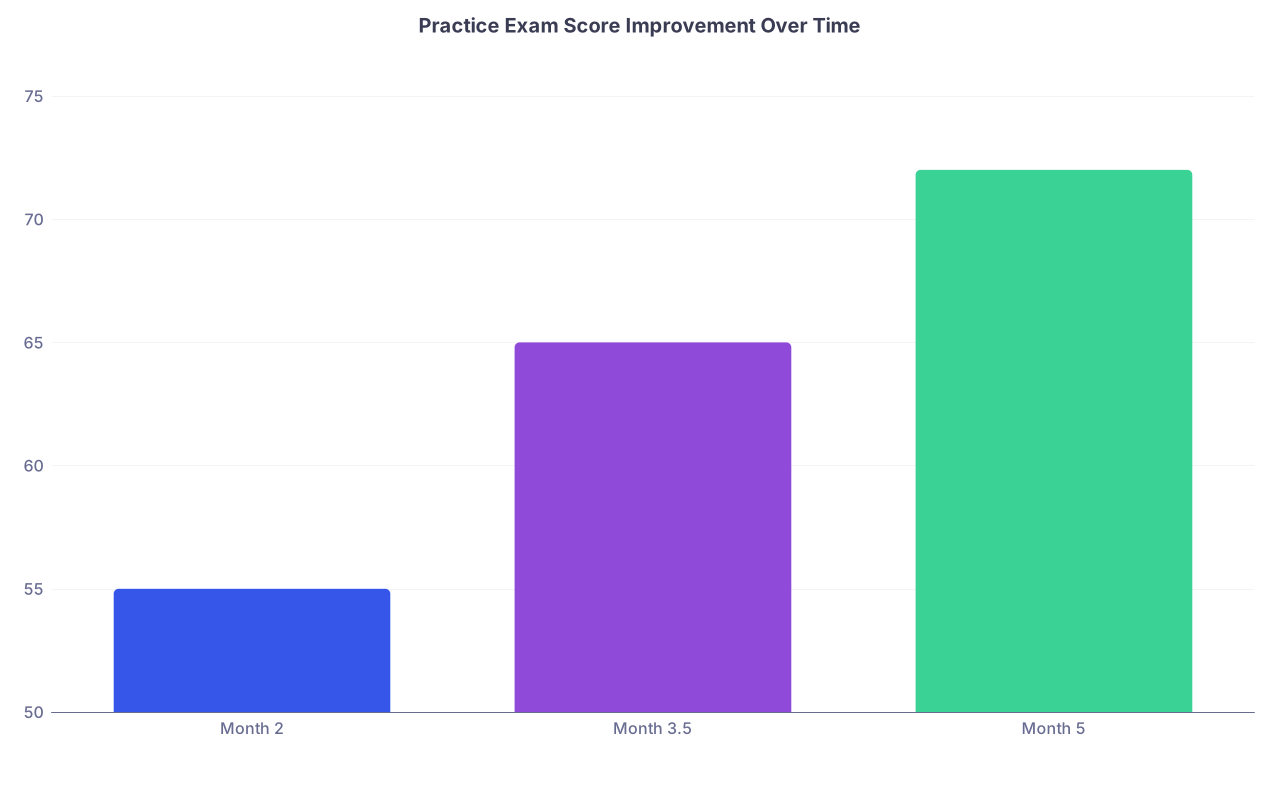
| Category | Value |
|---|---|
| Month 2 | 55 |
| Month 3.5 | 65 |
| Month 5 | 72 |
Your trend matters more than any individual score. If the trend is flat or dropping, that’s not a “you suck” message; that’s a signal to adjust:
- Check rotation intensity during that period.
- Check if you’re actually reviewing questions or just blasting through them.
- Check if your content patches target your real weaknesses.
Step 10: Manage Shame, Gossip, and Your Own Head
Coming back from LOA carries baggage. You hear whispers. Or you imagine them. Either way, it eats bandwidth you need for studying.
Let me be blunt: Gossip doesn’t appear on your board exam.
A few anchors:
- Script for nosey co-residents:
“I had some medical/personal stuff that needed real time. I’m good to be back and focused now.” Full stop. Change topic. - Script for yourself on bad study days:
“I missed content, not my IQ. I’m rebuilding. That takes reps.”
Then do 5–10 questions. Small win.

If your leave involved mental health, burnout, or performance issues, be honest with yourself about guardrails:
- Caps on total weekly hours (clinical + study).
- Non-negotiable sleep minimums before big shifts.
- Absolute rules like: “No studying post-night shift; only light review if anything.”
You are not weak for needing this. You are smart for not repeating the pattern that took you out in the first place.
Step 11: If You’re Clearly Not Ready by X Date
Sometimes, despite working the plan, your practice scores 1–2 months out are catastrophic. I’ve seen this more than once.
At that point you have two options:
- Take the exam underprepared and hope.
- Ask for a delay and intensify support.
Option 1 leads to one thing: a fail that will haunt every credentialing packet and job app. Programs and hospitals care far more about failures than about taking it a bit late.
If:
- You’ve used at least one full Qbank seriously
- You’ve taken at least 2 full practice exams
- Your scores are significantly below expected pass threshold
Then you should seriously consider delaying if at all possible.
That means:
- Meeting PD with actual data (score reports, Qbank trends).
- Proposing a concrete plan: reduced clinical schedule, study elective, targeted resources.
- Getting their support in writing when possible.
Is it annoying? Yes. Is it a logistical nightmare sometimes? Absolutely. Is it still better than failing? 100%.
Quick Recap: How to Actually Pull This Off
You’re not behind because you’re broken. You’re behind because you had less time in a system built on barely-enough-time.
Three things matter most:
Stabilize your life before expecting peak performance.
No amount of UWorld fixes sleep deprivation and chaos at home.Build a sustainable weekly question habit and patch your weakest areas deliberately.
Not random grinding. Structured, tracked, and aligned with your rotations.Protect your exam window and advocate for yourself early.
Schedule, not intelligence, destroys more board attempts than people admit.
You came back from leave. That alone says a lot about your resilience. Now you turn that into a plan instead of a story.
FAQ (Exactly 5 Questions)
1. How soon after returning from LOA should I restart serious board prep?
Give yourself 1–2 weeks to stabilize clinically and personally, then start light with 10–20 questions per day. By weeks 3–4 back, you should have a structured weekly question goal based on your rotation intensity. Don’t wait “until things calm down”—they rarely do.
2. What if my program seems unsupportive about adjusting my schedule for boards?
Document everything. Send polite follow-up emails after meetings summarizing what was said. Propose specific solutions (“Can we move my ICU month earlier so I can have clinic in May before the exam?”) instead of vague complaints. If you hit a wall, loop in your GME office or chief residents to help problem-solve, but stay factual and non-emotional in writing.
3. How many Qbank questions should I aim to complete before the exam after a leave?
For most specialties, a solid target is 1 full pass of the main Qbank (often 1,500–3,000 questions), plus targeted sets on your weakest areas. Coming off LOA, you may not realistically do multiple full passes; one high-quality, well-reviewed pass beats two rushed, poorly reviewed passes.
4. Should I tell fellowship programs or future employers about my LOA when they ask about training timeline?
You don’t need to volunteer details beyond what’s required. A simple, professional line works: “I had an approved leave during residency for personal/medical reasons, which is now fully resolved. I returned on [date] and have been in good standing since.” Focus on your board status, current performance, and letters of recommendation.
5. What if my ITE (in-training exam) score is bad after coming back from LOA?
Don’t panic, but don’t ignore it. Use it as a map. Break down performance by content area and align your next 2–3 months of study accordingly. Meet with your PD with a simple plan: “These are my lowest areas; here’s what I’m doing about them.” Programs care more about your trajectory than one bad ITE, especially if there’s a clear story and plan after an LOA.