<ai-image title="International medical resident studying for board exams in a small apartment at night" location="headline" prompt="Professional DSLR photograph of an international medical resident on a J-1 or H-1B visa studying late at night at a kitchen table, laptop open with medical questions on screen, US passport and visa documents visible on the side, coffee mug, exhausted but focused expression, dim warm lighting, small urban apartment" "/>
Your board exam timeline as a J-1 or H‑1B resident is not “just like everyone else’s.” If you treat it that way, you risk blowing your visa options along with your score.
I’m going to talk to you like someone whose visa clock is ticking. Because it is. And the standard “just focus on learning, the boards will come” advice you’re hearing from well-meaning attendings who are US citizens? It does not apply to you.
You have three overlapping problems:
- You must pass (and often excel on) boards.
- You must do it on a fixed and unforgiving visa timeline.
- You must line it up with job/fellowship and immigration strategy.
Let’s structure this the way you actually live: year by year, exam by exam, visa by visa.
1. Understand Your Clock: The Visa + Board Timeline Reality
If you do not understand your constraints cold, nothing else in this article matters.
J‑1 residents
You’re usually dealing with:
- Duration: Length of residency + fellowship, typically 7-year total max (with limited exceptions).
- Two-year home residency requirement after training (unless you get a waiver).
- Waiver jobs (Conrad 30, federal, underserved) that often require you to:
- Be board-eligible or board-certified by a specific date.
- Start on a strict timeline after training.
Board timing becomes part of your immigration strategy, not just your academic life.
Typical J‑1 pattern:
- Need to pass your primary specialty board quickly after residency so you:
- Qualify for waiver positions.
- Aren’t stuck at “board-eligible” with expiring eligibility windows.
H‑1B residents
Different set of headaches:
- Program must sponsor H‑1B (many don’t).
- H‑1B specialty occupation rules often require:
- Passing certain board exams or at least being board-eligible.
- For some roles (especially academic / subspecialty), being board-certified within a set period of hire (often 5 years).
- You may have:
- Prior H‑1B time from research or another job (so your 6-year total might be partially used).
- A future employer who wants to sponsor a green card, which can be tied to your board status.
In both cases, the brutal truth:
- A failed board exam is not just “I’ll try again next year.”
- It can delay waiver positions, job start dates, or even jeopardize immigration plans.
So you plan backwards from your visa/immigration constraints, not forwards from whenever you “feel ready.”
2. The Core Strategy: Work Backward from Your Immigration Endpoints
Let’s make this concrete with a simple planning framework.
| Pathway | Training End | Board Must Be Passed By | Why That Date Matters |
|---|---|---|---|
| J-1 IM + Conrad 30 | June 2027 | Fall 2027 (first attempt) | Needed for hospital credentialing |
| J-1 FM + Federal Job | June 2026 | Within 1 year post-residency | Federal site requirement |
| H-1B IM + Cards Fellowship | June 2027 | Before fellowship graduation | Academic job requires BC in IM |
| H-1B Surgery + Hospitalist Job | June 2026 | Within 3 years | Employer policy, green card timing |
Here’s how you do this for yourself:
- Identify your likely post-training path (waiver job vs fellowship vs straight job).
- Email or call 1–2 realistic target employers or fellows 1–2 years ahead of you and ask:
- “Do you require board certification or just board-eligible at the time of hire?”
- “Is there a deadline by which I must pass boards?”
- Mark that date as your immigration-critical board deadline.
- Look at:
- Board exam offering windows (ABIM, ABFM, ABS, etc.).
- How many attempts are allowed within your eligibility window.
- Plan your first attempt early enough that a failure still leaves room for at least one more attempt before your immigration-critical date.
If you are J‑1 and your waiver job requires board certification by July 2029, your first attempt should not be in Spring 2029. That’s reckless. You want:
- First attempt the first cycle after graduation.
- Space for at least one re-take within the credentialing window.
3. Year-by-Year Strategy: PGY1–PGY3 (or longer programs)
The details vary by specialty, but the pattern holds.
PGY1: Build your test muscles without blowing yourself up
You’re overwhelmed. New EHR, new country, new everything. But you cannot afford to “ignore boards until PGY3” like some classmates will.
Goal of PGY1:
Set up a low-grade, sustainable exam baseline and start protecting your visa timeline.
What to actually do:
- Choose one main Q‑bank linked to your specialty boards
(e.g., IM: UWorld + MKSAP; FM: AAFP board review; Surgery: SCORE + ABSITE questions). - Start with:
- 5–10 questions per day on non-call days.
- 20–30 questions on an easy weekend day.
- Treat in‑training exam (ITE or ABSITE etc.) as:
- A serious diagnostic.
- A rehearsal for board pacing and mindset.
You’re not aiming for brilliance in PGY1. You’re building:
- Stamina.
- Question-reading habits.
- Comfort with US exam style if you’re IMG.
And you’re preventing a future disaster where you’re PGY3 with weak fundamentals and the visa clock screaming at you.
PGY2: This is where you quietly lock in your future
PGY2 is the crucial year for most three-year programs (IM, FM, Peds, Psych). You’ll be less lost clinically but not yet drowning in chief responsibilities or senior resident admin nonsense.
Your objectives:
- Turn your ITE/ABSITE into a serious planning tool.
- Close knowledge gaps defined by PGY1 performance.
- Decide your target board exam year and season relative to graduation.
If your boards are typically taken:
- Right after graduation (summer/fall) → PGY2 is your heavy-lift year.
- During PGY3 (for some specialties with earlier exams) → PGY2 is the foundation; PGY3 is refinement.
Concrete PGY2 plan:
- Increase to:
- 20–40 Qs/day most days.
- 60–80 on some weekends when not on heavy rotations.
- Create a simple structure:
- Weekdays: Timed blocks of mixed questions.
- Weekends: Review of incorrects + targeted reading.
- Start using one primary resource in addition to Q‑bank:
- IM: MKSAP texts or Online Board Review videos.
- FM: Board review book + relevant guidelines.
- Surgery: SCORE topics aligned with your cases.
- Do at least 2–3 self-assessment exams (NBME/ACP/AAFP/ABSITE-style) and track:
- Percentiles relative to board pass thresholds.
- Weakest systems or content buckets.
For visa holders:
At some point in PGY2, sit down with:
- Program director or trusted faculty.
- Your program’s GME office or institutional immigration advisor.
You ask very direct questions:
- “If I fail boards on the first try, how does that affect my J‑1/H‑1B record or my ability to get a waiver/fellowship letter?”
- “Do you provide documentation to employers about board-eligible vs board-certified status?”
- “Have previous J‑1/H‑1B residents had issues with timing and boards?”
You’re not being paranoid. You’re being strategic.
PGY3 (and PGY4+): Transition from ‘learning’ to ‘passing’
By your final year, you should be in one of two situations:
- You’re on track: ITE/ABSITE scores at or above passing range, Q‑bank > 60–65% cumulative, self-assessments near pass line.
- You’re behind: Borderline or low scores, patchy knowledge, no clear exam date locked.
If you’re on track:
- Choose your board exam date as early as your schedule and visa reality allow.
- Budget:
- 6–8 weeks of tightened prep, not starting from zero.
- Ideally 1–2 weeks of lighter clinical duties before exam (outpatient, elective, or vacation if you can swing it).
If you’re behind: You do not have the luxury of pretending everything is fine. You need an aggressive, high-yield, no-BS plan. Something like:
- Daily:
- 40–80 timed Q‑bank questions (depending on schedule).
- Immediate review of all questions, focus on why wrong answers were wrong.
- Weekly:
- Dedicated 4–6 hour block for reading key resources on your weakest systems (cardio, heme/onc, etc.).
- Monthly:
- One full-length self-assessment if available.
- A forced check-in with yourself: are scores moving?
And you adjust your exam date if needed. For visa reasons, you sometimes:
- Delay by 1 exam cycle to maximize pass probability, if you still have room before your immigration-critical date.
- Or keep the early date if you need that extra attempt possibility to fit inside the waiver/credentialing window.
That’s the tension: early vs ready. As a visa holder, you’re balancing probability of first-time pass against the need for a backup chance. You don’t get to be casual about this.
4. Board Strategy by Visa Type: J‑1 vs H‑1B
Let’s get more concrete about the specific traps.
For J‑1 residents and fellows
Your main choke points:
Waiver job requirements
- Conrad 30 and other waiver positions may differ:
- Some only require board-eligible at start.
- Others strongly prefer board-certified.
- Many hospital bylaws demand board certification within X years of completion (commonly 5–7 years).
- Conrad 30 and other waiver positions may differ:
Home-country rule and timing of return vs waiver
- If you do not get a waiver, you must go back home for 2 years.
- That return is way smoother with a passed board.
- But if you intend to stay via waiver, the timing of:
- Board exam
- Credentialing
- Start of waiver job
all have to line up.
Your strategy:
- Plan your board at the very first feasible window after completing training.
- Use your final year of residency or first year of fellowship for maximum board focus, not as “I’ll just wing it.”
If you’re doing fellowship on J‑1:
- For IM residents going into Cards, GI, etc.:
Pass your internal medicine boards early in fellowship, not “whenever.” - Otherwise you hit the classic mess:
- Nearing fellowship completion.
- Still not board-certified in your primary specialty.
- Employer wants both primary and subspecialty boards on a specific timeline.
For H‑1B residents and fellows
Your two main constraints:
H‑1B total time limit (6 years)
If you had previous H‑1B years (research job, prior employment), you may:- Be close to the 6-year cap by the time fellowship ends.
- Need timely employment and green card processing, which some employers will only initiate once you’re board-certified or at least board-eligible.
Employer and credentialing policies
- Some hospitals: “Board-certified within 5 years of, or as soon as possible after, eligibility.”
- Some academic centers will not treat you as full faculty without boards done.
Your strategy:
- Clarify how much H‑1B time you have left. Exactly.
- For job applications, be ready to state:
- “I’m taking my boards on X date, with eligibility to retake on Y if needed.”
- Frontload your studying before green card applications, job onboarding, and relocation chaos.
Put bluntly: you don’t want to be cramming Q‑banks during your first year as an attending while also dealing with PERM, I‑140, and HR asking for documents every two weeks.
5. The Study Tactics That Actually Work When Your Time Is Not Endless
Let’s talk tactics that respect your schedule.
Use your rotations intelligently
Not all rotations are equal for studying.
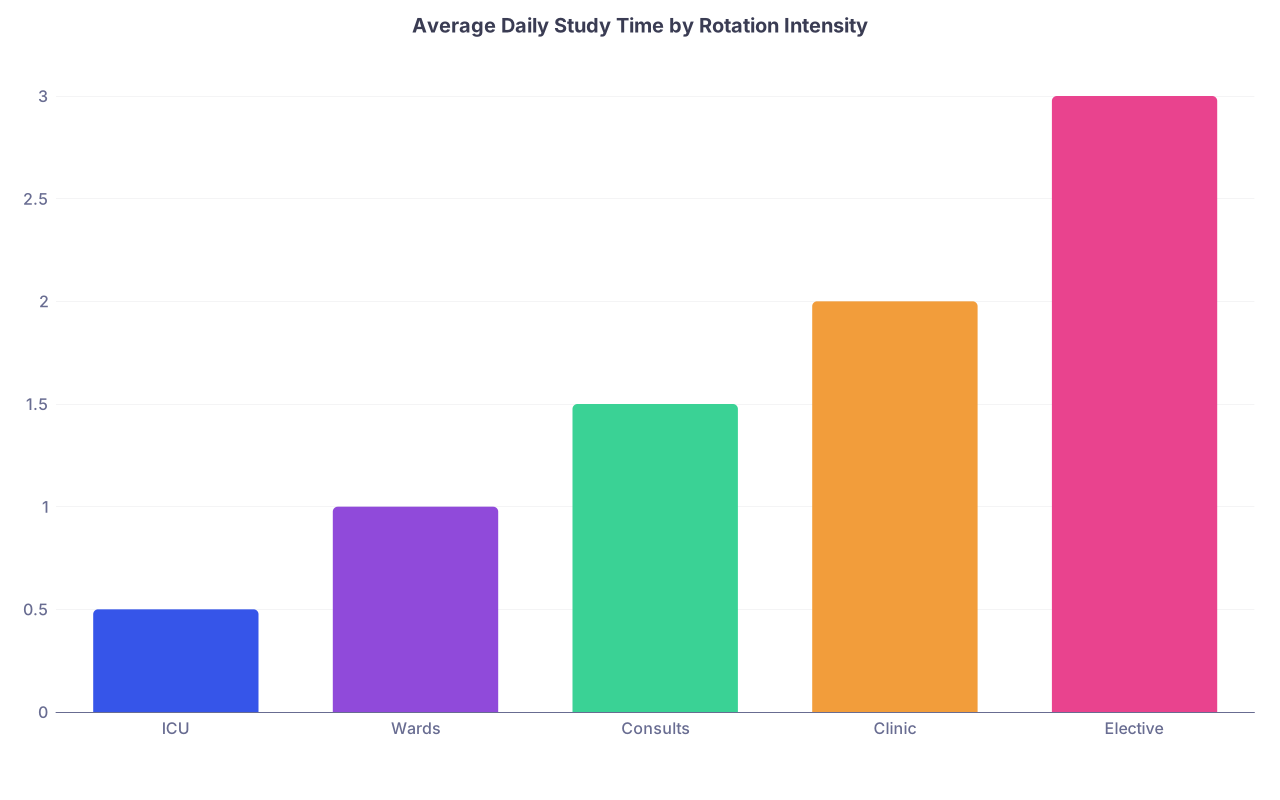
| Category | Value |
|---|---|
| ICU | 0.5 |
| Wards | 1 |
| Consults | 1.5 |
| Clinic | 2 |
| Elective | 3 |
Practical rule:
- ICU / Night float / Busy wards:
- Accept 30–40 questions on some days, zero on the worst days.
- Focus on reading around cases; annotate key board-relevant pearls into your review book or notes.
- Consult / Outpatient / Elective:
- Crush 60–100 questions some days.
- Do longer blocks (40–60 Qs timed) to simulate exam fatigue.
One primary Q-bank. One secondary at most.
If you’re on UWorld (or similar gold-standard):
- Treat it like your core curriculum.
- Go through it once thoroughly, then:
- Redo incorrects.
- Or redo key sections (cards, pulm, heme/onc).
If you add a second Q‑bank, fine, but:
- Only when you’re at least 70–80% through the primary.
- Use the second for variety or additional coverage, not to avoid facing your primary performance.
Enforce a minimum weekly floor
Here’s a trick I’ve seen work well:
Set a non-negotiable weekly floor:
- Example: “No matter how bad the week, I will hit 150 questions and 4 hours of review.”
- If you’re on vacation or light rotations, you overshoot that floor.
- If you’re on nights, you just barely scrape to the floor.
It keeps you from falling into the “I’ll restart next month when it’s calmer” lie. Residency never actually gets “calm.”
6. Scheduling the Actual Exam: How to Not Screw This Up
Residents on visas mess this up in predictable ways.
Here’s the decision sequence.

| Step | Description |
|---|---|
| Step 1 | Check visa and job deadlines |
| Step 2 | Plan exam at first cycle after training |
| Step 3 | Choose between final year or early attending year |
| Step 4 | Book early date, leave room for retake |
| Step 5 | Delay 1 cycle if visa window allows |
| Step 6 | Increase study intensity, repeat self assessments |
| Step 7 | Finalize study block and PD support |
| Step 8 | Need BC before job/waiver? |
| Step 9 | Self assessment scores near passing? |
Key principles:
Book early enough to create a re-take opportunity before:
- Your waiver job needs you.
- Your credentialing committee meets.
- Your H‑1B timeline backs you into a corner.
Do a real practice run:
- At least one full-length timed test 4–6 weeks before exam.
- After that:
- If you’re near or above the passing border → continue, sharpen.
- If you’re well below → reassess the date in the context of your visa window.
Coordinate with your PD:
- Ask directly for light blocks or clinic months before the exam.
- Request 1–2 weeks of vacation or research time pre-exam if possible.
And no, asking for study-friendly rotations is not “being demanding.” It’s protecting your board pass rate, which programs also care deeply about.
7. If You Fail: Damage Control for J‑1 and H‑1B
Nobody wants to think about this, but you’d better have a contingency plan before you walk into the exam. Especially with a visa.
Immediate steps (first 72 hours after failing)
- Don’t email the program director the same day. Sleep first.
- Download your performance profile and segment your weaknesses.
- Within a week, schedule a meeting with:
- PD or associate program director.
- If available, program’s board prep faculty.
You say something like:
- “I failed the boards. I’ve reviewed my score report. I want to create a structured plan to pass on the next attempt. I’m also on a J‑1/H‑1B, so I need to understand any implications for letters/waiver/fellowship.”
For J‑1 after a fail
Crucial questions:
- “Can I still get a waiver job if I’m board-eligible but not yet certified?”
- “Will my DS-2019 or visa documentation be affected?”
- “Have previous J‑1s in this situation successfully secured waiver positions after passing on a second attempt?”
You then:
- Rebook the exam at the earliest cycle that still lets you:
- Get results before job start or waiver paperwork deadlines.
- Shift your life around it:
- Cut nonessential commitments.
- Choose rotations intelligently to protect study time.
If absolutely necessary:
- You may have to adjust start dates for jobs.
- Some employers will wait if you’re transparent and have a realistic retake date. But you have to tell them early, not at the last second.
For H‑1B after a fail
You’re juggling:
- Employment start date.
- Credentialing.
- Possible green card timeline.
Ask your employer’s HR/credentialing:
- “Is board certification required for my position at start, or within X years?”
- “Can I start as board-eligible and then move to board-certified status after passing?”
Most US hospitals will let you start as board-eligible if:
- You’re licensed.
- You have a scheduled retake.
But immigration lawyers will sometimes time green card steps around your exam timeline. So loop your lawyer in early, even if it feels awkward.
8. Mental Bandwidth: Surviving the Combo of Residency, Boards, and Visa Stress
You’re not just tired. You’re tired + worried about status + carrying family expectations + learning US medicine. That combo is brutal.
A few things I’ve seen actually help:
Keep visa/immigration conversations scheduled and contained.
Don’t let them bleed into every day.
Example: One “immigration admin” hour every other Sunday for forms, emails, attorney calls.Don’t prep alone in a vacuum.
- Find 1–2 co-residents (ideally also IMGs or visa holders) and:
- Share timelines.
- Do weekly check-ins or short group sessions.
- Find 1–2 co-residents (ideally also IMGs or visa holders) and:
Protect sleep before blocks of intense study.
- Cognitive performance tanks when you’re at 4–5 hours per night.
- You might think you’re “studying more” but you’re mostly rereading the same sentence.
Most importantly, stop comparing yourself to the US citizen co-resident who shrugs and says, “If I fail, I’ll just do locums for a year and retry.” That’s not your reality. You’re playing a higher-stakes game. Act accordingly.
FAQ (Exactly 3 Questions)
1. Is it better to delay my first board attempt to “feel more ready” if I’m on a J‑1 or H‑1B?
Usually no. For visa holders, you want your first attempt as early as reasonably possible within your preparation window, so that if you fail, you still have a re-take opportunity before important immigration or job deadlines. Delaying into the last possible exam cycle before your waiver/job requirement is a common and dangerous mistake. The only time a delay makes sense is when your practice scores are far below passing and you still have plenty of time before any visa-related cutoff.
2. How many Q‑bank questions should I aim to complete before boards as a resident with limited time?
Aim for at least one full pass of a primary Q‑bank (often 1,800–2,500 questions depending on specialty), plus a thorough review of incorrects. For most residents, this works out to something in the 3,000–4,000 question range total when you include redos and a possible secondary bank. Spread across 9–12 months, that’s roughly 80–120 questions per week on average, with higher weeks on lighter rotations and lower weeks during ICU/night float.
3. Should I prioritize my in‑training exam (ITE/ABSITE) or my board exam prep if I’m short on time?
Treat your in‑training exam as a dress rehearsal and diagnostic tool, not its own separate project. Use the same Q‑banks and resources you’re using for boards, and let ITE show you where you’re weak. Don’t run parallel study programs. If forced to choose, prioritize the strategy that optimizes your actual board exam timeline, because that’s what employers, waivers, and immigration care about. A low ITE with a strong board performance is survivable. The reverse is not.