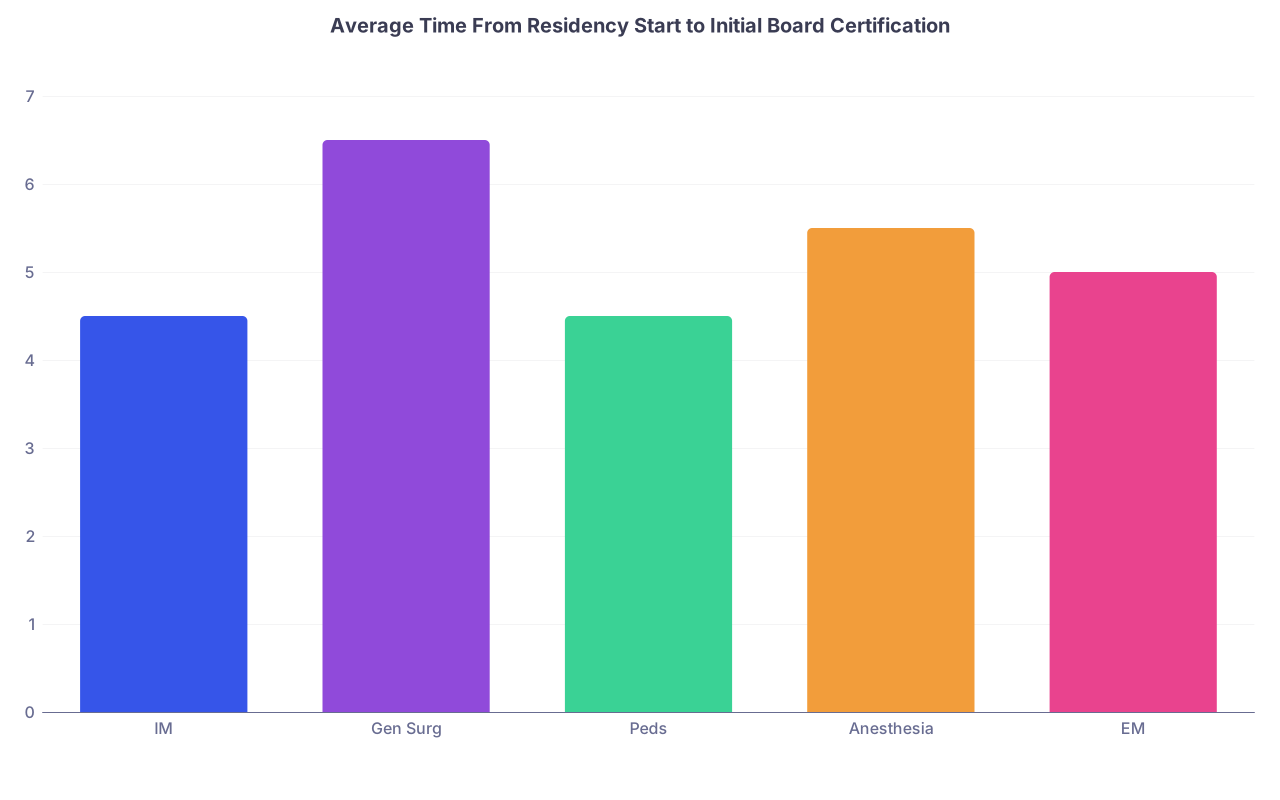
The usual board prep advice falls apart the second you bring a newborn home.
You are not going to “just wake up two hours earlier” or “grind 6 hours a day” when you’re up at 2:00, 3:30, and 5:00 feeding a screaming infant. Anyone who tells you otherwise has either forgotten what those months are like or never lived them.
You can still pass your boards. You just need a completely different playbook.
This is that playbook.
Step 1: Get Ruthlessly Honest About Your Reality
Before you touch a question bank, you need a clear picture of your actual life, not your fantasy life.
Here’s what matters:
- Your rotation / call schedule
- Who else is in the house (partner, family, nanny, no one)
- Baby’s approximate pattern (if there is one yet)
- Your exam date and how much you’ve already done
Grab your next 2 weeks of your schedule and do this quickly:
- Mark every shift where you’ll realistically be useless for studying before and after (e.g., 24-hour call, night float, brutal ICU days).
- Mark the “maybes” – reasonable days where you might squeeze in 30–90 minutes.
- Mark your guaranteed no-go zones: pediatrician visits, postpartum checkups, known family obligations.
Now overlay the baby realities:
- If you’re breastfeeding or pumping, when are you usually doing that?
- Who does night feeds?
- Does the baby cluster feed in the evenings? Nap at all during the day?
You’re looking for tiny, repeatable pockets of time. Forget 4-hour blocks. You’re hunting for:
- 15–20 minutes before sign-out
- 25 minutes in the pumping room
- 30 minutes during one mid-day nap
- 20–30 minutes after baby’s first nighttime stretch
If you find 2 predictable 20–30 minute windows most days, you actually have a workable base.
To make this visual:
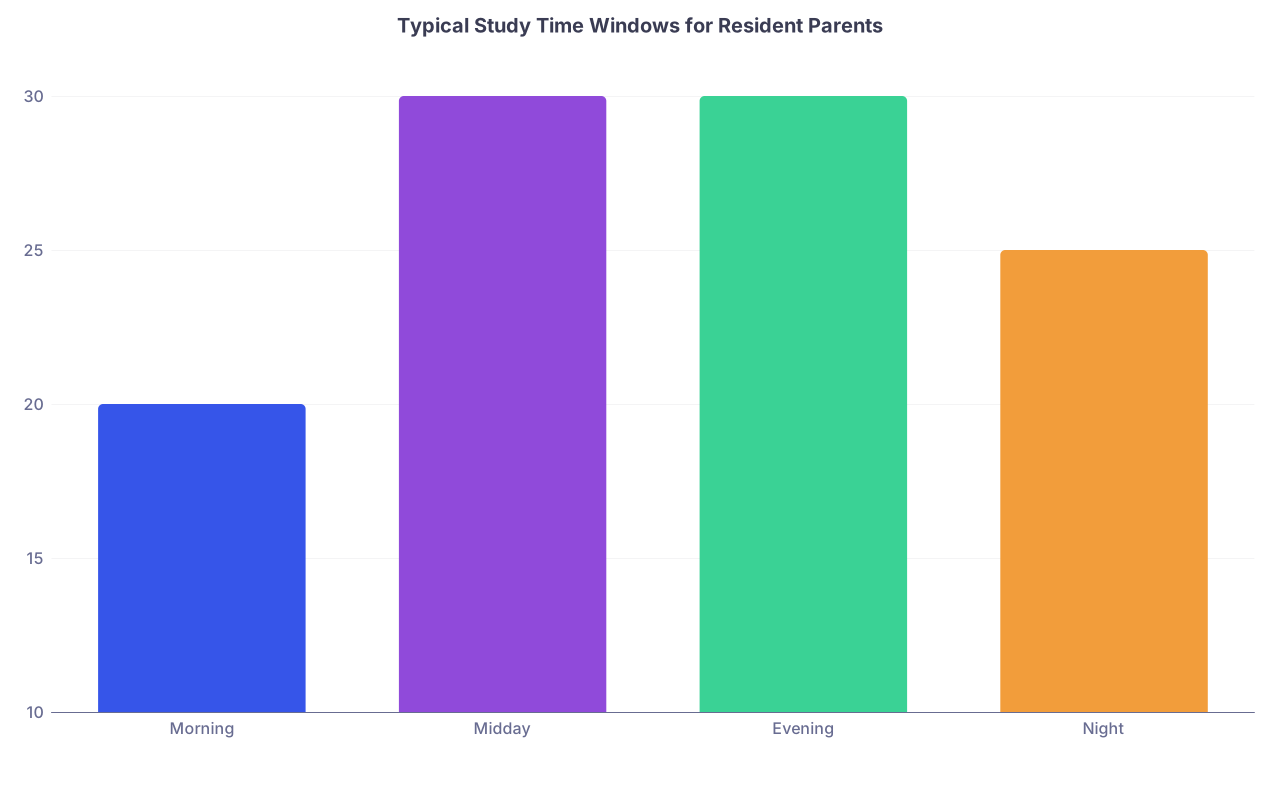
| Category | Value |
|---|---|
| Morning | 20 |
| Midday | 30 |
| Evening | 30 |
| Night | 25 |
That’s not a dream schedule. That’s 95–105 minutes per day. It’s enough if you don’t waste it.
Step 2: Throw Out “Ideal” Study Plans
Standard board schedules assume:
- 6–8 uninterrupted hours per day
- Regular sleep
- Emotional bandwidth
You have none of that. So here’s the mental shift:
Your goal is passing, not “destroying the exam.”
If your program or specialty wants a 90% pass rate and your exam’s pass threshold is, say, “answer roughly 60–70% correctly on average,” chasing 95th percentile scores while sleep-deprived with a newborn is a terrible trade.
You need:
- 1 primary Qbank
- 1 high-yield text/video resource
- 1 exam strategy (timing, breaks, fatigue)
Drop everything else.
Example combos that actually work for residents with babies:
- Internal Medicine: UWorld + ABIM-specific review book (or concise video series)
- Pediatrics: PREP questions + Board review book
- Family Med: AAFP questions + board review question set
- Surgery: SESAP or SCORE questions + high-yield outlines
Do not sign up for 5 different platforms because your co-residents did. More platforms = more guilt and fragmentation.
Step 3: Build a Micro-Study System, Not a Schedule
A “study schedule” assumes control of your time. You have a baby; you do not have control. You need a system that survives chaos.
Here’s the framework I’ve seen work repeatedly for new-parent residents:
A. Define your daily bare minimum
Decide what “I did my job today” means, even on a bad day.
Examples:
- 20–30 mixed Qbank questions (timed or tutor)
- Or 15 Qs + 10 minutes of reviewing marked/incorrects
- Or 1 small video module + 10 Qs
On great days you can do more. But your baseline has to be low enough to hit even after a night of 4 fragmented hours of sleep.
B. Pre-build “grab and go” study blocks
The moment you get a quiet 20–30 minutes, you shouldn’t be deciding what to study. Decision time kills study time.
Make this list once and keep it in your phone notes:
- “Random 10–15 Qs from weak system #1 (e.g., cardio)”
- “Review yesterday’s incorrects (max 15 min)”
- “Watch one 8–12 minute high-yield video on topic X”
- “Do 1 timed block of 10 Qs and only read explanations for the ones I missed”
You want each block to be small enough to finish in one baby nap / pump / commute window.
C. Use a process, not willpower
Do this:
- Baby goes down / partner takes baby / you start pumping
- Phone out → open note → pick the first unfinished “grab and go” block
- Start timer for the length of your usual window (20–30 min)
- Do only that. No reorganizing Anki. No reading blogs. No new resources.
That’s your micro-system.
Step 4: Negotiate Like an Adult With the Other Adult(s) in the House
Trying to “sneak” study time leads straight to resentment—for you and for them.
You need explicit deals.
Sit down with your partner (or whoever’s sharing baby duty) and say something like:
“My board exam is on [DATE]. If I fail, it means X (remediation, money, delayed promotion). I need about 60–90 minutes a day for focused study most days. I’m not disappearing to do 8-hour days, but we need some structure so I can pass and still show up as a parent.”
Then get concrete:
- “On post-call days, I get 45 minutes in the afternoon after I nap; you get a break in the evening.”
- “On my clinic days, I’ll study 25 minutes during lunch at work so I’m not doing it at home.”
- “Two nights per week, you handle bedtime entirely; I’ll be at the coffee shop from 7–9 pm.”
Do not promise to do it all when “everyone’s asleep.” That may not exist.
Spell out backup plans:
- If the baby is colicky all evening, when’s your makeup window?
- If you get slammed with admissions and miss your lunch study block, can you protect 20 minutes at night?
Write the plan down. Not because you’re formal, but because tired brains forget deals and default to “you never help” arguments.
Step 5: Choose the Right Question Strategy for a Sleep-Deprived Brain
You will not be at 100% cognitive capacity. So you have to adapt how you do questions.
Here’s how:
| Situation | Strategy |
|---|---|
| Brain fog, post-call | Tutor mode, 10–15 Qs |
| Reasonably alert | Timed, 20–25 Qs |
| Pumping / feeding | Untimed, 5–10 Qs + quick review |
| On service, short breaks | 3–5 Qs at a time, mixed topics |
A few hard rules that help:
- If you’re falling asleep while reading explanations, stop. You’re not learning; you’re punishing yourself. Do fewer questions, deeper review.
- Don’t chase completion percentage more than accuracy. Doing 2,500 questions at 45% because you were half-conscious is worse than 1,500 at 60–65% with real effort.
- Every question block gets a 2-minute debrief:
- What did I keep missing?
- Was it content, reading, or fatigue?
- One micro-thing I’ll do differently next block?
If your scores are wildly up and down, track how much you slept before each session. I’ve watched people panic over a 40% block that was 3 a.m. post-call with a crying baby. That’s not a knowledge problem. That’s a human physiology problem.
Step 6: Adjust for Different Rotations and Call Patterns
Your strategy on an outpatient month vs. ICU vs. nights with a newborn will be completely different. Plan for that.
On lighter rotations (golden weeks)
This is when you front-load:
- Aim for 40–60+ Qs/day broken into micro-blocks
- Use one longer stretch (maybe during one longer baby nap on the weekend) for:
- Reviewing your highest-yield incorrects
- Watching 2–3 important videos for weakest systems
But still don’t pretend you’re a carefree MS3 with 8 hours free daily. You’re still a parent.
On heavy rotations (ICU, wards, nights)
The goal shifts:
- Maintain touch with material (15–25 Qs/day max)
- Pick “survival” topics relevant to what you’re seeing on service; it reinforces both
- Cut yourself off from doing late-night blocks just to hit an arbitrary number
If you miss 2–3 days completely because life explodes—fine. The key is what you do the very next day. One missed day is life. Seven missed days is a pattern.
Step 7: Don’t Ignore Physical Survival
Board prep plus newborn plus residency is an endurance event.
You don’t need a wellness plan. You need a do-not-crash plan.
Keep it stupid simple:
- Hydration at work: Always have a refillable bottle. Dehydrated + tired = extra stupid mistakes.
- Minimal caffeine strategy:
- One moderate dose early in the day
- Avoid the 5 p.m. triple espresso that kills your only chance at sleep
- Food: anything with protein and actual calories is better than another vending machine run. Greek yogurt + nuts > candy.
Also, decide on non-negotiable sleep floors.
Example rule:
“If I slept less than 4.5 hours in the last 24, I’m not doing a study block. I’ll skim 5 flashcards or review 5 prior incorrects at most. Then I’m going to bed.”
That rule can be the difference between surviving this year and developing chronic burnout.
Step 8: Manage Guilt on Both Fronts
You are going to feel like a bad resident when you’re with your baby. And a bad parent when you’re studying.
That’s normal. It doesn’t mean you’re actually failing at both.
What helps:
Contain the guilt with specific windows.
When you’re on your 45-minute protected study time and you hear the baby cry, remind yourself:
“This block is one of the things that protects our family long-term.”
When you’re with the baby and not studying, remind yourself:
“This is the point of all that work. This is the reason.”Clear end times.
Tell your partner: “I’ll be back out of the bedroom at 8:30. After that, I’m done with study for tonight.”
Your brain calms down when it knows the guilt isn’t endless.Drop the comparison game.
The co-resident bragging about doing 120 Qs/day while sleeping 9 hours probably doesn’t have a newborn waking them every 3 hours. Different life, different strategy.
Step 9: Concrete 8–12 Week Survival Template
Let me give you a rough template a lot of new-parent residents adapt:
Baseline weeks (mixture of average rotations)
- 5 days/week:
- 20–30 Qs/day (timed if possible)
- 10–15 minutes reviewing incorrects or flashcards
- 1 day/week:
- Slightly heavier: 40–50 Qs split into 2–3 blocks
- 1 day/week:
- Light or off: maybe 5–10 Qs or just review
Heavy service weeks
- 4–5 days/week: 10–20 Qs/day, untimed or short timed blocks
- Minimum review of critical incorrects, then stop
- Expect lower quality and more fatigue; don’t judge global progress from these weeks
Final 2–3 weeks pre-exam
This is where you may ask for more serious help at home if possible.
If you can, arrange:
- At least 1–2 days with partial child care help or partner taking extra shifts at home
- You use that time for:
- 1–2 full-length practice blocks (to condition your exam stamina)
- Focused review of most-missed systems from your Qbank dashboard
Simulate the exam once:
- Even if you only do 2/3 of the full length, practice sitting, hydrating, and taking breaks
- That way, fatigue on exam day feels familiar, not catastrophic
Step 10: Know When You Need to Change the Plan
There are a few red flags that your current approach is not working—baby or no baby.
Pay attention if:
- Your Qbank performance is flat or dropping over 3–4 weeks, and you are actually trying
- You keep reading explanations but can’t recall anything 24 hours later
- You’re crying at work, snapping at your partner constantly, or having intrusive thoughts about walking away from everything
Those aren’t “push harder” signals. They’re “change something now” signals.
Possible adjustments:
- Drop one resource completely
- Cut daily targets by 30–40% and focus on quality, not speed
- Ask your program director about:
- Moving the exam date within the allowed window
- Getting a lighter elective block right before the exam
- Talk to someone who has power: chief resident, PD, faculty mentor. Not just co-residents.
I’ve seen programs quietly shift schedules or pull call nights once they realized a resident was trying to pass boards with a 6-week-old at home and zero support. They will not always offer; sometimes you have to ask.
One Realistic Example: Internal Medicine Resident, 3-Month-Old, ABIM in 10 Weeks
Let’s make this even more concrete.
- PGY3 IM resident
- Dayfloat M–F for 4 weeks, then ICU nights 2 weeks, then elective 4 weeks
- Partner on maternity leave, baby 3 months, breastfeeding, wakes 2–3x/night
- Has done ~40% of UWorld so far, scoring ~60–65%
Realistic 10-week plan:
Weeks 1–4 (dayfloat, somewhat predictable):
- Goal: Finish UWorld to ~80–90% complete
- Plan:
- 5 weekdays: 25 Qs/day (lunch + short evening block)
- 1 weekend day: 40–50 Qs split into 2 blocks during baby naps while partner takes baby out once
- 1 weekend day: “off” except reviewing 10–15 prior incorrects
Weeks 5–6 (ICU nights, chaotic):
- Goal: Maintain, not progress massively
- Plan:
- Aim for 10–15 Qs on 4–5 days/week
- Focus only on relevant systems (pulm, cardio, renal, ID, ICU topics)
- Accept dropped volume; protect sleep
Weeks 7–10 (elective, exam at end of week 10):
- Goal: Consolidate and simulate
- Plan:
- 4 days/week: 40–50 Qs/day in 2 blocks
- 1 day/week: 60–80 Qs + one longer review chunk (partner or grandparent babysits)
- 1 day/week: light review + rest
- 1–2 full practice blocks of 4–6 hours with exam-style timing, at least 7–10 days apart
That resident doesn’t look like a “perfect” studier. But they’re doing what matters, in a way that respects their actual situation.
The Bottom Line
You’re not trying to win a studying contest. You’re trying to keep your license/future secure while keeping your kid alive and your relationships mostly intact.
So here’s what you do today:
Take 10 minutes and do three things:
- Open your rotation schedule and mark the next 14 days with realistic study windows (in minutes, not wishful hours).
- Pick one Qbank and one primary review resource. Everything else goes on the “ignore until after boards” list.
- Write down your daily bare minimum on a sticky note and put it where you pump, feed, or usually crash on the couch.
By the time that sticky note is worn out, you’ll be a lot closer to a passing score than you think—baby and all.