It’s 11:40 p.m. You just finished a brutal admitting shift, your inbox is full of “we need to talk” emails, and your most recent CCC note has words like “probation,” “remediation,” or “performance review” in it.
Your co-resident is talking about which Qbank they’re switching to next. You’re thinking, “I might not even be here for the exam if I screw this up.”
You’re not just trying to pass boards. You’re trying to keep your job, your visa, your career, and your sanity—at the same time.
Here’s how to handle board prep when you’re under official scrutiny. No fluff. Just what to do next.
Step 1: Get Clear on the Threat Level
Before you can plan board prep, you need to know: what actually happens if you fail, and what actually happens if you keep struggling on service?
Do not guess. Guessing is how people get blindsided in June.
You need precise answers to:
What is my exact current status?
- Formal probation?
- Informal performance review?
- “Letter of concern?”
- Remediation plan with milestones?
What happens if:
- I fail my in-training exam again?
- I fail the board exam?
- I improve clinically but exam scores stay bad?
- I pass boards but still get poor evals?
Schedule a meeting with your PD or APD. And go in prepared like you’re prepping for a case presentation.
You bring a one-page sheet with:
- Your current status (from your last CCC note or letter)
- Your last in-training scores and any prior board attempts
- Your upcoming board exam date (or window)
- Your specific questions, written down
Say something like:
“I want to be very clear about expectations so I can prioritize correctly.
- What specific benchmarks do I need to hit clinically?
- What are your expectations for in-training or board performance this year?
- If I need extra time for board preparation, what options are realistic in this program?”
Listen for concrete statements, not vague reassurance. If you get soft answers, follow up:
“Can we put the expectations and milestones in an email or written plan so I can track myself and update you?”
If they seem surprised you’re taking it this seriously, good. That’s exactly the impression you want to make.
Step 2: Decide Your Primary Battle: Boards vs. Clinical Performance
You cannot fight a war on three fronts: boards, clinical performance, and your mental health… while pretending your schedule is “normal.” You have to triage.
Broadly, there are three common patterns:
| Pattern | Main Risk | Primary Focus |
|---|---|---|
| Strong clinically, poor test scores | Failing boards | Board prep |
| Weak clinically, OK-ish test scores | Non-renewal | Clinical performance |
| Struggling at both | Contract renewal | Targeted, not symmetric |
Pattern 1: You’re clinically solid but your exam scores are trash
Your evals say you’re good with patients, good team member, but your in-training exam is 10–20 percentile, or you failed your specialty boards once already.
Here, boards are your existential threat. You will be a great doctor who cannot practice independently if you don’t get certified. Programs know this. They get nervous when residents can’t pass.
Your moves:
- Ask directly for protected board-prep time or a lighter elective.
- Push for structured board support (board review course, Qbank, faculty coach).
- Keep your clinical performance at baseline solid, but not at the expense of studying.
If you’re being told “Your main issue is exam performance,” believe them. Make boards your focus.
Pattern 2: Your in-training is OK, but your clinical evals are rough
You get comments like “disorganized,” “slow to follow up,” “needs more supervision,” but your test scores are average or slightly below average.
Your job is at more risk from service performance than from boards right now. Failing boards would hurt, but they can often keep you around a bit longer to re-take. Sustained poor evals? Programs will cut you loose.
Your moves:
- Fix the behavior that’s making attendings and nurses complain. Fast.
- Shorten your study time if you must to focus on functioning safely and reliably on service.
- Use boards as a secondary, steady background project—not the main emergency.
Pattern 3: You’re struggling clinically and academically
This is the hardest scenario, but still salvageable if you stop trying to be “normal” and start being surgical.
You do not try to become perfect at everything. You aggressively prioritize:
- Not harming patients / being safe.
- Meeting concrete remediation milestones.
- Gaining just enough board traction that you’re not flatlined.
That means:
- You give up the fantasy of 4-hour daily study blocks after call.
- You build a lean, ruthless board plan (we’ll get there) and accept slower progress.
- You over-communicate with leadership so your effort is obvious and documented.
Step 3: Strip Your Board Plan Down to the Essentials
You’re not a typical PGY with a clean slate. You’re working against a clock with fewer cognitive and emotional resources.
You need a minimal viable board plan, not a perfect one. Here’s what that looks like.
Pick ONE main Qbank and commit
Stop hopping between Qbanks because “everyone on Reddit says X is better.”
Pick one. Stick with it. Finish it.
For most core specialties:
- IM: UWorld or TrueLearn
- EM: Rosh + maybe EM:RAP questions, but pick one primary
- Peds: PREP
- Anesthesia: ACE/Question banks like TrueLearn
- Psych: BoardVitals / Beat The Boards / NEJM KSA equivalents
If your program has strong thoughts, follow them. They know your specialty’s pattern.
Your rule: you must be able to say to your PD, “I completed 100% of [Qbank] with performance improving from X% to Y%.”
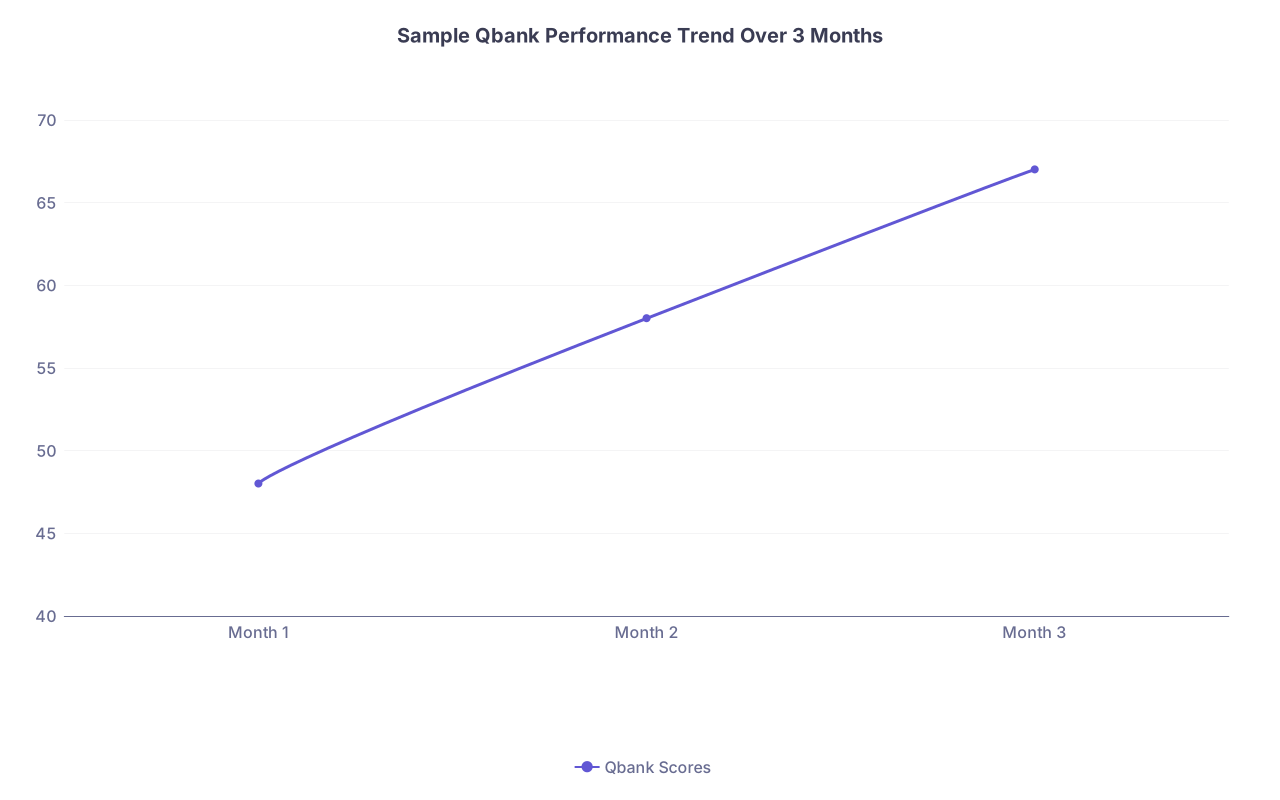
| Category | Qbank Scores |
|---|---|
| Month 1 | 48 |
| Month 2 | 58 |
| Month 3 | 67 |
That trend line matters more than which platform you chose.
Choose a focused content backbone
No, you do not need three full board-review books.
You need:
- One concise review resource (book or video series) that hits high-yield topics.
- A way to tie what you see on Qbank back to that resource.
Examples:
- IM:
- “MKSAP” + questions OR a concise board review book like “IM Board Review”
- EM:
- EM:RAP / Rosh review outlines
- Peds:
- PREP + concise peds board review book
- Anesthesia:
- Barash/Shorter review resource + TrueLearn Qs
The test is: could you reasonably cover this resource once before your exam if you were disciplined but tired? If not, it’s too big.
Hard rule: No “passive” studying as your main strategy
Reading without questions does not fix years of poor test performance. You will feel busy. You will not get better.
Your day-to-day structure should be:
- 70–80% questions
- 20–30% targeted review of missed concepts
Not the reverse.
Step 4: Design a Schedule That Accounts for Your Reality (Not Your Fantasy)
You’re on performance review. Translation: your days are already more stressful than your co-residents’. Your brain is getting cooked on service.
So be honest: how many real study hours can you pull on:
- A regular non-call day?
- A post-call day?
- A golden weekend?
Now subtract 25%. Because you’re not a machine and something will always blow up.
Let me give you a realistic structure for a PGY on probation.
Example weekly framework
You’re on a standard inpatient month.
Non-call weekdays (4 days/week):
- 60–75 minutes focused questions, broken into:
- 10–15 Qs before work OR during a reliably quiet mid-day window
- 10–15 Qs after work
- 5–10 minutes skimming notes of “big misses” before bed
- 60–75 minutes focused questions, broken into:
Call day:
- 0–5 questions max, if any. Call days are for survival.
Post-call day:
- Sleep, food, maybe 5–10 questions if post-call is light. If not, forgive yourself. Restart next day.
One weekend day off:
- 2–3 hours broken into:
- 20–25 Qs in the morning
- 20–25 Qs afternoon/evening
- 30 minutes content review of your worst topics
- 2–3 hours broken into:
That gets you roughly:
- 120–160 questions per week
- 2–3 hours of content review
Not sexy numbers. But that’s sustainable through bad rotations. And sustainable is what you need.
Step 5: Use Your Probation to Leverage Institutional Help
This is the part almost nobody does well. You’re already “flagged.” The downside is real. The upside? You now have a formal reason to demand resources.
You say to your PD or APD:
“Given my performance review and my upcoming boards, I want to propose a structured plan. Here’s what I’m doing on my own. Here’s what support would make the biggest difference.”
Ask for things that are actually useful, like:
- A lighter elective before your exam (clinic-based instead of heavy ICU month)
- Protected time weekly or biweekly for board prep (even 2 hours matters)
- Funding for a recognized board review course or Qbank if you don’t have one
- A designated faculty mentor specifically for board prep (separate from your remediation preceptor)
You’re not begging. You’re showing initiative. Program leadership would much rather write, “We supported the resident with X/Y/Z and they engaged actively” than “They disappeared and didn’t ask for help.”
Step 6: Tighten Your Clinical Game So Boards Aren’t Undermined
If you’re under performance review, the worst thing you can do is look like you’re blowing off the floor to cram for boards. That kills you politically.
You need some visible, quick clinical wins that don’t eat your entire life.
Target 3 specific clinical behaviors
From your evals or remediation plan, identify three very concrete behaviors, like:
- “Pre-round notes often incomplete”
- “Slow to respond to nurse requests”
- “Does not update families regularly”
- “Disorganized signout”
Pick three. For each, design one simple daily habit.
Examples:
Incomplete pre-round notes →
- Night before, spend 10 minutes writing “skeleton” notes for your sickest 2–3 patients; fill in data in the morning.
Slow responses to nursing →
- Every hour on the hour, scan your pager/EMR messages and clear what you can. Let nurses see you’re responsive. You’ll get a reputation boost quickly.
Poor signout →
- Use your program’s favorite signout template, and actually rehearse it with a co-resident once or twice. Yes, out loud. It feels dumb. It works.
Why does this matter for boards? Because if your team trusts you more, they’re more willing to help with small coverage favors that give you 20–30 quiet minutes for questions.
Step 7: Use Data, Not Vibes, to Show You’re Improving
Programs love numbers. Boards are numbers. Use that.
Track three things:
- Number of questions done per week
- Average percentage correct (rolling 2-week or 50-question blocks)
- Time per question (roughly – are you speeding up?)
You can keep this in a simple note on your phone:
- Week 1: 100 Qs – 48%
- Week 2: 130 Qs – 54%
- Week 3: 140 Qs – 58%
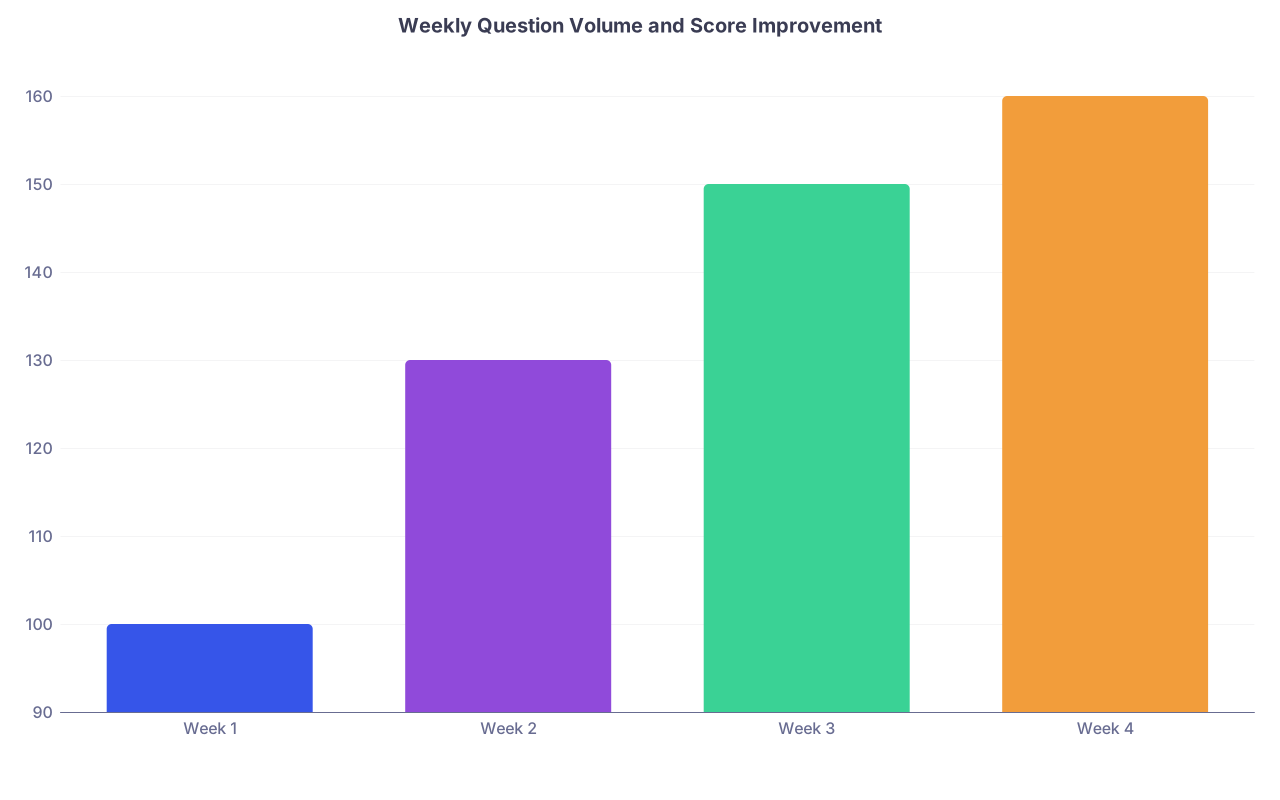
| Category | Value |
|---|---|
| Week 1 | 100 |
| Week 2 | 130 |
| Week 3 | 150 |
| Week 4 | 160 |
Bring this to your check-ins:
“Since our last meeting, I’ve done 380 questions and my average has improved from 48% to 59%. I’m focusing on [cardiology, heme-onc, etc.] because those are my weakest areas.”
This is how you change the story from “This resident is a problem” to “This resident is hustling hard and might actually pull this off.”
Step 8: Plan for Exam Day Like Your Career Depends on It (Because It Does)
If you’re on probation or review and sitting for boards in the next 6–12 months, the stakes are higher for you than for your co-residents.
You cannot treat this like just another test.
Make decisions early
If you’re >2–3 months out:
- Decide now: are you on pace to sit for this attempt? Look at your Qbank performance honestly. Consistently <50% on first-pass, close to exam? That’s a red flag.
Talk to your PD about:
- Whether they’d support rescheduling if your trajectory is bad
- How a fail vs. a delay would affect your standing
Sometimes, delaying one exam cycle to pass solidly is better than failing while on probation. But that depends on specialty, visa, and contract timing. That’s a real conversation, not one-size-fits-all.
Control what you can around the exam
- Do not schedule an ICU month ending three days before your exam if you can help it.
- Try to secure:
- A lighter rotation
- A few days of genuine study time pre-exam
- Use those final 7–10 days for:
- Mixed Q sets in exam-like blocks
- Rapid review of high-yield lists
- Fixing repeated mistakes, not starting new resources
Step 9: Use Mental Health as a Tool, Not an Afterthought
Here’s the thing programs do not say out loud: a resident on probation who quietly melts down is a liability. A resident on probation who gets help, stabilizes, and performs is a success story.
If you’re on edge, not sleeping, ruminating constantly about being “kicked out,” your board prep will be trash. Your memory is not the problem. Your stress physiology is.
Minimum viable mental health plan:
One mental break daily that is non-negotiable:
- 10–15 minutes walk outside
- Short workout, even bodyweight
- Sitting with coffee, phone away
If you’re having:
- Panic attacks
- Persistent thoughts about quitting medicine or worse
- Inability to sleep for days
You need to talk to someone. Program wellness, GME counseling, or external therapy if you don’t trust internal systems. Use them strategically, not as a last resort.
Also, be careful with substances. If your “coping plan” is three drinks nightly after call, your cognitive performance is going to crater. That will show up on your boards.
Step 10: Control the Narrative With Your Program
You might be tempted to go quiet and “just survive.” That usually backfires.
You want your PD to be thinking at CCC:
“This resident had issues, but they owned it, worked hard, and we’ve seen improvement.”
So:
- Show up to meetings on time and prepared.
- Bring brief written updates or a simple tracking sheet.
- When you screw something up (you will), own it quickly, outline what you’re changing, then shut up and do it.
And for boards specifically, about 1–2 months before your exam:
“My Qbank performance has gone from X% to Y%. I’ve completed Z questions. I’m devoting about [#] hours per week. I feel [cautiously] prepared but will continue working hardest on [weak areas].”
You’re signaling: I’m not in denial; I’m engaged.
Example 8-Week Crash Plan if Boards Are Imminent
Let’s say you’re 8 weeks out, on performance review, and you must sit for the exam.
Here’s a bare-bones structure.
Weeks 1–2
- 80–120 questions/week
- Track your baseline score
- Identify your 3 weakest content domains
- Start one concise review resource (video or book) targeting those domains first
Weeks 3–5
- 120–160 questions/week
- Start doing 20–40 question timed blocks to simulate test conditions
- Keep a “mistake notebook” or document:
- One line per question: topic + why you missed it (knowledge vs. rushing vs. misreading)

Weeks 6–7
- Maintain 120–160 questions/week
- Two or three full-length or near-full-length practice blocks (if available)
- Review heavily from your mistake notebook, not from random new resources
Week 8 (final week)
- Back down slightly on volume to avoid burnout
- Do mixed blocks in exam-like timing
- Sleep and schedule optimization, not last-minute new content
If your scores are clearly trending up and living in the pass range of your specialty’s Qbank benchmarks, you go in with realistic confidence.
If your scores are static and low, you need to talk urgently with your PD about the pros/cons of sitting vs. postponing—not silently roll the dice.
A Quick Reality Check
People do come back from:
- Failing Step 1 or Step 2
- Failing in-training exams twice
- Failing their specialty boards once or even twice
- Being on probation, performance review, formal remediation
I’ve seen residents who were one CCC meeting away from being cut, then pass boards, finish strong chief years, and get jobs they were proud of.
The ones who made it did not do it by:
- Hiding
- Pretending nothing was wrong
- Bouncing between 5 resources
- Cramming last minute and praying
They did it by being uncomfortably honest with themselves, using structure, and accepting that for a 6–12 month window, life was mainly: work, study, sleep, repeat—with surgical precision.
Key Takeaways
- Get brutally clear on your actual risk: what will end your career faster right now—bad evals or failed boards—and prioritize accordingly.
- Build a lean, sustainable board plan: one main Qbank, one concise review resource, realistic weekly question goals, and data tracking to show progress.
- Use your performance review status as leverage to get structured support, tighten your clinical behavior in a few visible ways, and control the narrative with leadership so they see a resident who is fighting to improve, not drifting toward failure.