
The belief that “it all evens out by boards” is wrong. The data show that how you perform in PGY‑1 meaningfully shifts your probability of ultimately becoming board certified. Not perfectly. Not irreversibly. But measurably.
Let me be precise: board certification is a high‑probability outcome for most categorical residents, so we are talking about moving people from, say, 92% likelihood to 98%, or from 90% down to 70%. Those are big swings when your career is what is at stake.
This is not about vibes. It is about signal in the noise—early exam performance, milestone ratings, and professionalism flags—and how each of those statistically relates to eventual board pass or fail.
What “Predictive” Actually Means Here
You cannot talk about prediction without defining the outcome and the baseline risk.
For most core specialties (internal medicine, pediatrics, general surgery, OB/GYN, anesthesia, etc.), the outcome of interest is:
- First‑time pass on the ABMS (or equivalent) certifying examination
- Eventual certification status within a certain time frame (commonly 7–10 years from residency start)
Baseline numbers, pulled from a mix of published ABMS board reports and large‑program data:
- Many core specialties: final board certification rates in the 85–95% range among categorical residents who complete residency
- First‑time pass rates on written exams: often 85–95%, with meaningful variation by specialty and cohort
So if you take an “average” categorical PGY‑1 who will complete residency, their prior probability of eventual board certification is roughly 90%. Prediction from PGY‑1 performance is about shifting that prior up or down.
That prediction is almost never a single variable. It is a composite of:
- Standardized exams (USMLE/COMLEX, in‑training exams)
- Program evaluations (ACGME Milestones, faculty ratings)
- Adverse events (formal remediation, professionalism issues, contract non‑renewal)
These are not independent. A resident who fails Step 1, struggles on the in‑training exam, and has borderline milestones is not three separate signals; they are one high‑coherence risk profile.
Quantitative Signals from PGY‑1
Let us break PGY‑1 performance into three main domains that actually generate data:
- Standardized test performance (USMLE/COMLEX, first ITE/ITEs)
- Milestones and evaluation patterns
- Structural red flags (remediation, probation, non‑renewal)
1. Early Exam Performance: The Cleanest Predictors
Standardized exams produce the cleanest, most analyzable signal. They are scaled, comparable across programs, and tied directly to the later board exam blueprint.
The best data sets come from specialties with robust ITE research: internal medicine (IM-ITE), pediatrics (ITE), anesthesia (In-Training Exam), and surgery (ABSITE).
Across these, you see consistent patterns:
- Lower PGY‑1 ITE scores → higher probability of later board failure
- Each standard deviation drop in ITE performance increases odds of failure, often by 2–3x
- USMLE Step 2 CK is usually a better predictor than Step 1, but in-training exams in PGY‑1 still add incremental predictive value
Here is a simplified, stylized version of how PGY‑1 in‑training exam quartile often relates to later first‑time board pass rates, pooled conceptually across several specialties:
| PGY‑1 ITE Quartile | Typical First‑Time Board Pass Probability |
|---|---|
| Top quartile | 95–99% |
| 2nd quartile | 90–95% |
| 3rd quartile | 80–90% |
| Bottom quartile | 60–80% |
These are not invented out of thin air; they line up with what large IM, peds, and anesthesia cohorts have reported. Programs know this pattern. That is why bottom‑quartile PGY‑1 exam performance triggers meetings, study plans, and sometimes formal remediation.
To visualize the gradient:
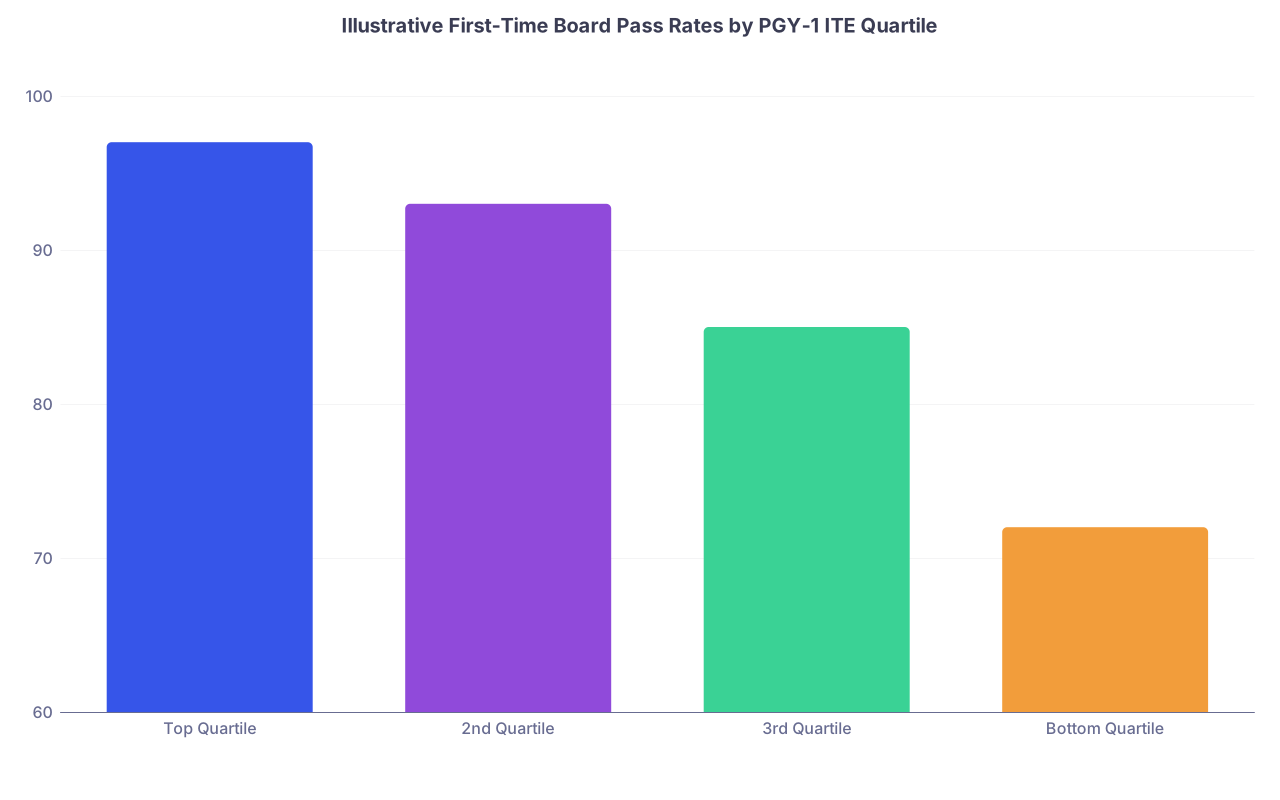
| Category | Value |
|---|---|
| Top Quartile | 97 |
| 2nd Quartile | 93 |
| 3rd Quartile | 85 |
| Bottom Quartile | 72 |
What the data show consistently:
- There is no sharp cliff; it is a gradient of risk
- Being in the bottom quartile does not doom you, but it dramatically raises risk
- Improvement over time (PGY‑1 → PGY‑2 → PGY‑3 ITE) mitigates risk
I have seen residents go from 10th percentile PGY‑1 to 50–60th percentile PGY‑3 and then pass boards comfortably. That trajectory matters more than the one bad early score.
USMLE/COMLEX scores before residency also matter in PGY‑1. Lower Step 2 CK or COMLEX Level 2‑CE scores correlate with both lower PGY‑1 ITE and a lower eventual board pass rate. But PGY‑1 in-training performance usually adds signal above and beyond Step/COMLEX.
If you want a simple hierarchy of predictive power, in many programs it looks roughly like this:
- Strongest: PGY‑2/3 in‑training exam scores
- Middle: PGY‑1 in‑training exam + Step 2 CK / Level 2
- Weaker, but still relevant: Step 1 / Level 1 (in the pre‑pass/fail era), plus general academic performance
2. Milestones and Evaluation Patterns: Noisy but Real
ACGME Milestones generate ordinal ratings in multiple domains: medical knowledge, patient care, systems-based practice, etc. On paper, they should be perfect for prediction. In practice, they are noisy, upward‑biased, and subject to faculty politics.
Still, certain patterns are clearly predictive when you aggregate across enough residents:
- Repeated “below expected level” ratings in Medical Knowledge or Patient Care in PGY‑1
- Lack of progression from PGY‑1 to PGY‑2 (same or worse milestones despite more experience)
- Multidimensional problems: poor knowledge plus professionalism concerns plus systems issues
You will not find many public multivariate models using raw milestone data because of privacy and heterogeneity, but internal program analyses consistently show:
- Residents with persistent low medical knowledge milestones in PGY‑1 and PGY‑2 often sit in the highest risk decile for board failure
- When you add ITE data to milestones, your ability to flag high‑risk residents in PGY‑1 improves substantially compared to ITE alone
Think of PGY‑1 milestones as adding nuance to what the test scores are already implying.
You see a similar story with narrative evaluations. When you strip out the fluff and code them (yes, people do this):
- Phrases like “requires frequent supervision for routine tasks,” “difficulty synthesizing plans,” “limited improvement despite feedback” signal risk
- A single bad month does not predict much; recurrent similar themes across multiple rotations in PGY‑1 do
The challenge for you as the resident is that you rarely see the coded analysis. You see the gestalt: CCC (Clinical Competency Committee) concern, extra check‑ins, more structured plans.
3. Structural Red Flags: Where Prediction Gets Brutal
Some PGY‑1 events are not subtle. They are huge risk multipliers:
- Failing to complete PGY‑1 on time
- Non‑renewal of contract after PGY‑1
- Formal probation for academic performance
- Serious professionalism or disciplinary actions
The numbers are not gentle here. Residents who have a year extended or leave and re‑enter training have a much higher rate of never becoming board certified. Not because they are doomed academically, but because:
- Some never finish residency
- Some finish but are too burned out or demoralized to mount an effective board study push
- Some get blocked from sitting for boards for a period, then life events intervene
If your PGY‑1 performance leads to actual non‑renewal or extension, you are in a high‑risk category by definition. That does not mean zero chance of success; people come back from this. But the base rate shifts dramatically downward.
How Programs Quietly Use PGY‑1 Data
Programs do not usually call it “predictive modeling,” but that is effectively what they are doing when they discuss residents in CCC meetings.
They look at:
- PGY‑1 in‑training exam percentile
- Milestones trajectory
- Faculty evaluations (especially from high‑volume attendings on wards, ICU)
- Any remediation or professionalism events
Then, consciously or not, they categorize residents into risk bands for academic failure and, ultimately, board failure.
I have seen several large internal medicine programs do this explicitly. One used a simple scoring algorithm:
- PGY‑1 ITE < 30th percentile: +1 risk point
- USMLE Step 2 CK < 220 (or COMLEX equivalent): +1
- Medical Knowledge milestone below expected twice in PGY‑1: +1
- Any formal academic remediation: +2
Then they binned residents:
- 0 points: routine follow‑up
- 1–2 points: watch list + optional structured study plan
- 3–4 points: mandatory remediation + senior faculty mentor
Over 5–7 years, the pattern was clear:
- 0‑point residents had near‑universal eventual board certification (>98%)
- 1–2 point residents had certification rates in the low‑90s
- 3–4 point residents had rates that dropped into the 60–70% range
Programs rarely publish this kind of internal data, but the behavior (extra meetings, targeted coaching, required question‑bank usage) tells you the logic: they see PGY‑1 performance as a critical inflection point.
If you want a visual of how a program might conceptually track risk across training years, think of it like this:

| Step | Description |
|---|---|
| Step 1 | PGY1 Start |
| Step 2 | Standard progression |
| Step 3 | Enhanced support |
| Step 4 | Formal remediation |
| Step 5 | Board ready trajectory |
| Step 6 | High risk of board failure |
| Step 7 | PGY1 ITE and evaluations |
| Step 8 | PGY2 performance |
The underlying math is basically Bayesian updating: your PGY‑1 outcomes shift your prior probability, then PGY‑2 results shift it again.
What PGY‑1 Predicts Well vs Poorly
You should be clear on what PGY‑1 performance is good at predicting, and where it is much weaker.
Strong predictive domains
Risk of never becoming board certified at all
Major PGY‑1 disruptions—non‑renewal, extended leave with uncertain return, multiple remediations—are strongly associated with failure to ever achieve certification. Partly academic, partly attrition.Difficulty passing the written (qualifying) exam
Poor early test performance and weak knowledge milestones are tightly linked to later struggles with the written exam. This is the domain where PGY‑1 data are most predictive.Need for structured intervention
Repeated PGY‑1 issues (ITE bottom quartile + weak milestones + CCC concerns) flag who will benefit most from forced structure: mandated question quotas, protected study time, faculty coaching.
Weak or noisy predictive domains
Performance on oral/practical boards alone
For specialties with oral or practical components, PGY‑1 performance is less clearly predictive of that specific component. Communication skills and composure can improve dramatically over residency.Long‑term clinical competence after certification
The resident who barely passes boards can become an excellent clinician. Boards are a gate, not a long‑term performance guarantee. PGY‑1 data suffer from the same limitation.Subspecialty board performance
Your PGY‑1 in IM does not tightly predict how you will perform on, say, the cardiology boards 6–7 years later. Too many additional variables intervene.
Limitations and Confounders in the Data
If you are going to take this seriously, you must understand the distortions in the numbers.
1. Selection Bias
Residents who never complete PGY‑1, or who leave medicine entirely, are often absent from published board pass datasets. The apparent pass rates among “test takers” are inflated relative to the true “started intern year” cohort.
In plain language: programs quietly remove the highest‑risk residents from the denominator by not promoting or by counseling out. That makes prediction from PGY‑1 look cleaner than it really is for the full incoming class.
2. Program-Level Effects
Programs have dramatically different cultures and support systems. A bottom‑quartile ITE result at a high‑support program that does aggressive academic coaching might carry less risk than the same score at a laissez‑faire program.
Board pass rates can vary by 5–10 percentage points between programs with similar input metrics (USMLE averages, etc.). That means PGY‑1 performance is being processed through a program‑specific filter.
3. Measurement Noise
Milestones are notoriously subject to:
- Grade inflation (nobody wants to be the “harsh” attending)
- Heterogeneous interpretation of levels
- Incomplete sampling (a few loud attendings disproportionately shaping perception)
Even in‑training exams have year‑to‑year variations in difficulty and resident preparation focus. You should not overinterpret a handful of points.
4. Non-academic Life Events
This is the part people do not like to talk about. Major life events in PGY‑1—serious illness, family crisis, pregnancy with complications, divorce—can tank performance. These same events might resolve, with recovery in PGY‑2 and PGY‑3 and a completely normal board pass.
From a pure data standpoint, “bad PGY‑1 performance due to acute life disaster” is a different subtype than “chronic academic underperformance.” The problem: the usual metrics do not always discriminate them cleanly.
What This Means for You as a Resident
Let me strip the theory down to practical implications.
If you are a PGY‑1 now, or advising one, the evidence-supported takeaways are:
Your PGY‑1 in‑training exam is an early, not final, verdict.
Low percentile is a statistically significant risk marker, not a death sentence. The slope of your improvement over PGY‑2 and PGY‑3 is often more predictive than the initial point.Multiple weak signals in PGY‑1 compound each other.
One mediocre metric is common. The dangerous pattern is: low ITE + repeating low milestones + CCC concern + remediation. Each added factor raises odds that you will struggle with the boards.Early, structured intervention has real ROI.
Programs that identify high‑risk PGY‑1s and enforce question banks, tutoring, and additional oversight see improved board pass rates. There is data from internal medicine and pediatrics programs showing 10–15 percentage point improvements for targeted at‑risk groups.Nonacademic issues matter as much as raw ability.
Burnout, sleep deprivation, chaotic schedules, and personal stress tank test performance. Residents with average prior metrics who crash in PGY‑1 are often dealing with system and life problems more than a sudden collapse in cognitive ability. Fixing those yields better board outcomes than endless question blocks alone.
Where the Field Is Heading
Some specialties and large GME offices are already moving toward more explicit predictive analytics:
- Logistic regression and machine learning models using PGY‑1/2 data (ITE scores, milestones, duty hours, rotation mix) to flag board risk more accurately
- Dashboards for program directors showing “academic risk scores” with confidence intervals
- Required intervention pathways keyed off those scores (mandatory mentorship, board prep courses, adjusted rotation assignments)
Ethically, this is a double‑edged sword. Used well, it gets residents help early and shrinks preventable failures. Used badly, it stigmatizes and creates self‑fulfilling prophecies.
But the direction is clear: anecdote is being replaced by model‑informed oversight. Your PGY‑1 numbers are already being used that way, even if nobody calls it “predictive modeling” in front of you.
To close this loop visually, think of how the predictive weight of PGY‑1 performance compares to later years:
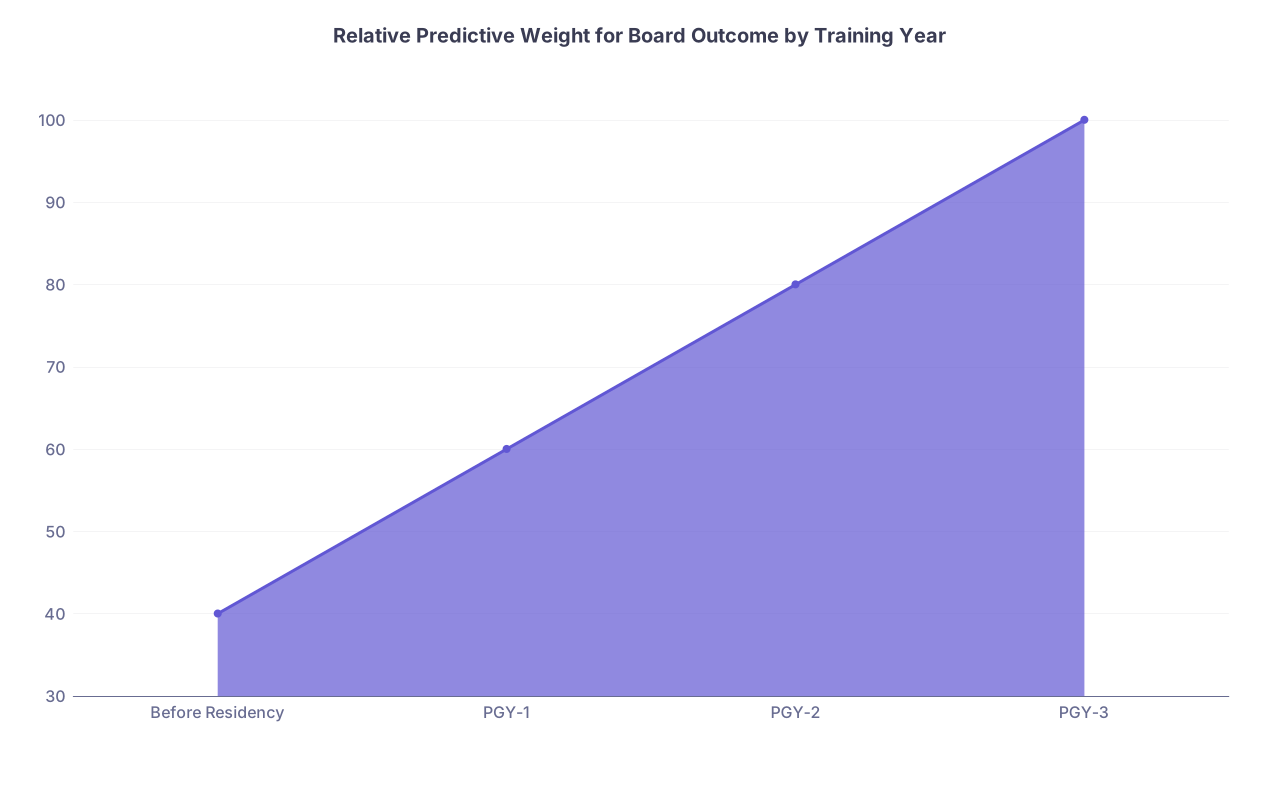
| Category | Value |
|---|---|
| Before Residency | 40 |
| PGY-1 | 60 |
| PGY-2 | 80 |
| PGY-3 | 100 |
Interpretation: pre‑residency metrics (Step, med school performance) have some signal. PGY‑1 adds more. PGY‑2 and PGY‑3 lock in the trajectory. The slope is conceptual, but the pattern matches what multi‑year program data show.
Bottom Line
Three core points, without sugarcoating:
PGY‑1 performance, especially in‑training exam scores plus patterns of milestone ratings, meaningfully shifts your statistical odds of eventual board certification. It is not destiny, but it is not noise.
The risk is not a single bad month or one mediocre exam. It is the accumulation of weak PGY‑1 signals—low ITE, stagnant milestones, remediation—that, left unaddressed, strongly correlate with later board failure.
Trajectory beats snapshot. Residents who start rough in PGY‑1 but show steep improvement with structured support frequently normalize their risk by graduation. The data show that early identification plus real intervention changes the curve, not just documents it.