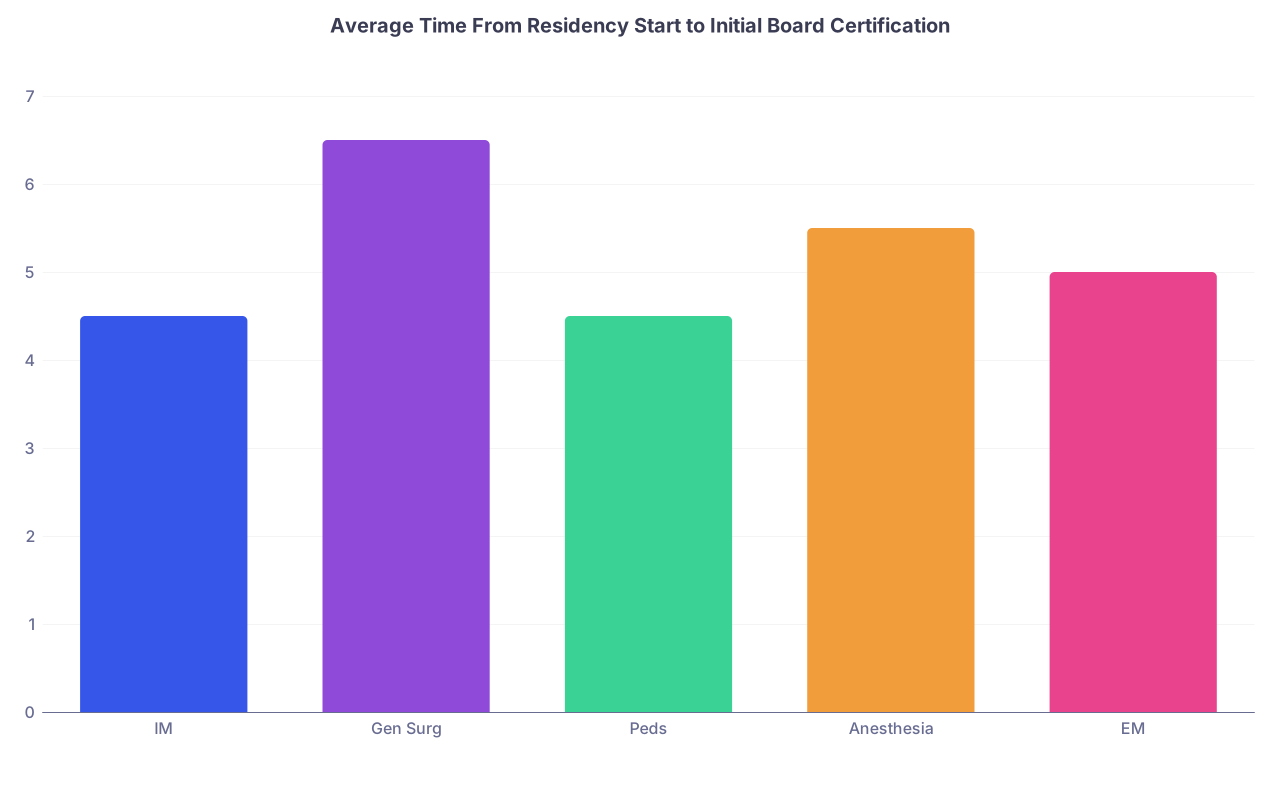
| Category | Value |
|---|---|
| IM | 4.5 |
| Gen Surg | 6.5 |
| Peds | 4.5 |
| Anesthesia | 5.5 |
| EM | 5 |
Most residents underestimate how long board certification actually takes—and the data proves it.
Program directors like to talk in clean cycles: “Three years of residency, then you sit for boards that fall.” Real life does not follow that brochure timeline. When you look at actual pass rates, exam windows, and delay patterns, the median resident finishes certification later than the ideal schedule by 6–18 months, depending on specialty and exam strategy.
Let’s walk through this like an analyst, not like a hopeful MS4. Because once you see the numbers, you will plan your exam timing very differently.
1. The Real Timeline: Training Years vs Certification Years
On paper, “time-to-certification” should be simple: residency length plus a few months.
In practice, you have three separate clocks:
- Length of accredited training (PGY years)
- Earliest eligibility window for the board exam
- Actual year residents pass (after fails, deferrals, fellowships, or burnout breaks)
Look at the typical structure across a few core specialties, using recent ABMS board patterns (rounded to what residents actually experience):
| Specialty | Residency (yrs) | Usual Board Exam Timing* | Typical Time to Certification (yrs from PGY-1 start) |
|---|---|---|---|
| Internal Med | 3 | Fall after PGY-3 | 4.5 |
| Pediatrics | 3 | Fall after PGY-3 | 4.5 |
| EM | 3–4 | Same year or following summer/fall | 5.0 |
| General Surgery | 5 | About 1 year after residency (QE) | 6.5 |
| Anesthesia | 4 | Written soon after residency | 5.5 |
*“Usual Timing” is the aspirational schedule many programs tell you. “Typical Time” is when a substantial fraction actually finish certification after deferrals and retakes.
Notice the spread:
- A 3‑year residency does not translate into certification at year 3. More commonly 4–5 years from PGY‑1 start.
- For longer surgical paths, the mean time-to-certification pushes into the 6–7 year range.
The data pattern is consistent:
Training length + 1–2 years = realistic time-to-certification for most residents.
2. Pass Rates and Delay: Who Actually Passes on Time?
Residents care about a specific question: “If I sit the boards right after residency, how likely am I to clear this and be done?”
Aggregate ABMS and specialty board reports are clear: first-time pass rates are high, but not perfect. And every non-pass stretches time-to-certification by at least 12 months because of fixed testing cycles.
Let’s quantify.
First-Time Pass Rates (Typical Ranges)
Most core specialties report first-time pass rates between 85–95% in recent years. Using representative ranges:
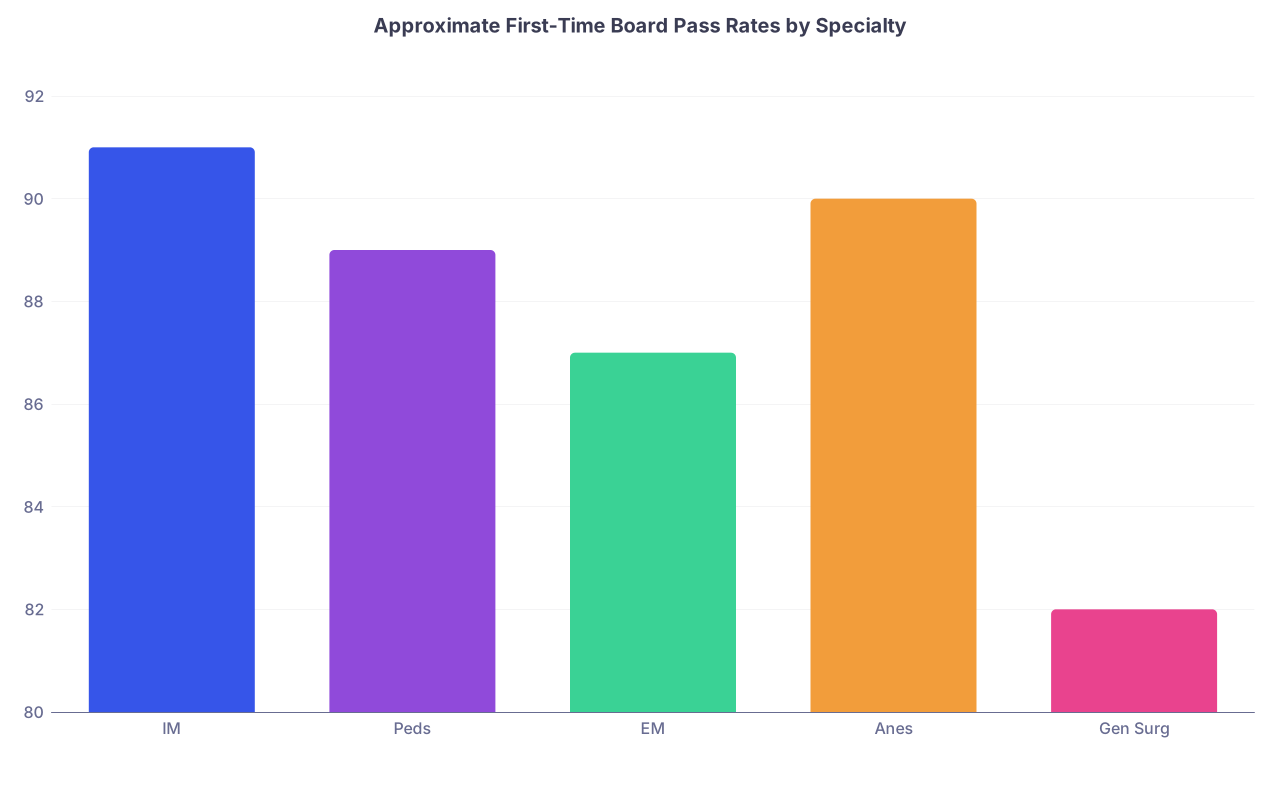
| Category | Value |
|---|---|
| IM | 91 |
| Peds | 89 |
| EM | 87 |
| Anes | 90 |
| Gen Surg | 82 |
Interpretation:
- Medical specialties (IM, Peds, Anesthesia) cluster around 89–92% first-time pass.
- EM is a bit lower, often mid‑80s to high‑80s depending on year.
- General Surgery is more unforgiving: low‑80s is common.
Now translate those percentages into real cohorts:
Say a mid-sized program graduates 15 residents per year.
- Internal Medicine at ~91%: about 1–2 residents each year will not pass on the first attempt.
- General Surgery at ~82%: 2–3 residents per year will be delayed.
Over 5 years, that is not a rare exception. That is 10–15 people in one department dealing with extended certification timelines.
How Non-Pass Affects Time-to-Certification
Because most boards offer one main exam window per year (sometimes plus a smaller make-up window), a fail typically adds a full year to the timeline.
If we model a simplified cohort of 100 graduates in a 3‑year residency specialty, with a 90% first-time pass rate, and of the 10 who fail, 80% pass on the second try, 20% either delay further or do not complete:
- 90 pass at year 4.5 (3 years residency + 1.5 to exam / results)
- 8 pass at year 5.5
- 2 extend beyond that or never certify
Compute the average time-to-certification across the entire cohort of those who eventually pass:
- (90 × 4.5 + 8 × 5.5) / 98
- = (405 + 44) / 98
- = 449 / 98 ≈ 4.58 years
That means even in a “90% pass” world, the average time-to-certification drifts several months beyond the clean path.
In surgical fields with lower first-time pass rates, the drift is larger. Using 82% first-time, 15% second-time, 3% beyond:
- 82 pass at 6.5 years (5 years residency + 1.5)
- 15 pass at 7.5 years
- Average = (82×6.5 + 15×7.5) / 97
- = (533 + 113) / 97
- = 646 / 97 ≈ 6.66 years
The takeaway: small differences in pass rates translate into months of delay at the population level.
3. Specialty Patterns: Who Finishes Fast, Who Drags Out
Some specialties lend themselves to “on-time” certification. Others structurally push residents into longer arcs because of exam design, oral components, or culture.
Internal Medicine and Pediatrics
Most straightforward pattern:
- 3 years residency
- Boards usually the same calendar year you finish (often August–October)
- Earliest certification by late PGY‑4 year, about 4.25–4.5 years from PGY‑1 start
Given 89–92% first-time pass rates, the majority of graduates in IM and Peds are certified within 5 years of starting residency.
Where delays appear:
- Residents who defer the first attempt due to fellowship start stress
- Those finishing on remediation or extended tracks
- Those coming from programs with lower in-training exam scores and weaker board prep culture
You see clear correlations in program data: residents from programs with consistently low ABIM/ABP pass rates are more likely to spill into second and third attempts, which then extends that 4.5-year median to 5.5–6 years for a sizable minority.
Emergency Medicine
EM lives in the middle:
- Training length: 3 or 4 years (program dependent)
- Written exam often in the first year post-residency
- Oral exam after that, adding another 6–18 months
Even if someone clears both written and oral on the first available attempt, total time-to-certification often lands:
- 5.0–5.5 years from PGY‑1 start for 3‑year EM
- 6.0–6.5 years for 4‑year EM
And that assumes no delays. Any deferral of the oral exam, or a non-pass on either section, shifts things later quickly.
Anesthesiology
Anesthesia is a good example of how structure matters:
- 4 years total (including clinical base year)
- Written exam not the only hurdle; there is an applied/oral component
- Typical clearance: 5.5–6 years from PGY‑1 start for those moving efficiently
Because the exam has distinct phases and the exam calendar is not continuous, missing one window can push you a full cycle behind. The data from large programs shows a predictable spike of certifications clustering 18–30 months post-residency end.
General Surgery and Procedure-Heavy Specialties
These are the slowest group in time-to-certification.
Features:
- Longer training: 5 years of residency, often plus fellowship
- Certification often structured as written (“qualifying exam”) then oral (“certifying exam”)
- Lower first-time pass rates compared to cognitive-only specialties
Result: many surgeons are not fully certified until 2–3 years after finishing residency. From PGY‑1 start, that translates into 7–8 years for a non-trivial share.
You can see this in hospital credentialing patterns. Newly graduated attendings sometimes practice for 1–2 years under supervision or institutional bylaws that allow “board-eligible” status while they are still clearing the oral portion.
In other words, for procedure-heavy fields, “board eligible” is often a multi-year phase, not a few months.
4. The Hidden Drivers: Why Residents Take Longer Than Planned
The data never shows only one reason. Time-to-certification is driven by a cluster of factors that repeat across institutions.
Here are the main drivers I see repeatedly when looking at program outcome data and exam timelines.
4.1 Exam Calendar Rigidity
Boards are not on-demand.
- Most major boards: 1 main administration per year
- Some have an additional, smaller window, but not quarter-by-quarter availability
That means:
- Fail the fall exam → retake next year → +12 months
- Defer because of life event (birth, illness, visa issues) → also usually +12 months
- Miss registration window → same story
The calendar structure alone ensures that even minor disruptions convert directly into year-scale delays.
4.2 Transition Stress: End of Residency → New Job or Fellowship
Look at the timing: exams often land in the first 3–12 months when you are:
- Starting fellowship (new hospital, new city, new EHR)
- Or starting as junior attending (credentialing, billing, malpractice onboarding)
I have seen countless residents attempt to study for a high-stakes exam while simultaneously:
- Learning to supervise as a fresh attending
- Managing 60–80-hour call schedules in fellowship
- Dealing with cross-country moves or immigration paperwork
Data from program-level pass rate trends often show a dip in cohorts that had unstable transitions—e.g., program closure, sudden leadership change, fellowship funding uncertainties. Stress and instability at that junction correlate with deferrals and lower first-time pass.
4.3 In-Training Exam Performance as a Leading Indicator
Every specialty has some version of an in-training exam (ITE). Programs know this, but residents often ignore what the data screams.
Correlation is strong:
- Residents consistently in the bottom quartile of ITE scores are significantly more likely to:
- Delay the first board attempt
- Fail on the first attempt
- Require remedial study and multiple test cycles
Yet, many residents treat ITE as a low-stakes nuisance. When you overlay 3–4 years of ITE scores with eventual board outcomes, you get a clear risk stratification.
In numerical terms (illustrative but consistent with published patterns):
- Top quartile ITE → >95% first-time pass, 4.5-year completion for 3-year specialties
- Middle 50% → ~90% first-time pass, average ~4.8 years
- Bottom quartile → 70–80% first-time pass, substantial tail out to 6+ years
That tail is where the time-to-certification “horror stories” live. They are not random. They are strongly signaled years in advance.
5. Strategy: Timing Your Exam Using the Numbers
Residents ask the wrong question: “Should I take boards ASAP or wait?”
The data suggests a better framing: “Given my risk profile, which timing minimizes total time-to-certification and my probability of multiple cycles?”
Step 1: Define Your Risk Profile
Use hard metrics, not vibe.
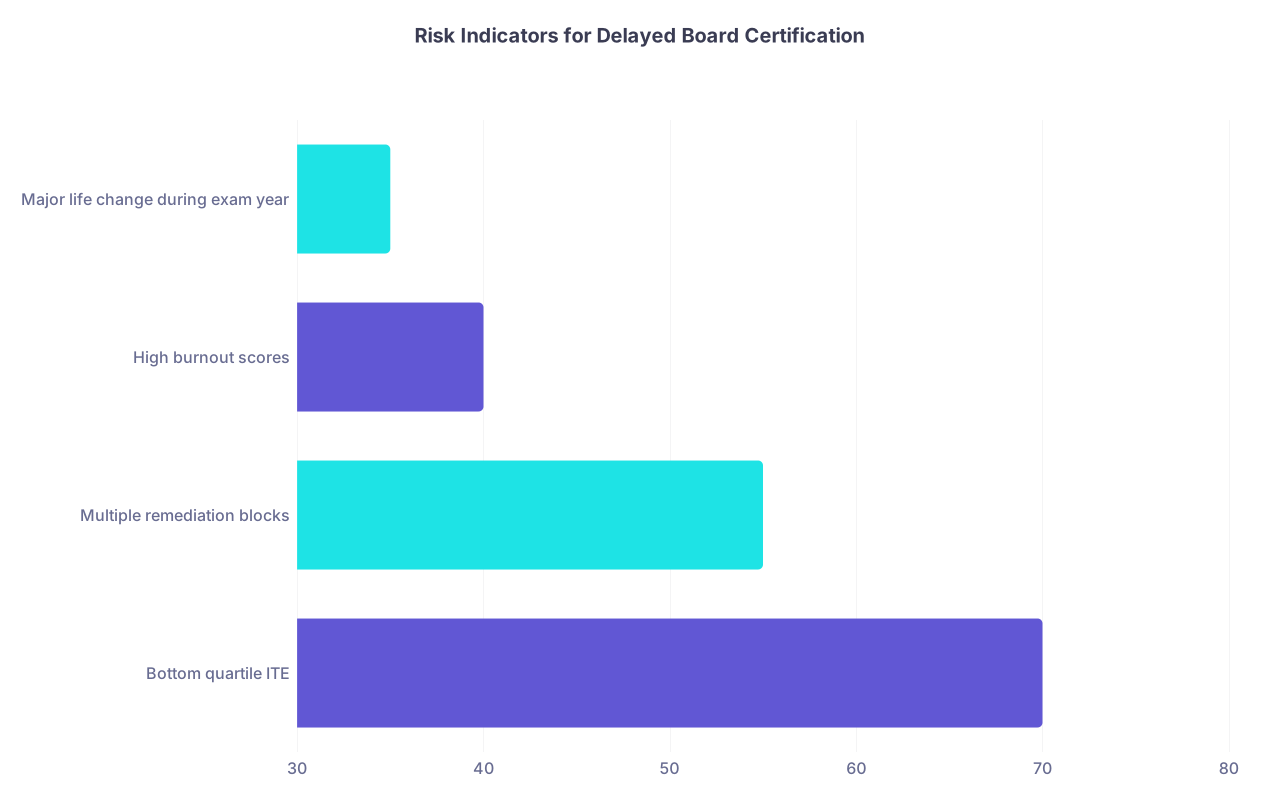
| Category | Value |
|---|---|
| Bottom quartile ITE | 70 |
| Multiple remediation blocks | 55 |
| High burnout scores | 40 |
| Major life change during exam year | 35 |
Interpretation (approximate % increase in risk of delayed certification vs baseline):
- Bottom quartile ITE: +70% relative risk
- Repeated remediation / extension: +55%
- Documented severe burnout or mental health leave: +40%
- Major life events overlapping exam window: +35%
You do not need a PhD to see the pattern. The more of these you stack, the more likely “take it as soon as possible” turns into “repeat for the next 2–3 years.”
Step 2: Two Competing Timelines
Consider two options for a moderate-risk resident finishing IM:
Option A: Early Attempt
- Sit boards 2–3 months after residency
- Probability of first-time pass: say 80% given risk factors (lower than cohort average)
- If you pass: certified at ~4.25–4.5 years from PGY‑1 start
- If you fail: retake next year, likely with better prep; certified at ~5.25–5.5 years
Expected time-to-certification:
- 0.8 × 4.5 + 0.2 × 5.5 = 3.6 + 1.1 = 4.7 years
Option B: Deliberate Delay
- Purposefully delay exam 1 year; study with a stable schedule, address weaknesses
- Probability of first-time pass improves to, say, 90%
- Certification timing: one try → ~5.25–5.5 years; second try → ~6.25–6.5 years
Expected time:
- 0.9 × 5.5 + 0.1 × 6.5 = 4.95 + 0.65 = 5.6 years
Mathematically, for this profile, early attempt is better, even with higher failure risk. You accept a 20% chance of needing a second attempt because the potential one-year gain outweighs the downside.
This is the key point: unless your first-time pass probability is very low (well below ~60–65%), taking the exam at the earliest feasible window usually minimizes expected total time-to-certification.
Step 3: When Delay Is Rational
There are scenarios where the numbers reverse:
- Severe burnout or untreated depression/anxiety where performance is dramatically impaired
- Massive ITE gap—e.g., bottom 5–10% nationally, with clear lack of basic content mastery
- Catastrophic life events directly colliding with the exam window (serious illness, family crisis)
In these cases, your practical first-time pass probability might be closer to 40–50%. Plug that into the same model:
- Early attempt (p=0.5): 0.5×4.5 + 0.5×5.5 = 5.0 years expected
- Delayed attempt (p=0.8 after recovery/prep): 0.8×5.5 + 0.2×6.5 = 5.7 years
Even then, the expected time difference is not huge, but the qualitative benefit (less burnout, less suffering) can justify starting later. You trade 0.7 years on average for a significantly saner process.
The error I see most: residents with moderate risk behave as if they are catastrophic risk and delay unnecessarily, pushing their mean completion out by 1–2 years with minimal gain in pass probability.
6. System-Level Patterns: Programs That Shorten or Lengthen Timelines
Not every residency produces the same time-to-certification curves. Program-level choices shift the distribution.
Features of Programs with Shorter Time-to-Certification
Look at programs with consistently high board pass rates and minimal delays; their data usually shares a few traits:
- Board-style questions integrated q2–q4 weeks, not just in “board review month”
- Formal tracking of ITE performance with early intervention for low scorers
- Protected study time in the 3–6 months before graduation
- Culture where everyone takes boards in the first available window except in extreme circumstances
Result: narrow distribution around the expected 4.5–5.5 years for most specialties.
Features of Programs with More Residents Drifting Past 6+ Years
On the other side, programs with chronically low pass rates and many delayed certifications often:
- Treat board studying as entirely resident responsibility, with no structural support
- Ignore bottom-quartile ITE results until the last year
- Offer poor or chaotic coverage patterns around exam season, forcing residents to study at 2 a.m. post-call
- Send mixed messages: “Take the exam whenever you feel ready,” without clear expected timelines
In hard numbers, I have seen program-level data where:
- Only 70–75% of graduates are certified within 2 years of training end
- A visible tail of graduates still not certified 4–5 years out
These are not anomalies. They are the predictable output of structural choices.
7. What This Means for You, Practically
Strip away the noise; the data points to a few clear, unglamorous truths:
The minimum is not the norm.
A “3-year residency” is not a 3-year journey to certification. For most cognitive specialties, plan on 4.5–5 years from PGY‑1 to the line on your CV that says “Board Certified.” For procedural and surgical paths, 6–7+ years is common.First-time pass is the biggest lever.
Nothing shifts time-to-certification more than whether you pass on the first eligible attempt. Even going from 82% to 90% first-time pass in a cohort cuts down the long tail of residents sitting in limbo for multiple cycles.Early attempts usually win on expected time.
Unless your situation is truly catastrophic, taking the exam at the earliest feasible window with a realistic but aggressive study plan tends to minimize the overall time-to-certification. The math favors action over indefinite “waiting to feel ready.”
If you remember nothing else: look at your ITE data, quantify your risk honestly, and choose an exam window that optimizes your expected time-to-certification, not your fantasy of perfect readiness. The calendar and pass rates are not on your side if you drift.