The rule about boards before fellowship is brutally simple: if you blow them off, you can absolutely wreck your future. But no, you don’t always have to pass before starting — it depends on the specialty, the specific exam (written vs oral), and the fellowship.
Let’s sort it out like an adult, specialty by specialty.
The core reality: written boards vs oral boards
You’re dealing with two different beasts:
- Initial written certifying exam (ABIM, ABEM, ABP, ABR, etc.)
- Oral/clinical/practical exam (e.g., anesthesia BASIC/ADVANCED, surgery oral boards, radiology oral equivalent where applicable, pathology practical components)
For fellowship programs, there are really three questions that matter:
- Do they require you to have taken the residency boards?
- Do they require you to have passed the boards before starting?
- Do they care whether you eventually become board-eligible/board-certified in your core specialty?
Most programs are technically bound by ACGME and the relevant specialty board. But locally? PDs make their own rules. Some are chill. Some are draconian.
Here’s the big overarching pattern:
- Almost all fellowships require you to be eligible for board certification in your core specialty (i.e., graduated from an accredited residency and met board requirements).
- Many do not absolutely require you to already be board-certified on Day 1.
- But failing or skipping your boards can:
- Screw your visa situation (if on J‑1/H‑1B).
- Threaten your long-term ability to practice in that subspecialty.
- Make some programs rescind or not renew your contract if you repeatedly fail.
So: you need a specialty-specific answer, not some vague “try your best” nonsense.
Quick comparison: do I need to pass before fellowship?
| Core Specialty | Must Take Before Fellowship? | Must Pass Before Start? | How Much Programs Care |
|---|---|---|---|
| Internal Med | Usually yes | Usually no | High |
| General Surgery | Often yes | Rarely required | Very high |
| Pediatrics | Usually yes | Usually no | High |
| EM | Usually yes | Usually no | High |
| Anesthesia | BASIC yes; ADV/Applied varies | Pass BASIC usually | Extremely high |
| Radiology | Core usually yes | Pass not always | Very high |
This is broad-brush. Individual programs can be stricter.
Internal Medicine → subspecialty fellowship (Cards, GI, Heme/Onc, etc.)
This is the classic setup: IM residency → cardiology, GI, heme/onc, pulm/crit, ID, etc.
ABIM rules:
- You must complete an ACGME-accredited IM residency.
- Then you’re board-eligible and can sit for the ABIM IM exam.
- Subspecialty boards (e.g., ABIM Cardiovascular Disease) require that you’re:
- Certified or eligible in Internal Medicine and
- Have completed an accredited fellowship.
Program reality:
- Most IM fellowships expect you to sit for ABIM IM boards either:
- Right after residency, or
- During your first year of fellowship at the latest.
- Do you need to have passed IM boards before you start cards or GI?
Usually no. But:- Top-tier programs (MGH, Penn, UCSF-type places) sometimes strongly encourage or informally expect at least taking the exam before fellowship.
- If you repeatedly fail, some PDs get nervous about your test-taking ability and professionalism.
Common pattern I’ve seen:
- Resident finishes PGY‑3 in June.
- Takes ABIM in August/September during PGY‑4 (fellowship year 1) with some protected time or light rotations.
- Programs are used to this.
So for IM:
You generally do not need a passing ABIM score in hand to start fellowship, but you’d be foolish to delay the exam more than a year. And if you skip it entirely? Some fellowships will not be happy.
General Surgery → surgical fellowships (Trauma, CT, Vascular, Surg Onc, etc.)
Surgery is more rigid and a little more old-school about this stuff.
ABS structure:
- There’s a qualifying written exam (QE) and an oral certifying exam (CE).
- To be fully board-certified, you must pass both.
- Many subspecialty boards want you to be either certified or at least eligible in general surgery.
Fellowship expectations:
- Most ACGME-accredited surgical fellowships require:
- Completion of an ACGME-accredited general surgery residency.
- Eligibility to sit for the ABS QE (so you have your case logs, training time, etc.).
- Do you need to have passed the QE before starting fellowship?
Usually no, but the smart move is to at least sit for it ASAP after residency. - Oral boards usually come later, during or after fellowship.
Reality on the ground:
- Many surgical fellows are still in the process of taking QE/CE during early fellowship years.
- Where you can get burned:
- Visa situations requiring “board certification or progress toward it.”
- Hospital credentialing down the line if you delay too much.
- Some competitive fellowships (CT surgery, complex GI, transplant) may strongly prefer candidates who’ve already passed QE.
So surgery:
You usually don’t have to be fully board-certified in general surgery before starting fellowship. But repeated ABS failures or blowing off the exams can absolutely poison your career.
Pediatrics → subspecialty fellowships (NICU, PICU, Peds Cards, etc.)
ABP rules are very similar to ABIM:
- Complete an ACGME-accredited peds residency → become board-eligible.
- Sit for the general pediatrics certifying exam.
- Subspecialty boards require you to be certified or eligible in general pediatrics and have completed the fellowship.
Program expectations:
- Many peds fellowships assume you’ll:
- Take the ABP general peds exam around the end of residency or early in fellowship.
- Most do not demand you already be board-certified on day one.
- But if you don’t at least schedule the exam, it’s a red flag.
Some children’s hospitals and academic centers later require board certification in general peds for staff roles, particularly if you want faculty appointments.
Bottom line for peds:
Like IM. Take the exam early, you don’t usually need the pass to start fellowship, but you 100% need to get this done if you care about future jobs.
Emergency Medicine → EM fellowships (Tox, Ultrasound, CCM, EMS, etc.)
ABEM rules:
- Need an ACGME-accredited EM residency.
- Then you’re board-eligible and can sit for the ABEM qualifying exam (QE).
- Subspecialties (e.g., EM/CCM, EMS) may be governed by ABEM, ABIM, or another board, but all expect core-board eligibility.
Program habits:
- Most EM fellowships expect:
- You’ve at least applied to sit for ABEM QE.
- You’re planning your QE during the year right after residency.
- They don’t usually block you from starting fellowship if your QE isn’t passed yet.
- But if you fail multiple times or ignore it, you’ll get a “we need to talk” meeting from both your fellowship PD and future employers.
Practical reality:
Fellowship years in EM can be quite busy (e.g., EM/CCM). Trying to prep for ABEM QE while drowning in ICU nights is not fun. You want that exam behind you.
Anesthesiology → fellowships (CCM, Pain, Cards Anesthesia, Peds, etc.)
Anesthesia is a bit different because of the split exam structure.
ABA structure:
- BASIC exam – taken after CA‑1 year; must pass to continue training.
- ADVANCED exam – after completion of residency.
- APPLIED exam – oral/OSCE style, after ADVANCED.
For fellowship entry:
- BASIC must be passed during residency. If you fail BASIC repeatedly, many programs will straight-up not graduate you, which kills fellowship eligibility.
- Most fellowships do not require you to have passed the ADVANCED exam before starting, but they expect:
- You’re registered for it.
- You’re serious about passing it early in fellowship.
- APPLIED is usually after fellowship or late fellowship.
Program nuance:
- Some top anesthesia fellowships (cardiac, critical care, pain at elite centers) quietly prefer people who already knocked out ADVANCED before arrival. Less distraction, less risk.
- Some institutions have internal policies about continuing appointments if you fail ADVANCED multiple times.
For anesthesia:
You absolutely must have BASIC done during residency, but you generally don’t need to have fully completed the board pathway (ADVANCED/APPLIED) before starting fellowship.
Radiology → fellowships (IR, Neuro, MSK, Body, etc.)
Radiology has its own complexity.
ABR structure (for diagnostic radiology):
- Core Exam – usually after 36 months of residency.
- Certifying Exam – after residency plus one year of practice/fellowship.
For fellowship:
- Nearly all radiology fellowships expect you to have taken and passed the Core Exam either:
- Late in residency, or
- Before fellowship starts.
- If you failed the Core, some fellowships will still let you start, but:
- You’ll be under more scrutiny.
- You’ll need schedule flexibility to re-take it.
- Some programs will flat-out not accept candidates who haven’t passed Core due to call responsibilities and coverage concerns.
Certifying exam is usually during or after fellowship; not a barrier to starting fellowship.
So:
Radiology is one of the stricter fields regarding having your major written exam (Core) done before fellowship. A failure doesn’t always exclude you, but it complicates everything.
Other specialties (FM, OB/GYN, Psych, Neuro, Path, Ortho, etc.)
Very short version:
Family Medicine → Sports Med, Geri, Palliative, etc.
Usually need to be board-eligible and have finished an ACGME FM residency. Taking the ABFM exam early is heavily encouraged but not always required before fellowship day 1.OB/GYN → MFM, Gyn Onc, REI, etc.
ABOG has a written exam and an oral exam. Most fellowships want you board-eligible in OB/GYN (i.e., completed residency). Written exam before or early in fellowship, orals usually later. Many fellows are still in the certification process.Psych → Child Psych, Addiction, Consultation-Liaison, etc.
ABPN wants completed residency and board-eligibility. Most psych fellowships don’t insist on already being board-certified for entry, but you absolutely should schedule the exam.Neurology → Stroke, Epilepsy, Neurocritical Care, etc.
Similar story: complete residency, be board-eligible, take primary exams early. Fellowships rarely require a passed exam at the start, but some hospital systems will care later.Pathology / Ortho / Urology / ENT subspecialties
Similar pattern: core residency completion + board-eligibility; fellowship entry usually doesn’t require full certification yet, but it’s highly advisable to get exams done as early as possible.
What actually happens if you fail your boards during fellowship?
Here’s the non-sugar-coated version:
First failure
Most PDs are disappointed but pragmatic. They’ll:- Adjust your schedule to allow some study time.
- Push you to retake at the next possible date.
- Document the conversation.
Second failure
Things get tense. You might:- Be flagged for academic concern.
- Have renewal of your next-year contract questioned (if multi-year fellowship).
- Face issues with visas and credentialing.
No attempt / refusal to schedule
That’s when PDs lose patience. Not taking the exam at all is seen as a professionalism and career-planning problem, and that can absolutely threaten your fellowship position.
Long-term fallout:
- Some subspecialty certifying boards require you to be board-certified or at least maintain eligibility in your core specialty.
- If you age out of eligibility (yes, there’s typically a time window), you can find yourself stuck: fellowship trained but never fully certifiable.
How to protect yourself: practical moves
Here’s what I tell residents who are serious about fellowship:
Ask every program directly
“Do you require me to pass my core boards before starting, or just be eligible and scheduled?”
Get the answer in writing if it’s critical (especially with visas).Take your core boards as early as is reasonably possible
For IM, peds, EM: ideally the year you graduate residency or PGY‑4 at the latest.
For surgery/anesthesia/rads: follow your specialty’s recommended sequence; don’t delay.Use elective/light rotations around exam time
PDs know you need exam time. Most will help if you ask early and show a real plan.Don’t hide failures
They will find out. Be upfront with your PD, have a concrete remediation plan, and show you’re taking it seriously.
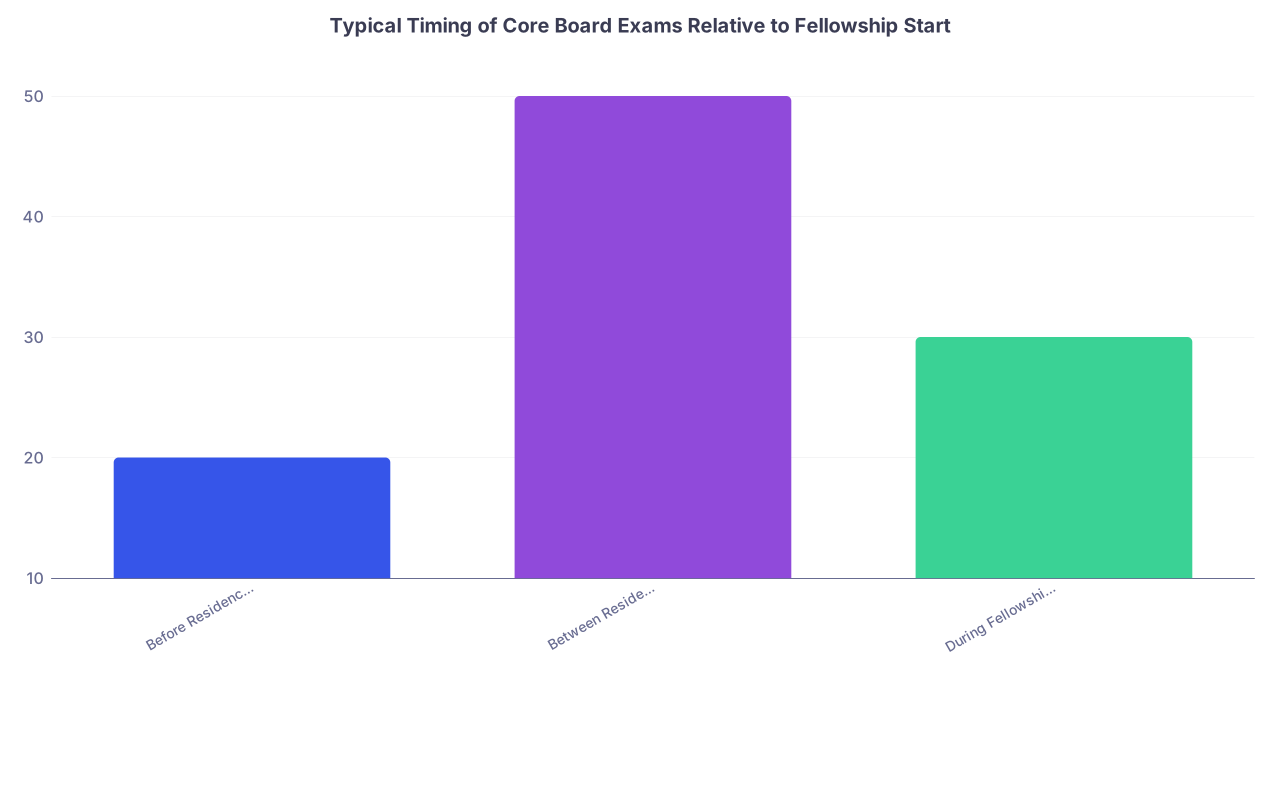
| Category | Value |
|---|---|
| Before Residency Graduation | 20 |
| Between Residency and Fellowship | 50 |
| During Fellowship Year 1 | 30 |

| Step | Description |
|---|---|
| Step 1 | Finishing Residency |
| Step 2 | Not Fellowship Eligible |
| Step 3 | Board Eligible |
| Step 4 | Must Take Exam Before Fellowship |
| Step 5 | Pass Not Always Required |
| Step 6 | Schedule Exam Early |
| Step 7 | Confirm With Fellowship PD |
| Step 8 | ACGME Accredited? |
| Step 9 | Core Specialty Rules |
FAQ: Boards and Fellowship (7 common questions)
1. Can a fellowship revoke my offer if I fail my boards after matching?
Yes, they can, and some have. Most programs won’t automatically boot you for a single failure, but if their contract or GME policy states that you must maintain board eligibility or pass within a certain timeframe, they have leverage. Always read your contract and ask directly what happens if you fail.
2. Will not being board-certified in my core specialty limit my subspecialty job options?
Absolutely. Many hospitals and academic centers require core specialty board certification for privileges, even if you’re fellowship-trained. Example: heme/onc job postings that say “BE/BC in Internal Medicine and Medical Oncology.” If you never get certified in IM, doors close.
3. Is it ever smart to delay taking boards until late in fellowship?
Generally no. The further you get from residency, the rustier your general knowledge becomes and the busier you get with subspecialty work, research, and life. There are rare exceptions (serious illness, maternity leave, major personal crises), but “I’m busy” is a bad reason to delay.
4. Do programs see my exact board scores or just pass/fail?
Fellowship programs usually see your pass/fail status, not exact scores, unless you tell them or include them in applications. Future employers care mainly that you’re certified. They don’t typically ask for your actual board scores.
5. I failed my core boards once. Will that kill my chances at fellowship?
Not automatically. If you already matched, it’s more about how you respond: honest discussion, clear study plan, strong clinical performance. For future applications, some programs may hesitate, but many will still rank or hire you if everything else is solid and you eventually pass.
6. For international grads on a visa, do board failures affect my status?
They can. Some visa extensions and institutional policies require maintaining “good standing” or “progress toward board certification.” Multiple failures or not taking the exam can complicate renewals or job offers. You need to loop in your GME office and immigration lawyer early if you’re in trouble.
7. Where can I find the exact board requirements for my specialty and subspecialty?
Go straight to the source: ABIM, ABFM, ABP, ABOG, ABEM, ABS, ABA, ABR, ABPN, etc. Each board’s website has a “Certification” or “Policies” section that lays out eligibility, timing windows, and whether subspecialty certification requires primary certification. Then cross-check with your specific fellowship’s website and ask the PD if anything is stricter locally.
Key takeaways:
- You almost always need to be board-eligible, but not always board-certified, to start fellowship.
- The safe strategy: take your core boards as early as possible and don’t play games with delays or secrecy.
- Exact rules vary by specialty and program, so ask directly, get specifics, and plan your exam timeline like it actually matters — because it does.