
You’re on night float. It’s 2:17 a.m. You’ve just admitted three patients back-to-back, and your brain feels like wet cardboard. You open your phone “just to check something,” and there it is: a WhatsApp “study group” pinging nonstop about Step 3 questions or boards prep.
Someone just posted a screenshot of a UWorld question. Another person is arguing about whether the answer is B or D. Polls, memes, “what do you guys think?” messages flying.
You tell yourself you’re “studying with others.” You feel slightly less guilty. But your notes are untouched, your QBank progress is stalled, and somehow that one quick check turned into 45 minutes.
If that sounds familiar, you’re exactly who I’m talking to.
Let me be blunt: most social media “study groups” for residents and board prep are productivity traps dressed up as collaboration. A few are useful. Most are cleverly disguised procrastination.
Let’s walk through the red flags that tell you your social media study group is wasting your time—and what to do instead.
The Core Problem: Fake Productivity Disguised as “Community”
The biggest mistake? Confusing noise with progress.
You feel “plugged in,” “motivated,” even “accountable.” But if I ask you:
- How many questions did you personally answer in the last 24 hours?
- How many pages did you actively review?
- What topics can you explain better today than yesterday?
If your honest answer is “uhhh… well, we talked about…”—you’re in trouble.
Most of these groups hit your dopamine receptors without actually building recall, pattern recognition, or test-taking skill. That is not studying. That’s vibes.
Let’s break down the warning signs.
Red Flag #1: It’s Mostly Screenshots and Polls, Not Deliberate Practice
You know this group:
- 30+ screenshots of QBank questions per day
- Polls like “What’s the best answer?” with zero actual explanations
- People flexing 80–90% correct on “today’s blocks” without context
- Endless “what resource is best?” arguments
Here’s the mistake: you think passively seeing questions counts as practice. It does not.
If you’re:
- Glancing at stems
- Clicking a poll button
- Reading other people’s answers
…you’re letting them do the cognitive heavy lifting. You are not training your own recall or decision-making.
If these apply, your group is a time sink:
- You scroll through questions without forcing yourself to pick an answer before seeing the poll results.
- You rarely type out your own full reasoning; you mostly read others’ explanations.
- You tell yourself you’ll come back later to “really do” the question—and never do.
What to do instead:
- If someone posts a question, hide the comments, answer it on your own (mentally or on paper), then compare.
- If you can’t commit to answering, skip the thread entirely. Don’t “half-study.”
- Limit question-discussion groups to a defined time (e.g., 30 minutes, 3x/week) instead of endless background noise.
If your group is 90% screenshots and polls and 10% actual structured reasoning, it’s not a study group. It’s a trivia feed.
Red Flag #2: The Group Chat Is Busier Than Your QBank
If your QBank app shows 0 completed blocks today but your WhatsApp/Discord has 100+ unread “study” messages… you already know.
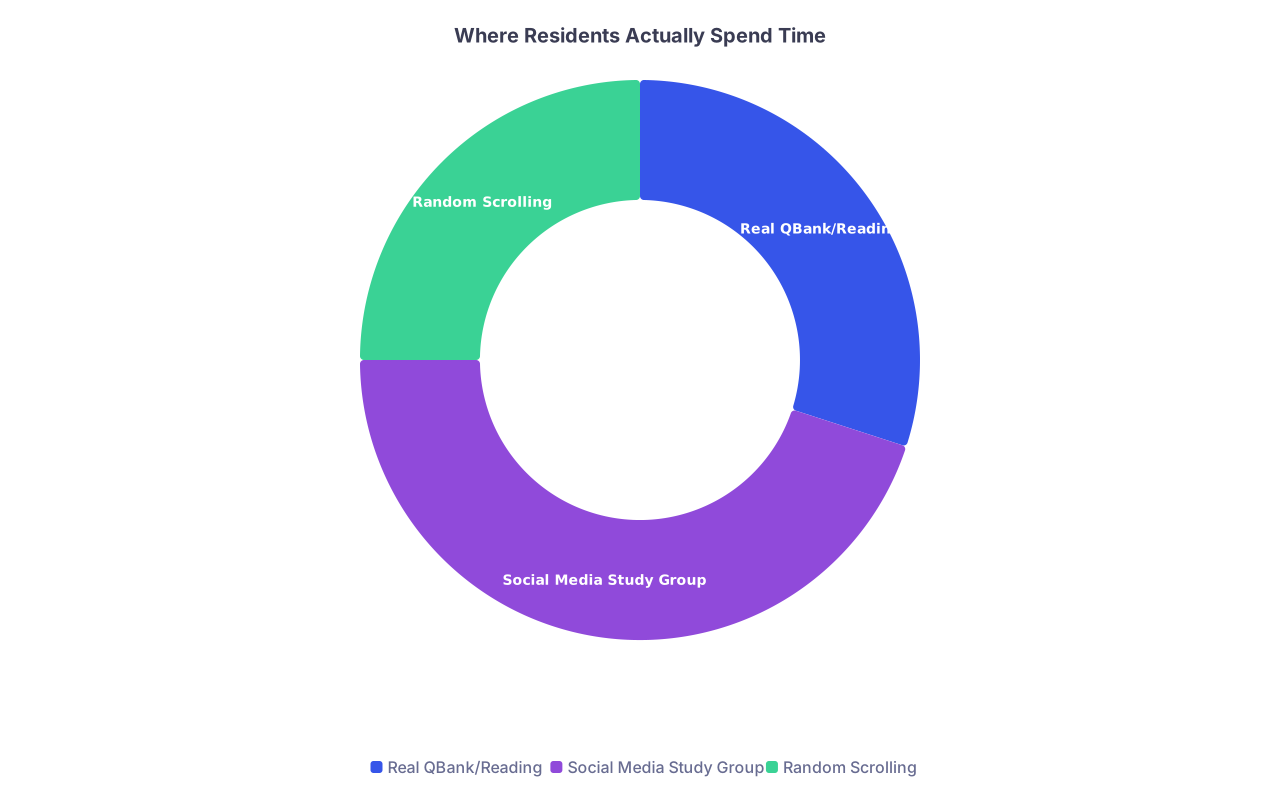
| Category | Value |
|---|---|
| Real QBank/Reading | 30 |
| Social Media Study Group | 45 |
| Random Scrolling | 25 |
I’ve watched this play out in every cohort:
- Interns and juniors especially feel anxious about “keeping up” with what the group is doing.
- They read every message because they’re scared of missing a “high yield tip.”
- By the time they’re done scrolling, their actual energy for real work is gone.
Here’s the harsh metric I use:
If your daily “study group” screen time > your dedicated study app screen time = you’re not studying. You’re hanging out in costume.
You’re making this mistake if:
- You open the chat “just to check” multiple times per hour.
- You feel pressure to read everything so you’re “not behind.”
- You haven’t finished a full 40-question block in days, but you can quote half the group’s memes.
Fix it:
- Hard rule: no group chat until you’ve completed your own scheduled block(s).
- Mute the group. If that makes you anxious, good. That anxiety is exactly what’s been driving your doomscrolling.
- Do a brutal audit: check your phone’s screen time and compare “social” vs QBank apps. If social wins, you cut usage in half starting tomorrow.
You’re not lazy. You’re outgunned by design—these platforms are built to hook you. Pretending you’ll “just be disciplined” without changing the setup is fantasy.
Red Flag #3: The Group Is an Anxiety Amplifier, Not a Support System
The worst groups are emotional landmines.
Patterns I see over and over:
- People posting: “I got 48% on my last block, am I doomed?” 3 times a day.
- Someone drops a 260+ Step 2 story or “aced boards with just Anki + 1 pass” and the chat devolves into panic.
- Every other message is: “I’m so behind,” “I’m so dumb,” “I’ll never pass.”
You go in looking for reassurance. You leave with your heart rate at 110.
This is the mental mistake: confusing shared anxiety with useful support.
Signs your group is harming more than helping:
- You feel worse about your prep after reading the chat.
- You waste time comparing your percent-correct or resource list to strangers.
- You start adjusting your plan every week based on what the loudest person is using.
There’s a difference between:
- Good: “Here’s how I structured my study schedule on nights; this worked and this didn’t.”
- Useless: “I’m at 72% correct, what about you guys?” x 50.
If you leave the group more often with a tight chest than a clearer plan, it’s not support. It’s chaos.
What to do:
- Leave, or at least stop sharing scores and progress. That alone kills a lot of comparison noise.
- Stick to 1–2 trusted humans for emotional support, not 80 semi-random residents.
- If you see the same doom spiral posts every day, that’s your cue: you’re in a venting chamber, not a study group.
You are not obligated to emotionally absorb everyone else’s panic as part of your prep.
Red Flag #4: There’s No Structure, Just Constant Chatter
A real study group has structure. Rules. An agenda. Some kind of plan.
Most social media groups? None.
Warning signs:
- No defined meeting times—people just post whenever.
- No clear goal: are you covering all systems, weak areas, question review, rapid recall? Nobody knows.
- No moderation. Off-topic chat, random rants, meme storms in the middle of “study time.”
You tell yourself you’re “learning here and there” throughout the day. In reality, what you’re doing is:
- Interrupting deep work.
- Fragmenting your attention.
- Training your brain to chase notifications.
Let’s be clear: unstructured, always-on study groups are almost always net negative for residents. You don’t have the bandwidth for that level of noise.
What a functional group looks like:
- Fixed times: e.g., “Tue/Thu 7–8 p.m. case review; Sun 10–11 a.m. rapid fire.”
- Defined focus: “This week is cardiology; we’ll hit ACS, valvular disease, arrhythmias.”
- Roles: one person moderates, one keeps time, others bring specific cases.
If your group is:
- 24/7 noise
- No calendar
- No expectation of prep or follow-up
…then it’s just a chat room with a guilty conscience.
Red Flag #5: It’s Becoming a Resource Shopping Mall
You’ve seen this:
- “Is UWorld enough?” “Is AMBOSS better than UWorld?” “What about BoardVitals?”
- “Do I need OME videos?” “Which Anki deck is best?”
- “What’s everyone using for CCS?”
Repeat. Every. Single. Week.
Instead of mastering any resource, people collect them like Pokémon. Endless FOMO.
The mistake here: thinking the next resource will fix inconsistent effort.
Reality: For 95% of residents, the problem is not the resource. The problem is:
- Not doing enough active questions
- Not reviewing deeply enough
- Not sticking to a focused plan long enough to see progress
Ask yourself:
- How many times have you changed your “main strategy” because of group chatter?
- How much time have you spent setting up new decks, new accounts, new spreadsheets instead of actually answering questions?
- Are you more excited about “optimizing your setup” than grinding through a boring block?
That’s how you know the group is pushing you into resource-shopping instead of study.
Set a rule for yourself:
- Choose 1 primary QBank.
- Choose at most 1–2 secondary supports (videos, book, or deck).
- Commit for at least 4 weeks without changing based on group hype.
If the group constantly makes you doubt that plan, it’s not helping you. It’s destabilizing you.
Red Flag #6: You’re There Because You’re Afraid to Study Alone
This one’s less obvious but more dangerous.
Some residents join and cling to these groups because:
- Studying alone feels intimidating and exposing.
- The group gives a sense of “we’re all in this together.”
- They’re afraid that if they step away, they’ll fall behind or miss something critical.
The hidden cost? You never build the skill you actually need for test day: sitting with your own thoughts, your own gaps, and your own performance without noise.
If you:
- Can’t do a full 40-question block without “checking in” with the group
- Feel like you “don’t know what to do” unless someone posts a plan
- Need constant reassurance that you’re “doing enough”
…you’re using the group as a crutch.
On exam day:
- No memes.
- No polls.
- No group reassurance.
Just you and the screen.
You must train for that.
Practical fix:
- Schedule solo-only study blocks: 1–2 hours, phone in another room, no chat.
- Afterward, if you genuinely have questions, pick 1–2 to bring to a select group (or attending/mentor), not dump everything into the chat.
- Gradually lengthen these solo blocks until your default is “I study alone; group time is bonus, not baseline.”
Red Flag #7: Nobody Is Actually Passing at Higher Rates
You’d think a “great” study group would produce better outcomes. Often it doesn’t.
Here’s the uncomfortable truth: a lot of loud study groups have terrible pass/fail stories.
| Approach | Typical Outcome | Main Risk |
|---|---|---|
| Solo + structured plan | Steady progress | Risk of isolation |
| Small, focused live group | Higher quality | Scheduling challenges |
| Huge social media group | Very variable | Time sink, anxiety, chaos |
| No plan, random resources | Poor outcomes | Burnout, last-minute panic |
If you actually track it (and I have in multiple programs), what you see:
- People who stick to a simple, boring plan with limited group noise do fine—often better.
- The ones who live in 200+ person Telegram/WhatsApp groups spend a ton of time worried and not enough actually reading or doing questions.
Red flag checklist:
- Does anyone actually track “X% of this group passed on first attempt” with real data? Almost never.
- Are there repeated stories like “I did everything this group was doing and still failed”? Probably.
- Does the group quietly go dead after exam results come out? That’s telling.
Don’t confuse high message volume with high yield. Results matter, not vibes.
How to Salvage or Replace a Bad Study Group
You don’t necessarily have to nuke every group from orbit. But you do need to stop lying to yourself about which ones are helping.
Step 1: Ruthlessly Categorize Your Groups
Sit down and ask of each one:
- Is this:
- Information (announcements, logistics, exam updates)?
- Support (emotional, venting, memes)?
- Actual study (structured questions, teaching, accountability)?
If a group claims to be #3 but functions as #1 or #2, relabel it in your mind—or leave.
Step 2: Set Hard Boundaries
You can do all of this today:
- Mute all “study” groups for 8–12 hours at a time.
- Only open them after finishing your personal tasks for the day.
- Turn off previews so your lock screen isn’t a constant temptation.

| Step | Description |
|---|---|
| Step 1 | New Group Message |
| Step 2 | Ignore message |
| Step 3 | Skip reading |
| Step 4 | Read after finishing block |
| Step 5 | Study time now? |
| Step 6 | Will this change my plan today? |
If you can’t trust yourself not to peek, just leave for the next 4 weeks. Your test date matters more than virtual FOMO.
Step 3: Build One Intentional, Low-Noise Setup
If you really want a “group”:
- Keep it small: 3–6 people max.
- Meet on a schedule (once or twice a week).
- Use live, time-limited sessions for:
- Rapid teaching on weak topics
- Explaining missed questions
- Quick oral recall drills
No 24/7 chat. No 200-person free-for-all.
You’re in residency. Your time is already sliced up by pages, codes, notes, and cross-cover. You can’t afford to let strangers on Telegram carve up the little that’s left.
FAQs
1. But I actually like my social media study group—should I still leave it?
Not automatically. But stop giving it more credit than it deserves. Ask: “If I left this group for 1 month and just did my own QBank + review, would my score go down—or possibly up?” If the honest answer is “it might go up,” then at minimum you mute it and only drop in on a schedule. Liking the people doesn’t mean the setup is good for your exam.
2. How do I tell a co-resident I’m stepping back from the group without sounding rude?
Be direct and neutral: “I’m tightening up my exam prep and cutting down on group chats for a while so I can focus on my own schedule. Nothing personal—I just know I get distracted easily.” If they get offended by that, that’s their issue. Your license and your sanity are more important than their feelings about a WhatsApp thread.
3. Is there any kind of online group that actually is high-yield?
Yes, but they’re rare. The better ones have: clear structure, limited size, defined goals, someone leading sessions, and actual content (short teaching, curated questions, targeted review). Think: weekly Zoom with 4 co-residents doing timed questions together, not a 300-person Telegram with nonstop chatter and no plan.
4. What’s the simplest “no-drama” study plan if I drop all my groups?
Use 1 main QBank (UWorld/AMBOSS), divide total questions by weeks left, and do that number of questions on your non-call days. Every block: answer under timed conditions, then spend at least as long reviewing as doing the questions. Supplement with 1 resource for weak topics (videos/book). That’s it. Boring beats chaotic 99 times out of 100.
Key points to walk away with:
- Most social media “study groups” are disguised procrastination and anxiety machines, not structured learning.
- If your chat time exceeds your QBank time, you’re not studying—you’re stalling.
- A small, intentional, low-noise setup (or just solo with a clear plan) will almost always beat a massive, noisy group when it comes to actually passing your boards.