
You’re PGY-2 going into PGY-3. Your co-resident just flexed that they “passed boards first try, no drama,” and now you’re wondering: is my fellowship dream wrecked because I needed more than one attempt?
Let me just answer the core question up front.
If you ultimately passed and are now board-certified or board-eligible, most fellowship programs do not care nearly as much about first-time pass vs multiple attempts as residents think. They do care about patterns, timing, and what your multiple attempts say about reliability and risk. But a single failure with a clean story and solid performance afterward? Usually a speed bump, not a wall.
Now let’s go through the details you actually need to know.
The Short Answer: How Much Do They Care?
Here’s the blunt version:
- Some top, hyper-competitive fellowships absolutely prefer (and sometimes expect) first-time board passes.
- Most solid, mid-to-high tier programs mainly care that:
- You passed by the time you start fellowship (or shortly after, for some specialties).
- You don’t look like a chronic academic liability.
- A single failure with subsequent passes, strong letters, and good clinical performance is rarely a deal-breaker.
- Repeated failures on multiple exams (e.g., USMLE + residency in-training + boards) will raise real red flags.
So yes, programs notice it. But what it means varies a lot and depends on everything else in your application.
Where This Actually Shows Up in the Application
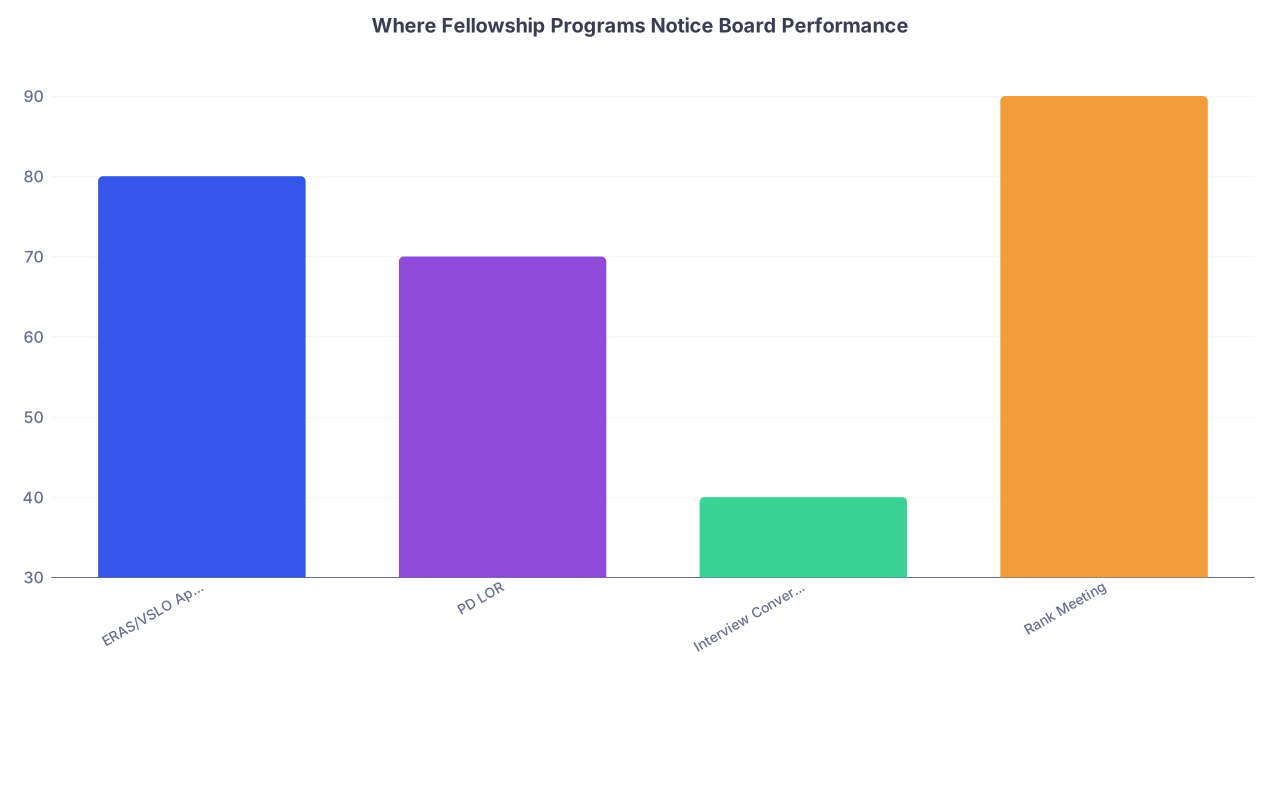
| Category | Value |
|---|---|
| ERAS/VSLO Application | 80 |
| PD LOR | 70 |
| Interview Conversation | 40 |
| Rank Meeting | 90 |
Fellowship programs don’t get a big flashing banner that says “FAILED BOARDS.” It shows up more quietly:
On your CV / application
You’ll typically list board status as:- “Board eligible” (haven’t taken or results pending)
- “Board certified” (passed) The number of attempts isn’t explicitly listed, but timing and gaps can hint at it.
Through your Program Director (PD) letter
This is the big one. PDs are often directly asked:- Did they pass boards?
- Any concerns about exams or professionalism?
A lot depends on how your PD frames your story.
In the interview
If you failed once, it may come up if:- There’s an obvious gap between training and certification.
- You’re borderline in other academic areas.
- You list “remediated” or similar language somewhere.
Behind closed doors at the rank meeting
That’s where the discussion happens:- “Reliable?”
- “Will this person pass our boards?”
- “Are we taking on a risk?”
So the failure isn’t a neon sign, but it’s not invisible either—especially if pattern + timing draw attention.
What Programs Actually Worry About
Most fellowship programs aren’t morally offended that you didn’t pass first time. They’re worried about risk.
Here’s what’s really going on in their heads:
Accreditation and pass rates
Programs are judged partly by their board pass rates. If they match someone who repeatedly fails, it drags down their stats. That becomes a problem in ACGME reviews and internal politics.Reliability and follow-through
Repeated exam failures sometimes correlate with:- Chronic procrastination or poor study habits
- Disorganization
- Burnout or life chaos
Programs don’t want a fellow who’s always “one crisis away” from another problem.
Signal vs pattern
A single miss:- “Okay, something happened that year. Let’s see the rest of the file.”
A pattern (Step failures, ITE at the bottom, multiple board attempts): - “This might be who they are, not just what happened.”
- “Okay, something happened that year. Let’s see the rest of the file.”
That’s the mental framework. You’re not being judged as “good/bad person,” you’re being evaluated as “high/low risk for our board pass stats and workflow.”
How Much It Matters by Specialty and Program Tier
This is where nuance actually matters.
| Fellowship Type | First-Time Pass Importance |
|---|---|
| Elite, academic subspecialty | Very High |
| Competitive academic (Cards, GI) | High |
| Solid mid-tier academic | Moderate |
| Community-based fellowship | Low–Moderate |
| Undersubscribed specialties | Low |
Big picture:
Hyper-competitive fellowships (GI, Cards, Heme/Onc at big-name academic centers)
These programs have plenty of applicants with spotless academic records. A first-time fail may not kill your chances, but it absolutely can hurt in tight comparisons—especially if the rest of your file isn’t stellar.Mid-tier academic programs
They’re more flexible. Strong clinical performance, good letters, research productivity, and a clear explanation can absolutely offset a non–first-time pass.Community-based or smaller programs
Often more forgiving. They’ll pay more attention to:- Your work ethic
- How you function on the team
- Whether your PD strongly backs you
The board story matters less if everything else is solid.
Undersubscribed fellowships
For less competitive fields, passing eventually is usually enough. They care more about “Will this person do the work and not blow up our pass rate?”
One Failure vs Multiple Tries: Huge Difference
There’s a giant gap between “failed once, then fixed it” and “needed 3–4 tries across multiple exams.”
Single failure (on USMLE/COMLEX or specialty boards), then clean passes
This is usually salvageable, especially if:
- Your ITE scores are average or better afterward.
- Your recent boards were passed with no drama.
- Your PD writes something like: “They had an early exam stumble but have consistently demonstrated strong knowledge and performance since.”
This can genuinely become a non-issue for many programs.
Multiple failures on the same board exam
This is different. It triggers thoughts like:
- “How much support will this person need to pass the subspecialty boards?”
- “Do they test poorly or not prepare well?”
- “Will we be dealing with remediation while they’re in fellowship?”
You’re not automatically out, but you’re in “need a strong mitigation story” territory.
Pattern across multiple exams
Step fails + low ITE + multiple board attempts? That’s when some programs will quietly remove you from the serious consideration pile, especially the competitive ones. Not personal—just risk management.
How Programs Weigh It Against Everything Else
Here’s roughly how the tradeoff works in real life.
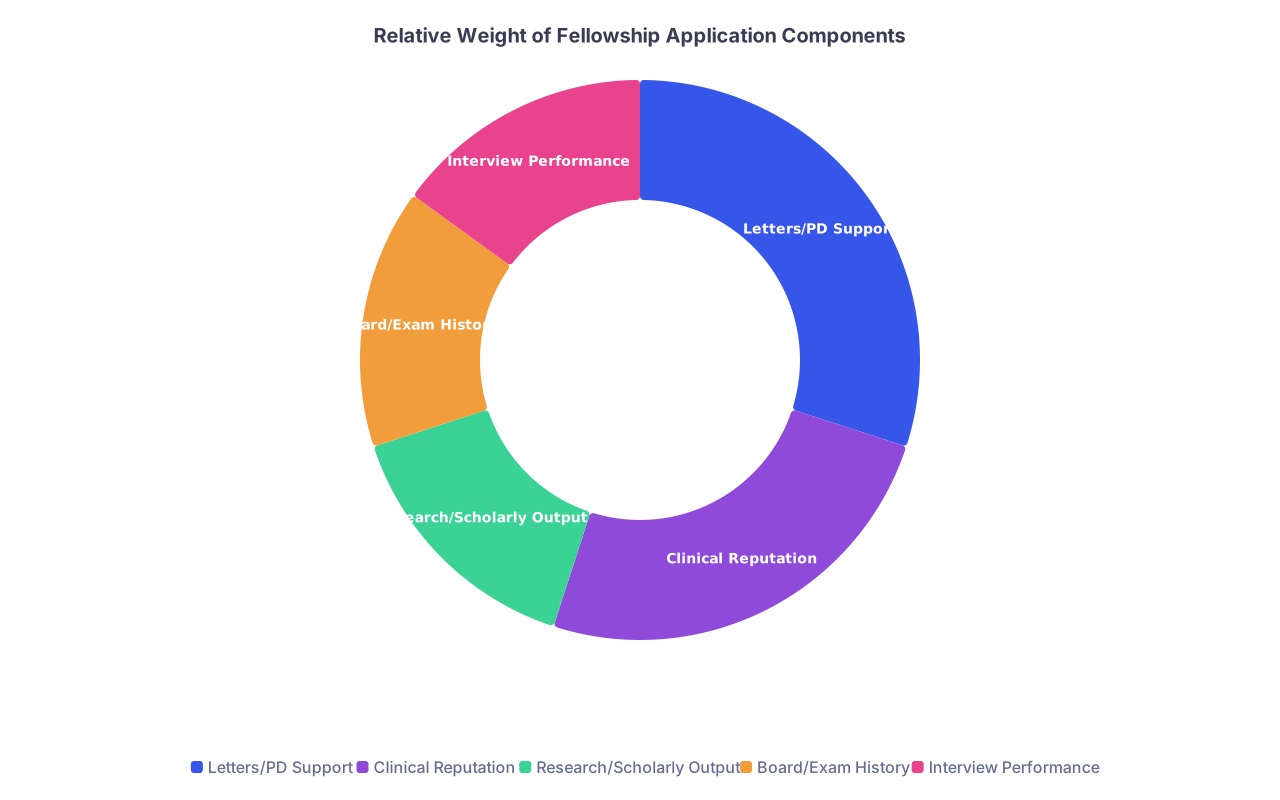
| Category | Value |
|---|---|
| Letters/PD Support | 30 |
| Clinical Reputation | 25 |
| Research/Scholarly Output | 15 |
| Board/Exam History | 15 |
| Interview Performance | 15 |
For many fellowships, the rough priority stack:
PD letter and reputation on your home service
“Do we trust this person in our ICU/clinic at 2 a.m.?”Clinical performance and word-of-mouth
Chiefs, attendings, and fellows talk. If you’re known as strong, that buys a lot of forgiveness.Research / scholarly activity (for academic programs)
Not everything, but definitely something for GI/Cards/Heme/Onc/Pulm/CC.Board and exam history
Important, but not usually the top line unless there’s a clear problem.Interview performance
Mediocre exams + fantastic interview + strong PD letter can still equal “rank to match” at many places.
Boards are one part of a larger picture, not the entire story.
How to Frame a Non–First-Time Pass
If you needed more than one try, your job is to control the narrative. Not hide it. Frame it.
1. Own it directly if asked
You don’t need a three-page essay about it. You need one tight explanation.
Good pattern:
- Brief context (no oversharing, no drama dump).
- What changed.
- How your later performance shows the change is real.
Example:
“I failed my IM boards the first time. My study approach was scattered, and I tried to squeeze in too much moonlighting. I sat down with my PD, cut back extra shifts, used a structured question-bank schedule, and joined a small study group. I passed comfortably on the second attempt, and my ITE scores the last two years have been solidly above average. I’m confident in where my knowledge base is now.”
That’s fine. That’s adult. Programs can work with that.
2. Make sure your PD is aligned
Have a direct conversation with your PD:
- “I failed X the first time but passed on the second attempt. I’m interested in fellowship Y. How do you think this will be viewed?”
- “When you write my letter, is there any way you can address that this was an isolated issue and that my performance since has been strong?”
You can’t script their letter. But you absolutely can ask them to contextualize it.
3. Back it up with fresh data
Use everything you can to show “that was then, this is now”:
- Recent ITE improvements
- Board pass on the next attempt
- Strong faculty comments on fund of knowledge
- Teaching awards or chief role (shows trust and reliability)
If your recent track record is boring and solid, that’s exactly what you want.
When It Actually Does Kill Applications
Let me be blunt: there are situations where board history really hurts you.
These are the common ones:
- You still haven’t passed your primary boards by the time you’re applying to fellowship and there’s no clear plan.
- You’ve failed the same boards multiple times with no sign of change in behavior or performance.
- You have exam failures plus poor clinical evaluations plus a lukewarm PD letter.
- The fellowship is extremely competitive, and the rest of your file isn’t exceptional enough to compensate.
In those cases, adjusting expectations or delaying application to fix the problem is sometimes the smarter move than just throwing apps everywhere and hoping someone doesn’t notice.
Practical Moves If You’ve Failed Boards Before
Here’s what I’d do if I were in your shoes with a non–first-time pass and fellowship on the horizon:
Have an honest PD meeting.
- Ask directly: “With my board history, which tier of programs do you think I’m realistic for?”
- Listen. Carefully. This is where fantasy dies and strategy begins.
Target programs strategically.
- Mix: a few reach, a solid group of realistic, and some safety programs.
- Don’t only apply to the three big-name places you rotated at as a med student.
Fix everything else you can control.
- Strong clinical performance now.
- Timely notes, good citizenship, no professionalism issues.
- Reasonable scholarly output if you’re going academic.
Be prepared with one clean answer.
- Not a script. Just a clear, practiced explanation so you don’t ramble or sound evasive.
If you haven’t retaken yet, over-prepare.
- If you’re going to sit again, this attempt absolutely has to be successful.
- Use question banks, study group, schedule, accountability. No half-effort.
Quick Reality Check
Let me say this plainly: fellowship programs have taken plenty of people who didn’t pass their boards on the first try. Some of them are now faculty, running services, leading programs.
A non–first-time pass is a scar, not an amputation. It marks you, but it doesn’t remove you from the game—unless you let it become part of a bigger pattern of inconsistency and denial.


| Step | Description |
|---|---|
| Step 1 | Board Exam History |
| Step 2 | Low concern |
| Step 3 | Look at recent performance |
| Step 4 | High risk concern |
| Step 5 | Usually acceptable |
| Step 6 | Case by case concern |
| Step 7 | May limit options |
| Step 8 | First time pass |
| Step 9 | Single failure or pattern |
| Step 10 | Strong PD letter |
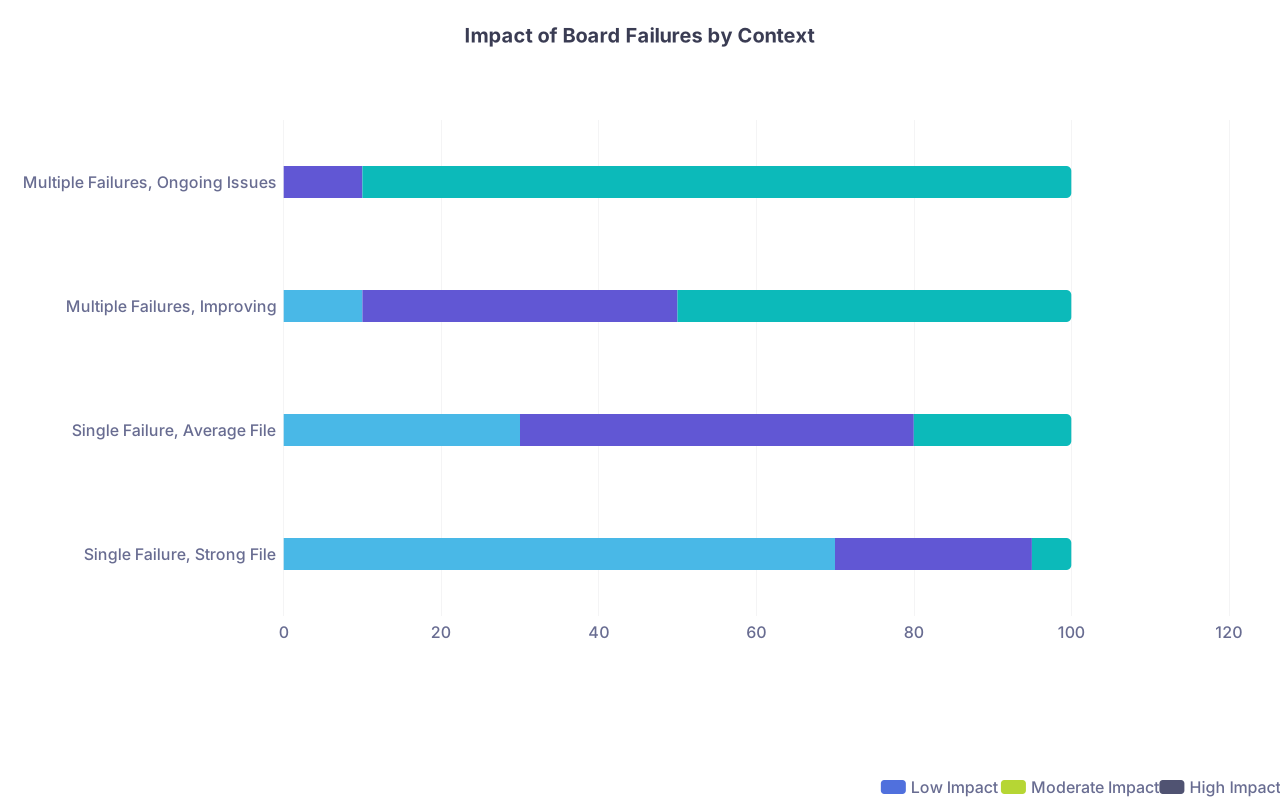
| Category | Low Impact | Moderate Impact | High Impact |
|---|---|---|---|
| Single Failure, Strong File | 70 | 25 | 5 |
| Single Failure, Average File | 30 | 50 | 20 |
| Multiple Failures, Improving | 10 | 40 | 50 |
| Multiple Failures, Ongoing Issues | 0 | 10 | 90 |

FAQ: First-Time Board Pass vs Multiple Tries
Will a single board failure automatically block me from a competitive fellowship (e.g., GI, Cards)?
No, not automatically. It will hurt you if everything else is just average. But if you’ve got strong letters, solid clinical performance, research, and a clean second pass, plenty of competitive programs will still consider you. It just moves you slightly down in comparison to similar applicants with spotless records.Should I disclose my board failure in my personal statement?
Usually no, unless you have a very tight, relevant story that ties into resilience, growth, or a clear turning point. Most of the time, it’s better handled in PD letters and, if brought up, in interviews. Volunteering it unprompted in writing can sometimes overemphasize something that programs might have mostly glossed over.How bad is it if I haven’t passed my boards yet but want to apply to fellowship this cycle?
Risky. Some programs won’t rank you without a pass by a certain date. Others will worry they’re taking on someone who might still be dealing with exams during fellowship. If your chances of passing before starting fellowship aren’t high, strongly consider delaying application, fixing the exam problem first, and then applying from a position of strength.Does a first-time board fail matter less if my ITE scores were good?
Yes, that helps a lot. Good or improving ITE scores suggest your knowledge base is there and the failure might’ve been about timing, preparation method, or personal circumstances. Programs like to see a consistent or upward trend on in-training exams as evidence that the failure was an outlier, not your ceiling.Can a very strong PD letter “override” a poor board history?
Sometimes, yes. A PD who writes, “This is one of the top residents I’ve trained in 10 years; their board issue was isolated and not reflective of their current performance” carries serious weight. Especially if backed by strong clinical comments and recent good performance. It won’t erase multiple failures at the most elite programs, but it absolutely moves the needle in your favor at many places.
Key points to walk away with:
- Programs care more that you eventually pass and don’t look like a chronic risk than about a pristine first-time record.
- One board failure with a clear fix and strong recent performance is usually survivable; a repeated, unexplained pattern is what really hurts.
- Your PD letter, clinical reputation, and how you frame the story matter more than the raw fact that you didn’t pass on the first try.