
The default advice about board studying—“find a group” or “go it alone”—is lazy. The right answer isn’t about what’s “better in general.” It’s about what’s better for you and for this exam, and most people pick the wrong setup by instinct.
You’re not choosing “solo vs group.” You’re choosing:
- How to learn new material
- How to drill questions
- How to keep going when you’re exhausted from call and clinic
So here’s the answer you’re actually looking for:
Most residents should learn solo, drill in a small group, and review high‑yield content alone again. Full-time group studying is usually a waste. Purely solo studying is usually unsustainable.
Let’s break it down so you can build a plan that actually survives residency chaos.
Step 1: Decide What You’re Solving For
Before arguing solo vs co-residents, you need to be clear on what problem you’re trying to fix. The right setup for someone with ironclad discipline and test anxiety is not the same as the co-resident who hasn’t done a full-length exam since Step 2.
Ask yourself, bluntly:
- Do you procrastinate unless someone’s watching?
- Do you retain better when you explain things out loud?
- Do you get irritated when people go slower than you?
- Are you already scoring near your goal on question banks, or far below?
- Is your schedule chaotic (night float, heavy ICU months) or stable?
Here’s how those answers typically steer you:
| Profile | Best Primary Mode |
|---|---|
| Highly self-disciplined | Mostly solo |
| Chronic procrastinator | Small group mix |
| Strong test anxiety | Solo + 1 study buddy |
| Easily distracted by others | Solo |
| Needs to verbalize concepts | Small group |
You’re not locked into one mode. You’re choosing what your default is, then layering the other on strategically.
Step 2: What Solo Study Is Actually Good For (and When It Fails)
Solo study isn’t just “no one else is around.” It’s a specific tool that does certain jobs extremely well.
Solo study is best for:
Learning & consolidating new content
Reading guidelines, watching videos, summarizing key tables—this is brutal in groups. Pace and style vary too much.
Want to learn the latest sepsis guidelines or memorize tumor staging? Do it alone. High focus, no social friction.Serious question-bank work
Timed blocks that actually mimic the exam? Do those solo.
Residents who “do questions together” almost always:- Over-discuss each item
- Look up things mid-question
- Destroy pacing
Save group time for post-hoc review of missed or tough questions, not live test simulation.
Custom weak-point repair
Your co-resident might be crushing endocrine while you’re still mixing up adrenal incidentaloma workup. You need targeted, boring repetition that no one else cares about. Flashcards. Re-questions. Annotating a single table ten times.Schedule flexibility
Call just changed? Kid got sick? You can shift solo blocks without messing up anyone else. This is not trivial. In residency, the “perfect group plan” dies by week two of wards.
Where pure solo study breaks down
I’ve watched plenty of residents swear, “I’ll just grind UWorld every night after work,” then watch Netflix with chart review open in the background. Solo study tends to fail when:
- You’re exhausted and no one’s expecting you to show up
- You’re behind and feel embarrassed, so you avoid the work
- You hate the content and your brain looks for any excuse to escape
- You’re anxious and keep “reviewing the same safe topics” instead of tackling weak spots
If this sounds like you, a hybrid model will beat pure solo every time.
Step 3: What Group Study Actually Does Well (and Where It’s a Trap)
Group study with co-residents can be powerful or completely useless. It depends on size, structure, and honesty.
Group study works best for:
Accountability and rhythm
Knowing three other people will be in the conference room at 7 pm? You’re more likely to drag yourself there, especially after a long clinic day.
The main benefit here isn’t “shared wisdom.” It’s just: you show up and don’t quit as easily.Verbalizing and teaching
Teaching forces you to confront whether you actually understand something or just recognize the words.
Example: each person gets assigned a topic (e.g., nephrotic syndrome, asthma phenotypes, spine imaging) and has to present a 5–10 minute high-yield breakdown to the group. You can’t hide in that.Rapid-fire, high-yield review
Short, structured drills work great in small groups:- “What’s the treatment of choice for…?”
- “Name the diagnostic criteria for…”
- “Walk through the management steps for…”
This is where co-residents can help you catch gaps fast.
Morale and realism
Sometimes you just need to see that everyone else is also tired, behind on questions, and confused by that one ridiculous guideline. That normalizes the anxiety and helps you keep going.
Where group study goes wrong
I’ve seen these failures over and over:
- Too big: More than 3–4 people and it becomes a social event with intermittent medicine.
- No plan: “Let’s just meet and do questions” turns into wandering discussions and checking phones.
- Mixed seriousness: One person is targeting 90th percentile; another just wants to pass. That mismatch poisons the dynamic.
- Schedule chaos: People keep canceling “just this once.” The group dissolves, and everyone’s worse off.
If your “group” looks like a post-call hangout with a review book open on the table, do not kid yourself. That’s not board prep.
Step 4: The Hybrid Model That Actually Works in Residency
Here’s the structure I push residents toward because it balances reality with what boards demand.
1. Solo = foundation + questions
Use solo time for:
- Watching or reading your main review resource
- Taking notes in a tightly organized way (by system, not chronologically)
- Doing timed question blocks at least 3–4 days per week
Protect this time like a clinic session, not “if I’m free.” If you can realistically give 60–90 minutes on most days, you’ll outpace the resident who “aims for 3 hours on weekends” and then works both days.
, Group Review](https://cdn.residencyadvisor.com/images/articles_svg/chart-recommended-weekly-study-time-split-1208.svg "Recommended Weekly Study Time Split")
| Category | Value |
|---|---|
| Solo Content Review | 45 |
| [Solo Question Banks](https://residencyadvisor.com/resources/board-exams-residency/how-many-question-banks-should-a-resident-use-for-boardsone-or-several) | 35 |
| Group Review | 20 |
2. Group = short, structured, and small
Build a group around tasks, not vibes. Ideal format:
- 2–3 co-residents, max 4
- Fixed meeting: e.g., Tue & Thu 7–8 pm (or 30–45 min over lunch twice weekly)
- Each person:
- Brings 3–5 hard questions they missed OR
- Leads a short mini-teach on one micro-topic
Sample one-hour block:
- 0–10 min: Each person says what they studied solo since last meeting and one weak area
- 10–40 min: Rotate through mini-teaches or “walk me through this hard question”
- 40–60 min: Rapid-fire recall (criteria, cutoffs, algorithms)
Notice what’s missing: doing timed blocks together. You can review questions together afterwards, but the exam-like conditions need to be solo.
3. Tight timeline planning
Your phase matters. Early PGY-2 vs three months before boards is a different game.
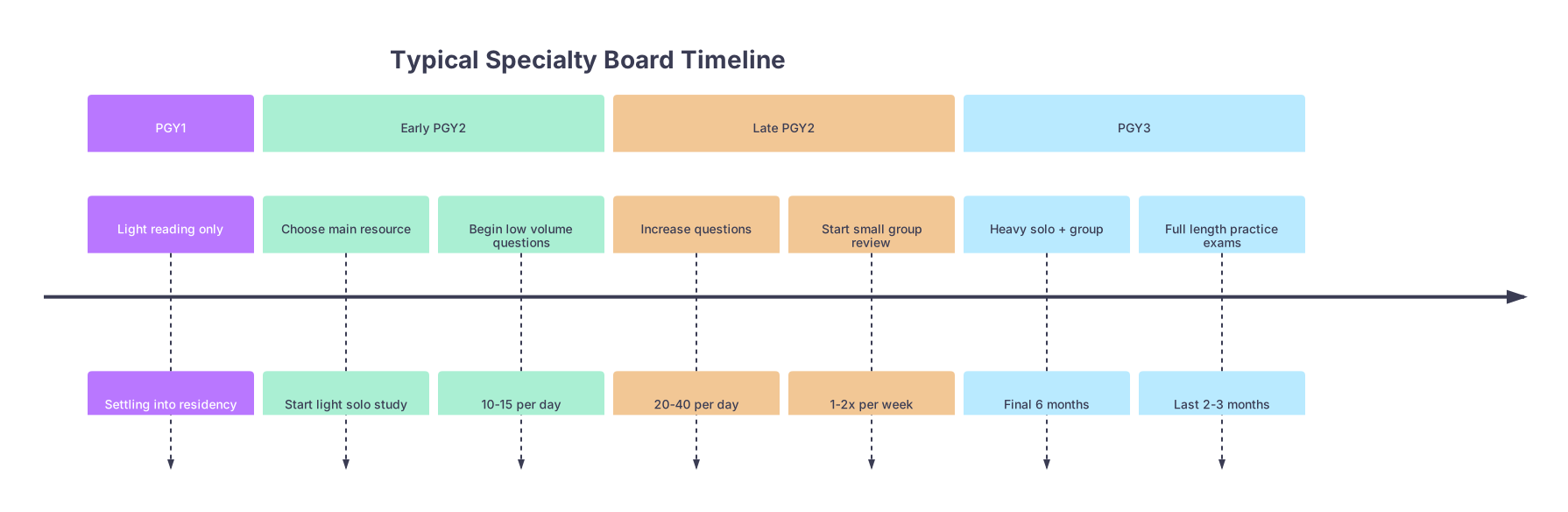
| Period | Event |
|---|---|
| PGY1 - Light reading only | Settling into residency |
| Early PGY2 - Choose main resource | Start light solo study |
| Early PGY2 - Begin low volume questions | 10-15 per day |
| Late PGY2 - Increase questions | 20-40 per day |
| Late PGY2 - Start small group review | 1-2x per week |
| PGY3 - Heavy solo + group | Final 6 months |
| PGY3 - Full length practice exams | Last 2-3 months |
Even if your specialty timing is slightly different, the progression stands: solo foundation → add questions → layer in structured group review → back to mostly solo in final stretch with targeted fixes.
Step 5: How to Choose the Right Co-Residents (and When to Walk Away)
Your study group is only as good as its worst habit.
Pick people who:
- Actually show up to work on time and finish notes
- Don’t constantly complain and derail conversations
- Have roughly similar score goals or at least similar seriousness
- Can tolerate being called out (“we’re drifting, let’s get back on track”)
Bad signs:
- “Sorry, got stuck in clinic” three weeks in a row
- Turning every hard question into a 15-minute pathophys lecture
- Bringing zero prep and saying “just quiz me on whatever”
You don’t need to be dramatic about it. You can simply:
- Shift to one-on-one sessions with the one serious person in the group, or
- Tell the group you’re going to focus on solo and occasional reviews before the exam
Protect your time. You don’t get that many evenings back before the test.
Step 6: Specialty-Specific Nuances (Because Not All Boards Feel the Same)
Different specialties push you slightly different directions.
| Specialty | Lean Solo or Group? | Reason |
|---|---|---|
| Internal Med | Hybrid | Broad content, lots of QBank value |
| Pediatrics | Hybrid | Guidelines + pattern recognition |
| General Surgery | More solo | Heavy independent reading, fatigue |
| Anesthesia | Hybrid | Concepts + algorithms |
| EM | Group-friendly | Cases and rapid-fire recall |
This isn’t gospel, but it tracks with reality I’ve seen:
- Medicine, peds, EM: group review of cases and guidelines is gold, as long as someone keeps you moving.
- Surgical fields: residents are often too wrecked from call for regular group time; short, targeted partner sessions (1 other resident) work better than large groups.
- Smaller specialties: your program size alone may limit group options; you might be better off finding 1 co-resident who matches your style.
Step 7: Practical Templates You Can Steal
If you just want plug-and-play structures, here you go.
Template A: The “I Mostly Have My Act Together” Hybrid
- Solo:
- 4–5 days/week: 60–90 min questions + brief review
- 2–3 days/week: 45–60 min content refresh in weak areas
- Group (2–3 people):
- 1–2 sessions/week, 45–60 min
- Each person brings 3 tough questions and 1 micro-topic
Template B: The “I Need External Pressure” Setup
- Mandatory group:
- 3x/week, 45 min at a fixed time (even if it’s Zoom)
- Structure:
- 15 min: go around, each person shares what they studied + 1 stat/cutoff/criterion they memorized
- 25 min: rotate through 6–8 challenging questions, focusing on reasoning
- 5 min: each person states the exact solo task they’ll do before next meeting
- Solo:
- Smaller, non-negotiable blocks (30–45 min) tied to something you already do daily (after clinic, after dinner)
Template C: The “My Schedule is a Disaster” Plan
- Solo:
- Microblocks: 2–3 sessions/day of 20–25 min questions or flashcards
- 1 “longer” session (60–90 min) on your post-call day off or lighter clinic day
- Group:
- Flexible pair system: find 1 co-resident and text “20 min rapid fire at lunch?” a few times per week
- Keep it super light-structure: pick one topic per session (e.g., shock, arrhythmias, pediatric rashes)
Step 8: How You’ll Know Your Setup Is Working
Use actual metrics, not vibes.
You’re on the right track if:
- Your QBank performance is trending up (not every day, but over 2–4 weeks)
- Your group sessions move quickly and end on time
- You can explain key algorithms out loud without getting lost
- You’re more consistent in study time than you were 4 weeks ago
You’re off track if:
- Group sessions run over and you’re more tired than helped
- No one in the group is improving QBank or practice test scores
- You keep “reviewing” the same chapters with no test behavior change
- You’re skipping solo time because you’re relying on group to fix everything
If that’s happening, adjust. Either:
- Tighten the group format (shorter, more focused)
- Change group members
- Or dial group way down and double down on solo with more structure

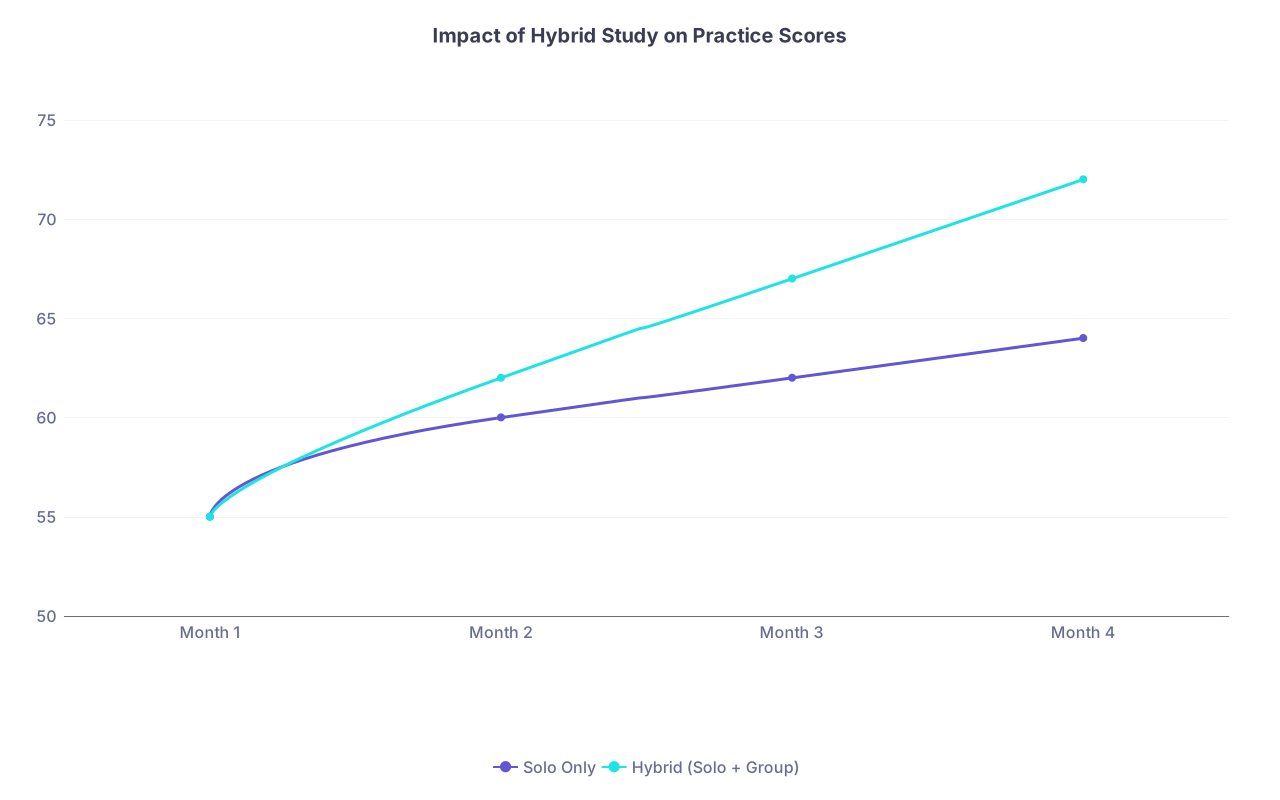
| Category | Solo Only | Hybrid (Solo + Group) |
|---|---|---|
| Month 1 | 55 | 55 |
| Month 2 | 60 | 62 |
| Month 3 | 62 | 67 |
| Month 4 | 64 | 72 |

| Step | Description |
|---|---|
| Step 1 | Start |
| Step 2 | Use hybrid with strong group |
| Step 3 | Mostly solo, light group review |
| Step 4 | Add focused small group weekly |
| Step 5 | Track scores and adjust |
| Step 6 | Refine plan in last 2 months |
| Step 7 | Good self discipline |
| Step 8 | Practice scores near target |
The Bottom Line
- Neither solo nor group is “better” in the abstract. Most residents do best with a hybrid: solo for learning and timed questions, small structured group for accountability and explanation.
- If your group doesn’t have structure, it’s not helping. Keep it small, time-limited, and focused on hard questions and micro-teaching.
- Measure success with scores and consistency, not feelings. If your current setup isn’t moving those, change the setup—not your goal.