The biggest scoring opportunities on boards are not obscure syndromes. They are the ventilator waveforms you stare at every call night and still misread.
You are already seeing these patterns on every ICU shift. The problem is that most residents never translate that real‑time chaos into the tidy, high‑yield patterns board writers love. Let me fix that.
This is not a “what is a volume control breath?” overview. You know that. This is a pattern‑recognition guide to the waveform traps that show up on exams and in real ICUs, and that residents miss over and over.
The Only Three Waveforms That Matter (For Boards)
Let me be blunt. If you cannot instantly visualize these three curves in your head, you are handicapped:
- Pressure–time
- Flow–time
- Volume–time
You do not need fancy loops for 90% of board questions. You need these three basics burned into your retina.
Step 1: Normal volume control breath in your head
Imagine: Volume control, square flow, normal compliance, no auto‑PEEP.
Pressure–time:
- Starts at set PEEP (e.g., 5 cmH₂O)
- Rises up in a roughly linear fashion during inspiration
- Peaks at peak inspiratory pressure (PIP), then drops slightly to plateau (if inspiratory hold used), then falls back to PEEP during expiration
Flow–time:
- Inspiration: a square wave – constant positive flow (e.g., +60 L/min) for the set inspiratory time
- Expiration: exponential decay of flow below zero, returning to baseline before next breath (i.e., expiratory flow hits zero before next inspiration)
Volume–time:
- Inspiration: smooth upward ramp from 0 to the set tidal volume
- Expiration: smooth downward ramp back to baseline (close to zero before next breath)
If you cannot sketch that from memory, boards will eat you alive when they distort it.
Board-Loved Distortion #1: Obstructive Disease and Auto‑PEEP
Residents conceptually “know” auto‑PEEP, but they miss it on waveforms.
Obstructive disease (COPD, asthma, bad secretions, kinked ETT) shows itself first on the flow–time curve, not the pressure curve.
The auto‑PEEP flow pattern they keep testing
Find the flow–time curve.
Normal: expiratory flow comes back to baseline (zero) before the next inspiration.
Auto‑PEEP pattern:
- Expiratory flow decays slowly
- Next inspiration starts while flow is STILL NEGATIVE (patient still passively exhaling)
- Baseline never reaches zero before the next breath
Boards will show you only the flow waveform and ask: “What is the best next step?” If you do not recognize incomplete exhalation, you will pick paralysis or weird bronchodilators instead of the right answer: allow more time for exhalation.
Classic intervention list:
- Decrease respiratory rate
- Increase inspiratory flow rate (shortens inspiratory time, lengthens expiratory time)
- Reduce tidal volume (in VC modes) to reduce total minute ventilation and allow full exhalation
- In severe COPD, sometimes a bit of extrinsic PEEP to counter dynamic hyperinflation – but that is a more nuanced board question
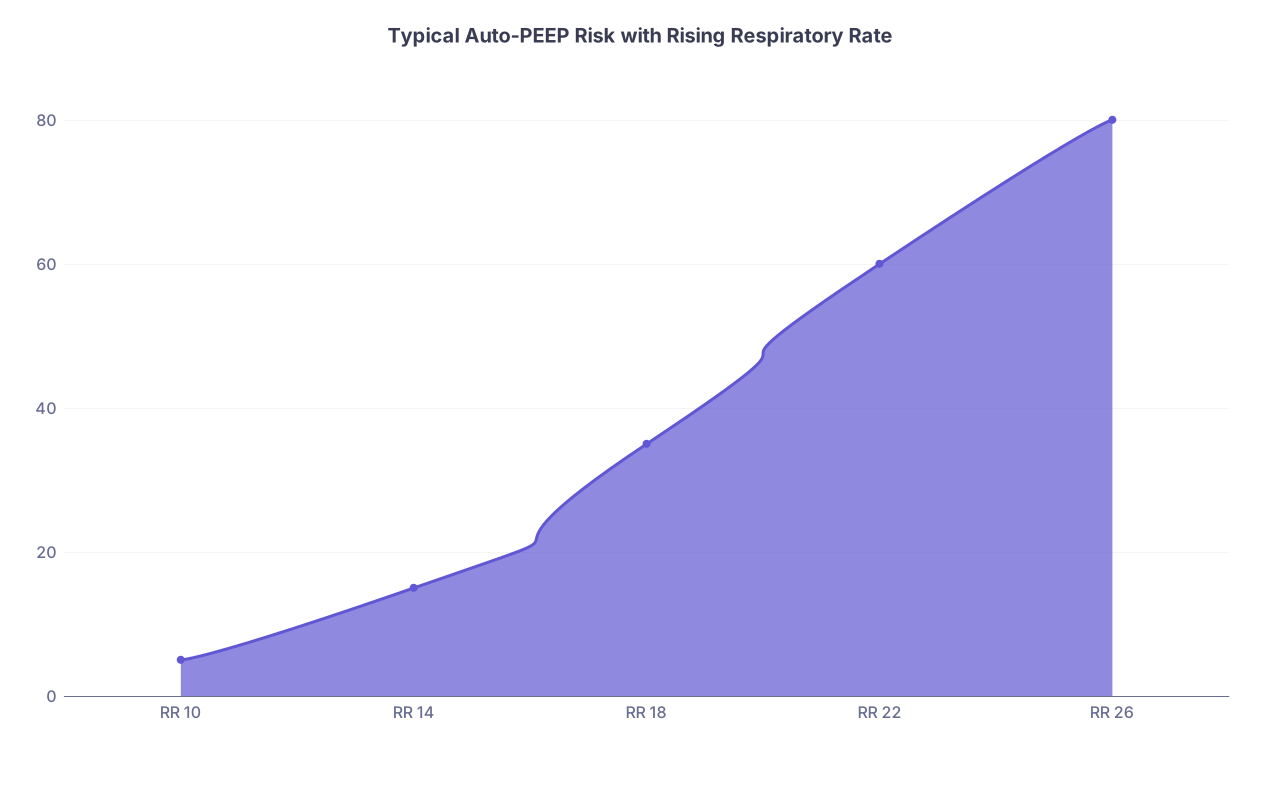
| Category | Value |
|---|---|
| RR 10 | 5 |
| RR 14 | 15 |
| RR 18 | 35 |
| RR 22 | 60 |
| RR 26 | 80 |
Those percentages are not “real” data; they approximate what exam writers have in their heads: higher RR = dramatically more risk of auto‑PEEP, especially in obstructive disease.
Obstruction vs decreased compliance on pressure waveform
Many residents mix these up on exams.
- Obstruction: PIP goes up. Plateau pressure (Pplat) is normal or near baseline.
- Low compliance (ARDS, pulmonary edema, abdominal compartment): both PIP and Pplat go up.
Board question classic: You get a pressure–time tracing showing high PIP. They mention you perform an inspiratory hold and Pplat is normal. What is the cause?
Answer: increased airway resistance. Think bronchospasm, secretions, kinked tube.
You need the mental picture:
- Pressure curve with a large gap between peak and plateau = resistance problem.
- Pressure curve where peak ≈ plateau = compliance problem.
Board-Loved Distortion #2: Patient–Ventilator Asynchrony
This is where residents in real life just press “increase sedation” instead of thinking. On boards, that reflex fails.
The examiners love to show gross asynchrony and then test if you can pick the correct ventilator adjustment instead of just “sedate” or “paralyze”.
1. Double triggering
You see it every night and call it “stacked breaths” without really analyzing it.
Pattern:
- Two breaths in rapid succession
- Little or no exhalation between them
- Volume curve: two partially merged volume ramps, effectively doubling tidal volume
- Flow curve: two consecutive inspiratory flows with minimal expiratory flow in between
Mechanism:
- Patient wants a larger tidal volume than what you are giving.
- First breath ends while the patient is still generating inspiratory effort → triggers a second breath immediately.
Board answer frequently:
- Increase set tidal volume (if safe)
- Or switch to pressure support / pressure control where the patient can control inspiratory time
- And address discomfort/anxiety if relevant
Never forget: double triggering leads to dangerous large tidal volumes in ARDS. Boards love to show ARDS + double triggering and ask, “What adjustment?” The answer is not “increase tidal volume to satisfy the patient” when you are trying to do lung‑protective ventilation. In ARDS, you instead might:
- Increase sedation,
- Consider neuromuscular blockade in early severe ARDS,
- Or change mode to better accommodate patient effort while keeping low Vt (e.g., pressure control with close monitoring).
Context matters.
2. Flow starvation (insufficient inspiratory flow in VC)
This one is heavily tested and frequently missed.
Pattern:
- Pressure–time curve shows a concave, scooped‑out shape during inspiration, rather than a straight or gently curving rise.
- Patient is sucking harder than the ventilator is delivering.
- They feel “air hungry.” You see them fighting the vent.
In volume control with a fixed square flow, if flow is too low, the patient’s effort produces a negative pressure deflection within the inspiratory phase. The curve bows inward.
Boards show that concave inspiration and ask: “What change will improve patient comfort?” The correct answer: increase inspiratory flow rate.
Wrong answers they like to tempt you with:
- Increasing PEEP
- Increasing tidal volume
- Changing I:E ratio the wrong way (lengthening inspiration, which worsens the problem)
3. Trigger asynchrony: ineffective efforts
Here the patient tries to initiate breaths but fails to trigger the ventilator.
Pattern:
- Pressure–time curve shows small negative deflections “not followed” by a full breath.
- Flow curve may show small blips of inspiratory flow that do not reach full ventilator-delivered breath.
Common causes:
- Trigger settings too insensitive (e.g., flow trigger set too high, pressure trigger set too negative)
- High auto‑PEEP (patient cannot generate enough negative pressure to overcome intrinsic PEEP plus trigger threshold)
Board favorite scenario: COPD patient on volume control, tachypneic, accessory muscle use, but low measured respiratory rate on the ventilator compared to observed effort. Flow waveform shows persistent negative baseline flow before each inspiration (auto‑PEEP) and small ineffective efforts.
Best answer:
- Reduce auto‑PEEP: lower RR, reduce Vt, shorten inspiratory time to lengthen expiration.
- You can also adjust trigger sensitivity (make it easier to trigger), but the “root cause” they want is addressing auto‑PEEP.
Board-Loved Distortion #3: Recognizing Mode from Waveform Alone
Exams increasingly expect you to know the mode simply by looking at the pattern of pressure and flow, even if they never tell you “VC‑AC” or “PCV.”
Volume control patterns
Key idea: Flow is set, volume is set, pressure varies.
Pressure–time:
- Characteristically ramping upward slope during inspiration.
- Peak pressure depends on compliance and resistance.
Flow–time:
- Inspiration: square (constant) positive flow.
- Expiration: passive exponential decay.
Volume–time:
- Smooth ramp to a fixed tidal volume each breath.
Pressure control patterns
Key idea: Pressure is set, flow and volume vary.
Pressure–time:
- Rectangular or square plateau during inspiration: pressure rapidly rises to the set inspiratory pressure and stays there for the set inspiratory time.
Flow–time:
- Decelerating inspiratory flow: starts high and tapers down as the lungs fill.
- Expiration: exponential decay below zero as usual.
Volume–time:
- Variable tidal volume depending on compliance and effort; the shape still ramps up during inspiration, but the peak height (Vt) changes with conditions.
| Feature | Volume Control | Pressure Control |
|---|---|---|
| Inspiratory flow shape | Square (constant) | Decelerating |
| Pressure during inspiration | Rising ramp | Square / flat plateau |
| Tidal volume consistency | Fixed | Variable |
Board trick: show a pressure–time curve with a flat plateau and a decelerating flow curve and ask: “Which of the following settings is most appropriate?” The right answer will be framed around inspiratory pressure and inspiratory time, not tidal volume and flow.
Classic Pathologic Patterns: What They Will Draw
Now we move into very specific waveform distortions that question writers love. These are the “I’ve seen that once in the unit, but never knew they would test it” patterns.
1. Breath stacking from intrinsic PEEP
We already discussed auto‑PEEP from obstructive disease, but stacking can produce dramatic volume and pressure changes.
Pattern:
- Flow: expiratory flow not returning to zero.
- Volume: incomplete return to baseline before next inspiration, so end‑expiratory volume gradually increases breath by breath.
- Pressure: progressive increase in PIP over several breaths.
Exam story: COPD exacerbation. On VC, high RR, PIP gradually rising, hypotension, distended neck veins, hyperinflated chest. Waveform shows incomplete exhalation. They ask: what is happening?
Correct answer: dynamic hyperinflation with auto‑PEEP causing decreased venous return. Best immediate step: disconnect from ventilator (allow full exhalation) and then adjust settings (lower RR, lower Vt, higher flow).
I have seen residents in real life chase this with fluids and pressors instead of fixing the vent. Boards punish that thinking.
2. Circuit leak / cuff leak patterns
Very testable, especially around post‑operative airway edema, cuff deflation, or uncuffed tubes in pediatrics.
Pattern:
- Volume–time: inspiratory volume rises to the set Vt, but the expiratory volume (what the ventilator “measures” coming back) is much lower.
- Flow–time: expiratory flow may be abnormal, with a lower peak and truncated duration.
- Alarm: low exhaled tidal volume / low minute ventilation.
In pressure control:
- Peak pressure is normal (limited by set pressure), but delivered tidal volume decreases because of leak.
Board scenario: “Volume–time curve shows inspiration reaching 450 mL, but expiration consistently returning ~250 mL. The nurse notes gurgling sounds. What is the next step?”
Answer: check and inflate the cuff, or evaluate for cuff leak / displaced tube.
3. Overdistension (too much pressure / volume)
This is where you see “beaking” of the pressure–volume loop in texts, but the concept also shows on simple pressure and flow curves.
In pressure control or high Vt volume control:
- Pressure curve is high.
- Flow decelerates to almost zero well before the end of inspiratory time – the lung is full, no further flow required.
Pattern they like:
- Prolonged inspiratory time with a long period where flow is essentially zero while pressure stays high. That means you are holding lungs at high pressure with no benefit in volume. Overdistension and unnecessary mean airway pressure.
Board answer: reduce inspiratory time or tidal volume, or decrease driving pressure.
Practical Pattern: ARDS Waveforms Boards Expect You To Handle
ARDS questions are everywhere. The waveform piece is usually around:
- High plateau pressure (poor compliance)
- Double triggering because the patient wants more volume
- Overdistension patterns with too high Vt or inappropriate inspiratory times
They may show:
- Pplat > 30 cmH₂O with lung‑protective settings ignored.
- Or low Vt but severe dyssynchrony, leading to high actual delivered Vt via stacked breaths.
Core exam moves in ARDS:
- Aim Vt ~6 mL/kg predicted body weight (not actual).
- Keep Pplat ≤ 30 cmH₂O.
- Accept permissive hypercapnia rather than raising Vt.
- Use higher PEEP according to ARDSnet tables.
So if the waveform shows stacked breaths and huge effective tidal volumes, the “most appropriate intervention” is often to increase sedation and/or use a short course of neuromuscular blockade (for severe early ARDS) rather than increasing Vt further.

| Step | Description |
|---|---|
| Step 1 | ARDS patient on vent |
| Step 2 | Maintain Vt 6 mL/kg |
| Step 3 | Reduce Vt and consider higher PEEP |
| Step 4 | Increase sedation or consider paralysis |
| Step 5 | Continue current strategy |
| Step 6 | Pplat less than 30 |
| Step 7 | Dyssynchrony present |
Pressure–Volume and Flow–Volume Loops: Just Enough for Boards
You are not doing detailed bench research. You need just enough to decode board pictures.
Pressure–volume loop essentials
Axes:
- X: Volume
- Y: Pressure
Normal:
- Inspiration limb: pressure rises with increasing volume.
- Expiration limb: curves back down, forming a loop (hysteresis).
Obstruction:
- Wider loop horizontally (larger difference between inspiratory and expiratory paths – more hysteresis) due to resistance.
Low compliance:
- Steeper slope (small changes in volume with big pressure swings).
Overdistension:
- “Beaking” at the top right: you increase pressure but volume does not rise proportionally. That is the region you want to avoid.
Boards: often they just want you to identify overdistension beak and lower Vt or PIP.
Flow–volume loop essentials
Axes:
- X: Volume
- Y: Flow
Normal:
- Inspiration: curve below the x‑axis (negative if convention), smooth.
- Expiration: curve above x‑axis, quick upstroke then decay.
Obstruction:
- Scooped‑out expiratory limb (like classic spirometry in COPD).
Endotracheal tube kink or major obstruction:
- Flattened inspiratory and expiratory peak flows.
They may show a flow–volume loop with markedly blunted peak flows and ask about a kinked tube vs bronchospasm. In bronchospasm, the pattern is typically more “concave” expiratory limb rather than symmetric flattening. For a tight ETT or upper airway obstruction, both inspiratory and expiratory flows are capped.

Sedation, Paralysis, and When Boards Want You To Touch Them
In real life, you see restless patients, strange waveforms, and the reflex is: “Can we give more fentanyl/propofol?” On exams, they are more conservative.
General rule boards follow:
- Fix the ventilator settings and mode FIRST.
- Only then escalate to deeper sedation.
- Reserve paralysis for specific, severe situations (e.g., refractory dyssynchrony in early severe ARDS with lung‑protective strategy, severe tetanus, etc.).
Pattern where sedation is the right answer:
- Patient is strongly asynchronous despite reasonable tidal volumes and appropriately set mode and flow.
- They are clearly agitated (pain, anxiety, delirium).
- Waveforms show frequent double triggering or breath‑by‑breath fighting despite adjustments.
Pattern where paralysis is board‑acceptable:
- Severe ARDS (Pao₂/Fio₂ extremely low).
- You are already on appropriate low Vt, optimal PEEP.
- Dyssynchrony is preventing lung‑protective ventilation (stacked breaths, huge tidal volumes).
- Short course of neuromuscular blockade (e.g., 24–48 h) is initiated.
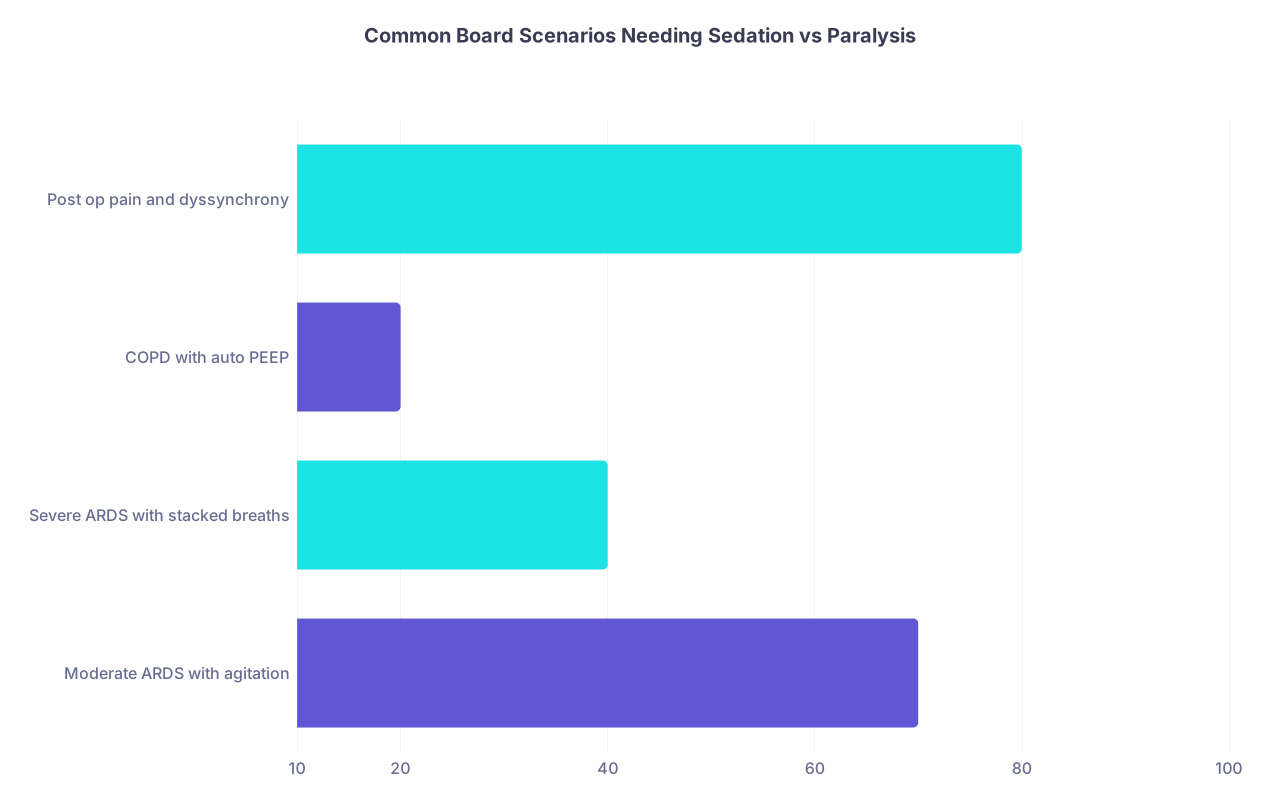
| Category | Value |
|---|---|
| Moderate ARDS with agitation | 70 |
| Severe ARDS with stacked breaths | 40 |
| COPD with auto PEEP | 20 |
| Post op pain and dyssynchrony | 80 |
Interpretation:
- Sedation is appropriate in most dyssynchrony scenarios (first and last).
- Paralysis is reserved for a smaller subset (severe ARDS with stacked breaths).
How Boards Actually Frame Ventilator Waveform Questions
Let me pull this together into how question stems are usually built. The mechanics repeat.
You will see something like:
- Clinical context:
- COPD exacerbation, severe asthma, ARDS, opioid overdose, neuromuscular disease.
- Ventilator mode and settings:
- “Volume assist control with Vt 500 mL, RR 22, FiO₂ 0.6, PEEP 5.”
- Hemodynamics or gas:
- Hypotension, tachycardia, hypercapnia, etc.
- A figure:
- Flow–time waveform, pressure–time waveform, or loops.
Then the question: “Which of the following changes is most appropriate?”
Your approach should be mechanical:
- First glance: look at flow–time expiration. Does it return to zero? If not, think auto‑PEEP.
- Look at pressure waveform: is there a big gap between PIP and Pplat? Resistance. Are both high? Compliance.
- Look at shape of inspiratory pressure curve: concave (flow starvation)? Square (pressure control)?
- Look at timing between breaths: any double triggering or ineffective efforts?

| Step | Description |
|---|---|
| Step 1 | See waveform question |
| Step 2 | Check expiratory flow |
| Step 3 | Auto PEEP - lower RR, Vt, increase flow |
| Step 4 | Check pressure pattern |
| Step 5 | Airway resistance - think obstruction |
| Step 6 | Low compliance - adjust Vt, PEEP |
| Step 7 | Look for asynchrony - double trigger or scooped pressure |
| Step 8 | Flow returns to zero? |
| Step 9 | PIP much greater than Pplat? |
| Step 10 | Both PIP and Pplat high? |
Once you get into that habit, waveform questions stop being “picture puzzles” and start being algorithmic.
Final Calibration: What Residents Should Stop Doing
I will be blunt about three bad habits, because they show up in both exam rooms and ICUs.
Ignoring flow–time.
Most residents obsess over pressure curves and ignore flow. That is backwards. Flow–time is where auto‑PEEP, leaks, and a lot of asynchrony first announce themselves. On exams, the key clue is often on flow.Calling everything “bronchospasm.”
High PIP? They call RT for bronchodilators before checking plateau pressure or the circuit. On boards, you must logically separate resistance vs compliance using plateau measurement or waveform clues.Reaching for sedation instead of the mode knob.
If every asynchrony answer you pick is “increase sedation,” your score will suffer. Boards want you to recognize flow starvation, double triggering, trigger sensitivity problems, and adjust ventilator settings accordingly.
Key Takeaways
- Board writers use a small set of reproducible waveform patterns: auto‑PEEP, resistance vs compliance, flow starvation, double triggering, and leaks. If you can sketch these from memory, you can answer most questions.
- Flow–time and simple pressure–time curves are more high‑yield than fancy loops. Always check expiratory flow reaching zero and the relationship between PIP and plateau.
- Fix the ventilator first, not the patient. On exams at least, the right move is usually adjusting rate, flow, tidal volume, or mode to correct the waveform pattern you are shown. Sedation and paralysis are secondary, reserved for specific scenarios like severe ARDS with refractory dyssynchrony.