
Perioperative risk questions are not about medicine. They are about whether you know the algorithms cold.
Let me be blunt: if you miss these on the boards, it is almost never because the case was “tricky.” It is because you did not run the exact decision tree the exam expected. The good news is that there are only a handful of core trees they keep recycling: ACC/AHA, METs, RCRI, anticoagulation timing, and a few pulmonary and endocrine patterns.
I am going to walk you through those trees the way they actually show up on exams and on call at 2 a.m.
1. The Spine of It All: The ACC/AHA Perioperative Cardiac Algorithm
If you do not have this framework in your head, every perioperative question feels like chaos. Once you do, most stems collapse into a 3–4 step flow.
Step 0: Is this emergency surgery?
- If emergency (hemodynamic instability, active hemorrhage, ruptured AAA, etc.):
→ Go to the OR
→ “Perform perioperative risk stratification and optimization as time allows”
→ No time for stress tests.
If they explicitly say “elective” or “semi-urgent,” you enter the real tree.
Step 1: Active cardiac conditions – the “automatic stop” list
These are the showstoppers. If present and surgery is not emergent, you delay and fix them.
Active (or “unstable”) cardiac conditions:
- Unstable angina (new, crescendo, or rest angina)
- Recent MI with ischemic symptoms or evidence of ongoing ischemia
- Decompensated heart failure (rales, JVD, edema, hypotension, pulmonary edema)
- Significant arrhythmias
- High-grade AV block (Mobitz II or complete)
- Symptomatic bradyarrhythmias
- Symptomatic ventricular arrhythmias
- Supraventricular arrhythmias with uncontrolled rate
- Severe valvular disease
- Severe symptomatic aortic stenosis (class II–IV symptoms)
- Symptomatic mitral stenosis
Boards will spell this out: “Patient with new orthopnea, S3, bilateral rales, and planned elective colectomy.” The answer: optimize HF, postpone surgery, do not rush them to the OR.
If “none of the above,” continue.
Step 2: Surgical risk – know the typical categories
You do not need the whole table in your head, but you must recognize low vs intermediate vs high risk because it changes how aggressive you get with testing.
| Category | Approx MACE Risk | Examples |
|---|---|---|
| Low risk | < 1% | Cataract, superficial, breast |
| Intermediate | 1–5% | Carotid, ortho, intrathoracic |
| High risk | > 5% | Major vascular, open aortic |
- Low-risk surgery (< 1%): almost never triggers stress testing. If they are walking and not in florid failure, you proceed.
- Intermediate/high-risk: now you care about METs and RCRI.
Step 3: Functional capacity – the 4 METs line in the sand
This is the next board favorite decision node:
“Can this patient do ≥ 4 METs without symptoms?”
METs examples you should recognize immediately:
- 1–3 METs: eating, dressing, walking around the house
- 4 METs: climb a flight of stairs or walk up a hill; walk on level ground at 4 mph
4–10 METs: heavy housework, yard work, golf, dancing
10 METs: strenuous sports
On exams:
- “Can climb 2 flights of stairs without symptoms” → Good functional capacity ≥ 4 METs
- “Becomes short of breath when walking from bedroom to bathroom; cannot climb stairs” → Poor functional capacity < 4 METs
Decision:
Good functional capacity (≥ 4 METs)
- Even with intermediate/high-risk surgery, proceed to surgery.
- No noninvasive stress testing unless other red flags are very prominent (boards rarely contradict this).
Poor or unknown functional capacity (< 4 METs)
- Now you look at clinical risk (RCRI).
Step 4: Clinical risk – RCRI is the workhorse
The Revised Cardiac Risk Index (RCRI) is the go-to on exams.
One point each for:
- High-risk surgery
- Major vascular, intraperitoneal, intrathoracic
- History of ischemic heart disease
- Prior MI, positive stress test, angina, pathologic Q-waves, prior revascularization
- History of heart failure
- History of cerebrovascular disease (stroke or TIA)
- Insulin-dependent diabetes mellitus
- Creatinine > 2.0 mg/dL
Interpretation that boards like:
- 0 points → low risk
- 1–2 points → intermediate
- ≥ 3 points → higher risk
In the ACC/AHA algorithm, if poor METs and RCRI ≥ 1 and the surgery is intermediate or high risk, then you may consider:
- Noninvasive stress testing
- Optimization strategies (beta blockers, statins, etc.)
If testing will not change management (e.g., they cannot have revascularization or surgery is urgent), do not bother.
2. The Exact Flow Boards Expect You To Run
Let me lay it out as an actual decision tree, because that is how many questions are written.

| Step | Description |
|---|---|
| Step 1 | Elective noncardiac surgery |
| Step 2 | Go to OR Optimize as able |
| Step 3 | Delay Evaluate and treat |
| Step 4 | Proceed to surgery |
| Step 5 | Noninvasive stress test |
| Step 6 | Coronary evaluation Possible revascularization |
| Step 7 | Emergency surgery |
| Step 8 | Active cardiac conditions |
| Step 9 | Surgical risk |
| Step 10 | Functional capacity 4 METs |
| Step 11 | RCRI score |
| Step 12 | High risk findings |
If you internalize that schema, many periop stems become autopilot.
Classic exam patterns using this tree
Good METs, intermediate-risk surgery, coronary history
- 68-year-old man, prior MI, walks 2 miles daily and climbs stairs without symptoms, scheduled for elective colectomy.
- RCRI not zero (he has ischemic heart disease), but his functional capacity is excellent.
- Correct answer: Proceed to surgery. Do not do a stress test.
Poor METs, high-risk vascular surgery, multiple RCRI points
- 72-year-old with insulin-dependent diabetes, prior stroke, creatinine 2.5, limited to walking 1 block before SOB, scheduled for open AAA repair.
- Poor METs, RCRI ≥ 3, high-risk surgery.
- Correct answer: Noninvasive stress testing if it would change management; otherwise proceed with maximal medical therapy.
Low-risk surgery with lots of cardiac history
- 75-year-old, prior MI, EF 30%, on beta blocker, for cataract surgery.
- Low-risk surgery (< 1%); this trumps the rest.
- Correct answer: Proceed to surgery in outpatient setting. No stress test, no echo, no cath.
Boards love it when you overthink these. Do not.
3. Beta Blockers, Statins, and ACE inhibitors – Subtle but High Yield
The algorithm opens the door; medications are the clean-up act. Testing you on “when to start or hold what” is low-effort, high-yield for exam writers.
Beta blockers
Rules the boards keep using:
- Continue beta blockers in patients already taking them. Always.
- Reasonable to start perioperative beta blockers when:
- Known CAD or multiple RCRI risk factors, especially for high-risk surgery
- Sometimes given if positive pre-op stress test and going for vascular surgery
Timing:
- Do not start the morning of surgery on a naive patient. That is how you tank their pressure and end up with worse outcomes.
- Best answer: initiate and titrate several days to weeks before surgery.
On a board question:
- “Start low-dose beta blocker now and titrate over the next week prior to surgery” beats “give IV metoprolol in pre-op holding area.”
What not to do:
- Do not abruptly stop beta blockers. Perioperative withdrawal is bad news.
Statins
Statin questions tend to be easier:
- Already on a statin? → Continue perioperatively.
- Going for vascular surgery or has clinical ASCVD? → Start or ensure on statin before surgery, if not contraindicated.
They are not asking you to hold statins. That is not a thing in this setting.
ACE inhibitors/ARBs
This one is nuanced and absolutely board-tested.
If the ACEi/ARB is for hypertension alone, especially with risk of intraoperative hypotension:
- Many tests expect: hold the morning of surgery.
If the ACEi/ARB is for heart failure with reduced EF or other compelling indication:
- Reasonable answers: continue or at least have a detailed discussion.
- On some exams, they still like: continue in HFrEF, hold in simple HTN.
Read the stem carefully. If they keep emphasizing “difficult to control blood pressure pre-op” and no HF, they may want you to hold the ACEi on the morning of surgery.
4. Coronary Stents, Antiplatelets, and Anticoagulation – Where People Hemorrhage Points
You will see at least one question about when to operate after a stent and what to do with antiplatelet therapy. The time intervals and the concept are predictable.
Timing of surgery after PCI
The board-friendly numbers:
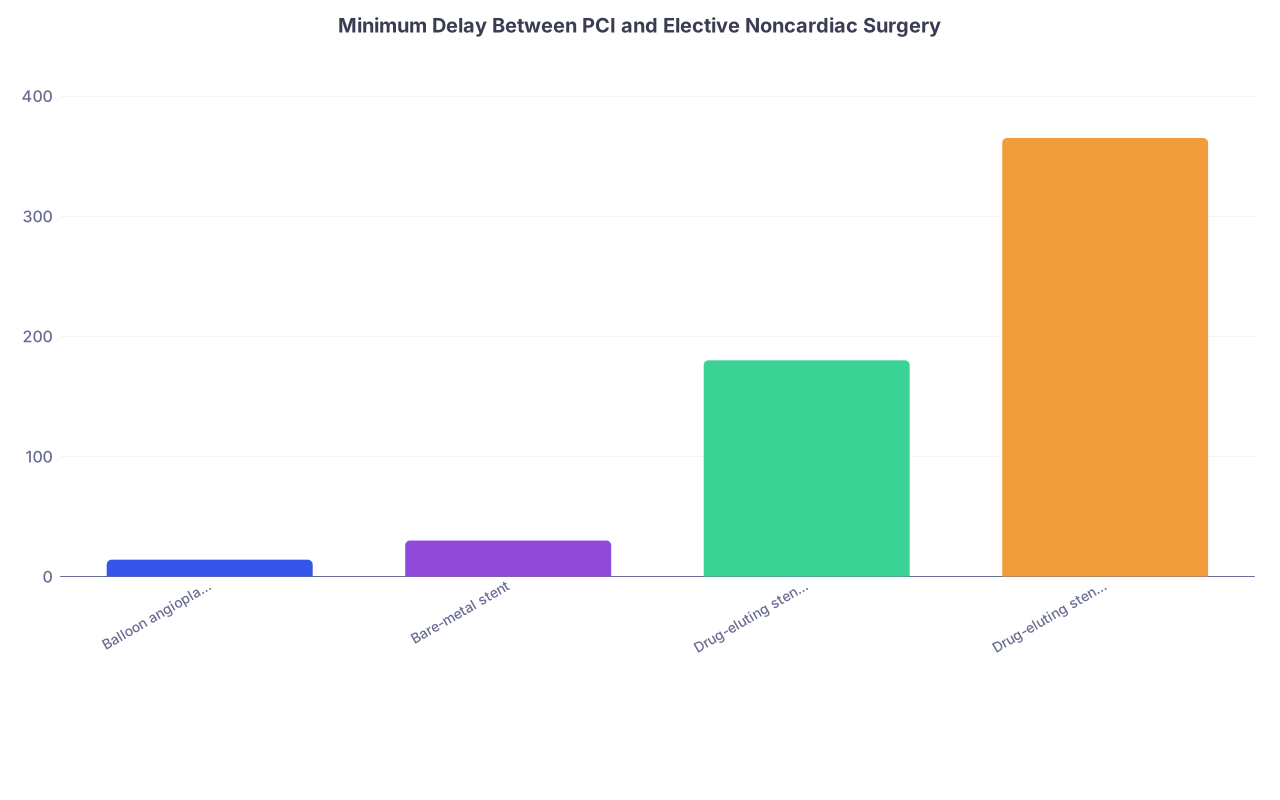
| Category | Value |
|---|---|
| Balloon angioplasty | 14 |
| Bare-metal stent | 30 |
| Drug-eluting stent (stable CAD) | 180 |
| Drug-eluting stent (ACS) | 365 |
Phrased verbally:
- Balloon angioplasty without stent: delay elective surgery at least 14 days.
- Bare-metal stent: delay at least 30 days.
- Drug-eluting stent for stable disease: delay ideally 6 months (180 days); some guidelines allow ≥ 3 months if benefit > risk, but exams usually stick with 6 months.
- Drug-eluting stent after ACS: delay 12 months.
Boards usually give you the “classic” numbers, not the nuanced exceptions.
If patient with recent DES (< 6–12 months) needs elective knee replacement → delay surgery or refer this as “too early, risk of stent thrombosis.”
Management of dual antiplatelet therapy
Basic logic: early interruption of DAPT after stent = stent thrombosis = potentially fatal. Exams want you to respect that.
General exam pattern:
- Aspirin: often continued perioperatively in most surgeries except those in closed spaces with catastrophic bleeding risk (intracranial, intramedullary spinal).
- P2Y12 inhibitors (clopidogrel, prasugrel, ticagrelor):
- If surgery can be delayed until minimum DAPT duration is complete → delay.
- If surgery cannot be delayed (e.g., colon cancer resection), and stent is older than minimal recommended age:
- Often: continue aspirin, hold clopidogrel 5 days before surgery, then restart as soon as acceptable post-op.
The “right” board answer tends to be:
- If < 30 days after BMS or < 3–6 months after DES → do not stop DAPT and try to delay surgery.
- If surgery cannot be delayed and is life-saving (e.g., ruptured appendix) → proceed with surgery and accept high bleeding risk; do not stop both agents.
Warfarin and DOACs – bridging logic
Warfarin is bridge-heavy. DOACs are usually just held.
Typical warfarin pattern:
- Stop warfarin ~ 5 days before surgery.
- Check INR pre-op:
- If still high → consider low-dose vitamin K.
- Decide on bridging with LMWH or IV heparin based on thromboembolic risk:
High-risk (boards like bridging):
- Mechanical mitral valve
- Recent (< 3 months) VTE
- Atrial fibrillation with CHADS2/CHA2DS2-VASc very high and/or recent stroke
Low-risk:
- Atrial fibrillation with low CHA2DS2-VASc and no recent stroke → often no bridging.
They like to ask:
- Elderly patient with nonvalvular AF, CHADS2 = 1, on warfarin, for elective cholecystectomy.
- Correct: stop warfarin 5 days prior, no bridging, restart post-op when safe.
DOACs (apixaban, rivaroxaban, dabigatran):
- Usually held 24–72 hours depending on:
- Renal function
- Bleeding risk of surgery
No bridging in most cases. If they want a number:
- Normal renal function, moderate bleeding risk surgery → hold 48 hours pre-op.
5. Preoperative Testing: When NOT to Order the Toy You Like
Most test-writers are not trying to see if you can remember obscure indications. They want to see that you will not shotgun labs and imaging “because surgery.”
EKG
Who gets a pre-op ECG?
Usually:
- Symptomatic cardiovascular disease (chest pain, dyspnea of cardiac origin, palpitations, syncope)
- Known CAD, significant arrhythmia, PAD, cerebrovascular disease, or structural heart disease undergoing intermediate/high-risk surgery
- Older patients (typically ≥ 65) undergoing high-risk surgery, depending on the guideline.
Normal, asymptomatic, low-risk 40-year-old for hernia repair? No ECG needed.
Echocardiogram
Boards push hard on this: do not repeat echoes just because you are curious.
You order TTE if:
- New or worsening dyspnea of suspected cardiac cause
- Signs of decompensated heart failure
- Clinical suspicion of significant valvular disease and no echo within a reasonable interval (e.g., >1 year or change in symptoms)
- Unexplained reduced exercise tolerance
You do not order TTE if:
- Stable, treated HF with no symptom changes and recent echo
- Just to “check EF” before moderate-risk surgery in an asymptomatic patient
Stress testing
You only get to stress test when all of these are true:
- Surgery is intermediate/high risk
- No emergency
- No active cardiac conditions
- Poor or unknown functional capacity
- Results would change management (i.e., you might cancel or revascularize based on a positive test)
Anything else, and the right answer is “do not stress test.”
6. Non-Cardiac Systems Boards Sneak Into “Periop Risk” Questions
The exam does not only care if you remember ACC/AHA. They like respiratory, endocrine, and renal risks dressed up as “pre-op evaluation.”
Pulmonary risk – who crashes on the vent
Pulmonary complications are common. The big risk factors to remember:
- COPD
- Smoking (active)
- Poor functional status
- Age > 60–65
- Obesity
- OSA
- Thoracic or upper abdominal surgery (especially open)
Classic board moves:
- Ask whether to order pre-op spirometry.
- Indicated when results will change management (e.g., deciding whether a COPD patient can tolerate lobectomy), not for routine hernia repair.
- Ask how long before surgery to stop smoking.
- Best data suggests ≥ 8 weeks improves outcomes, but any cessation is helpful.
Pre-op optimization:
- In COPD/asthma: maximize inhaler regimen, short course of steroids if needed, treat infections.
- For known OSA: continue CPAP; anticipate airway and post-op respiratory monitoring.
Endocrine – diabetes and steroids
Perioperative glucose:
- Keep between roughly 140–180 mg/dL in most hospitalized surgical patients.
- Resume basal insulin, adjust prandial due to NPO; avoid severe hypoglycemia.
Steroids and adrenal suppression:
- People on chronic steroids (e.g., ≥ 5 mg prednisone daily for > 3 weeks) may need stress-dose steroids.
Typical board answers:
- Minor surgery (like colonoscopy): continue usual dose only.
- Moderate/major surgery (e.g., colectomy, open AAA repair):
- Hydrocortisone 50–100 mg IV at induction, then taper over 24–48 hours.
They may also ask about hypothyroidism:
- Mild to moderate: generally safe to proceed with surgery; continue levothyroxine.
- Severe, symptomatic (myxedema risk): delay elective surgery, treat first.
Renal risk – AKI traps
Risk factors:
- Pre-existing CKD
- Diabetes
- Heart failure
- Nephrotoxins (NSAIDs, contrast, some antibiotics)
- Major vascular surgery with cross-clamping
Interventions:
- Ensure adequate volume status
- Avoid or minimize contrast; if absolutely needed, hydrate, use lowest dose
- Hold ACEi/ARBs in some high-risk settings if hypotension is a concern
Board question prototype: “Which intervention reduces risk of postoperative AKI?”
Correct answers: volume optimization, avoid nephrotoxins.
Wrong answers: routine dopamine, fenoldopam, or mannitol drips “to protect kidneys.”
7. Pulling It Together: How These Trees Actually Look on a 2 a.m. Call
Think about how this plays out in residency, because the boards love real-world-feeling vignettes.
Scenario:
- 64-year-old man
- Known CAD, prior PCI with DES 8 months ago
- Diabetes on insulin, CKD stage 3 (Cr 2.3)
- Can walk 2 blocks before getting SOB; cannot climb one flight of stairs
- Elective open AAA repair planned next week
Your internal algorithm on the boards (and in life):
- Elective, non-emergent surgery? Yes.
- Any active cardiac conditions? No chest pain, no HF signs, stable rhythm.
- Surgical risk? High (major vascular).
- Functional capacity? Poor (< 4 METs).
- RCRI:
- High-risk surgery
- Ischemic heart disease
- Diabetes on insulin
- Creatinine > 2.0
→ RCRI = 4 (high).
- Stent? DES 8 months ago (beyond the 6-month high-risk window).
- DAPT? On aspirin + clopidogrel. For AAA with massive blood loss risk, they may stop clopidogrel 5 days pre-op and continue aspirin, then restart clopidogrel ASAP.
- Given poor METs and high RCRI with high-risk surgery, noninvasive stress testing is reasonable because a positive test might trigger further coronary evaluation or a different management strategy.
On the exam, the question might ask:
- “Next best step?” → Order pharmacologic stress test.
- Or a different stem: if surgery is emergent AAA rupture → straight to OR, do not delay for testing.
8. A Quick Visual: What Actually Drives Perioperative Cardiac Risk
The big buckets you should keep in your head:
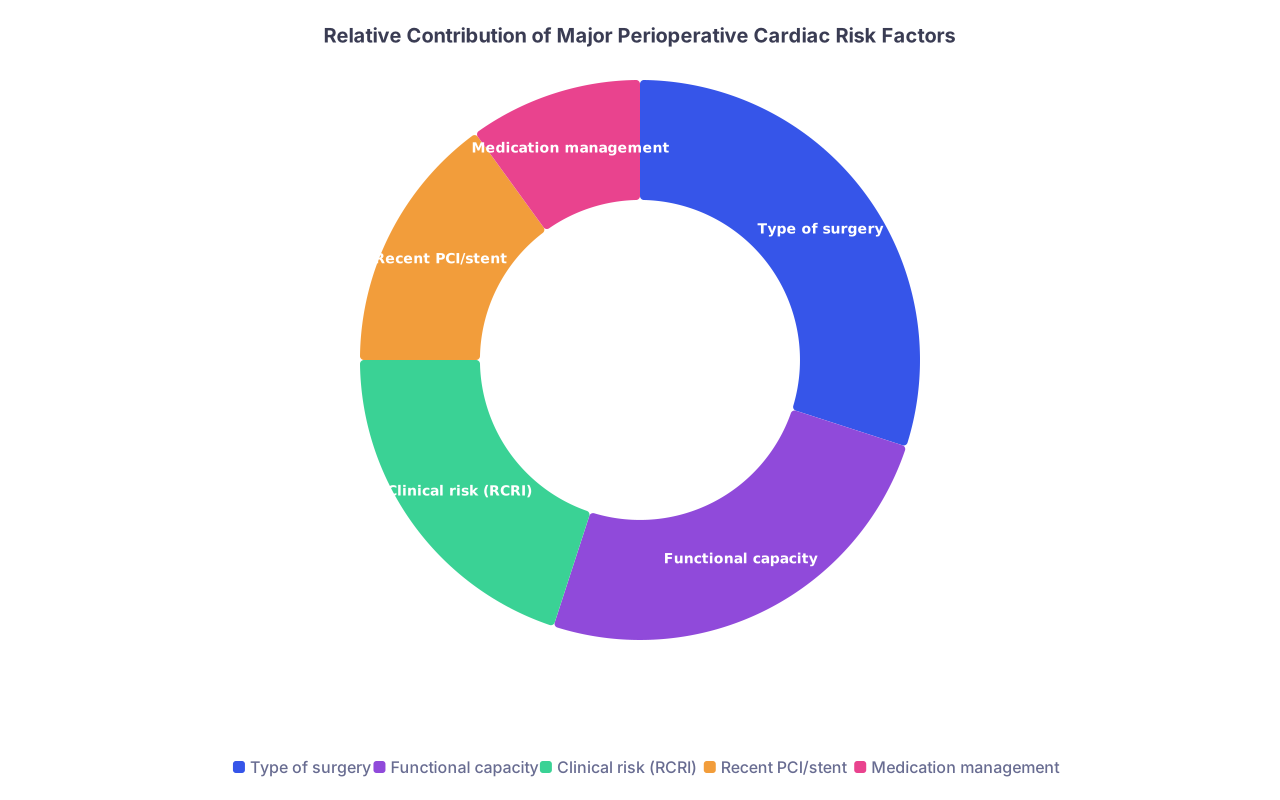
| Category | Value |
|---|---|
| Type of surgery | 30 |
| Functional capacity | 25 |
| Clinical risk (RCRI) | 20 |
| Recent PCI/stent | 15 |
| Medication management | 10 |
It is not the lab curiosities. It is the surgery type, METs, core cardiac history, and how you handle stents and beta blockers.
9. How To Study This Efficiently (Not Painfully)
You do not need to memorize 30 guidelines. You need a few anchor algorithms and the numbers that keep showing up.
I tell residents to build a one-page sheet with exactly these:
- ACC/AHA algorithm skeleton
- RCRI list (6 items)
- METs examples (just the key 4 METs threshold activities)
- Timing after PCI (14 days balloon, 30 days BMS, 6 months DES, 12 months DES after ACS)
- Simple beta blocker/statin/ACEi rules
- Warfarin 5 days, DOAC 2–3 days, when to bridge
Then do questions. Lots of them. You will see the same decision tree disguised 15 ways.
To lock it in, sketch the algorithm from memory once every few days for a week. It takes 30–60 seconds. That single habit fixes more perioperative questions than any textbook chapter.
Core Takeaways
- Most perioperative board questions follow the ACC/AHA tree: emergency? active cardiac disease? surgical risk? METs? RCRI? If you can run that in your head, you win.
- Do not over-test or over-treat: no stress test for good METs, no routine TTE “to check EF,” no unnecessary bridging. Follow the algorithm, not your anxiety.
- The big score-makers are RCRI, METs, PCI timing, and medication handling (beta blockers, statins, ACEi/ARBs, antiplatelets, warfarin/DOACs). Get those decision points reflex-fast and the periop section stops being a minefield.