
Professionalism questions on board exams are not about ethics in the real world. They are about ethics in a sterile, liability-driven, exam-writer world.
If you treat these questions like a real call night with real human beings, you will miss points. The writers are not testing what a reasonable attending might actually do. They are testing whether you recognize a narrow, idealized “professionalism script” and can regurgitate it under pressure.
Let me break this down specifically.
1. The Hidden Rules of Professionalism Questions
Every major exam – USMLE Step 2/3, shelf exams, in-training exams, many subspecialty boards – uses the same underlying template:
- Create a clinical vignette with an emotional, social, or system-based twist.
- Include at least one answer that sounds “helpful” but violates hierarchy, privacy, or boundaries.
- Include one answer that feels stiff or unhelpful but preserves:
- patient autonomy
- confidentiality
- clear roles and boundaries
- institutional policies.
The “correct” answer is almost always the one that:
- Protects confidentiality even when it feels cold.
- Respects formal reporting structures even when it feels slow.
- Avoids dual relationships and personal judgments.
- Prioritizes patient safety above convenience, collegiality, or kindness.
You are not being asked:
“What would a decent human clinician sometimes do?”
You are being asked:
“What would a risk-averse hospital compliance officer write in a policy manual?”
That mental shift alone raises people’s professionalism scores dramatically.
2. The Core Professionalism Axes Examiners Love
Most traps fall into predictable categories. If you can label the axis, you can usually predict the answer.
| Axis | Core Priority |
|---|---|
| Confidentiality | Privacy over convenience |
| Boundaries & Dual Roles | Avoid entanglements |
| Chain of Command | Proper reporting structure |
| Impairment & Safety | Protect patients, report |
| Cultural & Religious Issues | Respect + informed consent |
| Errors & Disclosure | Honest, direct communication |
Let us walk through these one by one, with the actual traps.
3. Confidentiality: The Seductive Overshare
Confidentiality questions are exam-writer candy. They know you want to be helpful and humane, and they weaponize that instinct.
Classic patterns
Family member wants information:
- Scenario: Adult patient is stable, fully competent. Family (spouse, parent, adult child) says:
“Doctor, what did the tests show? He will not tell us anything.” - Wrong answers:
- “Explain the results to the family to support their coping.”
- “Ask the patient’s permission later, then call the family to update them.” (Sometimes OK in real life, but exam wants a stricter line unless consent already exists.)
- Right answer pattern:
- “Encourage the patient to discuss the results with the family and ask for permission to share if he wishes.”
- Or: “Decline to share information without explicit patient permission.”
- Scenario: Adult patient is stable, fully competent. Family (spouse, parent, adult child) says:
Curious staff / colleagues:
- Scenario: A nurse from another unit / colleague not involved in care asks, “What happened to that trauma patient who came in last night? I heard it was wild.”
- Wrong:
- “Provide a brief update; she is a colleague.”
- Right:
- “Decline to discuss; remind them information is only for those directly involved in care.”
Adolescent confidentiality:
- Scenario: 16-year-old asks about contraception, STD testing, pregnancy, substance use, and begs you not to tell parents.
- Trap: Many answers will offer to “reassure the parents” or “discuss openly with the family.”
- Right answer pattern:
- Respect confidential adolescent care (in exam-land, assume laws allow confidential care for sexual/reproductive health unless explicitly stated otherwise).
- Encourage the adolescent to involve the parents but do not break confidentiality unless:
- Risk of serious harm (self-harm, violence, severe substance risk).
- Legal mandate described in the question.
Employer / school / coach requests:
- Scenario: Employer calls for drug test results. School asks for diagnosis. Coach wants to know if a player can “push through.”
- Right answer:
- “Do not disclose without explicit written consent from the patient.”
Board logic: “Not sharing” is almost never wrong unless it endangers someone. If a question forces you to choose between kindness and privacy, you pick privacy.
4. Boundaries and Dual Relationships: “But I’m Just Being Nice…”
Here is where people fail because they project their own reasonable humanity into the question. The test writers do not care that you would answer your neighbor’s quick blood pressure question in your driveway.
On exams, you are a boundary robot.
High-yield traps
Treating family, friends, or coworkers:
- Scenario:
- Your colleague asks you to prescribe antibiotics for “a UTI, I get these all the time.”
- Your cousin wants you to manage her depression “because I trust you more.”
- Wrong:
- “Prescribe a short course until she can see her physician.”
- Right:
- “Decline to prescribe and advise she see her own clinician,”
or “Offer to help her schedule with an appropriate provider.”
- “Decline to prescribe and advise she see her own clinician,”
Exception (exam-style): Basic first aid in emergencies with no access to other care is allowed. But chronic / non-urgent management for friends and family is a no.
- Scenario:
Romantic / sexual relationships:
- With current patient: always wrong. Period.
- With former patient: exam-world often says still wrong, at least highly discouraged, especially if power dynamics remain.
- With subordinate (student / resident / staff): strong no in exam-land.
If you ever see “begin a romantic relationship” as an answer → eliminate instantly.
Gifts and money:
- Scenario: Patient offers expensive gift, money, vacation tickets, or asks to borrow money.
- Right answer patterns:
- Decline inappropriate or expensive gifts.
- Modest tokens (homemade cookies, small value) may be acceptable if they do not affect care – but the test often still prefers a cautious, neutral response.
- Never lend or borrow money.
Social media and texting:
- Exam rule: do not friend patients, do not seek their profiles, do not post identifiable information, do not answer medical questions via personal accounts or unsecured channels.
- If an answer choice says “Respond via personal social media account” or “Post a de-identified but descriptive case online,” that is a trap. Avoid.
5. Chain of Command and Whistleblowing: Who Do You Tell?
This is where people over- or under-react. The exam writers love to see if you understand sequence.
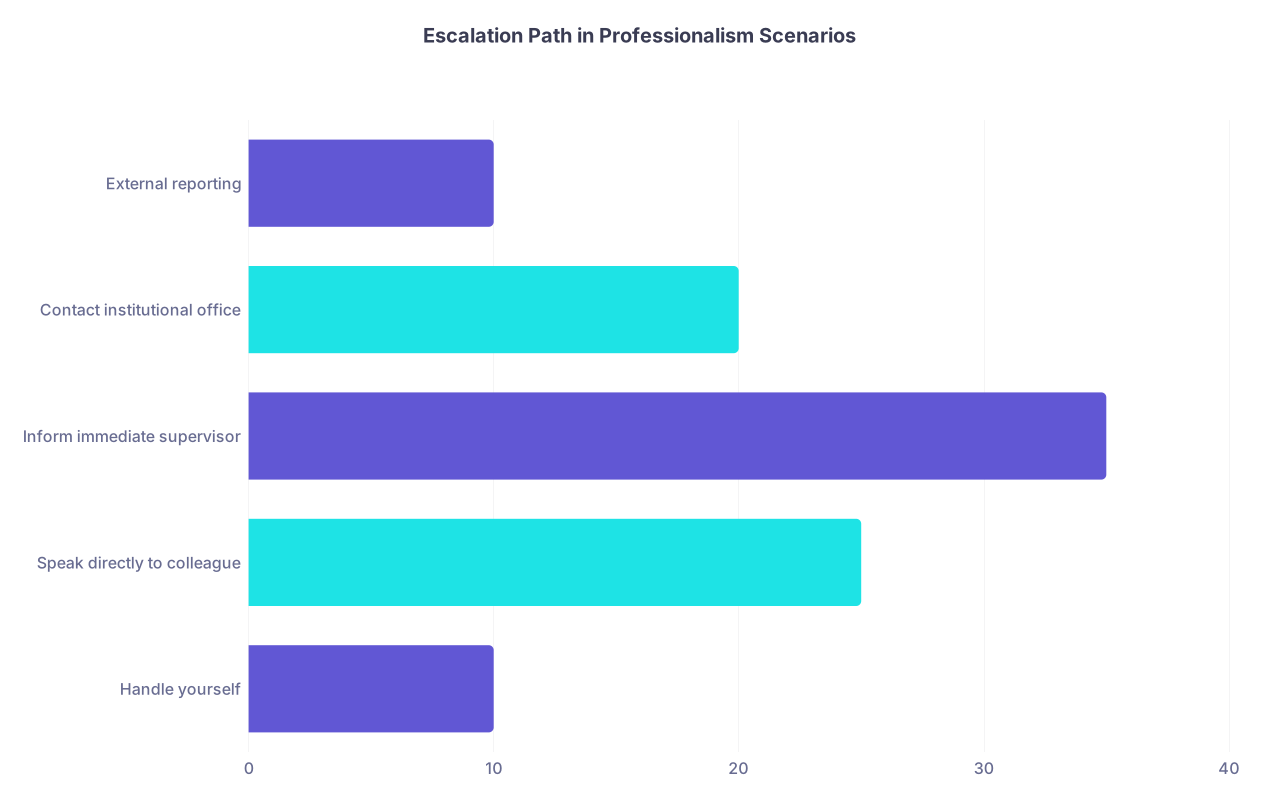
| Category | Value |
|---|---|
| Handle yourself | 10 |
| Speak directly to colleague | 25 |
| Inform immediate supervisor | 35 |
| Contact institutional office | 20 |
| External reporting | 10 |
Think in calibrated steps:
Minor issues with peers:
- Example: Resident showing up 15 minutes late a few times. Attending occasionally raising voice.
- Right: Address directly with the person first, if safe.
- The exam rewards direct, respectful, non-accusatory communication.
Serious but not emergent:
- Example: Colleague charting sloppily, cutting corners, occasionally missing labs but nothing life-threatening yet.
- Right: Usually discuss with colleague → if no improvement or you are not comfortable, then escalate to immediate supervisor / program director.
Impairment, abuse, or consistent dangerous behavior:
- Example: Surgeon frequently intoxicated, attending repeatedly berates patients or staff, resident consistently falls asleep during procedures.
- Wrong:
- “Cover for them this time and later speak privately.”
- “Ignore it; they are usually competent.”
- Right:
- Immediately report to supervisor or designated institutional body (chief, PD, department chair, patient safety/quality office).
- If it directly endangers a patient in front of you, your first duty is to protect the patient (remove them from procedure, call another attending, stop medication, etc.), then report.
Harassment and discrimination:
- Scenario: Staff or attendings making racist comments, sexual remarks, or retaliatory threats.
- Right answer pattern:
- Do not manage this privately only.
- Report to institutional mechanisms: HR, ombuds, Title IX / equivalent, program director or appropriate higher authority.
- If you are the target, you may remove yourself from the immediate unsafe situation, then report.
External reporting:
- Rarely the first move in exam questions.
- In exam-world, you exhaust internal mechanisms first unless the vignette explicitly shows that the institution is actively covering up and refuses to act, and harm is ongoing. Then external authorities (state medical board, legal authorities) may be appropriate.
6. Impairment and Fitness for Duty: “Ride It Out” Is Wrong
This is one area where exam expectations and real-life best practice actually align.
Common exam traps
Impaired colleague:
- Signs: slurred speech, smell of alcohol, frequent narc discrepancies, sedation at work, erratic behavior.
- Wrong:
- “Offer to cover their shift and let them go home quietly.”
- “Confront them privately and tell them to seek help.”
- Right:
- Immediately remove them from patient care and notify a supervisor or institutional body (chief, PD, medical director).
- Patient safety first, then colleague’s well-being.
Impaired self:
- Scenario: You are a resident who has been up 24+ hours, you just took a benzodiazepine for a panic attack, you feel too ill to function, or you are emotionally overwhelmed after a personal tragedy.
- Wrong:
- “Continue working because coverage is limited.”
- Right:
- Inform supervisor, step away from patient care, arrange appropriate coverage.
- The exam never rewards soldiering on when you are unsafe.
Substance use and reporting:
- The exam leans toward:
- Reporting to the institutional physician health program / impairment program.
- Encourage treatment, not punishment.
- But they always prioritize patient protection.
- The exam leans toward:
7. Cultural, Religious, and Value Conflicts: Respect Without Abandoning Care
These questions are subtle. The writers test if you can separate your personal beliefs from professional obligations, while also respecting the patient.
Patterns that score well
Respecting religious refusals:
- E.g., Jehovah’s Witness refusing blood.
- Correct pattern:
- Confirm decision-making capacity.
- Ensure informed consent: clarify risks of refusing.
- Respect refusal, even if you disagree personally.
- Wrong:
- Coerce, manipulate, or override a capacitated adult just because you “disagree.”
When the family disagrees with the patient:
- Competent patient vs. family insisting on something else.
- You side with the patient’s autonomous decision, not the family’s preferences.
Requests for non-standard, non-harmful accommodations:
- Separate waiting area for religious reasons.
- Female clinician for culturally modest patient, when reasonably available.
- Halal/kosher diet options.
- On exams: grant reasonable accommodations that do not compromise safety or standard of care.
Value-based conflicts for the physician:
- Scenario: Patient requests lawful procedure which the physician finds morally objectionable (e.g., abortion, contraception in some question banks).
- Exam answer:
- You may decline to perform if it violates your conscience, but you must:
- Be nonjudgmental.
- Not abandon the patient.
- Provide timely referral to another qualified provider or ensure access through the system.
- You may decline to perform if it violates your conscience, but you must:
8. Error Disclosure and “Throwing People Under the Bus”
Examiners are obsessed with how you handle mistakes.
The script they want
If you made the error:
- Acknowledge the error clearly.
- Explain, in understandable language:
- What happened.
- Potential consequences.
- What is being done to fix or mitigate it.
- Express regret / apology.
- Document and report through institutional safety channels.
Wrong answers:
- “Blame the system / nurse without accepting personal responsibility.”
- “Withhold details to avoid upsetting the patient.”
- “Alter the record to match what should have happened.”
If others made the error:
- You still:
- Ensure disclosure to the patient.
- Ensure appropriate reporting.
- You do not:
- Confront in front of the patient.
- Minimize or hide it.
- You still:
Near-misses:
- Even if harm did not occur, the exam expects:
- Reporting to quality/safety systems to prevent future harm.
- Even if harm did not occur, the exam expects:
There is a consistent pattern: honesty + system learning > fear of litigation. Exam ethics pretend malpractice risk does not exist.
9. The “Best First Step” Trap: What You Want vs. What They Want
This is one of the most testable patterns across all professionalism questions.
Many answer choices will sound good but occur in the wrong order.
Look at this common exam sequence logic:
- Suspected problem → Clarify, gather more information, or talk directly (when safe).
- Then → escalate via chain of command or institutional mechanism.
- Throughout → protect patients and confidentiality.

| Step | Description |
|---|---|
| Step 1 | Identify professionalism concern |
| Step 2 | Protect patient / remove risk |
| Step 3 | Can you safely speak to person directly? |
| Step 4 | Discuss concern with person |
| Step 5 | Report to supervisor or office |
| Step 6 | Monitor / document |
| Step 7 | Immediate risk to patient? |
| Step 8 | Problem persists or serious? |
On test day, you have to match each answer to where it sits on this ladder. They love offering you a “good step” but not the best first step.
Examples:
Resident sees attending belittle nurse:
- “Report to hospital administration” vs. “Speak privately with attending about your concern.”
If this is the first incident and not clearly abusive → talk first, then escalate if repeated.
- “Report to hospital administration” vs. “Speak privately with attending about your concern.”
Nurse slightly late for med pass, first time you notice:
- First step is not: “Notify nursing supervisor for formal discipline.”
- It is: “Clarify what happened with the nurse; explore barriers and expectations.”
Obvious impairment / abuse / danger:
- Here, “talk first” is not the best step.
- You skip straight to protecting patients and reporting.
10. The Exam-Writers’ Favorite Trick Scenarios
Let me give you a few archetypes you will see versions of, again and again.
Scenario 1: The “Just Sign This For Me” Resident
PGY-2 asks you (intern) to cosign a note for a patient you did not see, because “it is exactly what happened, I just forgot to add your name.”
Answer they want:
Refuse to sign because you cannot attest to something you did not personally perform or supervise. Offer to see the patient and then document appropriately.
Wrong but tempting:
Sign it to support the team and avoid conflict.
Scenario 2: Angry Family Demanding Confidential Info
Adult patient with depression refuses to share details with his wife. She corners you:
“Tell me his diagnosis and if he is suicidal. I am his wife. I have a right to know.”
Best answer:
Acknowledge her concern, explain you need his permission to discuss specific information, and encourage him to involve her. If there is known, acute risk to her or others, safety may override, but the question usually makes that explicit.
You do not “secretly” tell her behind his back just because she is worried.
Scenario 3: Social Media Venting
Resident posts on a private social media account:
“Just had a 45-year-old obese lady with uncontrolled diabetes refusing to take insulin. What a disaster.”
Even if no names, the combination of age, descriptors, and visit context might be identifiable.
Correct move:
Do not “like” or comment. If you see a clear breach, address it directly with the colleague and/or report per policy. The exam expects you to recognize that this is inappropriate and potentially reportable.
Scenario 4: Manipulative Attending
Attending pressures you:
“Do not report that borderline potassium mistake. We fixed it. The quality people just create paperwork.”
On boards, you always side with:
- Institutional safety systems.
- Honest documentation.
- Reporting serious errors or near-misses despite pressure.
You do not collude in hiding it. Period.
11. How to Attack These Questions Systematically
You are in residency. You do not have time to over-analyze every question on exam day. You need a rapid-fire mental checklist.
Here is the speed version I teach my residents.
Identify the axis:
- Confidentiality? Boundaries? Chain of command? Safety/impairment? Culture/values? Error disclosure?
Ask: Who is the primary duty to?
- Almost always: patient safety and autonomy.
- Rarely: colleague comfort, family desire, institutional reputation.
Check for:
- Any immediate safety issue → intervene and protect now.
- Otherwise, start low (direct conversation) and move up chain if needed.
Eliminate answers that:
- Ask you to lie, hide, alter records, or avoid documentation.
- Break confidentiality without a legally or morally compelling reason.
- Offer diagnoses / treatment outside professional boundaries (friends/family).
- Ignore or minimize impaired or abusive behavior.
Among remaining answers, pick:
- The most direct, honest, respectful, policy-aligned step,
- That is justified as the first step.
This is pattern recognition. Once you see it, you cannot unsee it.
12. Practice Patterns You Should Drill
You do not need 500 questions to get good at professionalism. You need the right types of questions, repeated.
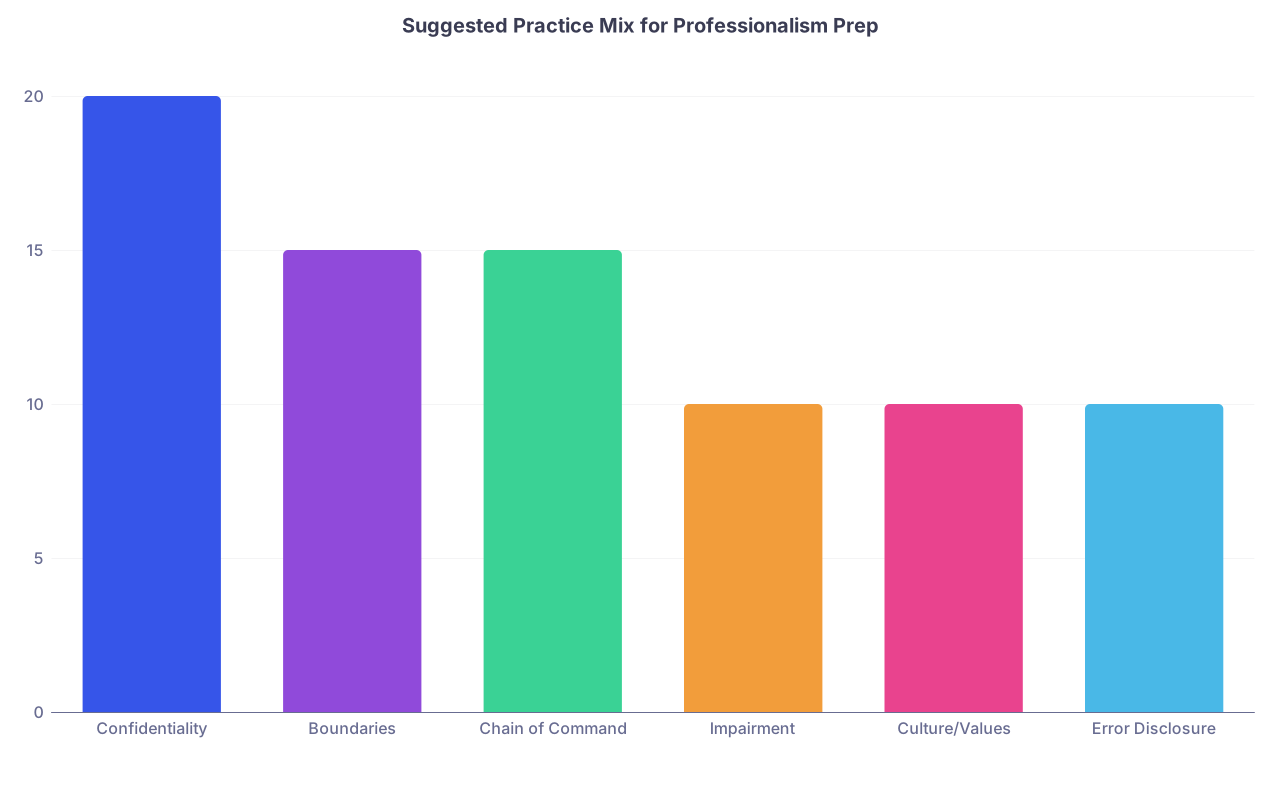
| Category | Value |
|---|---|
| Confidentiality | 20 |
| Boundaries | 15 |
| Chain of Command | 15 |
| Impairment | 10 |
| Culture/Values | 10 |
| Error Disclosure | 10 |
If you are prepping for Step 3, in-training, or boards, I suggest:
15–20 questions specifically on:
- Adult and adolescent confidentiality,
- Family requests for information,
- Sensitive topics (STD, pregnancy, substance use).
10–15 questions on:
- Dual relationships,
- Gifts, social media, prescribing for relatives.
10–15 questions on:
- Impairment (self and colleagues),
- Harassment, discrimination, abuse of power.
10–15 questions on:
- Error disclosure,
- Near-misses,
- Chain-of-command escalation.
While doing them, do not just memorize answers. For every item, ask yourself:
- Which axis?
- What rule did they just test?
- Why was each wrong option wrong on that rule?
This is how you stop falling for the same trap stated five different ways.
13. The Gap Between Exam Ethics and Real Life
Let me be blunt: If you copy exam answers directly into real clinical life, you will look stiff and sometimes useless.
Real life:
- You sometimes text colleagues about a mutual friend’s minor issue.
- You occasionally see a family member for something small.
- You occasionally give a quick driveway opinion.
- You sometimes delay reporting a borderline incident to gather context.
Board exam world:
- None of that exists.
- Everything is scrubbed down to idealized policies.
You need two toolkits in your head:
“Exam professionalism” and “Real-world professionalism.” Overlap is large, but not perfect.
On test day, default to:
- Maximal privacy.
- Clear hierarchy.
- Formal reporting mechanisms.
- Direct, honest, documented conversations.
On the wards, you use judgment, experience, and nuance the exam will never test.
14. Final Tight Takeaways
Three things to remember when you sit down for any exam with professionalism content:
These are not “what would you do?” questions. They are “what would an institutional policy manual say?” questions. When in doubt, side with privacy, safety, and process.
The highest-yield traps are:
- Sharing information “to be nice,”
- Treating friends/family “just this once,”
- Covering for impairment “to be supportive,”
- Hiding or minimizing errors “to avoid trouble.”
The winning pattern almost every time:
- Protect the patient.
- Be honest and transparent.
- Respect boundaries and confidentiality.
- Use the proper chain of command.
Learn the pattern, not just the answers. The test-writers are not as creative as they think. Once you see their traps, you stop stepping in them.