
The most dangerous cases in oral boards rarely walk through the door. They call you at 2 a.m.
If you do not have a structured way to think through telephone and night-coverage scenarios, examiners will dismantle you in under three minutes. I have watched strong residents who can crush complex ICU vignettes fall apart the moment the case starts with, “Doctor, this is the nurse on 7B…”
Let me walk you through how to stop that from happening.
Why Telephone and Night Coverage Scenarios Are Oral Board Traps
Examiners love these cases because they test two things you cannot fake: judgment and discipline.
You do not have vitals in front of you. You cannot see the patient. You are tired. You are getting partial, sometimes wrong, information from someone who is also stressed. That is exactly why oral boards use them.
Telephone/night coverage scenarios test:
- Your initial mental algorithm under uncertainty
- Your prioritization: what you absolutely must know first
- Your threshold to go see the patient versus giving phone orders
- Your safety net: what follow-up you demand after any order
- Your communication clarity under pressure
On exam day, clumsy structure in these cases reads as “unsafe physician.” Not “needs more experience.” Unsafe.
The good news is the patterns are remarkably consistent. Once you see the skeleton, you will start recognizing the same bones in every call.
The Core Algorithm: How You Answer Any Night Call
Before we talk about specific favorite cases, you need a template. Examiners are listening for structure. They do not care if you say it in exact phrases, but they absolutely care about the elements.
Here is the mental skeleton I recommend for any telephone/night coverage board scenario.
Step 1: Stop and Define the Situation Clearly
On the exam, do not just jump into orders. Start by framing.
Example opening line:
“I am the on-call resident receiving a phone call from the floor nurse about a change in patient status. First, I want to clarify who the patient is, the reason for admission, and the current concern.”
You are telling the examiner: I am not a reflex order machine. I contextualize.
Clarify:
- Patient identity and location
- Primary team / reason for admission
- Code status
- What the caller is worried about (not just the number they are reading you)
If the examiner says, “This is a hypothetical patient; you just know X, Y, Z,” fine. You have still shown that your instinct is to anchor in context.
Step 2: Demand Current Objective Data
This is where people fail. They respond to the headline label (“blood pressure low,” “pain uncontrolled”) without rebuilding basic data.
You should have a standard “phone data pack” that you ask for nearly every time:
- Full set of vital signs: T, HR, BP, RR, SpO₂, pain score
- Trend: change from prior values
- Mental status: baseline vs now
- Urine output (if sick, postop, or septic concern)
- Oxygen therapy: room air vs nasal cannula vs NRB vs vent settings
You say something like:
“I would like the most recent vital signs with trends over the last few hours, current oxygen requirements, and a brief report of the patient’s mental status and urine output.”
If it is a narrow question (e.g., hyperglycemia), you still ask: vitals, mental status. Because examiners want to see if you remember that “just a number” on a page might represent DKA, sepsis, stroke, etc.
Step 3: Triage: Phone Orders vs Go See the Patient
One of the most graded decisions: Do you stay on the phone or physically go to the bedside?
You need clear internal triggers:
You go to see the patient immediately (or say you will) if there is:
- Any hemodynamic instability: SBP < 90, MAP < 65, new tachycardia, concerning bradycardia
- Acute mental status change
- New hypoxia or escalating oxygen needs
- Acute chest pain, stroke symptoms, severe SOB
- Any caller phrase like “looks bad,” “I am really worried,” “this is not like before”
Say it explicitly:
“Given the report of hypotension and altered mental status, this is an unstable change. I will go immediately to the bedside while asking the nurse to begin the following measures…”
Examiners give you a ton of credit for this. They want to hear that you do not manage borderline crashing patients purely over the phone.
Step 4: What You Do While You Are Heading There
Night coverage is not “either I go or I give orders.” It is both.
You need a short default “while I am walking there” order set. Typical elements for a sick patient:
- Ensure ABC basics: ask the nurse to put the patient on oxygen if hypoxic or unstable
- Ask for repeat stat vitals, include manual BP if needed
- Ask for fingerstick glucose for any acute change
- Ask to place IV access or confirm it works
- If clearly crashing: ask nurse to call rapid response or code team based on your institutional structure
Say it. The examiner knows you are not teleporting to the bedside.
Step 5: At the Bedside: Focused Assessment
When you announce you are at the bedside, shift gears:
- I will reassess ABCs: general appearance, airway patency, work of breathing, perfusion
- I will perform a focused physical exam based on the complaint, but still anchored in general assessment (lung sounds, heart, abdomen, neuro, lines)
- I will review current meds, allergies, and recent labs/imaging (just say you will; they will feed you data if they want to)
You do not recite a full head-to-toe exam step by step. You show priorities.
Step 6: Initial Management and Reassessment Plan
Then you treat. But each treatment should be paired with:
- A monitoring plan
- A contingency plan (what if this does not work or worsens?)
- A communication plan (who you will call, what you will document)
For every significant intervention, add at least one of:
- “I will recheck vitals in X minutes”
- “If no improvement, I will escalate to ICU / attending / rapid response”
- “I will document this event and inform the primary team in the morning”
Examiners love people who think one move ahead.
Favorite Night-Coverage Scenarios (And How Examiners Expect You To Handle Them)
Let me go through some of the repeat offenders. These show up in different clothes, but the skeleton is the same.
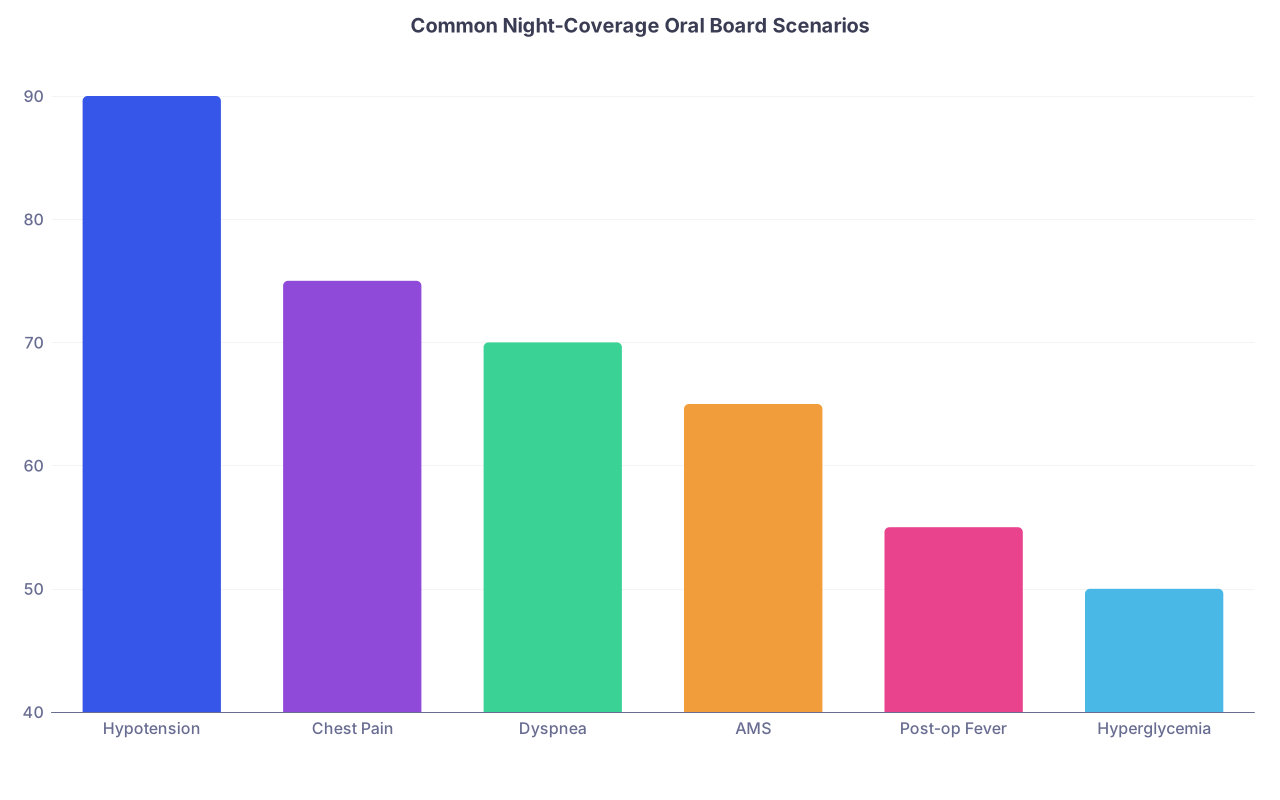
| Category | Value |
|---|---|
| Hypotension | 90 |
| Chest Pain | 75 |
| Dyspnea | 70 |
| AMS | 65 |
| Post-op Fever | 55 |
| Hyperglycemia | 50 |
1. “The Pressure Is Low” – Hypotension on the Floor
Classic script: “Doctor, this is the nurse on 6 West. Mr. Smith’s blood pressure is 78/40. He was fine earlier.”
Your moves:
Immediate clarifying questions on the phone:
- Vitals with trend
- Mental status (alert, confused, lethargic)
- Urine output
- Oxygen requirement and saturation
- Recent meds: antihypertensives, narcotics, sedatives, diuretics, beta-blockers
Decide: go now vs phone only. This is “go now.”
Say:
“With SBP in the 70s, I consider this unstable. I will go immediately to the bedside. On the way, I ask the nurse to place the patient supine, ensure oxygen is on at 2–4 L via nasal cannula, check a fingerstick glucose, and obtain a stat set of vitals and manual blood pressure.”
At bedside: ABC and quick exam. Look for:
- Signs of shock: cool extremities, diaphoresis, delayed cap refill, AMS
- Source clues: bleeding at surgical site, GI bleed signs, sepsis (warm, flushed or febrile), CHF signs
-
- Ensure IV access (two large-bore if suspect bleeding)
- Fluid bolus if no signs of volume overload and shock picture (e.g., 500–1000 mL isotonic crystalloid in adults, adjust in CHF/ESRD)
- If obvious bleeding, call for blood, labs, surgical team
- Draw stat labs: CBC, BMP, lactate, blood cultures if septic concern, type and screen if bleeding
Escalation:
- If persistent hypotension or signs of shock:
- Call rapid response / ICU consult
- Discuss vasopressors if in monitored/ICU-level care
- Call your attending and the primary/surgical team early, not after 3 liters of fluid
- If persistent hypotension or signs of shock:
On oral boards, they want to see that you:
- Do not just reflexively give fluid without looking for cause
- Do not manage a MAP of 50 on the floor for an hour
- Communicate early with higher level care and senior help
Examiners punish “I would order a normal saline bolus of 1 L and recheck in the morning.” That answer says you have never seen a real hypotensive patient.
2. “New Chest Pain” – The 2 a.m. STEMI Trap
Call: “Doctor, your 62-year-old patient just developed chest pain, 8/10, retrosternal.”
Again, script.
On the phone:
- Ask for vitals, O₂ sat, mental status
- Character of pain: onset, quality, location, radiation, associated symptoms (SOB, nausea, diaphoresis, syncope)
- Past cardiac history, DVT/PE risk, anticoagulation
- Current telemetry findings if on monitor
Threshold: new chest pain in a patient at risk = go see them. Say so.
While you are going:
- Put patient on oxygen if hypoxic or very ill-appearing (do not reflex oxygen for everyone; examiners notice nuance)
- Ask for stat 12-lead EKG
- Ask for STAT vitals and to place patient on continuous monitor if not already
- Ask nurse to bring chewable aspirin if no contraindication (unless they are NPO for major bleed or have severe allergy)
At bedside:
ABC, visual assessment: comfortable vs diaphoretic, pale, hypotensive
Interpret EKG: you should be prepared to say “ST elevations in contiguous leads” or “no acute ischemic changes” in broad terms
Management based on type:
STEMI picture:
- Activate cath lab (tell the examiner you will follow institutional protocol for emergent PCI)
- Aspirin, consider P2Y12 inhibitor depending on context
- Nitrates if not hypotensive, no RV infarct, no PDE-5 inhibitor
- Pain control (morphine sparingly, exam answers have moved away from reflex morphine)
- Heparin as per protocol
Unstable angina/NSTEMI:
- Same general ACS pathway but more nuance; call cardiology early
If you suspect PE instead (pleuritic pain, tachycardia, hypoxia, risk factors):
- Consider CTA chest, heparin if high suspicion and no contraindication
- Escalate to higher level of care if unstable
Examiners are watching:
- Do you treat chest pain as “could be lethal until proven otherwise”?
- Do you fixate on nitroglycerin and ignore hemodynamics?
- Do you forget aspirin (unforgivable in these exams)?
3. “He’s Short of Breath” – Acute Dyspnea at Night
This one is endlessly recycled, especially for medicine boards.
Call script: “Your 75-year-old, postop day 3 from hip surgery, is short of breath. The nurse says he is more tachypneic than earlier.”
On the phone:
- Vitals + trends
- O₂ requirement now vs baseline
- Mental status
- Associated: chest pain, cough, sputum, fever, leg swelling, pleuritic pain
- Recent fluids, diuretics, transfusions
- History: COPD, CHF, prior PE, home O₂
Given postop, dyspnea, tachycardia? PE until proven otherwise. But do not tunnel vision; CHF, pneumonia, atelectasis, aspiration all possible.
Decision: Go see? Absolutely, unless it is mild, unchanged, and fully explained. For board scenarios, they usually make it meaningful. So you say you will go.
On the way:
- Put him on O₂ (if SpO₂ low or moderate/severe dyspnea)
- Stat vitals and continuous pulse ox
- Ask nurse to check fingerstick glucose only if AMS or other concern
At bedside, work visually:
- General appearance: is he speaking in full sentences? Using accessory muscles? Cyanotic?
- Check for unilateral leg swelling, JVD, crackles, wheezes, asymmetric breath sounds, signs of consolidation
- Decide early: likely phenotypes
- Flash pulmonary edema / CHF: hypertension, crackles, JVD, possible orthopnea history
- PE: pleuritic chest pain, tachycardia, hypoxia out of proportion to CXR, risk factors
- Pneumonia: fever, productive cough, focal crackles
- COPD/asthma: wheezing, hyperinflation
Management directions:
Sick + suspected PE with hypotension:
- Call rapid response/ICU
- Consider bedside echo if available
- Empiric anticoagulation if no obvious contraindications
- Emergent CT angiogram when stable enough to leave unit, or bedside ultrasound/Echo for RV strain
CHF:
- IV loop diuretic
- Consider nitrates if hypertensive
- Upright positioning, BiPAP if needed
- ICU/step-up unit if respiratory distress moderate–severe
Pneumonia:
- Broad empiric antibiotics based on hospital/local patterns
- Blood cultures, lactate if septic concern
- Decide floor vs ICU based on vitals and respiratory status
Boards are less about picking the exact antibiotic and more about not watching a crashing PE on the floor for three hours.
4. “He’s Not Acting Right” – Acute Mental Status Change
Telephone AMS cases separate people who think systematically from those who chase single numbers.
Call: “Doctor, your 68-year-old patient is more confused. He was conversing this afternoon; now he is not making sense and keeps trying to get out of bed.”
On the phone:
- Clarify baseline mental status and time course of change
- Ask for vitals, including oxygenation and glucose if already checked
- Ask if there were recent meds: opiates, benzos, anticholinergics, sleeping meds, recent dose changes
- Ask about recent procedures, infections, urinary retention, constipation
Decision: this is always a “go see them” situation on an exam. There is no safe phone-only answer for new acute delirium unless the scenario is trivial (it will not be).
While going:
- Ask for stat vitals, fingerstick glucose
- Ask nurse to ensure safety: bed alarms, sitter if available, do not restrain unless absolutely necessary
At bedside, your priorities:
- ABCs. A delirious patient can be septic, hypoxic, or intracranial catastrophe
- Neuro exam: focal deficits? speech changes? asymmetry? gait changes if safe to test
- Consider causes in big buckets:
- Hypoxia
- Hypoglycemia / metabolic derangements (Na, Ca, uremia, hypercapnia)
- Infection (sepsis, UTI, pneumonia, meningitis)
- Drugs (opioids, benzos, anticholinergics, withdrawal)
- Stroke/ICH
Initial workup:
- Labs: CBC, CMP, LFTs, ammonia (if cirrhotic), UA, cultures, drug levels if relevant
- Imaging: non-contrast head CT if any concern for stroke/ICH, trauma, or unexplained focal findings
- If fever or meningitis concern: early antibiotics, LP planning after CT
Examiners care that you:
- Do not immediately jump to haloperidol or restraints as your “management”
- Check for reversible killers (hypoxia, hypoglycemia, stroke) early
- Avoid blaming “sundowning” without a workup
5. “The Sugar Is 480” – Nighttime Hyperglycemia
These cases are used to see if you can distinguish nuisance hyperglycemia from DKA/HHS.
Call: “Doctor, your 45-year-old type 1 diabetic has a blood sugar of 480. He is here with pneumonia.”
On the phone:
- Vitals, mental status
- Symptoms: nausea, vomiting, abdominal pain, polyuria, polydipsia, confusion
- Oral intake today
- Home insulin regimen and what they received in the hospital
- Any missed doses? Any steroids given?
If type 1 diabetic and clearly ill, you go see them. Hyperglycemia alone without symptoms could be handled with orders, but boards like nuance—if in doubt, see.
In your answer, explicitly say you want to rule out DKA/HHS:
“I am concerned about possible DKA or HHS, so I will assess for dehydration, acidosis, and mental status changes.”
Management thought process:
- Labs: BMP, serum ketones or beta-hydroxybutyrate, anion gap, venous blood gas, serum osmolality if suspect HHS
- If DKA/HHS: this is ICU/step-down level care; start fluid resuscitation, insulin infusion per protocol, frequent electrolyte monitoring (especially K)
- If simple hyperglycemia on the floor, stable:
- Correctional insulin plus adjustment of basal/bolus regimen
- Avoid massive single-dose sliding scale that will crash them at 4 a.m.
- Recheck glucose in a reasonable time frame you specify
Boards are not impressed by “I give 10 units of sliding-scale insulin” with no plan, no recheck, no mention of underlying cause or DKA screen.
6. “He Has a Fever” – Postoperative or Inpatient Fever Overnight
Fever calls are deceptively simple and heavily tested.
Scenario: “Postop day 2 after colectomy, T 38.8 °C (101.8 °F). Nurse calls you overnight.”
On the phone:
- Full vitals, trends
- Symptoms: cough, dysuria, abdominal pain, wound drainage, diarrhea, new lines, rash
- How the patient looks: comfortable vs rigoring, tachypneic, hypotensive
- Recent antibiotics, cultures, central lines, Foley
You do not CT scan every postop fever at 2 a.m. Nor do you blow it off casually.
Framework:
- Very early low-grade fever (POD 1–2) with stable vitals, minimal symptoms: often atelectasis, inflammatory. Boards expect a focused exam, CXR if pulmonary symptoms, UA if urinary symptoms, but no panic.
- Fever with instability (tachycardia, hypotension, rigors, altered): treat as sepsis until proven otherwise. That means:
- Go see them
- Sepsis bundle: lactate, blood cultures, urine cultures, broad-spectrum IV antibiotics, fluid resuscitation
- Consider CT abdomen/pelvis if abdominal surgery, leaks, abscess suspicion
Your answer should emphasize:
- Distinguishing “benign trend” vs “sepsis red flags”
- Appropriate level of response: you do not call surgery at 2 a.m. just to say “patient is 38.0, everything else fine” without any assessment
Communication and Documentation: The Hidden Grading Criteria
Night coverage boards are as much about how you talk as what you order.

| Step | Description |
|---|---|
| Step 1 | Call from nurse |
| Step 2 | Clarify concern and context |
| Step 3 | Request vitals and key data |
| Step 4 | Go to bedside immediately |
| Step 5 | Consider phone orders |
| Step 6 | Assess ABC and focused exam |
| Step 7 | Initiate management |
| Step 8 | Set monitoring and follow up |
| Step 9 | Communicate with team and document |
| Step 10 | Unstable? |
Examiners listen for a few specific behaviors that separate a safe resident from a liability.
Be Explicit About Closed-Loop Communication
When you give orders, do not leave them floating.
Instead of:
“Give a 500 mL bolus.”
Say:
“I will order a 500 mL bolus of lactated Ringer’s over 30 minutes and ask the nurse to call me back with repeat vitals, including manual blood pressure, immediately after the bolus.”
That last part is what most candidates omit. It screams safety and situational awareness to the examiner.
Call for Help Early, Not as a Last Resort
You are not the hero. You are the responsible adult who knows when the situation exceeds your level or the floor’s capabilities.
Say things like:
- “Given persistent hypotension despite fluid resuscitation, I will call my ICU fellow to evaluate for transfer and vasopressor support.”
- “I will update my attending now regarding this significant change in status and discuss further escalation.”
Residents who never mention attending or ICU involvement sound arrogant or naive. Both read poorly.
Document and Hand Off
Night events that disappear into the ether are a real-world patient safety problem. Examiners know that.
Build in:
“I will document this episode, my assessment, and interventions in the chart and leave a detailed sign-out note for the primary team.”
“I will also verbally sign out this event to the morning team, highlighting pending tests and what I am concerned about.”
One sentence. High yield.
Common Pitfalls That Make Examiners Cringe
I have to call these out bluntly because I see them constantly in mock orals.
| Pitfall | Why It Fails You |
|---|---|
| Managing unstable patients purely by phone | Signals poor judgment and unsafe practice |
| Ignoring vitals or trends | Suggests you do not understand acuity assessment |
| No plan for reassessment | Implies you think one order “fixes” complex physiology |
| Never calling senior help or ICU | Reads as ego or ignorance of system-based practice |
| Over-ordering tests without bedside exam | Shows cookbook thinking and lack of clinical reasoning |
1. “Order First, Think Later”
People jump straight to ordering CT scans, echo, broad labs before they have even seen the patient or stabilized ABCs. Examiners see that as “trying to impress with knowledge instead of acting like a real clinician.”
Your first response should be stabilization and bedside assessment, not exotic lab panels.
2. Forgetting to Cancel or De-escalate
They will sometimes build in a trap: you order two things, then new data comes that makes one irrelevant or harmful. They are testing if you reassess.
Example: You order 1 L fluid bolus in a dyspneic patient before you know they have flash pulmonary edema. Examiner then tells you: JVD, crackles to mid-lung, BP 200/110. You must pivot.
Say:
“Given this additional data suggesting flash pulmonary edema, I will stop further fluid administration and shift to diuresis and afterload reduction instead.”
That pivot is gold.
3. Overfocus on Numbers, Underfocus on the Patient
You get calls like “K is 3.1” or “Na is 128” or “Platelets are 80.” If you answer purely with repletion algorithms and never ask about symptoms, vitals, chronic vs acute, you look like a protocol clerk.
For any “number call,” anchor in:
- Acute vs chronic
- Symptomatic vs asymptomatic
- Underlying disease context (cirrhosis, CKD, chemo, etc.)
Then treat the patient, not just the lab.
How to Practice for These Scenarios (Without Wasting Time)
You do not need a 500-page book. You need repetition of structure.
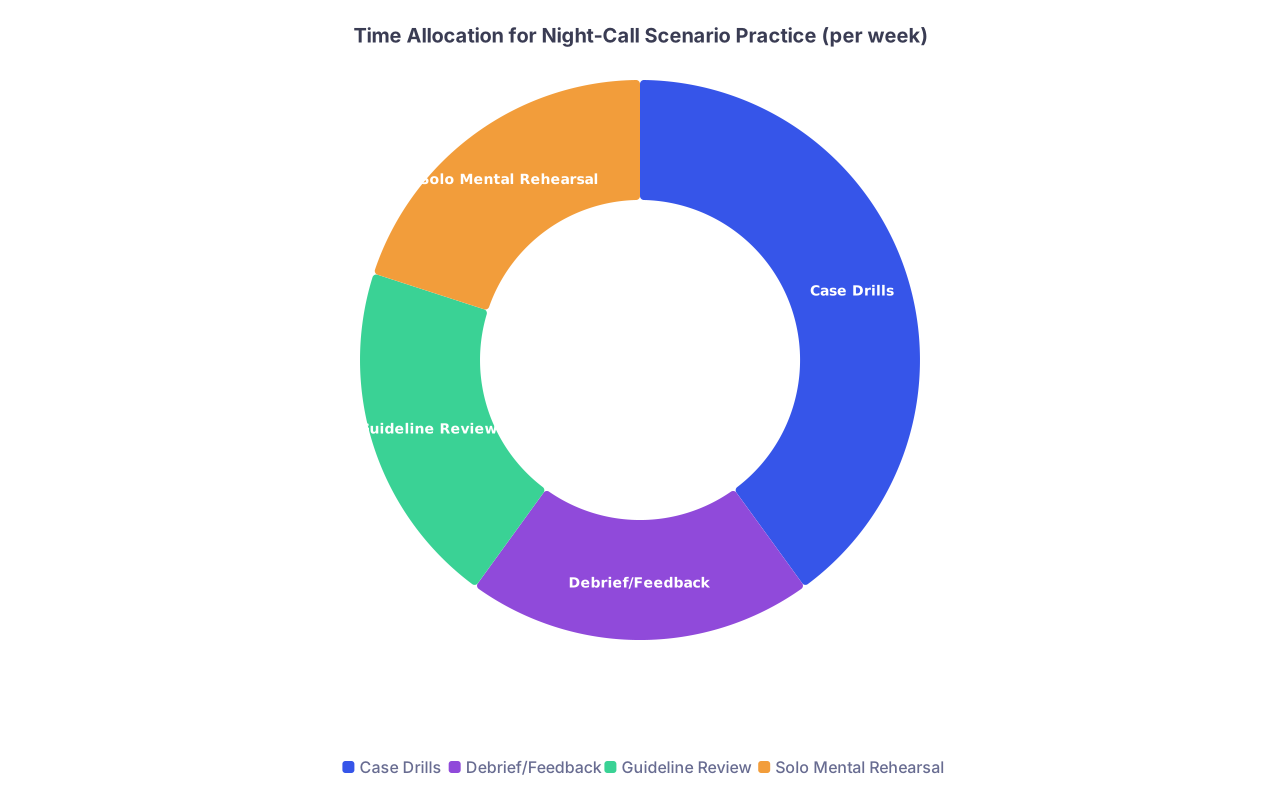
| Category | Value |
|---|---|
| Case Drills | 40 |
| Debrief/Feedback | 20 |
| Guideline Review | 20 |
| Solo Mental Rehearsal | 20 |
Practical ways to train this:
Two-case drill with a co-resident:
One person is “nurse + examiner,” the other is “on-call resident.” Run two phone calls each, 5–7 minutes per case. Focus on your opening structure and decision to go see vs phone orders.Mental reps during real call:
On actual nights, before you pick up, force yourself to think: “Okay, I will first ask for vitals, mental status, O₂, urine output.” Build that reflex.Record yourself answering one case per week:
Even audio-only. Then listen the next day. You will hear the rambling, the missing reassessment, the forgotten communication pieces.Build your default phrases:
Have 3–4 go-to formulations burned in:- “Given this instability, I will go immediately to the bedside while asking the nurse to…”
- “I would like a full set of vital signs with trends, current oxygen requirements, mental status, and urine output.”
- “After this intervention, I will recheck vitals in 30 minutes and ask the nurse to call me sooner if…”
These are the “muscle memory” parts of oral boards. The more automatic they are, the more cognitive bandwidth you have for the actual case.
Specialty-Specific Twists You Should Anticipate
Not all night-coverage calls are medicine-style. A few twists by specialty that oral boards like:

Surgery
Common themes:
- Postop hypotension or tachycardia → bleeding vs sepsis vs pain vs PE
- Postop abdominal pain, distention, no flatus → ileus vs obstruction vs leak
- Wound drainage at night → serosanguinous vs frank blood vs bile/feculent
Examiners want you to:
- Think early about return to OR in catastrophic bleeding or leak
- Call your attending sooner rather than later
- Not throw fluid at a patient with rigid abdomen and peritonitis without calling surgery
Pediatrics
Common night calls:
- Fever in a neutropenic child on chemo
- Worsening respiratory distress in bronchiolitis
- Decreased PO intake and minimal urine in toddler with viral illness
You must show comfort with:
- Age-appropriate vital sign interpretation
- Weight-based dosing
- Lower threshold for in-person evaluation and admission
OB/GYN
Night favorites:
- Postpartum hemorrhage: saturating pads, hypotensive, tachycardic
- Severe-range blood pressures postpartum with headache and visual changes
- Decreased fetal movement calls (in L&D exam style scenarios)
Your priorities:
- Hemodynamic assessment and immediate interventions for hemorrhage (uterotonics, uterine massage, blood products)
- Magnesium sulfate and BP control for severe preeclampsia/eclampsia risk
- Rapid fetal assessment (NST, BPP) for fetal concern
The same skeleton applies: clarify, assess stability, go see them, act decisively.
Building the Right Mindset for Night-Call Boards
Let me be blunt: oral boards are not impressed by encyclopedic recall of rare eponymous syndromes. They are impressed by boring, relentless, methodical safety in the middle of the night.

If you internalize only three things from this:
Always rebuild the basics first. Vitals, mental status, oxygenation, and trend are your foundation. Answering anything substantial without them looks reckless.
Say when you will go to the bedside and what you will do while you are on your way. That single behavior change will fix half of the common failures in telephone scenarios.
Pair every intervention with monitoring, escalation, and communication. “Do X, then reassess in Y, escalate to Z if no improvement, and document/hand off” is the mentality of a safe night-covering physician—and that is exactly what oral boards are really testing.