
You are on night float. It is 2:17 a.m. The ED calls with chest pain, borderline vitals, and a troponin that just came back “a little elevated.” Your brain is half-asleep, but the question forming in your head is exactly the same one the boards will ask you in a vignette: what is the next best step?
This is where management algorithms live. Not in pretty guideline PDFs, but in that narrow space between “I think I know what is going on” and “I must pick one action and own it.”
Let me walk you through how the boards weaponize clinical pathways, what patterns they use, and how you can train your brain to see the algorithm underneath the vignette instead of drowning in details.
1. What “Management Algorithms” Really Mean On Boards
Boards do not care if you have every KDIGO or ACC/AHA guideline memorized. They care whether you can:
- Recognize the clinical state
- Classify its severity or risk
- Apply the standard pathway one step at a time
On exams, “algorithm” usually means one of four structures:
- Stepwise escalation (start conservative, escalate if fail)
- Risk-stratified branches (low / intermediate / high risk)
- Time-bound sequences (within 10 min, 60 min, 24 hr)
- Test-directed management (if A is positive, do B; if negative, do C)
The question stem is built to obscure which branch you are on. The answer choices are each plausible… but only one is the correct next node.
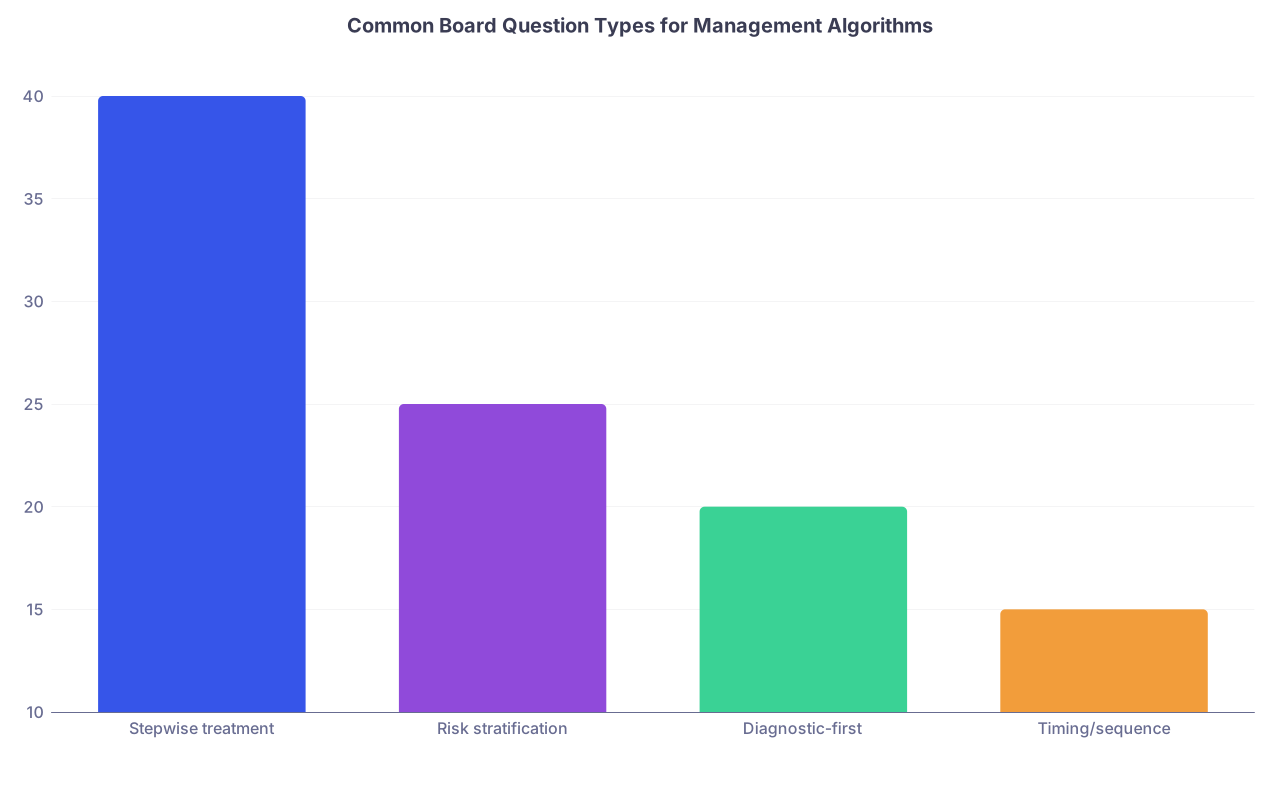
| Category | Value |
|---|---|
| Stepwise treatment | 40 |
| Risk stratification | 25 |
| Diagnostic-first | 20 |
| Timing/sequence | 15 |
When you see a management-heavy question, you should immediately ask yourself three things before touching the answer choices:
- What is the state? (diagnosis or provisional working label)
- What is the category? (severity, risk score, staging)
- Where am I on the timeline? (initial visit, after failed therapy, follow-up, complication)
If you cannot define those three, you are just guessing with vibes.
2. How Boards Hide Algorithms Inside Vignettes
Boards rarely say, “According to the XYZ algorithm, what should you do next?” They bury the branch point.
Patterns I have seen over and over:
- The branch hinge is in one tiny result: D-dimer level, troponin trend, O2 sat on room air, absolute neutrophil count, etc.
- “Prior treatment” is a single line in the middle of the stem: “He has been taking lisinopril and hydrochlorothiazide for the last 6 months.” That line alone can rule out “Start ACE inhibitor” and push you to “Add calcium channel blocker.”
- The time factor is implicit: “Three months later” or “Two days after starting therapy.”
On test day, you cannot scroll up and down five times for every question. You need a mental protocol.
Here is the basic mental flowchart for any management vignette:

| Step | Description |
|---|---|
| Step 1 | Read last line first |
| Step 2 | Identify question type |
| Step 3 | Scan for diagnosis and severity |
| Step 4 | Different strategy |
| Step 5 | Note prior treatments and timing |
| Step 6 | Ask what algorithm applies |
| Step 7 | Recall default first line |
| Step 8 | Adjust for comorbidities and contraindications |
| Step 9 | Pick the single best next action |
| Step 10 | Management next step? |
Key trick: read the last line of the question first. If it asks “What is the most appropriate next step in management?” you know you are in algorithm territory. Then you can read the stem with purpose: you are hunting specifically for branch-point data.
3. The Big Five Algorithm Domains Boards Love
There are dozens of clinical pathways they can hit, but a few areas get recycled mercilessly because they are clean, testable algorithms.
3.1 Cardiology: Chest Pain and Arrhythmias
You will see:
- ACS management (STEMI vs NSTEMI vs unstable angina)
- Chest pain risk algorithms (e.g., HEART-like thinking without naming it)
- Atrial fibrillation rate vs rhythm control and anticoagulation decisions
- Syncope workup based on red flags
Concrete example: NSTEMI / unstable angina.
The board’s algorithm is essentially:
- Suspect ACS → EKG + troponin.
- If STEMI → activate cath lab immediately.
- If NSTEMI/UA → risk stratify (troponin, EKG changes, symptoms, comorbidities).
- High risk → early invasive strategy (angiography within 24 hr).
- Lower risk → conservative medical management + stress testing.
The question often hinges on a single branch: high vs low-intermediate risk. They do not need to say “GRACE score.” They will give you:
- Troponin positive
- Dynamic ST changes
- Diabetes / renal disease / age 72
If you pick “Outpatient stress test in 1 week,” you have ignored the risk branch. They want “Coronary angiography during this hospitalization.”
Same deal in atrial fibrillation. The unspoken flowchart is:
- Stable vs unstable
- Rate vs rhythm issue
- Need for anticoagulation based on CHA₂DS₂-VASc and duration >48 hr
But they test it indirectly:
- 62-year-old woman, new AF with RVR, hemodynamically stable, normal EF, no CAD history. You are expected to know: rate control first (beta-blocker or nondihydropyridine CCB), not “immediate cardioversion” unless unstable.
- 70-year-old man, chronic AF, hypertension, diabetes. They hand you a CHA₂DS₂-VASc of at least 3. If you answer “aspirin,” you failed the algorithm. It must be full-dose anticoagulation unless contraindicated.
The boards are brutal on people who pick the “right drug” at the wrong point in the pathway.
3.2 Pulmonary & Critical Care: O2, Ventilation, PE
Pulm questions are basically nested algorithms. Example: acute hypoxemic respiratory failure.
The implicit pathway:
- Assess work of breathing + mental status + vitals.
- If crashing: endotrach + mechanical ventilation.
- If moderate distress but protecting airway: consider high-flow nasal cannula or noninvasive ventilation.
- If minimal distress: low-flow O2 or observation.
Where they trap residents:
- They describe a patient with increased work of breathing, confusion, and inability to speak in full sentences and give you “BiPAP” as an option. You are supposed to know: this is not a BiPAP patient. This is an intubation patient.
- Or they give you a COPD exacerbation, pH 7.28 with PaCO₂ 65, but still alert, speaking, moderate distress. The best next step is noninvasive ventilation, not “intubate now” and not “discharge with steroids.”
Then there is pulmonary embolism. Board questions follow a very predictable algorithm:
- Estimate pretest probability (they do this narratively).
- If low + negative D-dimer → no imaging.
- If intermediate/high → CT angiogram.
- If high and unstable → empiric anticoagulation or thrombolysis depending on shock.
You will absolutely see one question where the only correct answer is “D-dimer” and another where “D-dimer” is wrong, because pretest probability changed.
3.3 Infectious Disease: Sepsis, Meningitis, Endocarditis
ID is algorithm heaven. Pathways are rigid, which makes them testable.
Sepsis/septic shock algorithm on boards:
- Recognize sepsis: suspected infection + organ dysfunction (they give you lactate, MAP, creatinine, confusion).
- Initial bundle: fluids (30 mL/kg crystalloids), broad-spectrum antibiotics as early as possible.
- If persistent hypotension after fluids → vasopressors (norepinephrine first-line).
- Then source control.
Where people miss points: timing. The boards will hit: “What is the most appropriate next step?” in a hypotensive, febrile patient with possible pneumonia and a lactate of 4. The answer is not “CT chest,” not “order blood cultures,” and not “central line”. It is “Begin broad-spectrum intravenous antibiotics immediately” ± “Give IV fluids now.” They rate sequence.
Meningitis algorithm is even more rigid:
- Suspect bacterial meningitis.
- If there are signs of increased intracranial pressure / mass lesion risk (focal neuro deficits, papilledema, immunocompromised, history of CNS disease, new seizure) → do CT before LP.
- But do not delay antibiotics. Start empiric IV antibiotics ± dexamethasone immediately after blood cultures.
So they test tiny nuance:
- Patient with fever, neck stiffness, photophobia, but neuro exam normal → LP first, then antibiotics.
- Same patient but with HIV and CD4 40 → CT head first, but still start empiric antibiotics right away after blood cultures.
If the answer choices give you “CT head,” “LP,” “start ceftriaxone and vancomycin,” the correct move depends entirely on the presence or absence of risk factors for herniation. That single sentence in the stem is the branch point.
3.4 Oncology & Hematology: Staging, Risk, and Lines of Therapy
Heme-onc algorithms revolve around staging and prior lines of therapy.
For example, DVT/PE management:
- Provoked / unprovoked
- Cancer-associated vs not
- Renal function
- Bleeding risk
Boards love to ask:
- First DVT provoked by surgery → anticoagulate for 3 months.
- First unprovoked DVT in a low bleeding-risk patient → indefinite anticoagulation.
- Cancer-associated thrombosis → low-molecular-weight heparin or DOAC depending on the specific exam era.
The algorithm is “duration and type of anticoagulation based on provoking factors.”
Same with cancer screening / staging:
- Localized disease → surgery ± adjuvant therapy.
- Locally advanced disease → often neoadjuvant chemoradiation.
- Metastatic → systemic therapy; surgery usually palliative or for complications.
Missed questions often come from not acknowledging the “new stage” that the boards slip into the middle of the vignette. For example: a colon cancer patient who now has several liver lesions on imaging. Forget local resection at this point; the algorithm has moved into palliative / systemic management.
3.5 OB/GYN: Pregnancy, Bleeding, Fetal Status
OB/GYN is algorithm-driven by nature. They love:
- Pregnancy bleeding by trimester
- Fetal heart rate tracing pathways
- Gestational diabetes and preeclampsia management
- Ectopic pregnancy algorithm (methotrexate vs surgery)
Example: first-trimester bleeding.
The algorithm you are supposed to apply:
- Confirm pregnancy and stability (vitals, abdominal exam).
- Quantitative β-hCG + transvaginal ultrasound.
- Compare β-hCG to discriminatory zone (~1500–2000 IU/L).
- If β-hCG above zone and no intrauterine pregnancy → ectopic until proven otherwise.
So when they present a hemodynamically stable woman with mild cramping, β-hCG 400, and no gestational sac on ultrasound, the correct next step is not “methotrexate.” It is “repeat β-hCG in 48 hours” or “repeat ultrasound when β-hCG is higher,” because you are below the discriminatory zone. Wrong answers are usually earlier branches in the algorithm applied at the wrong point.
Same for nonreassuring fetal heart rate. There is an internal algorithm:
- Identify pattern: late decels, variable decels, bradycardia.
- Initial intrauterine resuscitation: maternal repositioning, oxygen, IV fluids, stop oxytocin, tocolysis if tachysystole.
- If persistent or severe: expedited delivery (operative vaginal or C-section depending on situation).
The board’s favorite trap: jumping directly to C-section when the tracing is abnormal but responsive to resuscitative maneuvers.
4. How Boards Sequence Multi-Step Algorithms
Management questions are often not “what is the ultimate treatment?” They are “what is the next move along the standard sequence?”
There is a pattern to how they do this.
They create a 3–5-step pathway and then ask you about step 2 or 3:
- Example: Asthma exacerbation
- Step 1: Short-acting beta agonist ± short course oral steroids.
- Step 2: Add inhaled corticosteroid.
- Step 3: Increase ICS dose or add LABA.
- Step 4+: Biologics, etc.
If they tell you “patient using albuterol inhaler several times a week, has required 2 prednisone bursts in the last 6 months, currently on low-dose ICS,” the question is: what is step 3? You are supposed to know that jumping straight to biologics skips mandatory steps.
Another classic: Type 2 diabetes progression.
| Step | Typical Board-Style Action |
|---|---|
| 1 | Lifestyle + metformin |
| 2 | Add second oral agent or GLP-1 agonist |
| 3 | Add basal insulin |
| 4 | Intensify insulin regimen |
They intentionally put answer choices from steps 1–4 all together. Your job is to see where in the ladder the patient currently sits and move exactly one rung up. Not three.
5. Practicing Algorithms the Right Way (Not Just Reading Guidelines)
Passive reading of UpToDate is the worst way to “learn” algorithms for boards. You will remember the overall concept, then forget the precise branch points.
You need active, pattern-based practice.
Here is a training structure that actually works:
- Pick a high-yield domain (e.g., chest pain, GI bleeding, sepsis, acute kidney injury).
- Find the main guideline/UpToDate algorithm once.
- Draw it yourself from scratch on paper. Arrows, boxes, branch points, all of it.
- Then do 10–20 questions in that domain and, for each question, explicitly state out loud:
- “This is the step where I…”
- “He has X, so he goes down this branch.”
- After each block, re-draw the algorithm from memory and fill any gaps.

Your recall needs to be procedural, not verbal. You should feel yourself “moving” through a pathway. Boards reward that kind of thinking.
To help you visualize, here is a simple algorithm diagram for acute upper GI bleeding, which is a classic board favorite.

| Step | Description |
|---|---|
| Step 1 | Suspected upper GI bleed |
| Step 2 | Assess ABCs and vitals |
| Step 3 | IV fluids and blood products |
| Step 4 | High dose IV PPI |
| Step 5 | Urgent endoscopy within 24 hr |
| Step 6 | Check Hgb and risk factors |
| Step 7 | IV PPI |
| Step 8 | Endoscopic therapy and admit ICU |
| Step 9 | Medical management and monitor |
| Step 10 | Hemodynamically unstable |
| Step 11 | High risk lesion |
If you have this mental picture, the inevitable exam question about “next step” after initial resuscitation is trivial: endoscopy, not tagged RBC scan, not elective surgery.
6. Recognizing When They Want Deviation From Algorithm
Boards love the algorithm. But they love the exceptions more.
You score points by knowing when the standard pathway is deliberately wrong for this patient.
Common exception patterns:
- Renal failure changes drug choice (e.g., avoid LMWH with severe CKD).
- Liver disease changes bleeding risk calculus for anticoagulation.
- Pregnancy overrides radiation-heavy imaging choices.
- Severe allergy history overrides first-line drug.
They often telegraph this with a very specific sentence:
- “He developed angioedema after taking lisinopril.” → ACE inhibitor is permanently off the table; ARB often is avoided on exams too.
- “She has a history of heparin-induced thrombocytopenia.” → Never give heparin again. Even if your algorithm brain screams “DVT → anticoagulate with LMWH,” the exception wins.
So as you run your mental algorithm, you also need a quick “contraindication scan”:
- Kidney, liver, platelets, bleeding history, pregnancy, allergies.
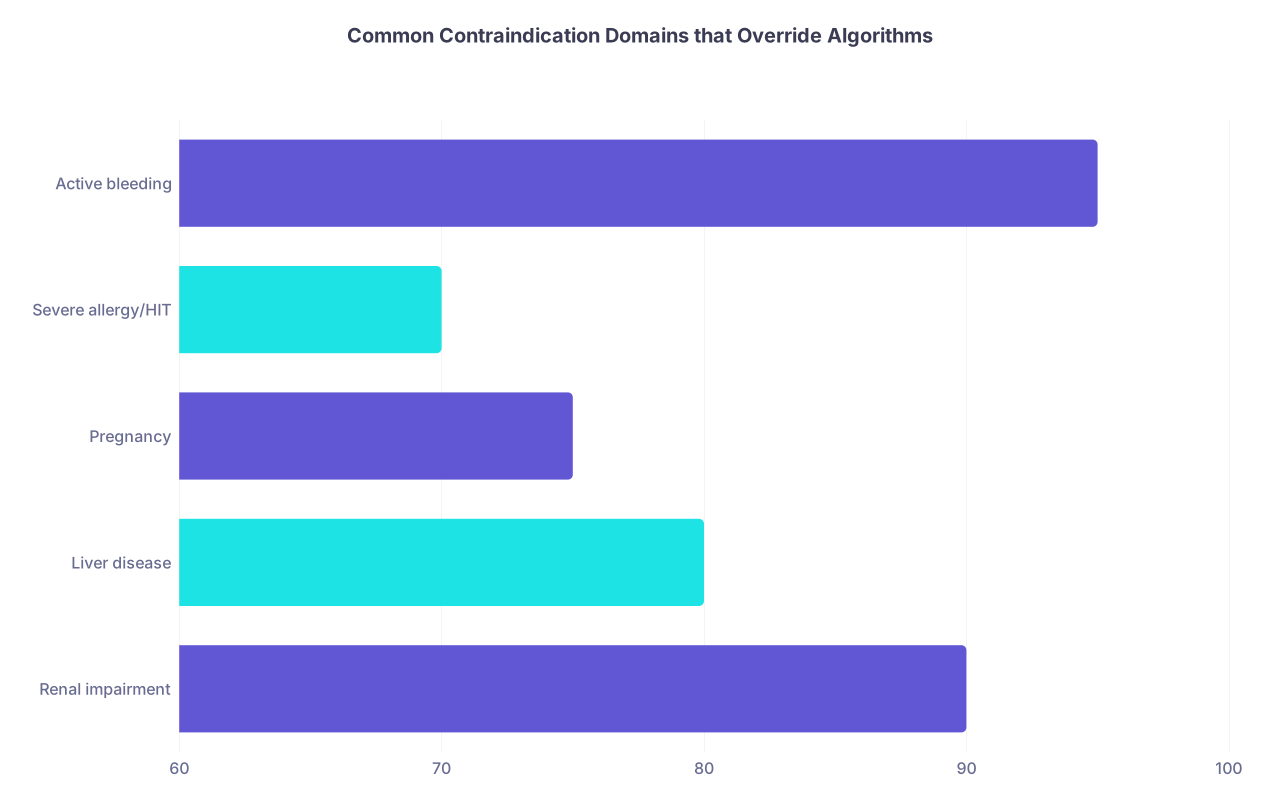
| Category | Value |
|---|---|
| Renal impairment | 90 |
| Liver disease | 80 |
| Pregnancy | 75 |
| Severe allergy/HIT | 70 |
| Active bleeding | 95 |
If you see one of those flashing, pause before you pick the default next step.
7. How This Looks Under Real Exam Conditions
Let me give you a concrete example, start to finish.
You are on question 32 of a long block. The last line reads: “What is the most appropriate next step in management?”
You instantly switch to algorithm mode.
You scan the stem:
- 68-year-old man with chest pain, diaphoresis
- Risk factors: HTN, diabetes, smoker
- EKG: ST depressions in lateral leads
- Troponin: elevated
- Vitals: BP 110/70, HR 95, O2 sat 96% RA
- Already received: aspirin, heparin, high-dose statin, beta-blocker, nitrates
- No active bleeding, creatinine 1.1
Answer choices:
A. Outpatient stress test in 3 days
B. Continue current therapy and observe in telemetry bed
C. Coronary angiography during this hospitalization
D. Immediate thrombolytic therapy
E. Add clopidogrel and discharge
If you are trying to remember every line of ACC/AHA NSTEMI guidelines, you will waste time. Instead:
- State the algorithm step: “NSTEMI, already medically stabilized”
- Identify risk: old, diabetic, positive troponin, dynamic ST changes → high risk
- High-risk branch of the algorithm: early invasive strategy, i.e., coronary angiography during this hospitalization.
C is obviously correct. Outpatient stress test (A) is wrong because the risk is too high. Thrombolytics (D) is for STEMI when you cannot do PCI. Discharge (E) is malpractice.
That is what algorithm thinking looks like on boards. Simple once your brain is wired for steps instead of trivia.

8. Integrating Algorithms Into Daily Residency (So It Sticks)
You are not just studying for a test. You are trying to build habits you can actually use at 2:00 a.m. on call.
Easy way to do that:
- When you admit a patient, verbalize the algorithm to your intern or student. “For new systolic heart failure, the steps are: confirm EF, start ACE inhibitor and beta-blocker if stable, consider diuretics for volume, then think about MRA, SGLT2 inhibitor…”
- When attendings do “chalk talks” on rounds, do not just listen. Translate their teaching into a decision tree in your notes. Circles and arrows, not paragraphs.
- Once a week, pick one case from your service and reconstruct the correct board-level algorithm. Ask: “Would the answer on an exam match what we did here?”
Over a few months, you will find questions on UWorld that feel eerily similar to your last call shift. That is exactly where you want to be.

FAQ (5 Questions)
1. Do I really need to memorize specific named scores (GRACE, TIMI, Wells, CHA₂DS₂-VASc) for the boards?
You do not need to recite point values, but you must know the logic: which factors push risk high vs low, and what the management branch is at each level. Boards usually hand you the situation in words, not the calculated number. Focus on: “This sounds high risk, so I pick the invasive or aggressive option.”
2. How can I tell if a question is asking for diagnosis vs management? They often blur together.
Look at the last sentence. If it says “most likely diagnosis,” then even if management options appear in choices, ignore them. If it says “next step in management,” assume they expect you to accept the working diagnosis implied by the stem and move forward; do not go backwards to repeat tests unless there is a red flag that the diagnosis is wrong.
3. Are board management algorithms the same as what my attendings do in real life?
Often similar at the core, but less messy. Real practice adds insurance, patient preference, and hospital quirks. Boards ignore those. When in doubt, pick the option that matches major guidelines and textbook pathways, not the “hack” your local system uses. If your attending’s practice consistently differs from UWorld explanations, boards usually side with UWorld.
4. How do I handle questions where more than one answer looks like a reasonable next step?
Force yourself to rank them: which is most time-critical for mortality or irreversible harm? The boards prioritize life over limb, limb over labs, labs over comfort. For sepsis, antibiotics beat CT scan. For ACS, EKG beats lipid panel. For meningitis, starting IV antibiotics beats LP timing perfection. That ordering usually breaks ties.
5. What is the most efficient way to review algorithms in the last few weeks before the exam?
Do not start new guidelines. Identify the 10–15 highest-yield pathways (sepsis, chest pain/ACS, AF anticoagulation, stroke/TIA, PE/DVT, AKI, GI bleeding, meningitis, pregnancy bleeding, diabetes escalation, COPD/asthma exacerbations). For each, draw the algorithm from memory, then do a small targeted question set (5–10 questions). Fix whatever you miss immediately. Short, focused bursts beat passive reading marathons.
Key points to walk away with:
- Boards test branches and sequences, not just drug names and procedures.
- Every management question hides a specific algorithm; your job is to identify the state, category, and place in the sequence.
- Train algorithms actively—on paper, in questions, and on the wards—until your responses feel like following a path, not guessing from a list.