
Most residents read ECGs backwards for board-style questions. They read the squiggles first and the stem second. That is why they miss easy points.
Let me fix that.
Board ECG questions are not about heroic pattern recognition. They are about ruthless pattern elimination under time pressure. Different skill. Different approach. If you try to read boards ECGs the same way you read ward ECGs at 2 a.m., you will bleed minutes and still get tricked.
I will walk you through a systematic, exam-specific way to read ECG stems that works across USMLE-style, in‑training, and specialty boards. Not a generic “look at rate-rhythm-axis” recipe. A brutal, priority-based triage system that matches exactly how questions are written.
The Reality of Board-Style ECG Stems
On the wards you often have context: the patient in front of you, labs, telemetry trends, prior ECGs, echo reports. On the exam, you get a paragraph and one ECG. That is it.
You are up against:
- 30–60 seconds per question on average.
- Tiny ECGs with poor resolution.
- Distractor vitals and labs.
- Answer choices designed to anchor you on the wrong diagnosis if you tunnel on one feature.
The exam is testing three things:
- Can you recognize immediately lethal or time-critical ECG patterns?
- Can you link those patterns to the correct next management step?
- Can you ignore irrelevant features and not overinterpret noise?
The trap: Residents stare at the tracing, count boxes, obsess about the exact QT, then have no time to process the stem. Meanwhile, the question is actually straightforward: “Is this a STEMI that needs cath, a wide complex tachycardia that needs shock, a heart block that needs a pacer, or something stable that gets meds/observation?”
So we build your approach around that hierarchy.
The Exam-Tuned Reading Algorithm
Here is the core rule:
On boards, you read the stem → answer choices → ECG in that order, with a fixed, fast ECG checklist.
Not the other way around.
You are not doing a full consult. You are doing a threat assessment.
Step 1: Extract the 5‑second diagnosis scaffold from the stem
Before you even look at the ECG, force your brain to build a crude differential from the words.
Scan the stem for:
Hemodynamic status
- Explicit: “BP 80/40, diaphoretic, confused” = unstable.
- Stable: “comfortable, talking, BP 130/80.”
Core symptom + time course
- Sudden syncope / collapse → arrhythmia, massive PE, catastrophic structural event.
- Crushing chest pain minutes–hours → ACS / dissection / PE.
- Palpitations, lightheaded, stable → SVT, AF, flutter, VT (stable), anxiety, etc.
- Chronic dyspnea/edema → structural disease, rate control issues, chronic arrhythmias.
Key comorbidities / triggers
- History of MI or cardiomyopathy → VT more likely than SVT with aberrancy.
- Dialysis, DKA, vomiting, on diuretics → electrolyte problems (especially K, Mg).
- On digoxin, antiarrhythmics, QT‑prolonging meds → suspect dig toxicity, torsades, pro‑arrhythmia.
- Post‑op, especially thoracic / upper abdominal / ortho with hypovolemia → AF, SVT, PE.
“Giveaway” phrases
I see these over and over in board stems:- “Fusion beats / capture beats noted on telemetry” → VT.
- “Regular narrow complex tachycardia, rate 180” in text → AVNRT/AVRT.
- “Cannon A waves in the neck” → AV dissociation (VT, complete heart block).
- “Peaked T waves on telemetry strip” in text even before ECG → hyperkalemia.
In 5–10 seconds, you should have something like:
“OK, 65‑year‑old with prior MI, now syncope, hypotensive. Probably VT or high‑grade block. ECG will decide.”
That frame is your anchor. Now you are not staring at lines; you are trying to confirm or refute a small list.
Step 2: Glance at answer choices before deeply scanning the ECG
This sounds backwards. It is not.
On boards, the type of question often tells you how detailed your ECG interpretation needs to be.
Examples:
If choices are “Synchronized cardioversion / Adenosine / Amiodarone / Carotid massage / Observe” — this is a tachycardia management question. You mainly need: wide vs narrow, regular vs irregular, stable vs unstable.
If choices are “Aspirin only / Fibrinolysis / Emergent PCI / Heparin only / Observe” — this is an ACS risk stratification question. You mainly need: STEMI vs NSTEMI vs non‑ischemic.
If choices are specific diagnoses like “Wenckebach / Mobitz II / Complete heart block / Sinus bradycardia / Atrial flutter” — this is a pattern recognition question. You must look carefully at PR intervals, P:QRS relationships.
So you do a fast skim of the options and decide:
Is this question about:
- Immediate resuscitation choice?
- Specific rhythm classification?
- Underlying etiology (e.g., hyperkalemia vs dig toxicity vs pericarditis)?
- Long‑term management (e.g., anticoagulation for AF, ICD for VT)?
Only then do you dive into the tracing.
The 10‑Second ECG Scan: A Board-Specific Checklist
Now the crucial part: a ridiculously compact but prioritized ECG scan you can do in ~10 seconds once trained.
Forget 14‑step textbook checklists. On boards, you need four passes:
- QRS width
- Rate and regularity
- Obvious ischemia / repolarization pattern
- Blocks and bizarre P‑QRS relationships
You are not going to precisely measure every interval unless the question clearly demands it.
Pass 1: QRS width — the immediate fork in the road
First thing your eyes do: look at the limb leads and one precordial lead and ask:
- Are the majority of QRS complexes narrow (<120 ms, basically thin) or wide (chunky, clearly broad)?
This instantly channels your thinking:
Narrow, regular tachy → SVT bucket (AVNRT, AVRT, sinus tach, atrial flutter with fixed block).
Narrow, irregular tachy → AF, atrial flutter with variable block, MAT.
Wide tachy → treat as VT unless proven otherwise. Boards love punishing people who overcall “SVT with aberrancy.”
Slow wide complex rhythm → bundle branch block with brady, ventricular escape, complete heart block scenario.
If you see polymorphic, changing QRS direction around the baseline with long QT background → torsades.
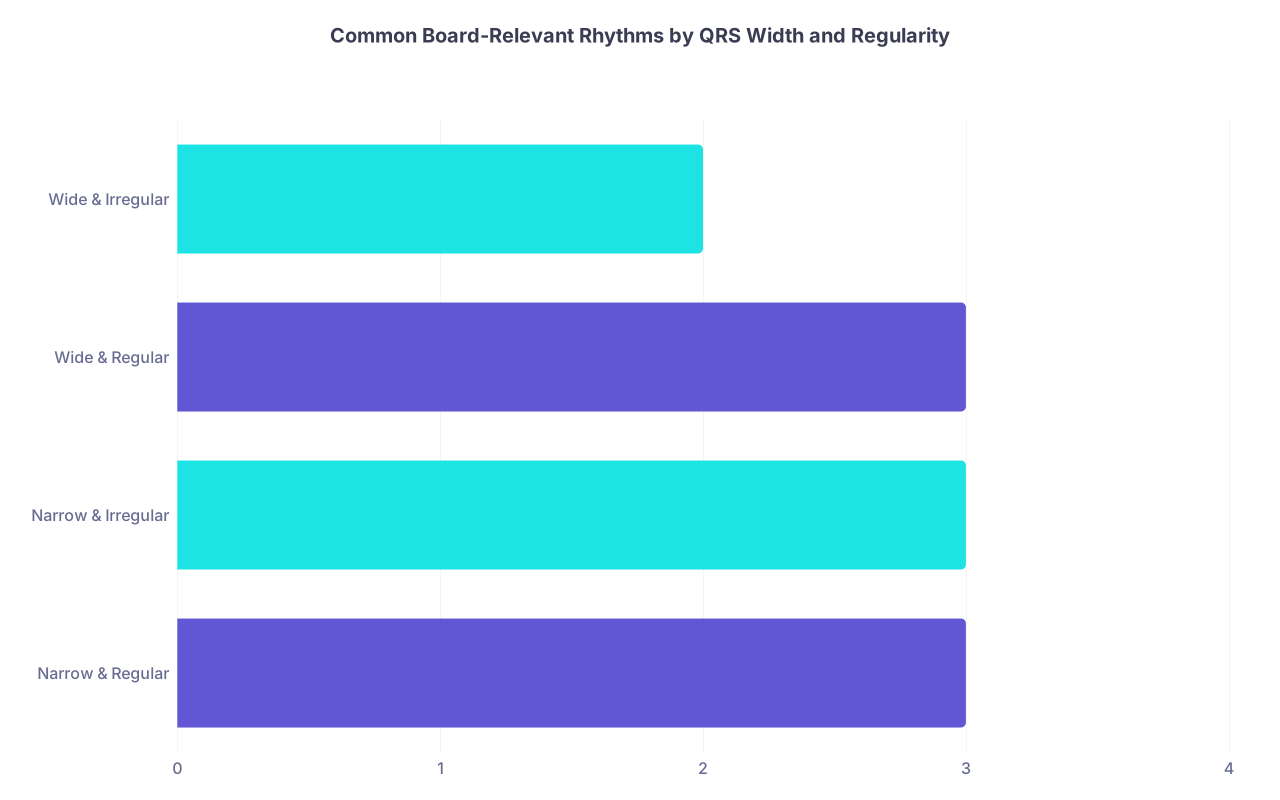
| Category | Value |
|---|---|
| Narrow & Regular | 3 |
| Narrow & Irregular | 3 |
| Wide & Regular | 3 |
| Wide & Irregular | 2 |
(Each category has a small, finite list of patterns. You should have 2–3 go‑to diagnoses per box.)
Pass 2: Rate and regularity
Do not waste time with exact box counting unless they are asking for something like “atrial flutter with 3:1 block” explicitly.
Rough rate categories:
- <40 → significant brady, think high‑grade block, junctional or ventricular escape.
- 40–60 → brady; may be sinus, junctional, or higher‑grade block depending on P waves.
- 60–100 → “normal” range. But check for AF with controlled ventricular response, flutter with 4:1, etc.
- 100–150 → common SVT or sinus tach zone.
150 and regular → classic AVNRT/AVRT or flutter (often ~150 for 2:1 flutter), or VT.
Regular vs irregular:
- Irregularly irregular + narrow QRS → assume AF unless P waves prove otherwise.
- Regular narrow tachy → AVNRT/AVRT vs sinus tach vs flutter with fixed conduction.
- Slightly irregular with multiple P morphologies and variable PR → MAT (think COPD).
At this point, with just QRS width + rate + regularity, you should have drastically narrowed down the realistic rhythms.
Pass 3: Look for obvious ischemia / repolarization patterns
Now, in 3–4 seconds, sweep ST segments and T waves:
You are looking for big-ticket patterns, not subtle ST depressions in V1.
Key board patterns to catch immediately:
STEMI: ≥1 mm STE in 2 contiguous limb leads or ≥2 mm in 2 contiguous precordials, usually convex or straight, with reciprocal depression.
Clusters:- II, III, aVF → inferior (think right ventricle involvement, heart block).
- V1–V4 → anterior / anteroseptal.
- V5–V6, I, aVL → lateral.
Diffuse ST elevation + PR depression in many leads, with reciprocal PR elevation in aVR → pericarditis.
Tall, narrow “hyperacute” T waves early post‑occlusion (subtle but high yield in explanations).
Deep symmetric T inversions and long QT in V2–V4 after reperfusion → Wellens (though less common in exam stems now than in FOAMed culture, still appears).
Giant peaked T waves + wide QRS + sine‑wave progression → hyperkalemia.
Scooped ST depression and bizarre ST‑T shape with sagging downsloping segments → digoxin effect. If combined with arrhythmias (atrial tach with block, VT) → dig toxicity.
You are not trying to call subtle subendocardial ischemia unless the stem and answers scream NSTEMI/UA vs stable angina.
Pass 4: Assess AV relationship — blocks and dissociation
Only now do you zoom into P waves, PR intervals, and P:QRS relationships.
Your goals:
- Is there a P for every QRS and a QRS for every P?
- Is the PR constant, lengthening, or variable?
- Are some P waves not conducted at all?
Core board patterns:
First‑degree block: PR >200 ms, every P conducted. Often incidental. Boards mostly use it as a distractor.
Mobitz I (Wenckebach): progressive PR prolongation until a dropped QRS. Grouped beating. Usually nodal, less dangerous.
Mobitz II: constant PR with intermittent non‑conducted P waves. Usually infranodal, dangerous, often with wide QRS. This is pacemaker territory.
Third‑degree (complete) heart block: P waves and QRS complexes march through independently, with no relation. Ventricular escape often slow and broad. Classic exam stems mention syncope, cannon A waves, and bradycardia.
Atrial flutter: sawtooth baseline, atrial rate ≈ 300, with fixed or variable conduction ratios (2:1, 3:1, 4:1).
AF: no discrete P waves, chaotic baseline, irregularly irregular QRS, variable R‑R.
Also look for AV dissociation with wide QRS tachycardia, fusion beats, capture beats → strongly supports VT over SVT with aberrancy.
Practical Pattern Sets You Must Own Cold
Let me break down the patterns that boards recycle mercilessly. If you can spot these in <5 seconds, your ECG questions become free points.
1. The “shock now” rhythms
If you mismanage these in exam logic, you miss the question even if you name the rhythm right.
- Pulseless VT / VF → Immediate unsynchronized defibrillation.
- Unstable VT with pulse → Synchronized cardioversion (not adenosine, not amio first).
- Unstable SVT or AF/flutter with RVR → Synchronized cardioversion.
- Torsades with hemodynamic compromise → Shock + magnesium (in their preferred sequence).
Boards are obsessed with this: “Do you shock this or do you push drugs first?”
Your mental script:
Wide, fast, unstable → shock.
Narrow, fast, unstable → shock.
Pulseless → defibrillate, not cardiovert.
2. The “call cath” ECGs
Anytime you see:
- STEMI pattern matching the symptoms (ongoing chest pain, diaphoresis, typical story):
The answer is almost always emergent PCI if the option exists. Not fibrinolysis if PCI is available and not “get troponins first.”
Classic trick stem: they give you a STEMI ECG, but the troponin is normal. The correct answer is still PCI because troponins lag.
Inferior STEMI with brady or AV block? They may be probing:
- Right ventricular involvement (look at V4R if given, hypotension with nitrates, clear lungs).
- Need to avoid nitrates and aggressively give fluids.
3. The “treat the potassium” ECGs

Boards love hyperkalemia patterns because the management is algorithmic:
ECG:
- Tall peaked T waves → early.
- Widening QRS, loss of P waves, sine wave → late and pre‑arrest.
Typical stem: “ESRD patient misses dialysis, now weakness, ECG shown.”
Correct sequence:
- IV calcium (gluconate or chloride) for membrane stabilization.
- Then shift K intracellular (insulin + dextrose, beta agonist, bicarbonate if acidotic).
- Then remove K (dialysis, resins).
If they show a hyperkalemic ECG and ask “next best step” and you choose insulin before calcium in a very high K + ECG changes scenario, you will get it wrong. The calcium answer is what they want when ECG is obviously abnormal.
4. The “SVT vs VT” fork
This is where residents overthink.
Real exam strategy:
- Any regular wide complex tachycardia in a sick-appearing adult with structural heart disease? Treat as VT. Period.
Evidence they use to drive this home in stems:
- History of MI, CHF, scar, ICD.
- Age > 50.
- Fusion beats, capture beats on strip.
- AV dissociation signs clinically.
In those cases, they want:
- If stable: IV amiodarone (or procainamide depending on the board’s habit), NOT adenosine, NOT vagal maneuvers.
- If unstable: synchronized cardioversion.
The only times they really want you to say “SVT with aberrant conduction” are:
- Younger patient, no structural heart disease, known bundle branch block baseline.
- Very fast narrow tachy that transiently becomes wide due to rate related aberrancy.
- Or when they are setting you up for an adenosine trial in a stable patient with regular narrow tachy.
But even then, they will rarely punish you for thinking “likely VT” in a wide complex unless they explicitly want the diagnostic nuance.
Putting It Together: A Realistic Exam Walkthrough
Let me run one all the way through.
Stem (condensed):
“62‑year‑old man with history of anterior MI presents with sudden onset palpitations and near syncope. BP 88/60, diaphoretic, cool extremities. Telemetry shows a wide complex tachycardia at 180/min. ECG shown. Next best step?”
Choices:
A. IV adenosine
B. IV amiodarone
C. Synchronized cardioversion
D. Carotid sinus massage
E. IV metoprolol
Your process:
From stem alone: older, prior MI, hypotensive, wide complex tachy. Likely VT, and he is unstable.
From answers: this is a management of unstable tachy question, not a subtle rhythm classification quiz.
From ECG (even a quick glance): wide complex regular tachy. You do not need to measure QRS or see capture beats to answer.
Correct answer: C. Synchronized cardioversion.
If you are still thinking about “SVT with aberrancy vs VT” when the BP is 88/60 with symptoms, you are off the exam’s wavelength.
Another type:
Stem (condensed):
“45‑year‑old woman with lupus presents with sharp pleuritic chest pain, worse when lying flat, improved leaning forward. Temp 38.2°C. BP 122/78. ECG shown.”
Choices:
A. Emergent PCI
B. High dose NSAIDs and colchicine
C. IV thrombolysis
D. Oral beta blocker and discharge
E. Heparin infusion and admit
ECG: diffuse concave ST elevation in most leads, PR depression, no reciprocal changes except maybe aVR.
Process:
- Stem: viral/autoimmune picture, positional pleuritic pain. Already screams pericarditis.
- Answers: they want diagnosis and treatment, not risk stratification for ACS.
- ECG: diffuse STE + PR depression → pericarditis.
Answer: B. High dose NSAIDs and colchicine.
Notice: you did not need to measure a single interval.
Training This Skill Under Real Exam Conditions
You cannot just “decide” to be faster at ECGs. You have to train the specific behavior: stem → choices → 10‑second ECG scan → decision.

| Step | Description |
|---|---|
| Step 1 | Read stem fast |
| Step 2 | Assess stability and context |
| Step 3 | Glance at answer choices |
| Step 4 | Check QRS width |
| Step 5 | Check rate and regularity |
| Step 6 | Scan for ischemia or classic patterns |
| Step 7 | Check P to QRS relationship if needed |
| Step 8 | Match to management in choices |
Here is how I tell residents to practice in the 4–6 weeks before exams:
Use question banks with ECGs (UWorld, MKSAP, board review books).
Do not just read the explanations. Force yourself through the workflow.For every ECG question:
- 10–15 seconds max to read the stem and declare “stable vs unstable, likely path.”
- 5 seconds to scan answer choices and label the question type.
- 10 seconds to run the ECG checklist.
Only after committing to an answer, read the explanation and ask:
- Did I misjudge stability?
- Did I miss a pattern I should recognize within 2–3 seconds?
- Did I overread something subtle and ignore something obvious?
Build a personal “pattern deck”:
Make a one-slide or one‑page collection for each of:- Classic STEMI territories
- AF, atrial flutter (with different conduction ratios)
- SVT (AVNRT/AVRT) vs VT
- Heart blocks (1st, Mobitz I, Mobitz II, complete)
- Hyperkalemia, digoxin effect, pericarditis, torsades
Review these visually every few days. Recognition becomes automatic.
| Category | Must-Recognize Patterns |
|---|---|
| Tachyarrhythmias | SVT, AF with RVR, atrial flutter, VT, torsades |
| Brady/Blocks | Mobitz I, Mobitz II, complete heart block |
| Ischemia | STEMI territories, Wellens pattern |
| Metabolic/Toxic | Hyperkalemia, digoxin effect |
| Pericardial | Acute pericarditis, tamponade clues |
Resident Life Angle: Why This Matters More Than You Think
You are busy. You have notes, pages, consults, and sign‑out. It is tempting to think ECGs are “cardiology stuff” that you will just look up later or let the attending read.
Here is the reality:
- On call at 3 a.m., you are the cardiologist for those first 5 minutes.
- For exams, no cardiologist is coming. It is you and a JPEG.
The residents who do well:
- Do not agonize over ECGs; they categorize them quickly and act.
- Ask cardiology to refine management, not to name the rhythm.
- Walk into rounds already knowing: “This strip is AF with RVR; we rate control and anticoagulate,” or “This is clearly Mobitz II with wide QRS; we need pacing.”
And because boards love to test “What should the resident do next?” you are training for both exams and real life simultaneously.
FAQs
1. Do I really have to memorize exact STEMI criteria and all lead territories for boards?
Yes. STEMI localization and recognition are basic expectations. You should know which leads are inferior (II, III, aVF), anterior (V1–V4), lateral (I, aVL, V5–V6), and how many millimeters of ST elevation constitute STEMI depending on chest vs limb leads. It is not optional at your level; they consider it core knowledge.
2. How precise do I need to be with heart block classification under time pressure?
You must reliably differentiate Mobitz I, Mobitz II, and complete heart block. That is because management diverges: Mobitz II and complete block often require pacing, while Mobitz I in a stable patient can be observed or treated conservatively. First‑degree block is rarely the point of the question; it is usually background noise. Practice on strips until you can spot grouped beating (Mobitz I) and constant PR with random drops (Mobitz II) without counting every interval.
3. How do I handle messy ECGs on the exam with poor resolution or odd printing?
You do not wrestle with them. You revert even harder to the systematic shortcut: narrow vs wide, regular vs irregular, any obvious massive ST/T abnormality, and P‑QRS relationship only if it is clearly visible. If the scan is low quality, the exam writers usually make the pattern exaggerated or the stem strongly supportive of the diagnosis. Trust the stem more when the image is bad; they are not trying to test your ability to count 1 mm boxes on a pixelated JPEG.
4. Is it ever correct to give adenosine in wide complex tachycardia on boards?
Very rarely, and only when they clearly frame it as “stable, regular wide complex tachycardia in a younger patient without structural heart disease where SVT with aberrancy is suspected.” Even then, most exam writers prefer that you treat undifferentiated wide complex tachycardia as VT. On standardized exams, adenosine is primarily the drug of choice for stable, regular narrow complex SVT, and occasionally as a diagnostic tool when they literally say that is the goal. When in doubt and the patient is sick: cardioversion over adenosine.
Key points:
- Stop reading ECGs first. Read stem → skim choices → then apply a 10‑second, exam-focused ECG checklist.
- Prioritize width, rate, regularity, and big-ticket patterns (STEMI, AF, VT, hyperkalemia, blocks) over fine detail.
- Train under time pressure with real ECG questions until these pattern sets are reflexive, not analytic.