
The way boards test quality improvement and patient safety is far more predictable than most residents realize.
Most people treat QI/PS questions like soft, hand‑wavy ethics items. That is why they miss them. Specialty boards, across internal medicine, surgery, pediatrics, EM, anesthesiology, you name it, use a surprisingly tight set of patterns. Once you see those patterns, these questions become easy points.
Let me break this down specifically.
1. What Boards Mean by “Quality Improvement and Patient Safety”
Boards are not testing whether you have a full Lean Six Sigma belt. They are checking three things:
- Do you understand how bad systems beat good people?
- Can you choose the right next step in fixing a safety or quality problem?
- Do you recognize unsafe practice and respond in a way that matches current culture and guidelines?
They wrap this inside their own blueprint language, but when you strip it down, the content clusters are very similar across specialties.
| Domain | ABIM (IM) | ABS (Surgery) | ABEM (EM) | ABP (Peds) |
|---|---|---|---|---|
| Patient safety culture | Yes | Yes | Yes | Yes |
| QI methods (PDSA, etc.) | Yes | Yes | Yes | Yes |
| Handoffs/communication | Yes | Yes | Yes | Yes |
| Medication safety | Yes | Limited | Yes | Yes |
| Infection prevention | Yes | Yes | Yes | Yes |
| Systems-based practice | Yes | Yes | Yes | Yes |
Guiding rule: if something regularly harms patients or shows up on incident reports—handoffs, med errors, central lines, falls—expect it to be fair game.
2. The Core Question Archetypes (You Keep Seeing the Same 7)
Boards love repeatable formats. For QI/PS, the archetypes are almost identical across specialties.
1. “What is the best next step to improve X?”
Classic format: They describe a problem trend. Then ask for the most appropriate intervention.
Example: ICU has high central line infection rates. Which intervention will most likely reduce CLABSI?
Wrong answers tend to be:
- “Educate staff more” (vague)
- “Discipline residents who violate the protocol”
- “Send reminder emails”
- “Post infection rates on the wall”
Right answers focus on:
- Standardized process
- Checklists
- Bundles
- System-level change
- Prospective measurement
So a better choice would be: “Implement a central line insertion checklist with a trained observer empowered to stop the procedure if elements are missed.”
2. Root Cause Analysis / Sentinel Event
They give you a bad outcome: wrong-site surgery, retained sponge, fatal heparin overdose, missed sepsis, etc.
Then they ask:
- Best next step after the event
- Most appropriate analysis method
- What to focus on to prevent recurrence
Red flags that boards punish:
- Blaming the individual
- Immediate termination as first step
- Telling the patient “nothing went wrong”
- Making major policy changes without analysis
High-yield answers:
- Conduct a root cause analysis with a multidisciplinary team
- Focus on system and process contributors
- Develop and test corrective actions
- Disclose the event to the patient/family honestly and empathetically
3. PDSA Cycles and QI Method Basics
They like testing whether you actually understand small tests of change.
Common question stems:
- “You want to reduce door‑to‑needle times. What is the most appropriate first step?”
- “Which of the following is the ‘Plan’ stage of PDSA?”
- “Which element belongs in the ‘Study’ phase?”
They want you to pick:
- Starting small (one clinic, one shift, one team)
- Baseline measurement
- Clearly defined metric
- Iterative testing, not “roll it out hospital‑wide tomorrow”
They punish:
- Giant system change with no testing
- Fuzzy goals (“improve satisfaction” without numbers)
- “Write a new policy and expect behavior to change”
4. Measurement: Structure, Process, Outcome, Balancing
This is a favorite exam toy.
They will give you an indicator and ask what type it is, or ask what you should measure next.
Examples:
- Percentage of patients discharged on appropriate DVT prophylaxis → process measure
- Postoperative mortality within 30 days → outcome measure
- Nurse‑to‑patient ratio in the ICU → structure measure
- ED length of stay after triage changes → outcome or flow; you might add falls or LWBS as balancing measures
Boards want you to:
- Recognize Donabedian’s triad (structure, process, outcome)
- Propose a process measure when you are early in a project
- Consider a balancing measure when you change something that might cause harm elsewhere (e.g., reducing LOS might increase readmissions)
5. Disclosure and Safety Culture
Every specialty board has bought into “just culture” language.
Common themes:
- How to talk to patients after errors or near misses
- When to disclose, what to say, who should say it
- Psychological safety: residents and nurses speaking up
Boards punish:
- Concealment
- Minimization (“We are not sure anything went wrong yet” when it clearly did)
- Blaming a single person without systems review
They reward:
- Honest disclosure of harm and error
- Apology (without getting into legal minutiae)
- Involving risk management or institutional leadership appropriately
- Encouraging reporting and non-punitive responses
6. Checklists, Standardization, and Bundles
You will see:
- Surgical safety checklist
- Time‑outs
- “Sign‑in / time‑out / sign‑out”
- Ventilator bundles
- Sepsis bundles
Question style:
- Which element most likely explains improvement?
- What is the most appropriate step to add?
- Why did the program fail?
High-yield answer patterns:
- Pre‑operative checklists reduce errors by standardizing critical steps.
- Empowering nurses/techs to stop the line improves adherence.
- If bundle compliance is low, first step is to understand workflow barriers, not just yell “do it better.”
7. Handoffs, Communication, and Teamwork
Expect SBAR/IPASS style questions:
- “What should be included in a safe sign‑out?”
- “Which action best reduces information loss between ED and inpatient”
- “How can you improve OR to PACU handoff?”
Right answers emphasize:
- Structured communication tools
- Closed‑loop communication
- Minimizing interruptions
- Clear assignment of responsibility
3. The QI/PS Content You Actually Need to Know (Not Everything)
You do not need a master’s in healthcare quality to pass boards. You need a targeted set of mental models.
Core QI Concepts
You should be fluent with:
PDSA cycles – what happens in each stage:
- Plan: define aim, choose metrics, plan the change and data collection.
- Do: implement on small scale, collect data.
- Study: analyze data, compare to predictions.
- Act: adapt, adopt, or abandon; plan the next cycle.
Types of measures:
- Structure: environment, resources, staffing, equipment.
- Process: what you actually do (adherence to protocols, time to antibiotics).
- Outcome: what ultimately happens to the patient.
- Balancing: checking that improvement in one area is not causing harm elsewhere.
QI vs research:
- QI: local improvement, usually no randomization, minimal risk, focused on operations.
- Research: generalizable knowledge, more formal design, IRB oversight.
They love that last contrast. Common trick stem: “Which project is QI vs research?” The one trying to “develop generalizable knowledge” is research. The one focused on “improving sepsis care in our ICU using evidence‑based guidelines” is QI.
Safety Concepts
There are a few safety buzzwords that boards expect you to treat as familiar territory.
- Swiss cheese model – multiple layers of defense, each imperfect; harm occurs when the holes align. In other words, they want you to look for system failures, not just the last person who touched the patient.
- Human factors – design systems that fit human limitations: checklists, standardized order sets, colors and shapes that reduce confusion, limit reliance on memory.
- High‑reliability organizations – preoccupation with failure, reluctance to simplify, sensitivity to operations, commitment to resilience, deference to expertise.
- Just culture – distinguishes:
- Human error (slip, lapse) → console and correct system.
- At‑risk behavior (shortcuts) → coach and redesign environment.
- Reckless behavior → disciplinary action.
That last breakdown shows up in stems like: “Nurse retrieves wrong medication from a poorly organized Pyxis. What is the most appropriate response by leadership?” Firing them is almost never the “best” answer on boards.
4. How Boards Wrap QI/PS into Clinical Vignettes
Nobody is asking: “Define PDSA.” Boards are not that naive.
They embed QI/PS into the same long vignettes you see for clinical management—but the question at the end is different.
Internal Medicine / Family / Pediatrics
Very common formats:
- Chronic disease clinic with poor control metrics (A1c, BP, asthma control), asking what system change will help.
- Hospital with high 30‑day readmissions, asking what intervention addresses the root problem.
- Outpatient practice struggling with vaccine uptake.
Sample board-style stem (abbreviated):
A clinic notes only 50% of eligible adults receive the influenza vaccine annually. Physicians report they “offer it when they remember.” What is the most effective next step?
Answer they want: Implement standing orders with nursing‑driven vaccination based on EMR prompts, removing reliance on physician memory.
Emergency Medicine
Expect:
- Door‑to‑ECG, door‑to‑balloon, sepsis bundle timing.
- ED overcrowding and boarding.
- Communication between EMS, ED, and inpatient teams.
They test:
- Protocols and pathways
- Triage safety
- Checklists during high‑acuity situations (e.g., RSI checklists)
Surgery / Anesthesia / OB‑GYN
You will see:
- Wrong‑site surgery prevention.
- Retained surgical items.
- Time‑outs and checklists.
- Preop optimization and postoperative monitoring.
Common trick: They give you a scenario that went badly (missed time‑out, incorrect implant). Wrong answer: “Remind the resident to be more careful.” Right answer: “Ensure full surgical safety checklist compliance with participation by the entire team and confirmation of patient, procedure, and site.”
Psychiatry
QIs often around:
- Medication reconciliation.
- Suicide risk assessment.
- Restraint use and monitoring.
- Coordination with primary care for metabolic monitoring of antipsychotics.
Problem scenario: Rising rates of patients lost to follow‑up post‑discharge. Best intervention: standardized follow‑up appointment scheduling before discharge + reminder systems + perhaps case management—not “tell the residents to emphasize compliance.”
5. High-Yield Patterns in Answer Choices
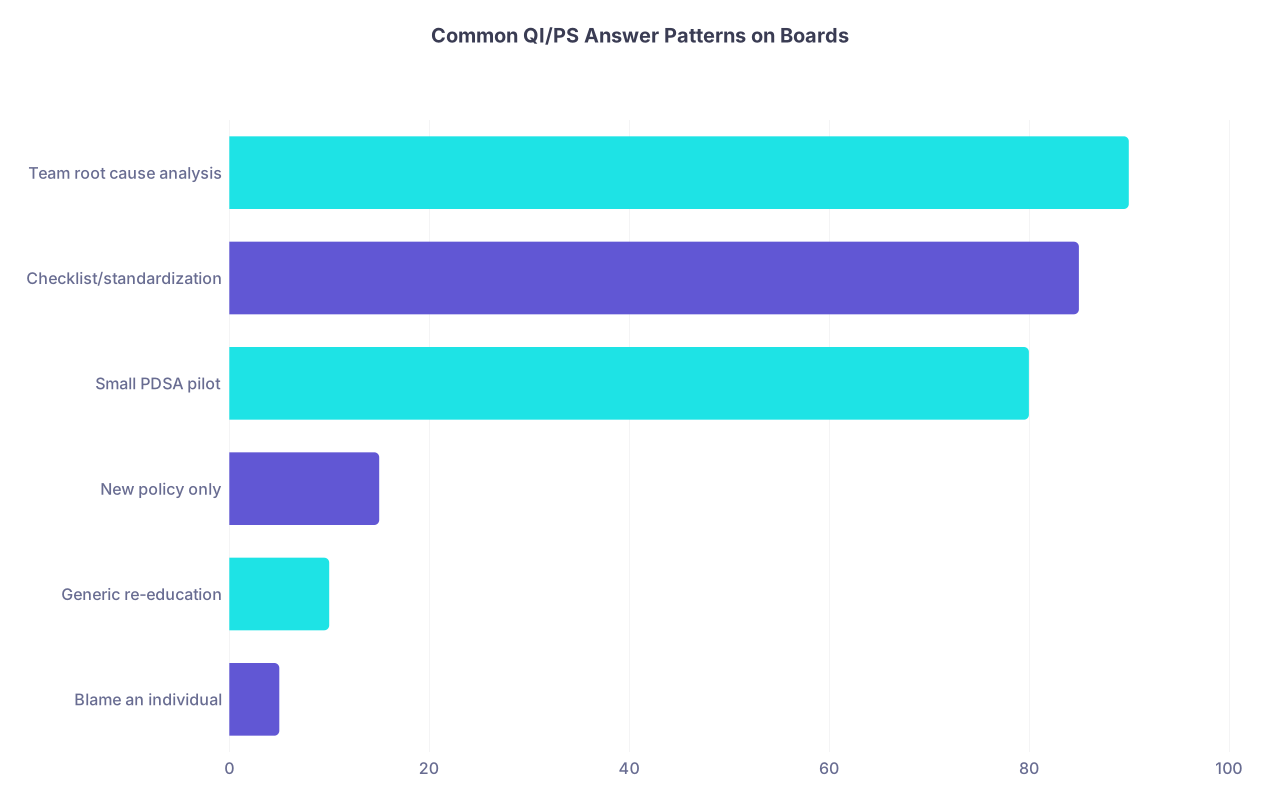
If you want a practical shortcut: you can often identify the correct QI/PS answer without even reading the full stem when you recognize board patterns. Do not rely on that alone, but use it as a check.
Here is the pattern:
| Category | Value |
|---|---|
| Blame an individual | 5 |
| Generic re-education | 10 |
| New policy only | 15 |
| Small PDSA pilot | 80 |
| Checklist/standardization | 85 |
| Team root cause analysis | 90 |
Those percentages are not exact, but that is the direction:
- “Teach everyone again” is almost never the best evidence-based answer by itself.
- “Write a new policy” without workflow or measurement rarely wins.
- “Discipline or fire the resident/nurse” is usually wrong unless the behavior is explicitly reckless or malicious.
- “Do a small pilot using a PDSA cycle,” “implement a standardized checklist,” or “conduct a multidisciplinary root cause analysis” are routinely favored.
Also high yield: anything that uses structured tools or data:
- Checklists
- Protocols / order sets
- Standardized handoff tools
- Audit and feedback based on data
- Baseline measurement and run charts
6. Specific Board Traps and How to Avoid Them
You know the style: they do not test concepts directly; they construct tricky distractors around them.
Trap 1: “Education fixes everything”
Stem: “Nurses frequently mis-program the infusion pumps.” Answer choices include:
- Provide in‑service training again.
- Simplify the pump interface and standardize medication concentrations.
- Send a warning memo to nursing staff.
- Require nurses to sign a statement after reading the policy.
Boards want: fix the system. Simplify the pump, reduce variability, enforce double‑checks where risk is high.
Teaching is not useless. It is just not sufficient when design is bad.
Trap 2: “Hero solutions”
Anything that relies on:
- “Work harder”
- “Pay more attention”
- “Be more vigilant”
This may feel intuitive, especially to residents used to living on adrenaline and caffeine, but safety science has moved beyond heroics. Boards reflect that.
The correct direction is always: reduce dependence on perfect human performance.
Trap 3: Massive rollout as “first step”
They love this one in QI/PDSA questions. Wrong choice: “Implement this new sepsis protocol across all ICUs and wards immediately.”
Right first step:
- Pilot in one unit.
- Collect data.
- Adjust.
- Then scale.
Remember: PDSA is iterative. Boards want you to respect that.
Trap 4: Confusing individual malpractice with system improvement
Sometimes there is clearly reckless behavior. A surgeon operating drunk, a resident altering documentation after an adverse event, a physician deliberately ignoring sepsis protocols.
In those cases, system change is still important, but boards will often expect you to:
- Remove the provider from duty.
- Report to proper authorities if required.
- Protect patients immediately.
You need to distinguish:
- Normal human error in a bad system → system fix + support.
- Deliberate or reckless action → individual accountability plus system review.
Trap 5: Disclosure weasel words
Boards care a lot about ethical disclosure.
Worst answer examples:
- “Tell the patient nothing went wrong but you will monitor closely.”
- “Wait until the internal review is complete before saying anything.”
- “Inform the family the outcome was unavoidable.”
Preferred answers:
- “Inform the patient and family that an error occurred, describe what is known, what you are doing to investigate, and express regret.”
- “Meet with the patient promptly with key team members to discuss the event openly.”
7. How QI/PS Content Is Growing on Exams (Reality Check)
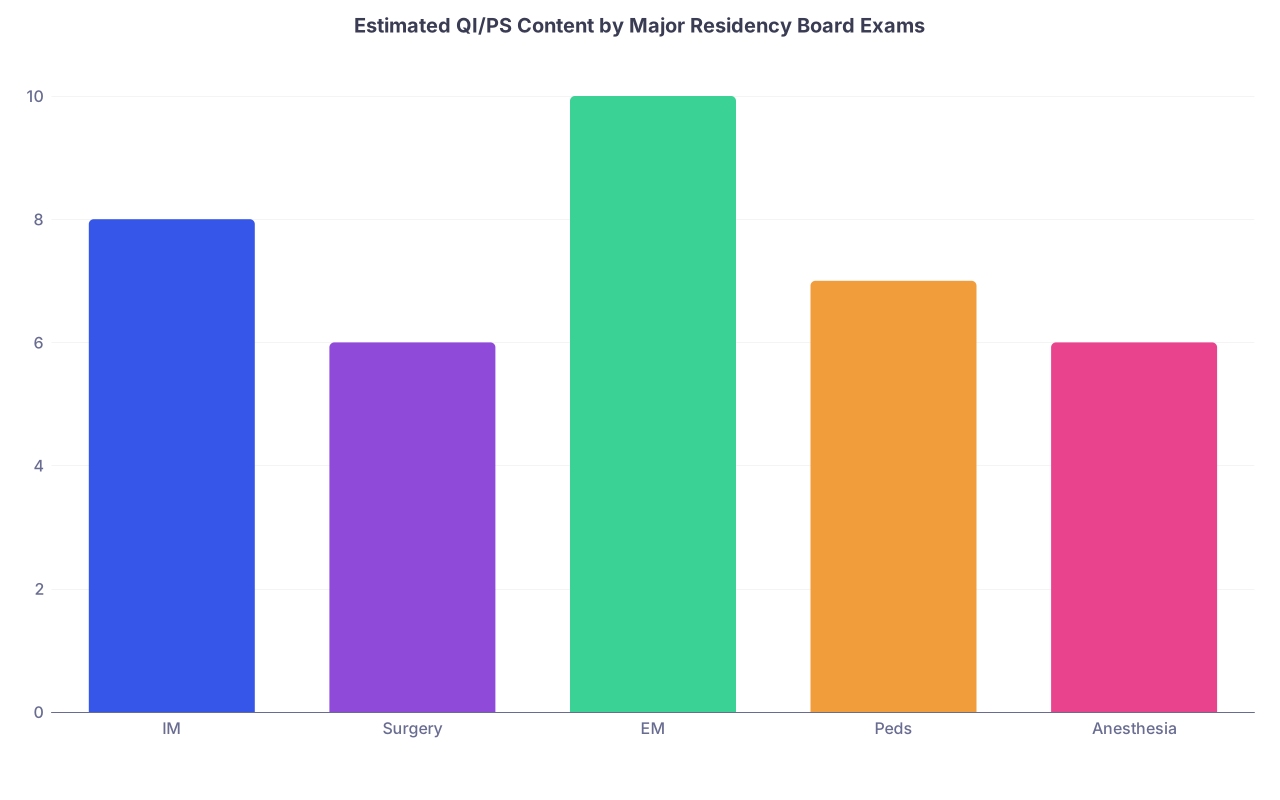
Every major board has increased its emphasis on QI/PS and “systems-based practice” in the last decade. Not because they love buzzwords. Because payers, regulators, and patients do.
You are unlikely to see 20% of your exam on QI/PS, but you will see it sprinkled everywhere.
| Category | Value |
|---|---|
| IM | 8 |
| Surgery | 6 |
| EM | 10 |
| Peds | 7 |
| Anesthesia | 6 |
Those are rough estimates, but directionally correct: EM and IM tend to have more overt systems questions; surgical boards sometimes hide them inside perioperative complications and checklists.
And it is not just written exams. OSCEs and oral boards use QI/PS scenarios explicitly:
- Explain how you would handle a near miss.
- Describe how to improve handoff quality between OR and ICU.
- Outline how you would respond to repeated wrong labeling of blood specimens.
In orals, they are watching for:
- Clear, structured thinking
- Recognition of system-level issues
- Straightforward, non-defensive language about error and risk
8. What to Actually Study (Without Wasting Time)
You do not need to memorize every QI framework ever invented. But you should not wing it either.
Prioritized list:
- PDSA cycle – one clean mental picture, including what belongs in each step.
- Donabedian’s structure‑process‑outcome model; add “balancing” as a practical test concept.
- Safety event response flow: immediate care for patient → disclosure → report → RCA → system changes.
- Common hospital QI interventions:
- Checklists and bundles (surgery, CLABSI, VAP, sepsis).
- Standardized handoff tools (SBAR, IPASS).
- Standing orders / nurse‑driven protocols (vaccines, DVT prophylaxis).
- Basic “just culture” tiers:
- Human error → consoling + system fix.
- At-risk behavior → coaching, remove incentives for shortcuts.
- Reckless behavior → discipline.
If you like processes laid out visually, this is roughly what boards imagine when they test “you handled this safety event correctly”:

| Step | Description |
|---|---|
| Step 1 | Adverse event occurs |
| Step 2 | Stabilize and care for patient |
| Step 3 | Disclose to patient and family |
| Step 4 | Report event in institutional system |
| Step 5 | Multidisciplinary root cause analysis |
| Step 6 | Develop system level interventions |
| Step 7 | PDSA pilot of changes |
| Step 8 | Measure outcomes and adjust |
Notice what is missing:
- “Yell at the intern”
- “Send a memo”
- “Wait and hope it does not happen again”
9. How to Think During the Exam: A Simple Mental Algorithm
You are in the exam. You hit a QI/PS question. You are tired and tempted to click “educate staff.”
Slow down and run this compact algorithm:
Is this describing a single bad actor doing obviously reckless stuff?
- Yes → choose answer with immediate patient protection and appropriate discipline/reporting.
- No → go to step 2.
Is the proposed solution system-level or individual-level?
- Prefer system-level: standardize, simplify, checklists, protocols, change equipment or workflows.
Does the option include measurement or testing?
- Prefer: baseline data, small pilot, PDSA, tracking metrics.
Is there any suggestion to hide or delay disclosure of an error?
- Avoid it. Choose honest, early disclosure paired with institutional review.
Is education the only intervention?
- If yes, it is probably not the best choice unless everything else is wildly off-base.
If you use that logic, you will get the vast majority of QI/PS items right.
10. Tying This Back to Real Residency Life (Not Just Exam Theater)
Unlike some obscure zebras, QI/PS questions are actually aligned with what you do daily.
The resident who understands this material:
- Speaks more confidently during morbidity and mortality.
- Drives better change on their ward or clinic.
- Sounds like a grown-up at job interviews when asked about “a system problem you helped improve.”
You do not have to lead a massive hospital project. But you should be able to say:
“I noticed delays in antibiotics for febrile neutropenia patients. We pulled baseline data, mapped the process, and then piloted a triage protocol in our ED where triage nurses would immediately flag oncology patients and initiate labs and IV access before physician evaluation. After a few PDSA cycles, median time to antibiotics dropped from 180 to 70 minutes.”
That kind of thinking is exactly what boards reward in multiple‑choice form.
If you want to be very literal, you can even sketch your own little “QI mental model” in your notes as you study:

Not pretty, but sufficient.
Key Takeaways
- Boards test quality improvement and patient safety through a small, predictable set of patterns: PDSA cycles, root cause analysis, system-level fixes, structured communication, and honest disclosure.
- Correct answers almost always emphasize systems over individuals, measurement over anecdotes, iterative tests over massive rollouts, and transparency over concealment.
- If you can recognize those patterns and avoid the classic traps—“re-education only,” heroic vigilance, and blame—you will turn QI/PS questions from vague irritants into reliable points on your board exams.