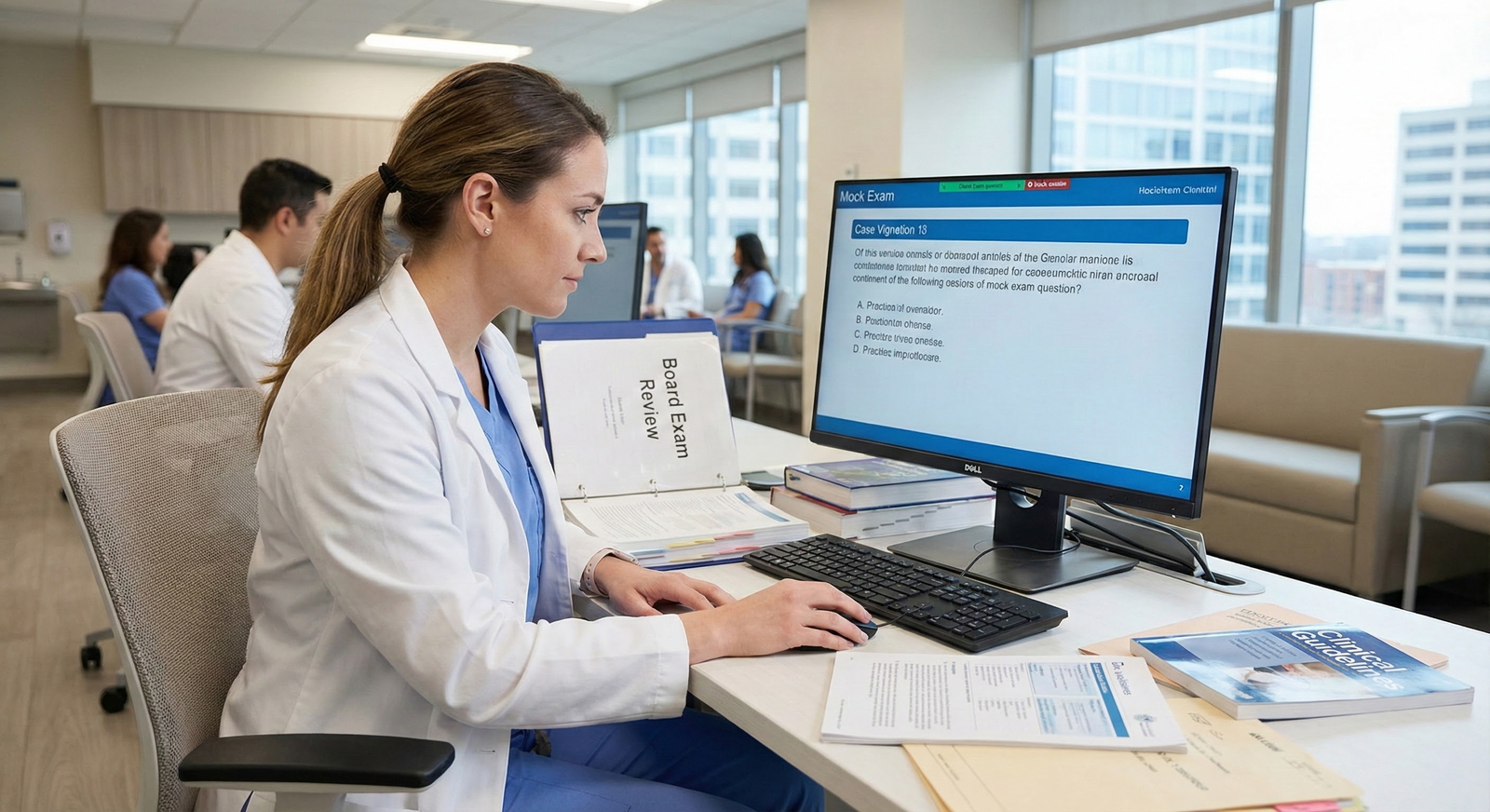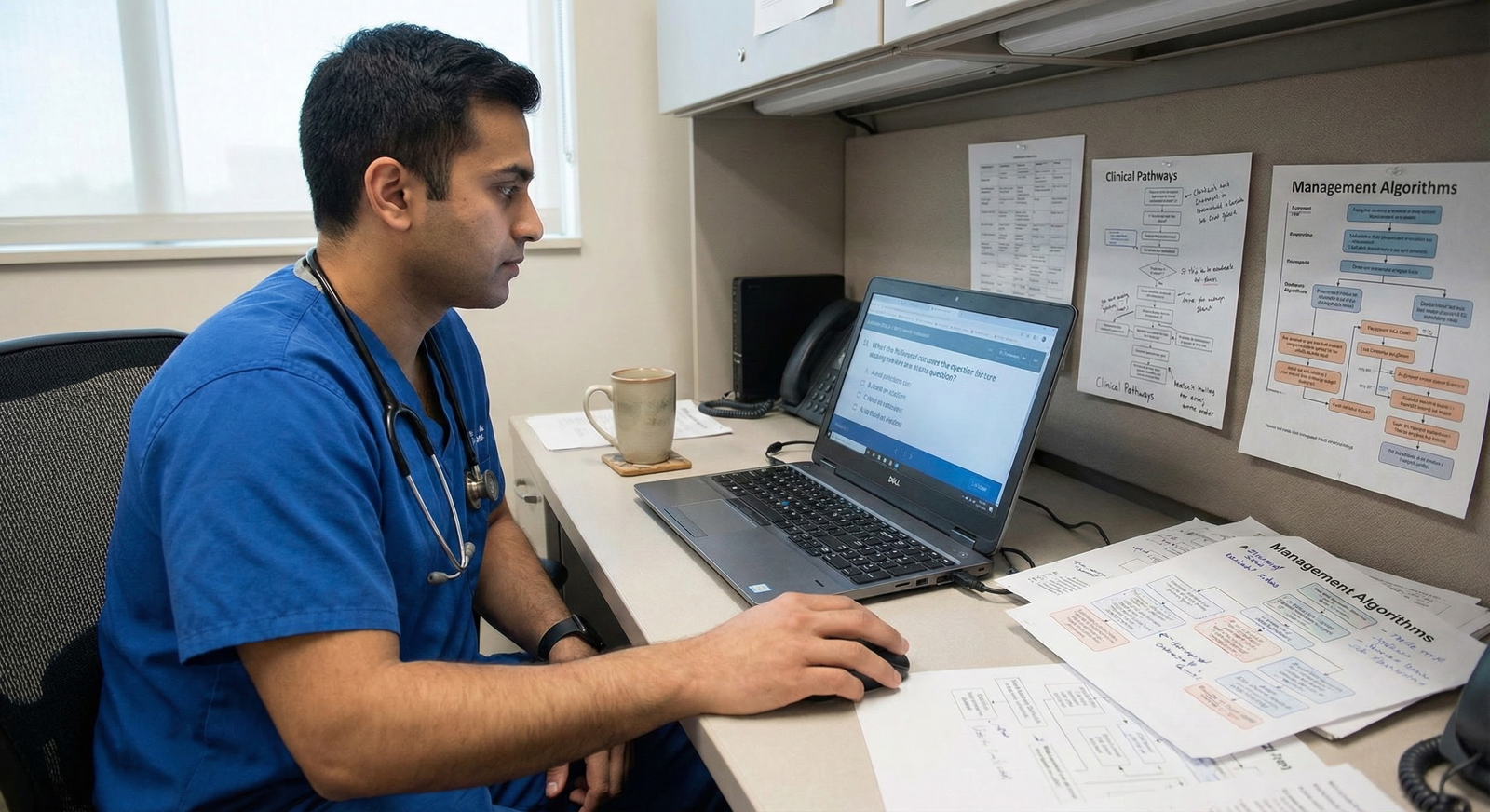
Board exam preparation is one of the defining challenges of residency. These exams shape eligibility for board certification, influence fellowship and job opportunities, and often feel like a referendum on years of training. Yet even highly capable residents unintentionally sabotage their performance with a few common, predictable mistakes.
Understanding these pitfalls—and having a plan to avoid them—can transform a stressful, haphazard study experience into a strategic, sustainable process that supports both performance and well-being.
Below are the top five mistakes residents make when preparing for board exams, along with detailed, practical strategies to help you study smarter, protect your wellness in medicine, and enter exam day with genuine confidence.
Mistake 1: Procrastination and Poor Time Management in Board Exam Preparation
Residents are already stretched thin with clinical duties, research, call schedules, and personal responsibilities. Under these pressures, it’s easy to delay serious board exam preparation until “things calm down”—which, in residency, rarely happens.
How Procrastination Undermines Performance
Putting off board studying doesn’t just compress your timeline; it changes how your brain learns:
- Cramming overloads memory: Short, intense bursts of last-minute studying may help with isolated facts but are poor for long-term retention and application—exactly what board exams test.
- Increased anxiety: The closer you get to the exam without a clear plan, the more anxiety rises. Anxiety then impairs focus, sleep, and recall, creating a vicious cycle.
- Inefficient learning: Under time pressure, residents tend to re-read notes or highlight rather than use high-yield strategies like spaced repetition and practice testing.
- Missed opportunities: Without early planning, you may fail to integrate board-focused learning into daily clinical work, losing one of the most powerful learning tools you have.
Building a Realistic, Resident-Friendly Study Plan
Effective board exam preparation starts with structured time management that respects your reality as a resident.
1. Start with a backwards timeline
- Identify your exam date.
- Count back 4–6 months for serious, structured studying (for some specialties or if content is weaker, 6–9 months is more comfortable).
- Divide that time into:
- Foundation phase (first 1–2 months): Content review, light questions.
- Integration phase (middle): Heavier question bank use, targeted review.
- Refinement phase (final 4–6 weeks): Practice exams, fine-tuning, high-yield review.
2. Use micro-planning, not just big goals
Instead of vague goals like “start boards studying in January,” translate your Board Exam Preparation into weekly and daily tasks:
- Weekly goals:
- “Complete 200–250 question bank items and review them fully.”
- “Finish cardiology and nephrology sections of main review book.”
- Daily goals (flexible by call schedule):
- “30–40 questions on off days; 10–20 on heavy call days.”
- “Review flashcards for 20 minutes before bed.”
3. Use tools that fit your workflow
- Digital calendars (Google Calendar, Outlook) to block:
- 30–60 minute study blocks around shifts
- Dedicated “review and question” slots on lighter days
- Task apps (Todoist, Notion, Trello) with:
- Sections for systems (e.g., Cardio, Pulm, ID)
- Checklists for question blocks, videos, and chapters
- Dedicated board prep trackers:
- Many question banks have built-in progress trackers—use these to monitor pace and avoid falling behind.
Time Management Tips for Busy Rotations
- On heavy inpatient or ICU months:
- Aim for maintenance mode: small, consistent doses (10–20 questions, 15–20 minutes of flashcards).
- Don’t expect major content overhauls; just keep momentum.
- On lighter or elective months:
- Increase volume: 40–80 questions per day, longer review sessions.
- Schedule 1–2 mini “full-length blocks” under timed conditions each week.
When you honor your time constraints but maintain consistency, you replace procrastination with progress—and protect yourself from a frantic last-minute scramble.
Mistake 2: Neglecting Practice Questions and Mock Exams
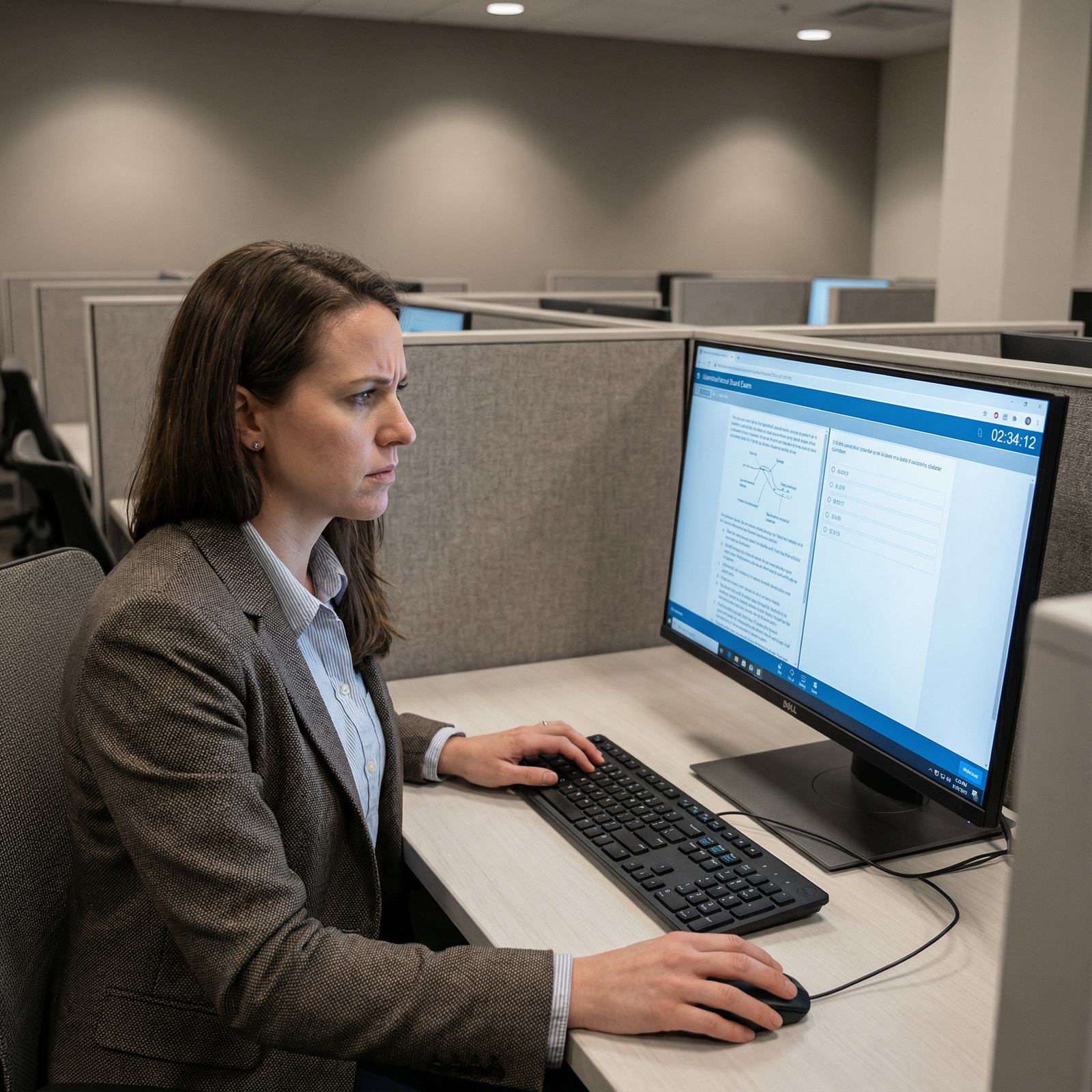
Many residents still approach Board Exam Preparation as if they’re studying for a traditional written test: heavy reading, note-taking, and watching lectures—but relatively few practice questions. This is one of the most damaging mistakes.
Why Practice Questions Are Non-Negotiable
Board exams are not testing your ability to recite lists; they’re assessing your ability to:
- Recognize patterns
- Interpret clinical vignettes
- Prioritize in complex scenarios
- Manage time under pressure
Practice questions directly train these skills, while also:
- Providing active recall, which is far more effective than passive reading.
- Highlighting knowledge gaps, so you can target weak areas.
- Familiarizing you with question style and traps, reducing surprises on exam day.
- Building stamina for long exam blocks.
How to Use Question Banks Strategically
1. Start early and build steadily
- Begin using a question bank at least 4–6 months before the exam.
- Early phase:
- 20–30 questions per day, untimed if needed.
- Focus on learning from each item, not on speed.
- Middle and late phases:
- Increase to 40–80 questions per day when feasible.
- Add timed blocks (e.g., 40–60 questions in 1–1.5 hours).
2. Prioritize depth of review over raw numbers
Just “doing questions” without thorough review wastes effort. For each block:
- Spend at least as long reviewing as doing the questions.
- For incorrect or guessed items:
- Understand why the correct answer is right.
- Understand why each incorrect choice is wrong.
- Ask: “Would I get this right next time? What single takeaway will make that happen?”
- Keep a running list of high-yield points:
- Can be a digital document, flashcards, or app-based notes.
- Revisit weekly to reinforce.
3. Use multiple modes: tutor vs timed
- Tutor mode:
- Early-phase learning.
- Good for new or weak areas (e.g., neuro, rheumatology).
- Timed mode:
- Middle/late phases.
- Essential for time management and building endurance.
The Role of Full-Length Mock Exams
Too many residents skip full-length practice tests or leave them until the last week. This misses several benefits:
- Stamina: Most board exams require 6–9 hours of focused effort.
- Pacing: You learn how fast you must move to finish comfortably.
- Psychological readiness: A full simulation reduces fear of the unknown.
Aim to:
- Take 2–3 full-length practice exams in the final 6–8 weeks.
- Simulate real conditions:
- Same wake-up time
- Same nutrition and caffeine plan
- Minimal phone use during breaks
- After each exam:
- Analyze performance by content area and question type.
- Adjust study priorities based on weak sections.
Question banks and mock exams are the backbone of effective preparation. Reading fills the reservoir of knowledge; practice questions teach you how to use it under exam conditions.
Mistake 3: Overlooking Study Groups and Peer Collaboration
Many residents assume they’re better off studying solo. While individual study is essential, completely avoiding collaboration can limit your understanding and motivation—especially during a long Board Exam Preparation period.
How Peer Collaboration Enhances Learning
Collaborative learning supports board prep in ways individual study cannot:
- Explaining concepts improves mastery: Teaching a topic to peers forces you to organize your knowledge and identify gaps.
- Exposure to different frameworks: Colleagues may have mnemonics, heuristics, or algorithms you haven’t seen.
- Accountability matters: Knowing others are expecting you to show up prepared keeps you on track when motivation dips.
- Emotional support: Residency and exam prep can feel isolating. Peers normalize your challenges and share coping strategies.
Designing an Effective Study Group
A productive study group is intentional—not just a social gathering with laptops.
1. Choose the right people
- 3–5 members works best—small enough to stay focused, large enough for diverse strengths.
- Aim for:
- Similar exam timelines and levels of commitment
- A mix of strengths (e.g., someone strong in ICU topics, someone strong in outpatient management)
2. Set clear structure and expectations
- Frequency: 1–2 times per week for 60–90 minutes.
- Format ideas:
- Rapid-fire questions: Each person brings 5–10 questions to discuss.
- Case-based discussions: Present short clinical vignettes and walk through diagnosis and management.
- Topic teaching: Rotate who gives a brief, 10–15 minute “mini-teach” on a focused subject (e.g., hyponatremia, anticoagulation reversal).
- Norms:
- Start and end on time.
- Minimize distractions (phones away, pagers on vibrate if possible).
- Come with at least one concept or question to contribute.
3. Use group time for higher-order thinking
Avoid simply reading slides together. Instead, focus on:
- Decision-making in ambiguous cases.
- Differential diagnoses for common board vignettes.
- Debating “why not” for wrong answer choices.
If in-person isn’t feasible, use virtual platforms (Zoom, Teams, WhatsApp audio) to maintain collaboration on busy rotations or during night float.
Mistake 4: Inadequate Focus on Clinical Application and Exam-Style Thinking
Board exams are not pure recall tests. They’re designed to assess whether you can think like a safe, competent physician under realistic conditions. Residents who memorize guidelines and lists without embedding them in clinical context often struggle with vignette-based questions.
Bridging the Gap: From Facts to Clinical Reasoning
Effective Board Exam Preparation integrates what you read with what you see on the wards and in clinic.
1. Turn real patients into learning anchors
Use daily patient encounters as board-relevant teaching tools:
- For each interesting case, ask yourself:
- “If this were a board question, what would the stem emphasize?”
- “What is the single most important next step in management?”
- “What red flags or atypical features could show up on boards?”
- After rounds, take 5–10 minutes to:
- Look up guideline-based management.
- Capture 2–3 board-style learning points (“In a patient with X and Y, the preferred next step is Z.”).
2. Study with clinical vignettes at the center
When choosing resources, prioritize those with:
- Case-based explanations
- Stepwise reasoning
- Emphasis on “next best step” in management
While reading, practice:
- Predicting the answer before you see the options.
- Asking:
- “What is life-threatening here?”
- “What do I need to rule out first?”
- “Is this an outpatient vs inpatient problem?”
This mindset mirrors how real exams are written.
3. Use attendings and fellows as real-time board coaches
Attendings can be invaluable for refining board-style reasoning:
- During rounds, silently think: “What’s the board answer to this scenario?”
- When appropriate, ask:
- “How would this case be written on the boards?”
- “What features would they emphasize to point toward diagnosis X vs Y?”
- “What do exam writers want us to avoid in this situation?”
You’ll often get nuanced, experience-based tips that you won’t find in review books.
Mistake 5: Ignoring Wellness and Self-Care During Board Exam Preparation

Many residents unconsciously accept a harmful belief: that suffering and self-neglect are the price of success. In reality, ignoring wellness in medicine during intense Board Exam Preparation directly harms your ability to learn, retain, and perform.
How Burnout Sabotages Exam Performance
Chronic sleep deprivation, stress, and emotional exhaustion impair:
- Working memory – making it harder to understand complex vignettes.
- Attention and focus – especially in later exam blocks.
- Emotional regulation – increasing panic when encountering difficult sections.
- Motivation – increasing the urge to procrastinate or give up.
Over time, this can lead to disengagement from both studying and clinical work.
Building Sustainable Wellness Habits During Board Prep
You don’t need a perfect “self-care routine.” You need small, consistent habits that support brain function and emotional resilience.
1. Protect your sleep as a core study tool
- Aim for 7–8 hours on most nights when possible.
- Use strategic naps (20–30 minutes) on post-call or heavy days instead of forcing low-quality late-night studying.
- In the 1–2 weeks before the exam, work toward a stable sleep-wake schedule matching exam day.
2. Incorporate movement, even in small doses
- 10–20 minutes of walking, stretching, or light exercise:
- Improves focus and mood.
- Reduces stress hormones.
- On busy days:
- Take the stairs, walk during lunch breaks, or do short bodyweight exercises at home.
3. Set realistic study boundaries
- Designate protected time off: at least one half-day per week where you are not studying for boards.
- Communicate with family or partners about:
- When you need quiet, focused time.
- When you will be fully present with them.
- Avoid turning every spare moment into more studying; mental breaks are part of effective time management.
4. Use available support systems
- Many programs now have:
- Resident wellness initiatives
- Counseling services
- Peer support or mentorship programs
- If anxiety or burnout feels overwhelming:
- Consider professional help early—therapy, coaching, or support groups tailored to physicians can make a significant difference.
- Share your concerns with trusted mentors; they may help adjust schedules or provide perspective.
Wellness in medicine is not optional or a luxury. It’s a performance-enhancing, career-sustaining necessity—especially during demanding milestones like board exams.
Putting It All Together: A Sample Integrated Study Strategy
To see how these principles work in real life, consider this example of a PGY-2 internal medicine resident preparing for boards over six months:
Months 1–2: Foundation and Planning
- Create a 6-month calendar with weekly goals.
- Start a primary question bank:
- 20–30 questions per day in tutor mode.
- Begin a simple study group:
- 1 meeting per week, 60 minutes of case-based review.
- Focus on:
- Cardio, pulm, and ID content review.
- Integrating learning with daily patients.
Months 3–4: Integration and Expansion
- Increase to 40–60 questions per day, mostly timed blocks.
- Use performance analytics to:
- Identify weaker systems (e.g., rheumatology, endocrine) and allocate extra time.
- Add a second weekly study group meeting if helpful.
- Take first full-length practice exam at the end of month 4:
- Adjust study plan based on results.
Months 5–6: Refinement and Exam Readiness
- Emphasize:
- High-yield review
- Missed questions
- Weak topics from practice tests
- Complete at least two additional full-length practice exams under exam-like conditions.
- In the final 2 weeks:
- Focus on consolidation and rest, not learning entirely new material.
- Stabilize sleep schedule and refine exam-day logistics (what to bring, timing, nutrition).
Throughout the 6 months, this resident:
- Maintains one protected half-day per week off from studying.
- Incorporates short walks or light exercise most days.
- Uses clinical cases on the wards as daily board prep opportunities.
This kind of plan is structured but flexible, demanding but humane—and aligns with how adults learn best under pressure.
Frequently Asked Questions (FAQ)
1. When should I realistically start studying for my board exams during residency?
For most core specialty board exams, a 3–6 month focused preparation window works well, depending on your baseline knowledge, schedule, and specialty.
- If you feel less confident with core content, are changing specialties, or have a very demanding schedule, consider starting 6–9 months out with low-intensity preparation (e.g., small daily question sets, light reading).
- Intensify your efforts in the final 3–4 months with more structured question blocks, mock exams, and focused review.
2. How many questions should I aim to complete before the exam?
A common target is at least one full question bank, often around 2,000–3,000 questions, with thorough review. Many high scorers complete 1.5–2 full passes of a bank, but quality matters more than raw numbers.
A reasonable benchmark is:
- Early phase: 20–30 questions/day
- Middle/late phase: 40–80 questions/day when schedule allows
Always budget time to deeply review why answers are right or wrong.
3. What are the most effective study techniques for long-term retention?
The most evidence-based techniques for board prep include:
- Active recall: Testing yourself rather than re-reading (flashcards, question banks).
- Spaced repetition: Revisiting material at increasing intervals (e.g., Anki or similar tools).
- Interleaving: Mixing topics (e.g., alternating cardio and renal questions) rather than studying each topic in isolation for long periods.
- Elaborative practice: Asking “why” and “how” for key concepts and tying them to clinical cases.
Combining these with consistent practice questions and clinical integration yields the best long-term results.
4. How should I adjust my study strategy in the final month before the exam?
In the final 4 weeks, shift from broad content coverage to refinement and performance:
- Focus on:
- Reviewing your weakest topics identified from question banks and practice exams.
- Re-doing missed or marked questions.
- Practicing timed blocks and at least 1–2 full-length practice exams.
- Avoid:
- Starting entirely new, dense resources from scratch.
- Extreme cramming that sacrifices sleep and wellness.
Use this period to consolidate knowledge, solidify test-taking strategy, and optimize your physical and mental readiness.
5. What can I do if I struggle with test anxiety despite adequate preparation?
Test anxiety is common among high-performing residents. Strategies that often help include:
- Simulated practice: The more you expose yourself to exam-like conditions, the less threatening they feel.
- Structured routines: Having a clear exam-day plan (sleep, meals, transportation, timing) reduces uncertainty.
- Cognitive strategies: Reframing anxious thoughts (“I’ve prepared systematically; it’s normal to feel nervous”) rather than trying to eliminate them.
- Relaxation techniques: Deep breathing, brief mindfulness exercises, or progressive muscle relaxation before and during breaks.
- Professional support: If anxiety significantly interferes with studying or functioning, consider talking to a mental health professional familiar with physicians and high-stakes testing.
By avoiding these five common mistakes—procrastination, underuse of practice questions, isolation from peers, failing to link content to real clinical practice, and neglecting your own wellness—you set yourself up not just to pass your board exam, but to approach it with clarity, confidence, and resilience.
Board Exam Preparation during residency is demanding, but it doesn’t have to be chaotic or self-destructive. With strategic planning, effective Study Tips, intentional Time Management, and a real commitment to Wellness in Medicine, you can turn this challenge into a powerful capstone to your training and a springboard for the next phase of your medical residency and career.