
What happens to your career if your body gives out before your training does?
I've asked myself that at 2 a.m. more times than I'll admit. You're in fellowship, or finishing residency, and everyone keeps asking the big question, academic or private practice? like it's a personality quiz. Meanwhile you're doing a different kind of math in your head: What if I get sick? What if I need surgery? What if the thing I've been ignoring in my own body becomes a thing I can't ignore? And suddenly the career question isn't about prestige or RVUs anymore. It's about survival.
So let's walk through the fear together, because I've done the catastrophizing already, and some of it is justified, and some of it isn't.
Before we get into it: this article is for educational purposes only and is not financial advice. It is not legal advice and it is not tax advice. Contract terms, insurance policies, and benefits figures vary widely by institution, state, and employer, so consult a qualified professional before making decisions about disability coverage, employment contracts, or loan repayment.
What If I Get Sick Right Now? The Fear of Losing My Spot
The panic starts with a simple thought: if I can't show up, do I still have a job? In residency and fellowship, that fear has a specific flavor, because training spots feel fragile. You fought for this position. You don't want to be "the one who had to take leave."
If you're leaning academic, the anxiety gets sharper. It's not just about showing up to clinic, it's about the research output hanging over your head. What if three months of recovery means three months of zero publications? What if that's the difference between staying and being quietly pushed out?
Here's the first thing to check: has anyone in your program actually taken medical leave before? Ask around. A program that has shepherded people through maternity leave, cancer treatment, or back surgery, and brought them back, is telling you something real about itself.
Academic Medicine: The 'Publish or Perish' Trap
Academic medicine runs on a clock that does not care about your health. The tenure clock ticks. Grant cycles roll. Your division chief needs publications to justify your protected research time. And here's the ugly truth nobody says at recruitment dinners: a lot of academic faculty income is soft money. If your salary depends on grant funding and you can't do the work, the financial logic of keeping you gets uncomfortable fast.
The worst-case scenario is real, and I won't pretend it isn't. I've watched a junior faculty member take extended leave for a serious diagnosis, come back to a lapsed grant, and spend a year clawing back toward funding that never fully materialized. Tenure-track positions have slipped away over less.
Then there's the bureaucracy, which deserves its own special place in hell. Medical leave in a university setting means coordinating between HR, the GME office or faculty affairs, your department chair, and sometimes a promotions committee, four or five offices that barely speak to each other. FMLA gives you twelve weeks of job-protected, unpaid leave, assuming you qualify. Unpaid. Let that sit for a second.
Most institutions technically allow you to "stop the tenure clock" for medical reasons. On paper, great. In practice? I've heard senior faculty whisper about candidates who "took time off" like it's a character flaw. That's my honest read: academia's sick leave problem isn't the policy, it's the stigma. The written rules are usually decent. The culture around using them is not.
Does this mean academic medicine is a death trap for anyone with a health condition? No. Big academic centers often have genuinely strong benefits, structured leave policies, and institutional short-term disability. But you need to verify that before you sign, not after you're hospitalized.
Private Practice: Is It the Safety Net I Need?
Private practice looks like the obvious escape hatch when you're scared. No tenure clock. No publication quota. You see patients, you go home, and if you need two weeks off, you rearrange the schedule instead of filing paperwork with a dean.
And honestly? That relief is real. The absence of research pressure removes an entire category of "what if I'm falling behind" terror. Nobody in a private group is counting your citations.
But here's where my anxiety just flips directions instead of disappearing. Private practice flexibility is often just risk in a different costume.
Think about how a small group actually works. Your income is frequently productivity-based. If you can't see patients, the money stops, sometimes immediately. Your partners cover your panel, and even if they're saints about it, you're watching them absorb your workload while you recover, and you're doing the math on how much goodwill that burns. In a four-person group, one physician out for six months is a genuine crisis for everyone.
The benefits picture is wildly variable, too. A hospital-employed practice might offer disability coverage that rivals any university. A small independent group might hand you a high-deductible health plan and a group disability policy that caps out at a fraction of your actual income. I've seen contracts where the "benefits package" was basically a handshake and a 401(k).
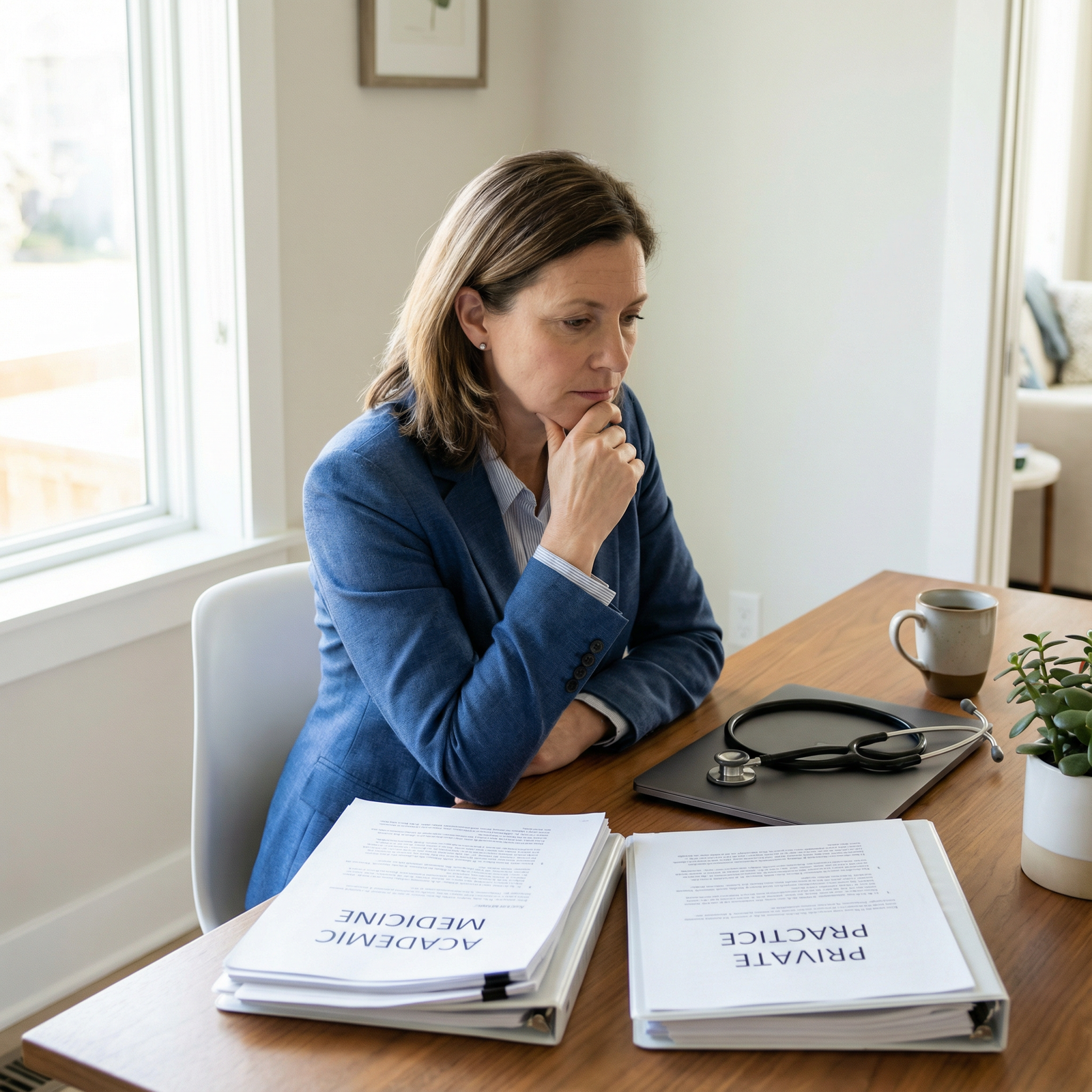
So no, private practice isn't automatically the safe choice. It solves the research pressure problem beautifully. It can make the financial protection problem worse. You trade one fear for another, and the only way to know which fear you're signing up for is to read the actual contract.
Financial Anxiety: Disability and Loan Repayment
Let's talk about the thing that actually keeps me up: the loans. That number sitting on your chest. The terrifying scenario isn't just getting sick, it's getting sick, losing income, and watching loan payments pile up while you can't work.
This is where the academic vs. private practice comparison gets concrete.
Disability insurance. Academic centers typically offer group long-term disability, often around 60% of your salary, frequently with a cap, and commonly shifting to an "any occupation" definition after a couple of years. Translation: after a certain point, if you're well enough to do some job, benefits can shrink or stop. Also, if the employer pays the premium, the benefit is usually taxable income. Private practice coverage is a choose-your-own-adventure, some groups have solid group policies, others leave you entirely on your own.
Here's my strong opinion, and I'll die on this hill: buy your own individual, own-occupation, specialty-specific disability policy during training, regardless of which path you choose. Own-occupation means if you can't do your specialty, you get paid, even if you could theoretically do something else. It follows you between jobs. Group coverage doesn't. This one decision defuses more worst-case scenarios than anything else in this article.
Loan repayment. Many academic centers qualify as PSLF employers, and some offer their own repayment assistance. Leave early, or get pushed out, and that assistance evaporates. Private practices often don't qualify for PSLF at all unless they're hospital-employed through a nonprofit. And while federal loans offer deferment, forbearance, and even discharge for total and permanent disability, those are last-resort options with long tails.
The chart below shows the general pattern, not gospel, because figures vary enormously by employer, but it captures the trade-off that made my head spin.
The pattern: academic medicine tends to offer a sturdier institutional floor. Private practice offers freedom, but you may have to build the floor yourself.
Navigating the Choice: A Decision Framework
Okay. Deep breath. How do you actually decide when you're scared?
Start with honest risk assessment. Do you have a chronic condition, a family history, or a body that's already sending warning shots? That's not pessimism, that's data. If your medical risk is elevated, the flexibility of private practice (paired with a rock-solid individual disability policy) starts looking very rational.
Then, before you accept any position, ask the uncomfortable questions. Out loud. In interviews. I know it feels like you're jinxing yourself. Ask anyway:
- How many faculty or physicians here have taken extended medical leave in the past five years, and what happened to their careers afterward?
- Is there paid medical leave beyond FMLA, or is it unpaid the moment PTO runs out?
- What exactly does the group disability policy cover? What's the cap, and is it own-occupation?
- Does the tenure clock stop for medical leave, and has anyone who stopped it actually been promoted here?
- (For private practice) If I can't work for six months, what happens to my income, my panel, and my partnership track?
That last one matters more than people realize. If you're on a partnership track with a buy-in, ask what happens to that investment timeline if disability hits before you buy in. Nobody thinks to ask. Ask.
And build the contingency plan now, while you're healthy: the individual disability policy, an emergency fund covering a few months of expenses, a working knowledge of your FMLA rights, and documentation of everything. Worst-case thinking is only useful if it turns into preparation. Otherwise it's just suffering in advance.
Notice what this framework doesn't include: prestige. Your CV will survive a detour. You might not survive pretending you're invincible.
Remember: You Are Human, Not a Machine
Here's the reassurance I needed someone to say to me, so I'll say it to you: programs and practices handle medical leave all the time. Physicians get cancer. Physicians have surgeries, pregnancies with complications, mental health crises, car accidents. The system is imperfect, sometimes infuriating, but it bends for this more often than your anxiety tells you it does.
Your career is a marathon. A three-month leave in a thirty-year career is a rounding error. A career destroyed because you refused to rest is not.

If something happens, advocate for yourself immediately, don't wait until you're drowning. Talk to your program director, your GME office, your partners. Early. The doctors who get hurt worst aren't the ones who got sick. They're the ones who hid it too long.
Key Takeaways
- Academic medicine offers institutional stability but real risk if illness disrupts research output, the policies are often decent, the stigma often isn't.
- Private practice removes research pressure and adds schedule flexibility, but benefits and disability coverage vary wildly and must be verified in writing.
- Buy your own individual own-occupation disability policy during training. It's the single best protection against the worst-case scenario, no matter which path you pick.
- Ask blunt questions about medical leave history, paid leave, and disability caps before you sign anything.
- Figures vary by employer and contract, consult a qualified professional about your specific situation.
So here's your reminder to carry into every interview and every contract review: a sick doctor can't help anyone, including yourself. Choosing the path that lets you stay healthy isn't weakness, and it isn't giving up. It's the most strategic career decision you'll ever make.