
The worst academic job searches start in PGY-3. The best ones start a full year earlier.
If you wait until everyone else is emailing division chiefs, you are already behind. Academic medicine runs on slow committees, long budget cycles, and people who take weeks to answer one email. You cannot brute-force that with “interest” and a polished CV in March of your final year.
Here is the month‑by‑month plan from early PGY‑3 to the end of Year 1 as faculty. At each point, I will tell you exactly what you should be doing, and what is a waste of time.
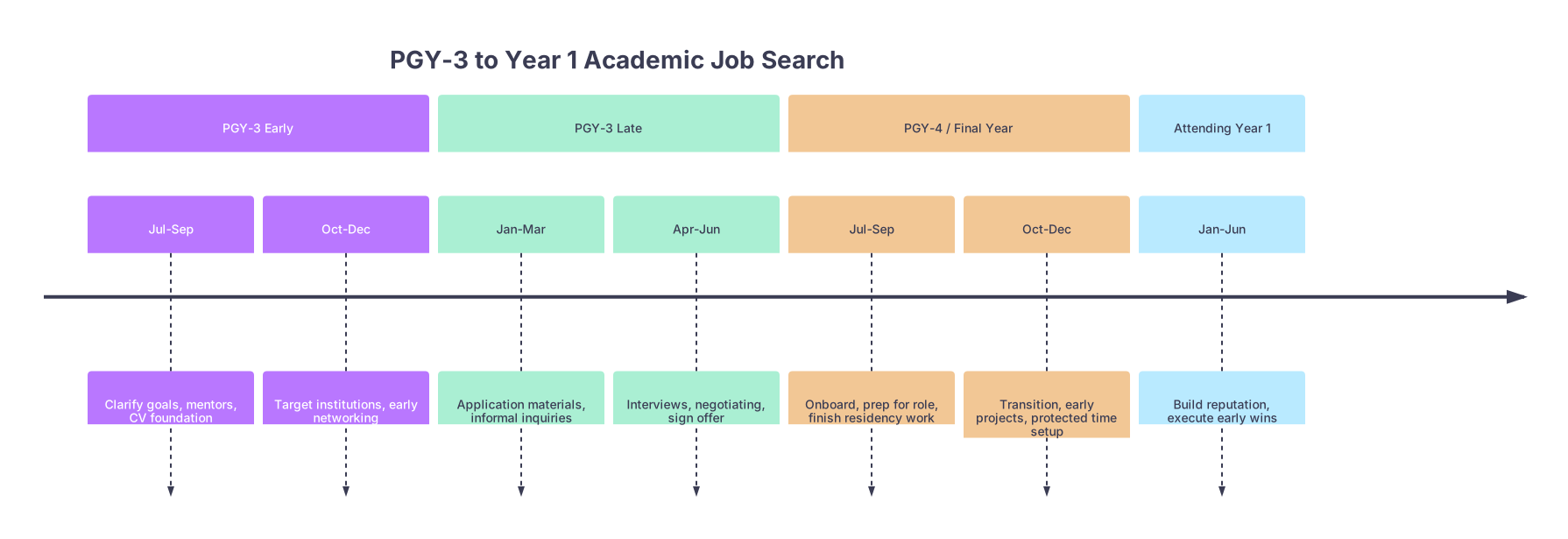
Big Picture Timeline: From PGY‑3 – Year 1
| Period | Event |
|---|---|
| PGY-3 Early - Jul-Sep | Clarify goals, mentors, CV foundation |
| PGY-3 Early - Oct-Dec | Target institutions, early networking |
| PGY-3 Late - Jan-Mar | Application materials, informal inquiries |
| PGY-3 Late - Apr-Jun | Interviews, negotiating, sign offer |
| PGY-4 / Final Year - Jul-Sep | Onboard, prep for role, finish residency work |
| PGY-4 / Final Year - Oct-Dec | Transition, early projects, protected time setup |
| Attending Year 1 - Jan-Jun | Build reputation, execute early wins |
PGY‑3: Foundation and Quiet Positioning (12–18 months before start date)
July–September: Decide what kind of “academic” you actually mean
At this point you should stop saying “I want an academic job” like it means anything. It does not.
You must pick a dominant lane:
- Clinician‑educator (majority clinical + teaching, limited research)
- Research‑focused (substantial protected time, grants, publications)
- Hybrid with niche expertise (QI, simulation, ultrasound, informatics, etc.)
This choice drives everything: where you apply, who you email, what your CV must show.
This 3‑month block:
Clarify your target role and setting
- Make a one‑page “career snapshot” for yourself:
- 3–5 year goal (e.g., “Clinician‑educator at mid‑sized academic center, 70% clinical / 30% education + admin.”)
- Geography you will consider (ranked)
- Dealbreakers (no night shifts, must have fellowship, must have 0.3 FTE protected time, etc.)
- Reality check with one trusted mentor: “Does this sound realistic given my CV and interests?”
- Make a one‑page “career snapshot” for yourself:
Lock down mentors and sponsors
- Identify:
- 1–2 core mentors (career, scholarship)
- 1–2 potential sponsors (people with titles who can email division chiefs and say, “You should look at this resident.”)
- At this point you should schedule a standing 30–45 minute meeting every 2–3 months with your main career mentor.
- Identify:
Get your academic paperwork in order
- Build a serious CV (not the med school one you never updated):
- Standard academic format (Education, Training, Licensure, Positions, Honors/Awards, Publications, Presentations, Teaching, Service).
- Every talk, poster, abstract, committee, QI project. Document it now before you forget.
- Start an “Academic Log” document:
- Talks given (title, audience, date).
- Teaching (small group, bedside teaching, lecture).
- Volunteer or committee work.
- Update your PubMed and ORCID profiles; standardize your name.
- Build a serious CV (not the med school one you never updated):
Decide on fellowship (if applicable)
- If you are PGY‑3 in IM, peds, etc. and still “thinking about” fellowship, stop dragging your feet.
- At this point you should commit: immediate attending vs fellowship. Academic employers want clarity.
October–December: Build a targeted map and a real network
Now you identify realistic places and people, not “anywhere that will take me.”
- Create a target institution list (Tiered)
| Tier | Type | Example Characteristics |
|---|---|---|
| A | Dream programs | Top 10–20, competitive markets |
| B | Strong matches | Solid research/teaching culture |
| C | Safety options | Regional, higher clinical load |
- Aim for:
- 5–7 “A” programs
- 8–15 “B” programs
- 5–8 “C” programs
- For each, document:
- Division chief name and email
- Department chair
- Anyone from your med school / residency / fellowship already there
- Known strengths (education, QI, subspecialty programs)
Quiet reconnaissance
- Read faculty pages in your niche area. Who does what? Who looks like “future you”?
- Scan recent job postings to understand:
- Typical FTE split
- Call expectations
- Promotion track language (“clinician educator track,” “tenure track,” etc.)
Start low‑pressure networking
- At this point you should schedule 1–2 informational conversations per month:
- Alumni from your program
- Faculty you met at conferences
- People publishing in your area
- Email script (shorter is better):
- Who you are
- Your training level and rough interest (“career in clinician‑educator role with interest in simulation”)
- Ask for 15–20 minutes to learn about their path and their institution, not for a job.
- At this point you should schedule 1–2 informational conversations per month:
Stack your CV with visible academic activities
- Volunteer for:
- Resident teaching sessions
- Simulation cases
- Curriculum development pilots
- QI projects that will generate a poster or abstract this year
- You are not doing this for “experience.” You are building bullet points that match actual job descriptions.
- Volunteer for:
Fix problems now
- Weak evaluations? A professionalism hiccup? Gaps in scholarship?
- Work with your mentor on a repair plan:
- One strong QI project
- A first‑author poster
- Extra teaching, with documented positive evaluations
PGY‑3 Late: Moving from preparation to real signals (6–12 months before start date)
January–March: Application materials and early outreach
This is when people who start early move ahead. Others are still asking “when do jobs get posted?”
Polish your core documents At this point you should have:
- Academic CV (finalized and proofread by mentor)
- Cover letter template that you can tailor:
- Opening: who you are, training, current year
- Middle: 2–3 paragraphs focused on your value (teaching, research, niche skills)
- Closing: specific reasons that institution/region fits you
- One‑page career statement (or teaching statement if you are education‑heavy):
- Your teaching philosophy
- Concrete examples of teaching or curriculum
- Future plans (courses, programs, or scholarship you want to build)
Get your references lined up early
- Identify 3–4 referees:
- Program director
- Departmental mentor / division chief
- Project/research/education mentor
- Ask explicitly:
- “Can you write me a strong letter for academic clinician‑educator positions?”
If there is hesitation, find another person.
- “Can you write me a strong letter for academic clinician‑educator positions?”
- Share:
- Your CV
- Career snapshot
- List of programs you are targeting
- Identify 3–4 referees:
Start semi‑formal outreach to top programs
- For your Tier A and B programs:
- Basic structure:
- Intro: current PGY level, training, intended graduation date.
- One paragraph on interests and niche strengths.
- One sentence on why that institution / location specifically.
- Ask whether they anticipate any upcoming needs and whether you could schedule a brief call to introduce yourself.
- Attach CV. Not the cover letter. You are not formally applying yet; you are giving them a heads‑up that you exist.
Conferences: make them work for you
- If you attend a winter/spring meeting (e.g., SGIM, ATS, Society of Hospital Medicine):
- Before the conference:
- Email 3–5 faculty at target institutions to ask for a 15‑minute coffee chat.
- At the conference:
- Treat this as “pre‑interview” networking: show up on time, have 1–2 specific questions about their division.
- Mention your graduation timeline and interest in future openings without begging for a job.
- Before the conference:
- If you attend a winter/spring meeting (e.g., SGIM, ATS, Society of Hospital Medicine):
Monitor job postings – but do not panic
- Academic positions may not post until late spring or even early summer.
- At this point you should be:
- Checking major job boards monthly.
- Watching institution career pages for your target list.
- But the emails to division chiefs you already sent are more important than obsessively refreshing a job site.
April–June: Formal applications, interviews, and negotiating
This is when the process gets real. You will be interviewing while finishing training and maybe taking boards. The chaos is normal. The lack of structure is not.
Apply strategically as jobs appear
- When a posting fits you reasonably well:
- Submit through the official HR portal.
- Same day, email the division chief:
- Reference the posting and your application.
- Attach CV + brief cover letter.
- For places without posted jobs where you already had positive contact:
- Send a more formal note:
- “As I approach the end of my training in June 20XX, I wanted to follow up regarding any potential faculty opportunities in your division…”
- Send a more formal note:
- When a posting fits you reasonably well:
Prepare for academic interviews properly At this point you should have answers ready for:
- “What do you want your career to look like in 5 years?”
- “What niche do you see yourself developing?”
- “How would you use 0.2 FTE of protected time?”
- “What would your first project here be?” And you should have questions ready that reveal you have done your homework:
- How they evaluate clinicians on the promotion track.
- How FTE is actually measured and enforced.
- How new faculty get teaching opportunities or mentorship.
Track your options like a project manager
| Program | Stage | Contact Person | Last Action | Next Step / Deadline |
|---|---|---|---|---|
| University A | 2nd interview | Dr Smith (Chief) | Zoom on 4/12 | Send thank you 4/13 |
| Regional Med Center | Initial email | Dr Lee | CV sent 4/3 | Follow up 4/24 |
| State University | Applied HR | HR portal only | App submitted 5/1 | Wait 2–3 weeks |
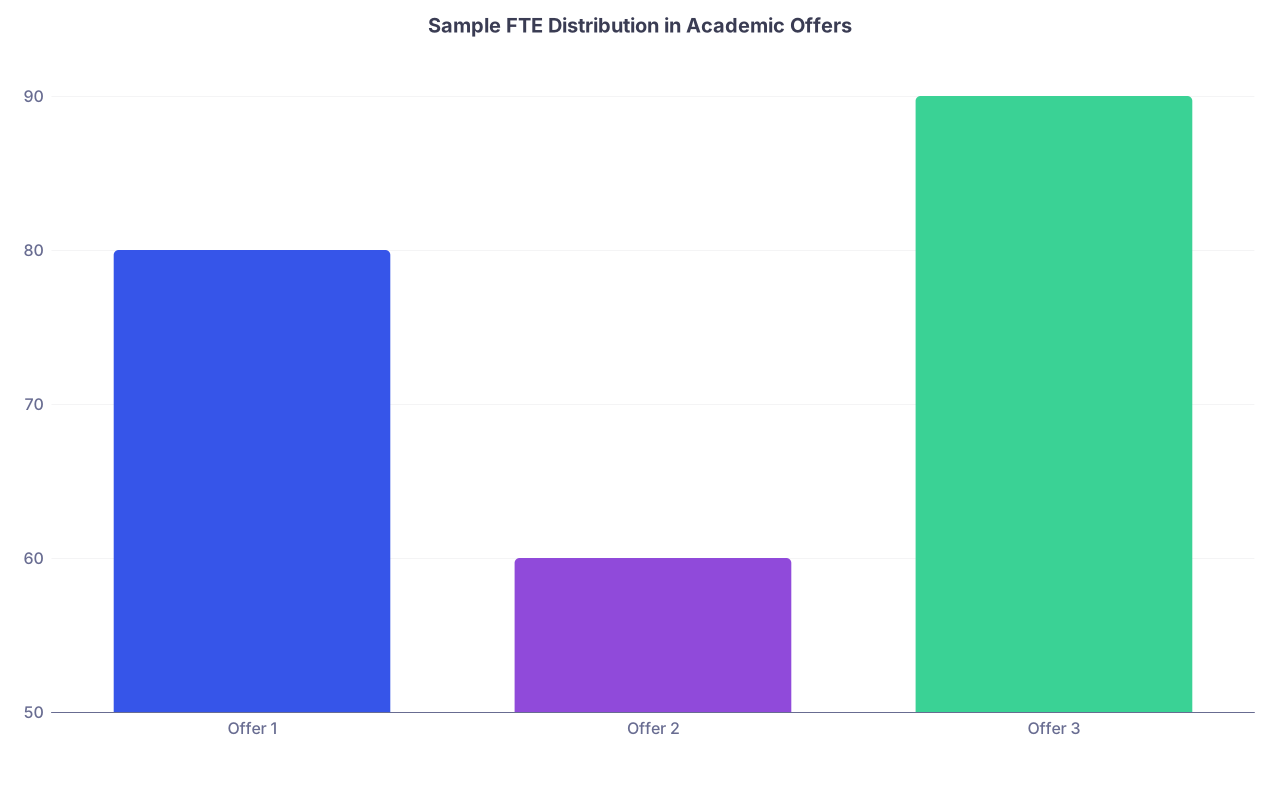
- Evaluate offers using reality, not fantasy When offers start appearing (often late spring / early summer), compare them on real variables:
| Category | Value |
|---|---|
| Offer 1 | 80 |
| Offer 2 | 60 |
| Offer 3 | 90 |
Use that as a rough idea: one job might be 80% clinical, another 60%, etc. But you must get exact numbers.
Key dimensions to clarify in writing:
- Clinical FTE (percentage and what that actually means in shifts/clinic sessions).
- Call expectations (nights, weekends, holidays).
- Protected time: how much, and protected for what (research, education, admin).
- Start date flexibility.
- Base salary, bonus structure, RVU expectations if applicable.
- Support for your niche (simulation center usage, QI infrastructure, data support, etc.)
- Negotiate like an adult, not a supplicant
- At this point you should prioritize:
- Protected time and clear expectations over small salary bumps.
- Reasonable asks:
- Modest reduction in clinical load for first year.
- Explicit protected time with written percentage and reporting structure.
- Seed funding for a project, or technical support (e.g., biostat help, simulation tech resources).
- Unreasonable (for a first job with average CV): Demanding tenure track at a top‑tier place with no track record.
- At this point you should prioritize:
Final Training Year: Onboarding and Launching (0–6 months before start date)
Assume you sign an offer between May and August before your start date. From then until you actually start, your job is to set yourself up so you do not drown when you arrive.
July–September: Tie up residency; align with your new division
Finish residency strong
- Program directors talk. A lot.
- At this point you should:
- Avoid coasting. Late professionalism issues can poison your reputation just as your new boss is checking references.
- Maintain solid clinical performance; attendings at your new institution will ask people they know.
Clarify your role at the new place
- Schedule a meeting (or two) with your future division chief or section lead:
- Clinical: what your schedule template will look like.
- Teaching: which courses, clerkships, or rotations you will plug into.
- Scholarship: what projects they expect you to join or lead.
- Ask for:
- The name of your formal mentor at the new institution.
- Any early committee or teaching assignments they are planning.
- Schedule a meeting (or two) with your future division chief or section lead:
Line up projects that start early
- You do not want to be “new attending with no projects” for 18 months.
- At this point you should:
- Identify 1–2 projects that can be started or at least planned before you arrive:
- Continuing a QI initiative from residency in a new context.
- Joining an existing research or education project at your future site.
- Schedule pre‑start planning calls with your future colleagues on these projects.
- Identify 1–2 projects that can be started or at least planned before you arrive:
Protect your board preparation
- Academic employers assume you will pass your boards. They get very nervous if you do not.
- Block time, right now, for:
- A realistic board study schedule that does not dissolve under night float or ICU months.
- If possible, avoid starting your new job in the same month you sit for boards. That combination is brutal.
October–December: Pre‑attending reset and logistics
If your start date is July 1, your PGY‑3 year might have ended already, and you could be in fellowship or a gap period. Same logic applies.
Handle the boring but essential logistics At this point you should be:
- Completing licensure paperwork for the state where you will work.
- Handling hospital credentialing forms, immunizations, background checks.
- Getting your DEA, NPI if not already done.
Prep your “academic brand”
- Update:
- CV with final residency awards, leadership roles, publications.
- Professional email signature (once you have an institutional address).
- Draft:
- 2–3 sentence bio you will use for introductions, talks, faculty pages.
- Think:
- What is the 10‑second version of who you are, academically?
E.g., “Hospitalist with a focus on resident education and handoff safety.”
- What is the 10‑second version of who you are, academically?
- Update:
Sketch your first‑year plan
- One-page document:
- Clinical goals (competence + efficiency benchmarks).
- Academic goals:
- 1–2 presentations (local/regional).
- 1–2 manuscripts/abstracts submitted.
- Teaching evaluations that are at or above division average.
- Mentorship:
- How often you will meet your primary mentor.
- Any secondary mentors (research, education, wellness).
- One-page document:
Year 1 Attending: Surviving while actually building something
You are “done” with the job search. You are not done with your career launch. Year 1 will make or break the next few years. Many people spend it in reactive mode and then wonder why nothing academic happened.
Months 1–3: Orientation, observation, and guardrails
At this point you should:
Learn the job deliberately
- First 4–8 weeks:
- Prioritize clinical competence and safety. You are no use to anyone as a “future researcher” if you scare the nurses.
- Watch how senior people manage time, documentation, difficult patients.
- Keep a tiny notebook or digital file:
- Pain points you might later address with QI or education.
- First 4–8 weeks:
Set boundaries early
- Say no (politely) to:
- Extra committees unrelated to your goals.
- Random admin tasks “because you are new and have energy.”
- Say yes strategically:
- One committee and one teaching role that fit your academic lane.
- Say no (politely) to:
Formalize mentoring relationships
- Have a real conversation with your assigned mentor:
- Go over your one‑page first‑year plan.
- Ask what “success at 12 months” looks like in your division.
- Have a real conversation with your assigned mentor:
Months 4–6: Execution of early wins
Now you stop orienting and start producing.
Launch 1–2 visible, achievable projects
- Examples:
- A short, well‑evaluated resident lecture series.
- A narrow QI project with measurable impact and a plan for an abstract.
- At this point you should have:
- Clear aims.
- A realistic 6‑month timeline.
- At least one senior person co‑signing.
- Examples:
Get on the academic radar
- Submit:
- An abstract or poster to a local/regional meeting.
- Volunteer once (not five times) for:
- Moderating a session, leading a case conference, or helping with M&M.
- Submit:
-
- Compare:
- Promised clinical FTE vs actual hours/number of sessions.
- If there is a mismatch:
- Document it.
- Bring it up in a professional way with your division chief at an early check‑in, not five years later when resentment is cemented.
- Compare:
Months 7–12: Consolidation and promotion track positioning
By the end of Year 1, your department should have a clear sense of who you are and what you bring. Not just “another attending who covers nights.”
Review and adjust your trajectory
- At this point you should:
- Revisit your first‑year plan.
- Note what actually got done (projects, teaching, scholarship).
- Decide what to drop vs. what to double down on.
- At this point you should:
Make your case for staying (or for the next step)
- If you love the place:
- Talk with your chief about:
- Next‑year clinical schedule.
- Any expansion of protected time.
- Steps toward promotion (titles, committee leadership, program roles).
- Talk with your chief about:
- If the job is clearly not a fit:
- Start documenting why:
- Misalignment of expectations.
- No realistic path to protected time in your lane.
- Quietly restart a lighter version of the job search a full year before you move.
- Start documenting why:
- If you love the place:
Get your academic output on paper
- Aim to have by the end of Year 1:
- At least one submitted manuscript, review, or educational resource.
- 1–2 conference abstracts or posters.
- A teaching or evaluation narrative you can show on promotion forms.
- Aim to have by the end of Year 1:
Key Takeaways
The academic job search starts 12–18 months before your planned start date, not after you finish boards. Early quiet networking and a clear lane (educator, researcher, niche clinician) are your real advantages.
At each phase—PGY‑3 early, PGY‑3 late, final training months, and Year 1 attending—you should have specific, concrete tasks: build the CV, map targets, reach out, interview and negotiate, then execute early wins once you arrive.
Protected time, realistic clinical load, and mentorship are more valuable than a slightly higher starting salary. Structure your search and your negotiations around that reality, and your first academic job will be a launchpad, not a trap.