
The biggest financial mistakes physicians make after residency are not about salary—they’re about misreading RVUs.
You can absolutely “win” the negotiation on base pay and still lock yourself into a deal that pays you $80,000 less per year than your co‑fellow… because you misunderstood the work–RVU math. I’ve seen it happen. More than once.
Let me walk you through the traps, the red flags, and how to protect yourself before you sign anything.
1. Confusing “RVU” With “wRVU” (And Letting Recruiters Slide Past It)
If you mix up RVUs and work RVUs, you’re already losing.
There are three main types in the RVU world:
- wRVU (work RVU) – what you did clinically; this is what most comp plans pay on
- peRVU (practice expense RVU) – overhead
- mRVU (malpractice RVU) – malpractice component
Your paycheck almost always rides on wRVU. Not “RVU.” Not “total RVU.” wRVU.
Here’s the common mistake:
A recruiter says, “Our docs produce around 9,000 RVUs.”
You assume they mean work RVUs that tie to your bonus. They might not.
If a contract or recruiter uses the generic “RVU” instead of “wRVU,” you should immediately:
- Ask in writing:
- “Is this work RVU (wRVU) or total RVU?”
- Get sample productivity reports from actual employed physicians with identifiers removed.
- Confirm that the compensation formula uses wRVUs, not some other number.
If they dodge, delay, or “don’t know,” your response should be simple: you cannot evaluate the offer. Period.
2. Ignoring the Conversion Factor Games
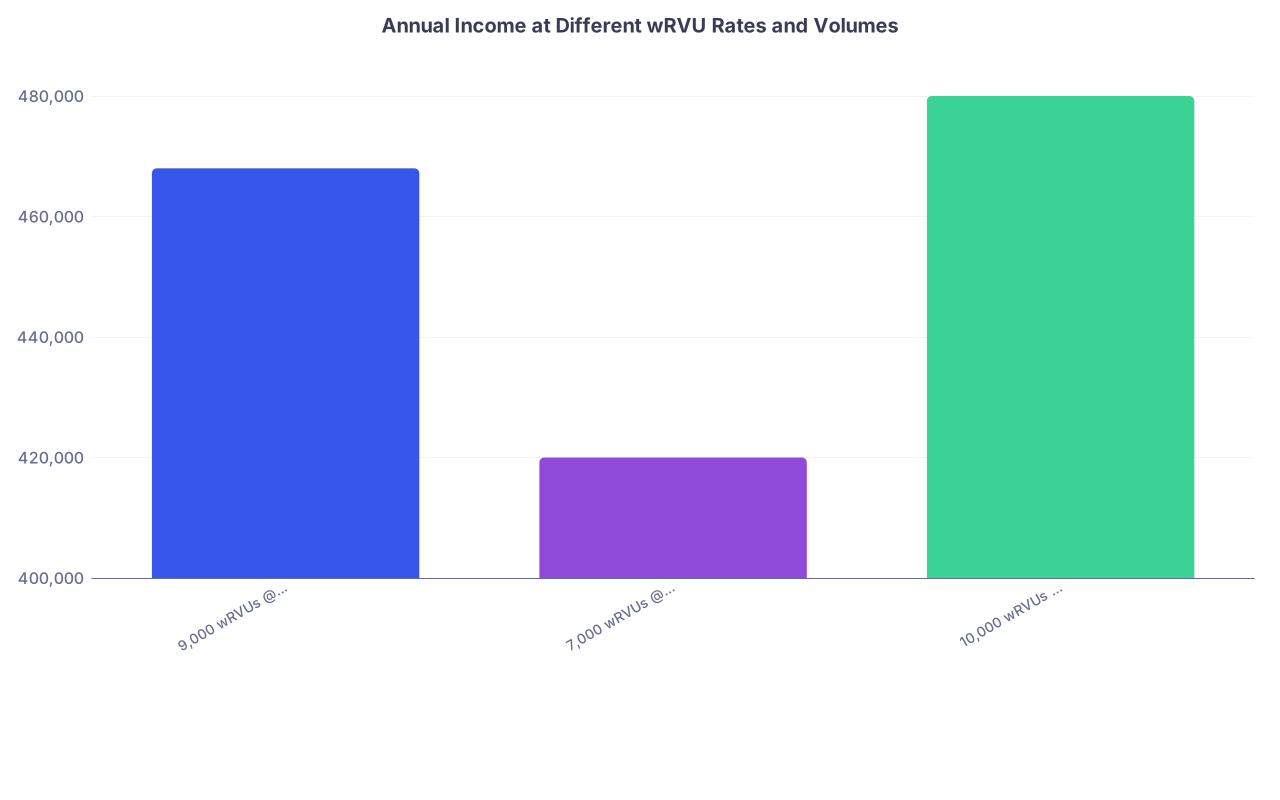
“$60 per wRVU” sounds great. Until you realize they’re paying on a much lower wRVU count than a neighboring system that “only” offers $52 per wRVU.
You never compare wRVU rates in a vacuum. You compare them against realistic volume.
| Category | Value |
|---|---|
| 9,000 wRVUs @ $52 | 468000 |
| 7,000 wRVUs @ $60 | 420000 |
| 10,000 wRVUs @ $48 | 480000 |
On paper, $60 looks like the winner. In reality, the 9,000 @ $52 job could be far better if that volume is realistic and sustainable, and the 7,000 is a fantasy.
Three conversion factor mistakes I see constantly:
Comparing rates without volume
- “Offer A is $10 more per wRVU!” means nothing if your clinic schedule won’t let you generate the wRVUs you think you will.
Ignoring how wRVUs are counted
- Some systems suppress wRVUs for certain payers, “non-billable” visits, or shared/split services. You think you’re getting 6,500 wRVUs; they’re crediting 4,800.
Not realizing the rate resets
- That shiny $70/wRVU may be a temporary ramp-up rate that drops to $50 after 12–24 months. I’ve seen entire incomes fall off a cliff because someone missed that line in the contract.
You must see, in writing:
- The base wRVU conversion factor
- Whether there’s a tiered structure (more on that later)
- How long any promotional rate lasts
- What happens to your pay when it reverts
If the contract references “current compensation policy” in a separate document, get that document. Today. Not after you sign.
3. Believing Projected wRVUs Without Proof
This one burns new attendings all the time.
The recruiter: “Our average internal medicine doc does 7,500 wRVUs. Easy.”
Reality: half the docs are at 4,500, one workhorse is at 9,000, and three people left last year because they couldn’t get enough patients.
If you take their projection at face value, you’re taking a blind pay cut.
Here’s what you must demand before trusting any wRVU projections:
Distribution, not just average:
- “Show me the range of wRVU production for current physicians in this specialty: median, 25th percentile, 75th percentile.”
Panel size, new patient wait time, and template:
- How many new patients per week will you see?
- What’s the average wait time for a new patient? (If it’s 2–3 weeks, demand is high. If it’s next‑day, be suspicious.)
- What’s your clinic template (number of slots, length of visits, blocked procedures)?
Lead time to full schedule:
- How long did it take the last new hire to reach the “average” wRVU level?
- What was their wRVU production by quarter in their first 2 years?

| Step | Description |
|---|---|
| Step 1 | Start Job |
| Step 2 | Months 0-6 - Build Panel |
| Step 3 | Months 6-12 - Moderate Volume |
| Step 4 | Year 2 - Near Steady State |
| Step 5 | Year 3+ - Max Sustainable Volume |
Red flags:
- They quote only the “top performer’s” wRVUs.
- They refuse or “can’t” give you de‑identified production data.
- Nobody will tell you how long it took others to ramp up.
- They wave it away with “You’ll be busy from day one.”
Busy with what, exactly? Follow‑ups from someone else’s panel? Hospital work that doesn’t generate wRVUs? Call coverage?
4. Forgetting to Separate Base Salary From wRVU Pay
A lot of systems use some version of this:
- Base salary (often guaranteed for 1–3 years)
- wRVU bonus on top
- Then a switch to fully productivity-based pay, or a lower base + higher wRVU rate
The mistake: you only look at year 1 and ignore the post‑guarantee shock.
Example:
Job A
- Years 1–2: $280k base, no downside, minimal wRVU expectations
- Year 3+: $210k base + $50/wRVU after 4,000 wRVUs
Job B
- Years 1–2: $240k base + $40/wRVU over 3,000 wRVUs
- Year 3+: Same structure
Everyone loves Job A in the beginning. Until year 3 hits and they realize:
- The clinic support is terrible
- They’re stuck at 5,000 wRVUs because of system bottlenecks
- Actual pay is now: $210k + (1,000 × $50) = $260k
- Meanwhile the colleague at Job B is pulling $280k–320k consistently
You should model at least three scenarios for each offer:
- Conservative – 25th percentile wRVUs
- Realistic – Median wRVUs
- Aggressive – 75th percentile (if you’re willing to work like that)
Then compare Year 1, Year 3, and Year 5 totals, not just the starting guarantee.
| Scenario | wRVUs | Rate (over threshold) | Total Comp |
|---|---|---|---|
| Conservative | 4,500 | $50 | $235,000 |
| Median | 6,000 | $50 | $310,000 |
| Aggressive | 7,500 | $50 | $385,000 |
If the practice cannot give you data to plug in for those scenarios, that’s the problem—not your spreadsheet.
5. Not Realizing How Different Codes Convert to wRVUs
Two jobs. Same specialty. Same hours. Same “patients per day.” Very different wRVUs.
Why? Because the mix of services matters more than the headcount.
Common pitfalls:
- A job that’s heavy on low‑acuity follow‑ups and minimal procedures will underperform on wRVUs.
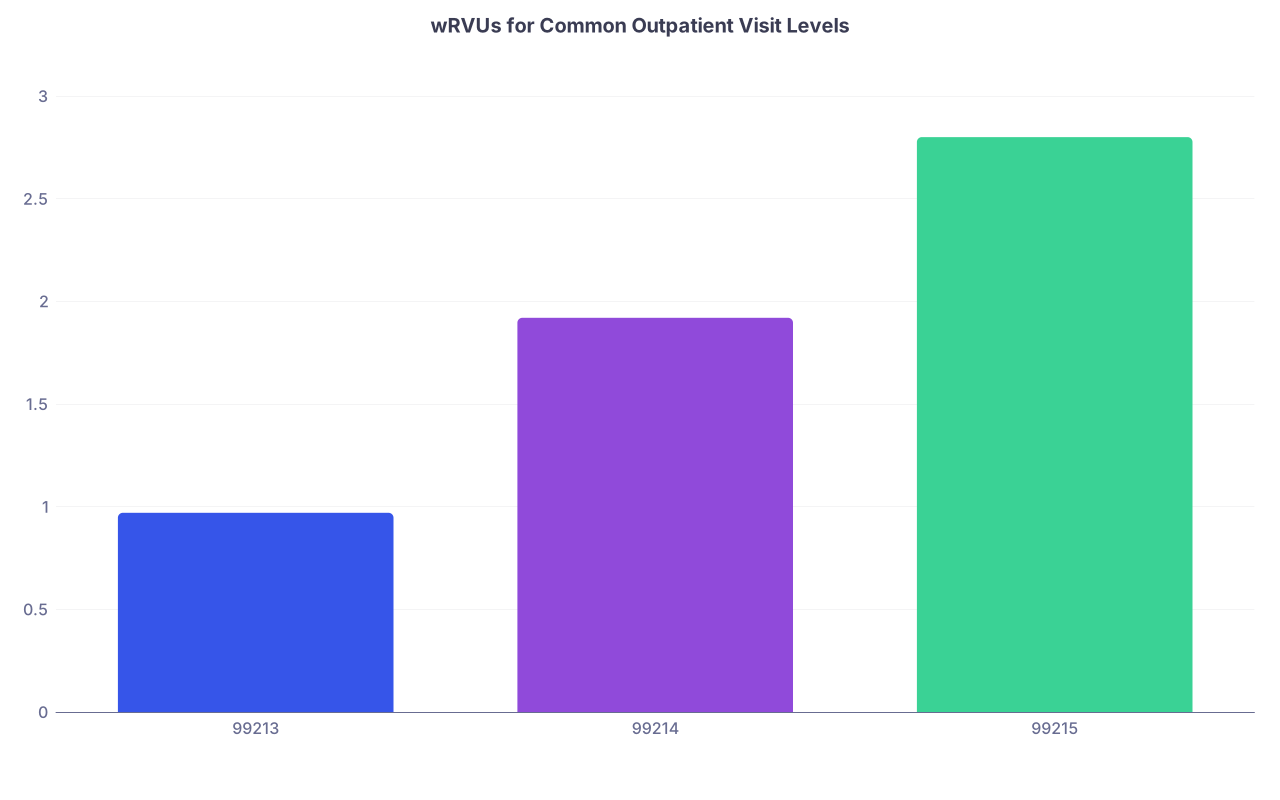
- A job that pushes you toward higher‑level visits, diagnostic procedures, or interventions generates far more wRVUs per patient.
| Category | Value |
|---|---|
| 99213 | 0.97 |
| 99214 | 1.92 |
| 99215 | 2.8 |
If one employer has systems and support that allow consistent, accurate use of higher visit levels (with appropriate documentation) and in‑clinic procedures, your effective hourly pay increases—without more hours.
Questions to ask each practice:
- What percent of visits are typically level 3 vs level 4 vs level 5?
- Who does common procedures—do you, or do they get referred away?
- Are there NP/PA colleagues who siphon off simpler visits (good for your wRVU efficiency) or who compete with you for volumes (bad for your total wRVUs)?
- Who does the documentation—are there scribes, templates, helpful EMR tools—or are you buried in notes at night?
A “60 wRVUs per clinic day” job with procedures is not equivalent to a “60 wRVUs per clinic day” internal promise with only 15‑minute chronic care follow‑ups. Get the structure and scope clear.
6. Overlooking wRVU Thresholds, Tiers, and Traps
This is where a lot of the fine print hides.
Typical designs:
- Straight rate: $X per wRVU from wRVU #1
- Threshold + rate: Base salary covers some “expected” number (say 4,000), then $X per wRVU above that
- Tiered rates: $40/wRVU up to 6,000; $50 from 6,001–8,000; $60 over 8,000
The traps:
Threshold far above what anyone actually produces
- They tell you, “Most doctors earn $60,000 in bonuses!”
- But nobody hits the 8,000+ tier unless they’re sacrificing their sanity.
Resetting thresholds each year
- “We’ll credit you each quarter after 1,500 wRVUs.”
- But there’s no true-up at year-end—if you have one slow quarter, you lose money forever.
Changing thresholds unilaterally
- Contract says comp plan can be “modified at employer’s discretion.”
- Next year, suddenly your expected wRVUs go from 5,000 to 6,500 to access the same bonus.
You want:
- Clear language on what count is expected before bonus kicks in
- Written detail on tier structure and whether it can change mid‑contract
- A guarantee that earned wRVUs are paid, even if counted at year-end rather than quarter only
If they won’t spell it out, you know exactly where they plan to make their margin—from your confusion.
7. Forgetting Call, Inpatient, and “Invisible” Work in the wRVU Math
Few things feel worse than doing endless call, phone work, and inbox triage that generates exactly zero wRVUs.
Huge mistake: assuming “more work = more pay.”
Not always. Here’s where people get trapped:
- Call that’s “unpaid” because consults are billed under someone else’s name
- Inbasket work that’s considered “part of your job” but not billable
- Handoffs and sign‑outs that generate no wRVUs
- Procedures where the wRVUs are credited to an attending or to the hospitalist of record, not the actual operator
You need to know, explicitly:
- How call is compensated:
- Flat stipend? Extra wRVUs? Nothing?
- Who gets credit for:
- Admissions
- Consults
- Shared visits with advanced practice providers
- Whether there is:
- Pay for non‑face‑to‑face work (CPT codes for chronic care management, virtual visits, etc.)
- A formal system to document and bill these activities, or just a theoretical possibility no one uses

Do not let them hide massive unpaid obligations in the phrase “reasonable additional duties.”
Spell it out: “How will I be paid for this time?”
8. Ignoring Overhead, Support, and System Bottlenecks
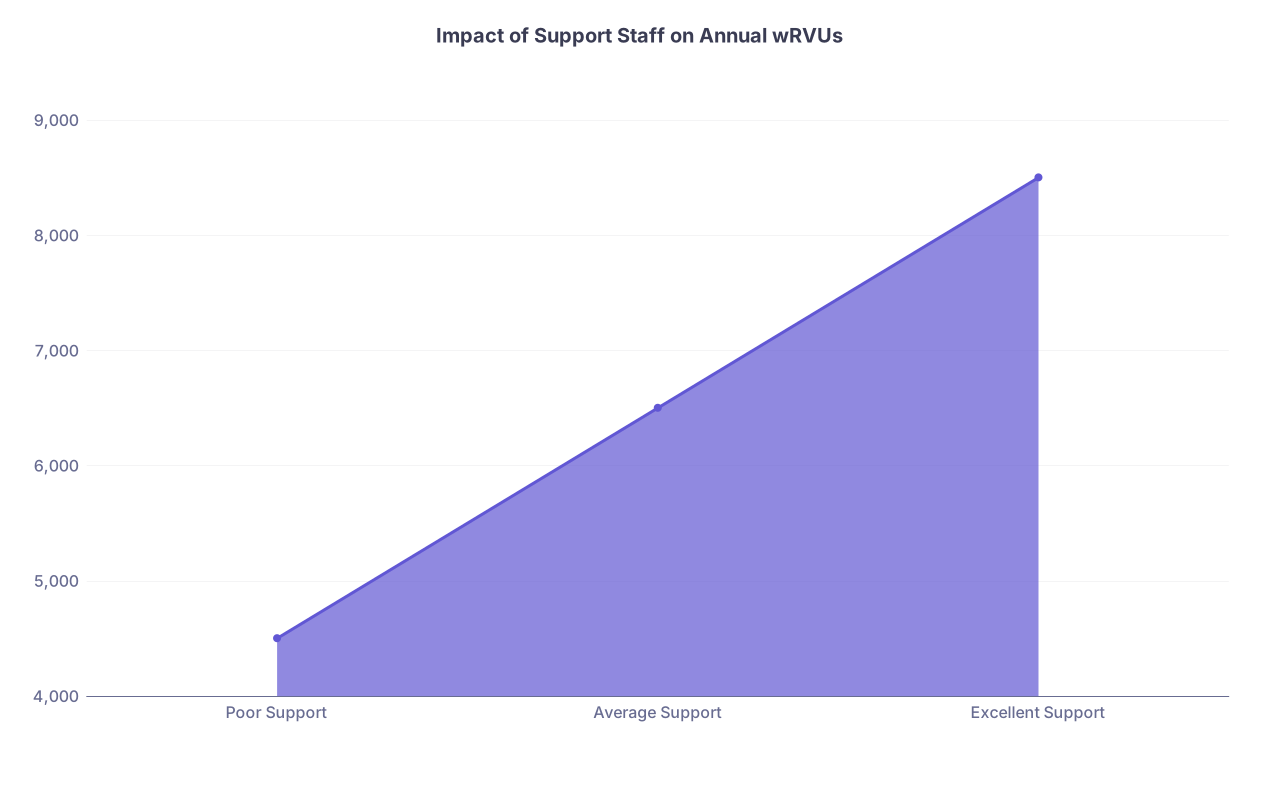
RVUs do not exist in a vacuum. You don’t create them alone with “hard work.”
You need:
- MA and RN support who know how to keep clinic flowing
- Front desk that actually answers phones and schedules new patients
- Referral management that doesn’t lose consults
- Imaging, lab, procedures that are available when needed
| Category | Value |
|---|---|
| Poor Support | 4500 |
| Average Support | 6500 |
| Excellent Support | 8500 |
I’ve watched two jobs, same specialty, similar wRVU rates:
- Job 1: One MA shared between two clinicians, constant no‑shows, poor scheduling. Doc stuck at 4,800 wRVUs and burning out.
- Job 2: Dedicated MA, RN triage, referral coordinator, aggressive new‑patient scheduling. Same hours, 8,200 wRVUs and a functional life.
When you interview, ask:
- What’s the staffing ratio (MA/RN per provider)?
- How much of my time will be spent on:
- Inbox messaging
- Prior auth
- Refills
- Forms
- Are there scribes? Templates? Reasonable documentation expectations?
An extra $5 per wRVU is meaningless if the system only lets you produce 60% of what you’re capable of.
9. Treating wRVU Offers as If They’re Comparable Across Specialties and Markets
This one is subtle but dangerous.
You can’t compare:
- $55/wRVU in rural primary care
- $70/wRVU in ortho
- $48/wRVU in academic cardiology
…and draw any straightforward conclusion about “which is better” without context.
You must factor:
- Specialty‑specific benchmarks (e.g., MGMA, AMGA)
- Market (urban academic vs rural community vs private group)
- Non‑wRVU comp: call stipends, administrative pay, medical directorships, teaching income, partnership track, ancillaries

Also: wRVUs don’t capture everything you might care about—research time, teaching, leadership roles, protected quality improvement work. If your identity is wrapped into those things, a straight wRVU grinder job may pay more but make you miserable.
Look at:
- Total comp for your actual mix of duties
- Total hours (clinical + nonclinical)
- Career development (partnership, tenure, leadership)
10. Failing to Get the wRVU Formula in Writing (With Examples)
The last, and probably biggest, mistake: accepting vague language like “doctor will be compensated per group compensation policy” without seeing:
- The current policy document
- Worked examples for how a bonus is calculated
- Clear explanation of what can be changed unilaterally by the employer
You want the contract or an attached exhibit to show, in plain math:
- Your base salary
- Your expected wRVUs
- The rate per wRVU above that
- The timing of bonus payments (monthly, quarterly, annually)
- What happens with overpayments if your guarantee exceeds your production
Ask for a sample calculation like:
“If Dr. X produces 6,000 wRVUs in a year, with a base salary of $240,000, a threshold of 4,000, and a rate of $50 per wRVU above threshold, their total compensation would be $240,000 + (2,000 × $50) = $340,000.”
If they cannot or will not give you this level of specificity, they either:
- Don’t understand their own system (which is terrifying)
- Or prefer the flexibility to change the rules later (which is worse)

And yes, you should have a physician-knowledgeable attorney or experienced advisor review the contract. Not your cousin who does real estate law.
Quick Visual: wRVU Comparison Checklist
| Area | Critical Question |
|---|---|
| wRVU Definition | Is this clearly work RVU, not total RVU? |
| Rate & Tiers | What is the rate, threshold, and tier structure? |
| Volume Reality | What are median and range of wRVUs for current docs? |
| Non-wRVU Work | How is call, inbox, admin time compensated? |
| Timeline | What happens to comp after the guarantee ends? |

| Step | Description |
|---|---|
| Step 1 | Get Written Offer |
| Step 2 | Clarify wRVU Details |
| Step 3 | Request Production Data |
| Step 4 | Model 3-5 Year Income |
| Step 5 | Review Support and Call |
| Step 6 | Contract Review by Expert |
| Step 7 | Negotiate or Walk Away |
FAQ (Exactly 4 Questions)
1. How many wRVUs should I expect to produce as a new attending?
It depends heavily on specialty and practice environment, but the mistake is to accept any single number without context. Ask for de‑identified reports of new hires from the last 3–5 years: what were their wRVUs in Year 1, Year 2, and Year 3? Use median values, not the superstar outlier. Then sanity‑check those numbers against national benchmarks (MGMA, AMGA, etc.) for your specialty and region. If their “average” is way above the 75th percentile nationally, they’re probably selling you fantasy.
2. Is a higher wRVU rate always better than a higher base salary?
No. A slightly lower wRVU rate with a stable, reasonable base and solid support can easily beat a high rate tied to unrealistic volume or poor infrastructure. You should model out total expected compensation at conservative, median, and aggressive wRVU levels, and then decide. Early in your career, a strong guarantee with non‑toxic expectations is often worth more than a flashy rate you can’t realistically hit without burning out.
3. How risky is it to join a purely productivity-based wRVU model right out of training?
Riskier than most people realize. You usually don’t control referral patterns, clinic templates, or staffing. If the system is dysfunctional, you eat the loss. New grads often have no negotiating leverage once they’re in. If you’re going to take a pure productivity job, you want written assurances about referral streams, call burden, support staff, and at least some floor (draw or minimum comp) for the first year or two. Otherwise, you’re carrying all the risk the employer should be sharing.
4. What’s the single biggest red flag in a wRVU-based offer?
Vague language. If the contract references “current compensation policy” without attaching it, if they can’t show you real production data, if nobody will write down the formula with actual numbers and examples—walk away or assume the worst. Lack of clarity usually isn’t an accident; it’s a feature that lets the employer change the game later.
Key takeaways:
- Never compare wRVU offers on rate alone—always tie them to realistic, documented volume and support.
- Demand written, specific formulas, thresholds, and examples before you sign; vague policies are where your money disappears.
- Model your income beyond the guarantee years and include call, non-billable work, and system support in your calculations—or you’ll be the one paying for everyone else’s assumptions.