

What if the “academic job = teaching, community job = no teaching” idea is not just wrong, but actively sabotaging your career choices?
You hear it every year:
“If you want to teach, you have to be at an academic center.”
“Community jobs are just RVUs and volume.”
“Once you leave academics, your teaching career is over.”
That mental model is from about 1998. Modern practice models have blown it up.
Let me be blunt: a lot of residents are turning down better pay, better schedules, and better autonomy because they’re clinging to a cartoon version of “academics vs community” that does not match what’s actually happening on the ground.
Time to dissect this.
The Old Myth vs The Current Reality
The traditional dogma in training is simple, comforting, and wrong:
- Academic = teaching, conferences, students, residents, research
- Community = productivity, RVUs, “service,” no learners
That distinction used to be more accurate when:
- Medical schools were tightly tied to a few big university hospitals
- Community hospitals rarely had residents or students
- “Academic” meant tenure tracks and protected time, not RVU quotas
But look at what’s changed in the last 10–15 years:
- Explosive growth of regional campuses and distributed clinical education
- Expansion of community-based residency programs, often sponsored by health systems, not legacy universities
- Massive hospital consolidations, with “academic” systems buying community hospitals and slapping “teaching” on them
- Hospitalists becoming the backbone of inpatient education, even at non-university sites
Translation: the presence or absence of learners is no longer cleanly tied to the “academic vs community” label.
Here’s a rough snapshot you almost never see in recruitment brochures:
| Practice Setting | Regular Learners? |
|---|---|
| University tertiary academic center | Yes – residents + students |
| Large community hospital with GME | Yes – often residents, sometimes students |
| Community hospital without GME | Sometimes – students, APPs, nursing ed |
| Private specialty group in the community | Variable – fellows/students if affiliated |
| Pure outpatient private clinic | Rare but possible – students/NP/PA learners |
The key word: variable. “Community” doesn’t tell you if you’ll teach. The structure of the practice and the institution does.
Where Teaching Really Lives Now
You don’t want labels. You want to know: “If I take this job, how much will I actually teach?”
That depends on three things far more than whether the logo on your ID badge is “University of X.”
1. GME and UME presence on-site
If a hospital has:
- A residency program (IM, FM, EM, surgery, etc.)
- A medical school campus or formal student rotation site
- A consistent pipeline of NP/PA students, paramedic students, pharmacy residents
…then you will almost certainly have teaching opportunities. Whether the hospital is technically “academic,” “affiliate,” or straight-up community is secondary.
I’ve seen “community” hospitals where:
- EM attendings run daily teaching rounds with PGY1-3s
- Hospitalists give noon lectures 1–2 times per month
- Intensivists precept residents on procedures all day
- OB/GYNs have residents on every delivery, every section
And I’ve also seen “academic” jobs where:
- 90% of your shifts are at the satellite community site without learners
- Your title says “Assistant Professor,” but you’re basically a high-volume service doc
- Your teaching is limited to the occasional M&M or a few med students per month
Labels are marketing. On-the-ground structure is reality.
How Much Teaching Do Community Docs Actually Do?
Let’s ground this with what modern practice models really look like.
Hospitalist example
A typical “community hospitalist” job can fall into several buckets:
Pure service, no learners
- 12–18 patients per day
- No residents, no students
- Maybe you teach nurses or APPs informally
- RVU-driven, minimal academic meetings
Hybrid community-teaching model
- Hospital hosts IM or FM residents
- Teams structured like “teaching service” vs “non-teaching”
- You might be assigned to teaching service X weeks per year
- You give morning reports or noon conferences
“De facto academic” community site
- Full residency program based primarily at this hospital
- Daily rounds with resident teams and students
- Program director, core faculty, and faculty meetings on-site
- You may carry an academic appointment at an affiliated med school
There are hospitalists in #2 and #3 who teach more than their counterparts at “big name” academic flagships, because their residents rely heavily on them rather than a legion of subspecialists.
Same goes for EM, surgery, pediatrics, OB, you name it.
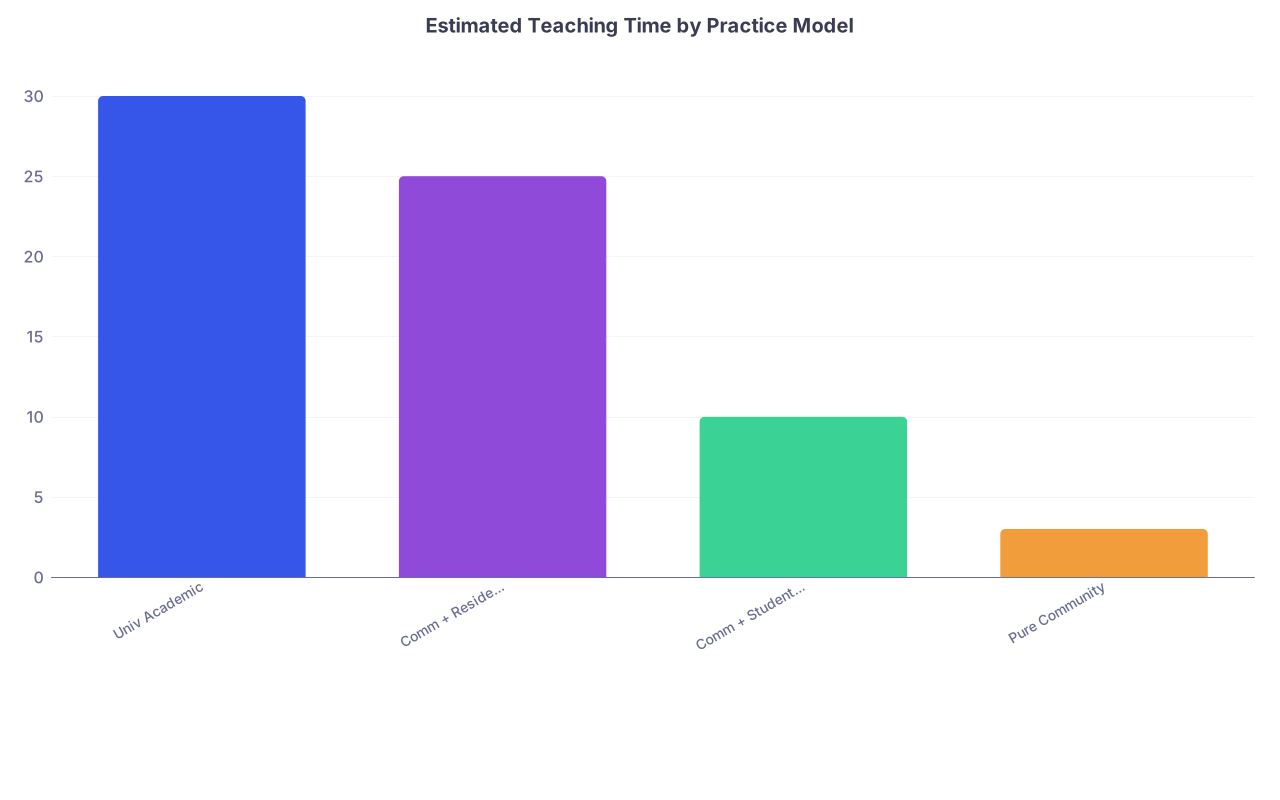
| Category | Value |
|---|---|
| Univ Academic | 30 |
| Comm + Residency | 25 |
| Comm + Students Only | 10 |
| Pure Community | 3 |
Those numbers (hours of formal teaching per month) are ballpark, but they track very closely with what I’ve seen and what surveys from ACP, SHM, and specialty societies suggest: “community with residency” is often just a slimmer version of classic academic life.
The Part Nobody Tells You: Academic Jobs Aren’t Pure Teaching Either
People romanticize academic jobs like it’s Grand Rounds and chalk talks 24/7.
Reality:
- RVU expectations exist in almost every academic department now
- Protected time is shrinking; even promoted faculty are getting pushed back toward clinical
- Many “academic hospitalist” or “academic EM” roles involve big blocks of clinical time without learners (nights, weekends, off-site coverage)
- Your schedule may actually give you less consistent, high-quality teaching time than a well-structured community residency program
I’ve lost count of how many junior faculty on “academic” contracts have told me:
“I thought I’d be teaching all the time. I’m basically a workhorse with a fancier badge.”
You need to be comparing actual teaching structure and incentives, not brand prestige.
The Real Levers That Control Your Teaching Opportunities
If you care about teaching, you should be interrogating job offers with a very specific lens. Not “Is this academic or community?” but:
Who are the learners, and how many days a month will they be with me?
Residents? Students? APPs? Pharmacy? Nursing?
Is teaching scheduled or just “optional if you’re into it”?Is teaching built into the schedule, or added on top?
Example differences:- Built-in: “You’ll staff the resident team 7 days a month; those days have fewer patients.”
- Tacked-on: “Oh yeah, if we have students you can pick them up, but your RVU target doesn’t change.”
What’s the formal structure?
Do they have:- A DIO (designated institutional official) and GME office?
- A clerkship director, program director, core faculty roles?
- Evaluations, feedback, teaching awards?
- CME or salary incentives for education?
How are you evaluated and paid?
Pure RVUs? Or a mix of:- Base salary + stipend for teaching
- Academic rank with expected educational duties
- Quality or teaching metrics that matter on your review
If they get uncomfortable or vague when you ask these questions, you have your answer. That place doesn’t really care about education, regardless of how they brand themselves.
Common Myths About Community Jobs and Teaching
Let’s kill a few of the most persistent myths outright.
Myth 1: “If I go to a community job, my teaching career is over.”
False.
You can:
- Become core faculty in a community-based residency
- Take on a residency program director or APD role at a non-university hospital
- Get a clinical faculty title at a med school as community faculty
- Teach NP/PA students, nursing, pharmacy, EMS — all formal educator roles
- Run SIM sessions at a regional center that serves multiple hospitals
I’ve seen community hospitalists become program directors. Community EM docs become regional clerkship directors. Community surgeons running residency bootcamps.
Your zip code doesn’t disqualify you from academic promotion anymore. Your activity and affiliation do.
Myth 2: “Academic jobs always pay less, but you get protected teaching time.”
Half true, half fantasy.
Patterns I’ve actually seen:
- Many academic hospitalist and EM jobs now have RVU incentives almost indistinguishable from large community groups
- “Protected time” is often conditional on grant funding, QI projects, or leadership roles you do not start with
- Some community jobs with heavy teaching actually pay worse than pure service community jobs, because they bake in teaching days
If you assume “academic = lower pay but more teaching,” you may be trading away money for teaching time you never actually get.
Myth 3: “Community hospitals don’t care about education quality.”
Depends entirely on the site.
Some community hospitals chase ACGME accreditation purely as a workforce strategy and phone in the education. Those are rough. Residents and faculty both feel it.
But there are robust community programs where:
- Attendings are heavily invested in teaching (because they chose that life, not by inertia)
- Residents get more direct attending time, fewer layers of hierarchy
- Bureaucracy is lower, so curricular changes happen faster
Quality is program-specific. You need to talk to current residents and students, not rely on the word “university” in the logo.
How to Evaluate a “Community” Offer if You Care About Teaching
Here’s how a smart graduating resident actually vets a job.
Step 1: Ignore the marketing label
Academic, community, hybrid, affiliate. Forget the jargon.
Focus on:
- Is there a residency? Which specialties? How long established?
- Are there med students on core rotations here? From which school?
- Who coordinates their education on-site?

| Step | Description |
|---|---|
| Step 1 | Job Offer |
| Step 2 | Mostly informal teaching |
| Step 3 | Opportunistic, variable teaching |
| Step 4 | Structured educator role |
| Step 5 | Ask about time, pay, expectations |
| Step 6 | Residency or Students On-site |
| Step 7 | Defined Teaching Role? |
Step 2: Ask rude-but-necessary questions
To the division chief or recruiter:
- “On how many shifts per month will I be working directly with residents or students?”
- “Are there explicit teaching responsibilities on my schedule, or just ‘as available’?”
- “Does any portion of my compensation or evaluation depend on education?”
- “Who is the program director / clerkship director, and how often do faculty meet?”
To current faculty (off the record):
- “Who actually teaches here?”
- “If I’m interested in teaching more, is that welcome or just extra unpaid work?”
- “What percentage of attendings do you think actively enjoy teaching?”
To residents/students:
- “Which attendings do you learn the most from?”
- “Do community attendings get recognition here for teaching, or is it invisible?”
- “If I came here, would you actually want to be on my service?”
Their tone of voice will tell you as much as their words.
Step 3: Look at your own goals on a 5–10 year horizon
There’s a difference between:
“I want to be a career clinician who occasionally teaches,”
and
“I want education to be a central part of my professional identity.”
For the first group, lots of community jobs with intermittent residents/students will be more than enough.
For the second group, you want:
- Formal roles: core faculty, APD, clerkship director, SIM faculty
- A consistent stream of learners on your clinical time
- A pathway to more teaching time if you earn it (and not purely at the expense of sleep and sanity)
You can absolutely find that in community-based programs. But you will not find it by skimming the job title and assuming “academic = teaching.”
Quick Comparison: Stereotype vs Reality
| Aspect | Old Stereotype | Modern Reality |
|---|---|---|
| Academic job | Heavy teaching, light clinical | Often mixed; RVUs and service still big component |
| Community job | No teaching, just volume | Ranges from zero learners to full residency hub |
| Career in teaching | Requires university appointment | Possible via community-based GME and affiliations |
| Prestige | Only university roles are “real academic” | Educator reputation now spreads across both settings |
FAQ (Exactly 4 Questions)
1. If I start in a pure community, non-teaching job, can I move into a teaching role later?
Yes, but it is harder than starting where at least some teaching already exists. You’ll need to either: join a site that later adds a residency or med school affiliation, switch jobs to a hospital with GME, or build teaching experience through students, CME, or SIM first. Program directors want to see a track record of teaching and educational involvement, not just “10 years of solid clinical work.”
2. Does an academic title (Assistant Professor, Clinical Instructor) actually matter?
It matters far less than you think early on. Those titles are easy to hand out and often reflect affiliation more than real educational impact. What actually advances your career as an educator: documented evaluations from learners, teaching awards, workshops you’ve created, curriculum development, and leadership roles. You can accumulate those in both community and academic settings if the structure is there.
3. Are community-based residencies “worse” for teaching than university programs?
Sometimes they are weaker, but many are not. Some community programs are under-resourced and use residents as cheap labor. Others are tight-knit, well-resourced, and give residents more attending time and broader procedural exposure. As faculty, you may have more room to shape curriculum and be visible. Don’t generalize. Review ACGME citations, talk to residents, and see how engaged faculty actually are.
4. If I want a mainly clinical job with a little teaching, where should I aim?
Look for hybrid models: large community hospitals with a residency, or academic systems where your clinical shifts split between teaching and non-teaching services. You’re probably better off avoiding ultra-tertiary, hyper-subspecialized centers if you just want occasional hands-on teaching; residents there can be spread across huge teams. A busy community GME site often gives you that “real clinical work + reasonable teaching” balance you’re picturing.
Key points:
Community job does not automatically mean less teaching; the presence of structured GME/UME and defined educator roles matters far more than the “academic vs community” label. Academic jobs are increasingly RVU-driven and not guaranteed to deliver the teaching time residents fantasize about. If you care about teaching, interrogate the actual practice model—who you’ll work with, how often, and under what incentives—instead of chasing or avoiding a logo.


