
The biggest lie about your first academic job is that the contract is “standard.” It is not. It is a political document that encodes your status, your leverage, and your future workload—whether anyone admits that to you or not.
I’ve sat in faculty meetings where we quietly laughed at how little a new hire asked for. I’ve also watched chairs grumble, then magically “find” an extra $40,000 and half a nurse when a candidate pushed back intelligently. Same department. Same budget. Different politics.
You’re not walking into a neutral HR process. You’re walking into a turf war with committees, legacy deals, budget constraints, and egos you haven’t met yet.
Let’s walk through how this actually works behind the curtain.
The Myth of the “Standard Contract”
Let me be blunt: “This is our standard offer” is usually shorthand for “This is the least we think you’ll accept.”
There are template contracts—legal language about benefits, at-will employment, institutional policies. HR protects that. But the pieces that matter for your life: salary, FTE allocation, RVU targets, protected time, startup funds, mentoring, title, promotion track—that’s where politics lives.
Inside the department, we talk about three quiet tiers of new hires:
- Must-have recruit – leadership wants you badly (strategic hire, prestige, grant dollars, unique skill).
- Nice-to-have recruit – good clinical coverage, not expected to change the department’s identity.
- Warm body – they’re plugging a hole and praying you don’t leave in 6 months.
Your “standard contract” is pegged to whichever box you’re in. They won’t tell you which. But the behavior of the chair and division chief around negotiation reveals it fast.
If they respond to your counter with, “Let’s see what we can do,” and come back with real movement, you were under-offered. If they immediately go to “All offers must be identical for equity,” that’s almost never fully true; it’s just the line they use when they’ve decided you’re replaceable.
Here’s the part most early-career docs miss: the real politics isn’t “What’s fair?” It’s “Who will the chair be willing to fight for in the Dean’s office?”
How Your Value Is Quietly Calculated
Nobody writes this on the whiteboard, but this is the mental math chairs and section chiefs are doing when your name comes up.
| Factor | High-Leverage Hire | Low-Leverage Hire |
|---|---|---|
| External funding | K/R/large grant or strong pipeline | None |
| Clinical niche | Hard-to-recruit subspecialty | Easily replaceable generalist |
| Institutional priority | Aligned with strategic plan | Fills service need only |
| Reputation | Known name / strong letters | Solid but not special |
| Competing offers | Multiple serious options | Only one or unclear alternatives |
If you tick boxes in the left column, you’re walking in with more power than you realize. Chairs expect you to negotiate. When you don’t, they’re surprised. And a little relieved.
If you’re in the right column, you’re not doomed—but you’re playing a different game. You’re negotiating more for protection than for perks.
How they really think about your salary
No one is sitting there talking about your “worth” in some moral sense. They’re reconciling three things:
- Department budget and what the Dean approved
- Internal equity landmines (what current faculty make, especially the loud ones)
- Risk of losing you vs. the pain of bumping everyone else to match your deal
I’ve been in those rooms. Someone will say, “If we give her 280, I’m going to have four mid-level faculty in my office with pitchforks.” Then someone else says, “She has an R01 and a competing offer at X. The Dean will back us.” That’s the fight.
So your negotiation isn’t just with HR. It’s with all the ghosts of past contracts they’re afraid of reopening.
The Hidden Currencies: What Actually Matters Long-Term
Here’s the ugly truth: new faculty obsess about base salary. Chairs obsess about your time.
They know they can buy your present with an extra $10,000. They know they can steal your future with an extra half-day of clinic.
Let me show you how that plays out.
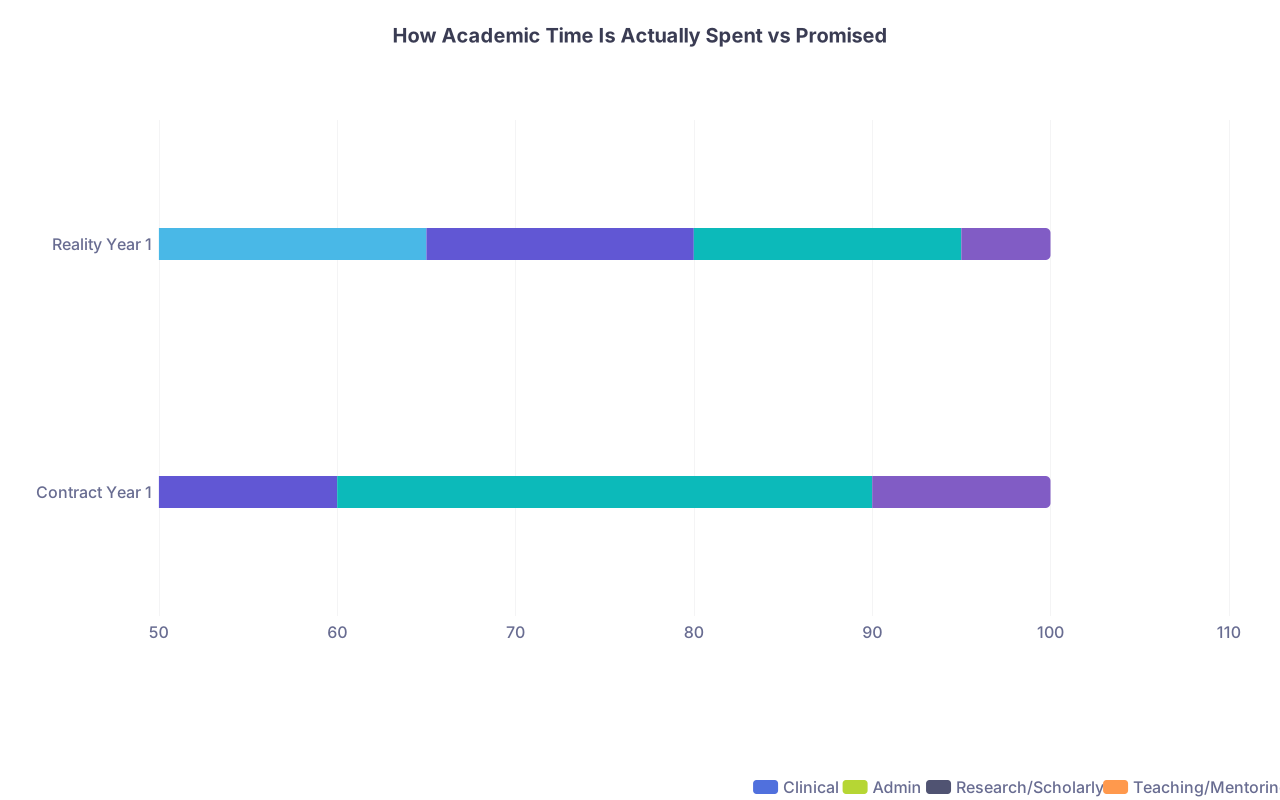
| Category | Clinical | Admin | Research/Scholarly | Teaching/Mentoring |
|---|---|---|---|---|
| Contract Year 1 | 50 | 10 | 30 | 10 |
| Reality Year 1 | 65 | 15 | 15 | 5 |
That “0.5 FTE research” you’re so happy about? It evaporates into undocumented tasks if you do not bolt it down in writing with painful specificity.
The real levers you should care about
FTE breakdown with numbers, not words.
“50% clinical” means nothing unless it says exactly how many clinics, how many sessions, or what your RVU target is. Without that, you’ll slowly creep upward until you’re 0.7–0.8 clinical and nobody remembers you were hired as a “clinician–investigator.”RVU or clinical expectations defined clearly.
I’ve seen contracts with “RVU target per departmental norms.” That’s a trap. Those “norms” are whatever the chair decides next year. You want a number, a ramp-up period, and what happens if the system itself changes.Protected time: not just percent, but protected from what.
The dirty secret: “protected time” is often only protected from formal clinic scheduling, not from “Hey, can you cover this?” calls, new committees, or extra teaching dumped on you. You need language that ties your protected time to named commitments (grant aims, specific projects) and specifies who can override it (ideally only the chair, not every random admin).Support staff and infrastructure.
A 0.5 FTE coordinator is worth more than a $15K salary bump in many academic jobs. Same for access to statisticians, biobank, regulatory support. Departments will toss you an extra few thousand before they’ll commit a coordinator FTE—because staff are harder to claw back quietly.Promotion track clarity.
Titles are cheap. Tracks are not. You need to know if this is tenure-eligible, clinician-educator, research-intensive, and what the unwritten promotion bar is in that department. Every place has its own “We say 2–3 papers a year, but really it’s X, Y, Z.”
The politics here: giving you more protected time or staff can irritate senior faculty who never had those perks. Chairs sometimes under-offer to you just to avoid that headache. They’re not necessarily being malicious—they’re being conflict-avoidant.
You need to be willing to make them a little uncomfortable.
How the Internal Politics Around You Actually Work
You might think your negotiation is with the chair. Sometimes. But rarely only.
Here’s the usual behind-the-scenes choreography.

| Step | Description |
|---|---|
| Step 1 | Division Chief |
| Step 2 | Department Chair |
| Step 3 | Comp Committee |
| Step 4 | Dean Office |
| Step 5 | HR |
| Step 6 | Existing Faculty |
| Step 7 | Final Offer Letter |
Your division chief sells your value. The chair weighs you against budget and existing faculty politics. The comp committee and Dean’s office act like traffic cops: they don’t drive the car, but they can definitely block the intersection.
If your division chief is weak, distracted, or politically sidelined, your negotiation ceiling is lower. That’s the part candidates never see.
What actually moves the needle in those rooms
Things that have triggered real changes to offers in rooms I’ve sat in:
- A clear, credible outside offer with a strong salary/FA package
- A grant score that just missed funding, with likely resubmission success
- A subspecialty that has been impossible to recruit for (think pediatric subspecialties, certain surgical niches)
- Strategic alignment with some shiny institutional initiative (cancer center, AI, global health, equity work with funding behind it)
- A senior faculty champion saying, “If you want this program to grow, we need this person and this package”
Things that almost never move the needle:
- “Cost of living in this city is high” (everyone knows, nobody cares)
- “I have a lot of loans” (so does everyone else)
- “I worked really hard in residency/fellowship” (baseline expectation)
You should absolutely mention cost of living and debt when comparing offers and deciding, but do not expect them to justify major increases. Programs care about their problems, not yours.
The Games They Play With “Equity” and “Fairness”
Equity is the most abused word in academic compensation discussions.
When they say, “We must maintain equity,” it usually means, “We’re afraid if we give you X, we’ll have to fix 8 other people’s salaries too.”
The internal problem they’re hiding: they’ve been underpaying people for years and know it. Your ask highlights the misalignment.
Here are three common moves:
The “band” move.
“All assistant professors in this track are paid between 230–260.”
That might be true. But “between” gives them plenty of room to work. You want to know exactly where you’d fall in that range and why.The “we can’t set a precedent” move.
Used when you ask for something unusual: more protected time, stronger title, big startup. Translation: “We could, but we’d have to justify why you get it and others do not.”The “this is what we gave the last person” move.
Sometimes legitimate. Sometimes lazy. Sometimes a straight-up lie. The last person may have completely different funding, clinical obligations, or track. Or they might be underpaid and miserable.
Your response to these shouldn’t be emotional. It should be surgical:
- Anchor your ask to institutional priorities (“This aligns with your stated goal of X”)
- Anchor to market data (MGMA, AAMC benchmarks, offers from comparable institutions)
- Anchor to your specific value (funding, niche skills, program-building potential)
They can still say no. But the conversation shifts from “you’re being unreasonable” to “we’re choosing not to back up our own stated goals.”
Negotiating Without Becoming “That Person”
This is the fear I hear from early-career physicians: “If I negotiate hard, they’ll think I’m difficult, and it’ll poison the relationship.”
Here’s the insider truth: the faculty branded as “difficult” are almost never the ones who negotiated hard up front. They’re the ones who endlessly complain after signing, or who violate every boundary they agreed to.
Thoughtful, data-backed negotiation is read differently. It signals that you understand your value, you think long-term, and you’re not desperate.
What does get you labeled problematic during negotiation?
- Constantly changing your asks with no clear logic
- Making it personal (“If you cared about diversity/wellness/young faculty…”) instead of strategic
- Dragging the process out for months with vague noncommittal responses
- Gossiping with current faculty about the exact numbers you’re asking for (it always gets back)
You can be firm, specific, and efficient without being obnoxious.
Concrete Strategy: How to Play This Politically Smart
Let’s get very practical for a minute.
Step 1: Understand your leverage honestly
Before you even respond to the first offer, ask yourself:
- Do I have competing offers—or a realistic chance of them?
- Do I bring external funding or a near-miss score?
- Am I in a hard-to-fill subspecialty?
- Is this institution targeting my area as a growth priority?
If the answer to most of those is “no,” you’re negotiating from a different place. Focus on time and protection, not trying to blow up the salary band.
Step 2: Prioritize 3–4 non-negotiables
The worst mistake I see? People hand the chair a Christmas list.
Pick 3–4 core items that truly change your life and career trajectory. For example:
- Specific FTE with concrete clinical expectations
- Startup package / pilot funds over the first 2–3 years
- Named support staff (coordinator, NP/PA, statistician access)
- Clear written expectations for promotion and evaluation timelines
Everything else—small sign-on bonus, relocation, CME, modest salary bump—is secondary.
Step 3: Send one coherent counterproposal
Do not drip out asks piecemeal. Chairs hate that. It makes them look weak when they keep going back to the Dean.
You want one organized response: appreciation for the offer, excitement about the role, then a short, numbered list of specific adjustments that would allow you to accept enthusiastically, with a one-sentence rationale for each tied to institutional goals or your success.
Then stop talking. Let them work.
Step 4: Get the real rules from insiders
You need at least one person inside that institution or department who will talk candidly. Not the official recruitment liaison. A real faculty member who’s a bit jaded and has nothing to gain from sugarcoating.
You ask them:
- “What do people actually get here for assistant professor offers?”
- “Does protected time stay protected?”
- “Who actually runs this department—the chair, division chief, or someone else?”
- “What are people quietly unhappy about with their contracts?”
Those answers change how aggressive you should be.
Beware of These Quiet Red Flags
A few patterns that should make you pause:
- They refuse to put FTE and clinical load in writing (“We’re flexible.”)
- Nobody will tell you the promotion criteria in plain language
- Every time you ask for clarification, you hear “We’ll work that out after you start”
- The chair bad-mouths current junior faculty for “not being productive enough” without mentioning their clinical loads
- There’s lots of talk about “family” and “we’re all in this together” but no specifics about support or structure
I’ve watched more than one brilliant young physician sign in those conditions and be on the market again two years later, bitter and burned out.
On the flip side, some places that look stingy on salary are actually better long-term because they’re honest about expectations, protect time fiercely, and have real mentorship. You need to decode which they are.
You’re Not Just Negotiating a Contract. You’re Negotiating Who You’ll Be There.
The first contract sets your identity in that institution.
- If you sign as the “80% clinical workhorse who will maybe do research,” that’s who you are. Good luck clawing back time later.
- If you sign as the “junior but serious investigator/educator with protected time and a defined track,” people treat you differently from day one. They route opportunities, committees, and mentees to you differently.
Chairs and chiefs remember your negotiation. HR forgets. But leadership files away who was clear about their goals and who just grabbed the first number on the table.
You do not need to win every point. You do need to walk away knowing that your contract matches the story you’re telling yourself about your career.
If there’s a huge gap between the two, no amount of “We really value you” talk will fix that once you’re in the system.
FAQs
1. Won’t negotiating hard make them pull the offer?
It’s extremely rare for an academic department to yank an offer simply because you negotiated in a focused, respectful way. Pulling an offer is politically costly—they’ve already sold you to the Dean, the division, sometimes even to partners like the hospital. What does push them to the edge is erratic or hostile behavior, or dragging the process out indefinitely without making a decision. If they pull the offer because you reasonably asked for clarity and modest changes, you just dodged a toxic place.
2. Is it better to get more salary or more protected time?
Protected time wins nine times out of ten, if it’s real. Over a few years, meaningful protected time with proper support can generate grants, reputation, and negotiating power that dwarfs a $10–20K bump. But “protected” has to be nailed down: specific FTE, clinic sessions, RVU expectations, and who can override it. If they won’t define it clearly, it’s not protected—it’s a suggestion.
3. Should I tell them about other offers and numbers?
You should absolutely tell them you have other serious offers if that’s true. You don’t have to (and often shouldn’t) share exact numbers in the first breath. Instead, say, “I have an offer from X that includes more protected time / higher base in the range of Y.” If they press, you can choose how specific to get, but never lie. If they later learn you inflated numbers, your credibility is shot and your future negotiations there are dead.
4. Can I fix a bad contract after I start?
You can improve a mediocre contract. You almost never fully escape a fatally bad one. Once you’re in, the default institutional assumption is that you’ve accepted the terms. To renegotiate, you need leverage: grants, major program-building, major clinical value, or a credible outside offer. I’ve seen people successfully renegotiate FTE and support after delivering on clear metrics. I’ve also seen people beg for relief from impossible clinical loads and get nothing because they had no leverage and signed those expectations. Front-load the hard work now, while they still need you more than you need them.
Key points: Your first academic contract is not “standard”—it’s a political artifact of how they value you. The real battleground is not just salary but your time, protection, and identity in the department. Negotiate like someone who plans to stay and build something, not like someone desperate to grab any badge that says “assistant professor.”