
The fastest way to kill an academic career is not laziness. It’s making the wrong moves in the first 3–5 years and not realizing the damage until promotion time.
You can be smart, hardworking, clinically excellent—and still quietly destroy your promotion chances with a handful of predictable mistakes. I’ve watched new faculty do this over and over at big-name institutions and smaller programs alike. Same pattern. Same outcome.
If you’re post-residency or fellowship and just starting on the academic job track, this is the landmine map you’re not getting in orientation.
1. Saying “Yes” to Everything – and Building a CV Full of Noise
Your biggest early-career risk is not being ignored. It’s being too helpful.
You’re new. You want to be a team player. A senior faculty member asks, “Can you help with this committee?” Another: “We need someone to cover this QI project, can you do it?” Before you know it, your calendar is full, your nights are gone, and your CV reads like random debris.
Here’s the mistake:
You confuse “busy” with “promotable.”
Promotion committees do not care how exhausted you are. They care whether your work is:
- Coherent
- Aligned with your track (clinician–educator, research, clinical)
- Documented with outcomes (publications, curricula, grants, measurable impact)
What tanks promotion:
- Serving on too many low-impact committees (e.g., ad hoc wellness group, parking task force, random hospital subcommittee) with no clear outcomes.
- Taking every small teaching gig offered—one-off lectures scattered across five programs—without building anything durable or promotable (like a course, a longitudinal curriculum, or a training program).
- Volunteering for every “we just need a warm body” project with no authorship or leadership role.
What to do instead:
Before you say yes, ask yourself:
- “Will this lead to a product I can list for promotion?”
- “Does this fit my academic identity or track?”
- “Is there a clear role, timeline, and outcome?”
Set a hard cap on early committee work and non-core projects:
- Year 1: 1–2 meaningful committees, max
- No more than 10–15% of your total work time on service
Ask explicitly:
- “What will my role be?”
- “Will I be listed as first or senior author, course director, or lead?”
- “Has this led to publications or recognized outcomes in the past?”
If the answers are vague, that’s a red flag. You’re about to be used as labor, not developed as faculty.
2. Misunderstanding Your Track – and Getting Evaluated on the Wrong Criteria
This one is brutal because it’s usually discovered too late.
A new faculty member thinks:
“I’m a great clinician and teacher. My patients love me. Residents love me. I’ll be fine.”
Meanwhile, they’re on a research-heavy track that expects grants and publications. Or they’re on a clinician–educator track but never actually build or lead any educational programs—just show up and teach.
Then mid-promotion-cycle, someone says, “Your teaching evals are great, but where’s your scholarship?”
And the silence is career-ending.
Classic track mistakes:
- Being on tenure track with no real plan for funding or protected time.
- Assuming “clinician–educator” means “do a lot of teaching” instead of “create educational scholarship with dissemination.”
- Ignoring what “academic productivity” means in your department until it’s time to go up for promotion.
Do not rely on verbal reassurance like, “Oh, don’t worry, we’re flexible,” or “Just keep doing what you’re doing.” That’s how people get burned.
Your survival checklist:
- Get the written promotion criteria for your specific track and rank. Read them line by line.
- Ask a blunt question at the start:
“If I keep doing what I’m doing now for 5 years, will that be enough for promotion on this track?”
If they hesitate or say “it depends,” push: “What exactly would I need to add?” - Confirm:
- How many publications?
- What kind (first author, last author, peer-reviewed, educational)?
- Any grant expectations?
- What counts as “excellent teaching” in writing? (Evaluations? Awards? Innovations?)
| Track Type | Dominant Metric | Protected Time | Promotion Risk for New Faculty |
|---|---|---|---|
| Tenure/Research | Grants & papers | 40–80% | Extremely high if unfunded |
| Clinician–Educator | Teaching + scholarship | 10–30% | Moderate if no scholarly output |
| Clinical (non-tenure) | Clinical RVUs | 0–10% | Lower, but capped advancement |
If your current job description doesn’t line up with the promotion criteria for your track, you are on a conveyor belt headed to a denial letter. Fix the mismatch early or change tracks while you still can.
3. Letting Clinical Work Swallow Your Career
This is the most common way good people disappear from academic promotion lists.
The hospital is short-staffed. Volumes are high. Someone leaves; someone goes on leave; the ER is slammed. Leadership says, “We really need you right now.” So you add more shifts. Cover more weekends. Pick up more inpatients.
Two years later, your RVUs are fantastic. Your academic output is zero.
You’ve made a predictable error: treating clinical work as “temporary” and academic work as “eventually.”
Here’s the harsh reality:
- Clinical needs never go away. There is no quiet season.
- If you don’t protect academic time ruthlessly in years 1–3, you will not have the portfolio you need by year 6.
Red flags you’re headed for trouble:
- Your “protected time” keeps getting nibbled away by “just this week” coverage.
- You frequently say, “I’ll get to that paper after this month’s crazy schedule.”
- You’re on clinical e-mail 24/7 and “fit in” academic work at night and weekends.
You need boundaries that feel uncomfortable:
- Block non-negotiable writing/academic time on your calendar—2–4 hours at a time, weekly. Defend it like a clinic session.
- If someone tries to schedule over it, respond:
“I’m not available during that time; that’s contracted academic effort.” - When asked to add clinical coverage, have a default line:
- “I can help this month if we adjust my academic expectations or shift some tasks. I’m happy to discuss with leadership.”
If your department consistently ignores your protected time, that’s not an accident. That’s the culture. And you need to decide if you’re willing to trade promotion for workload.
4. Treating Teaching as “Showing Up” Instead of Building a Portfolio
Many new faculty love teaching. They say yes to lectures, bedside teaching, small groups, simulation. Great. Then promotion comes around and the committee asks: “What have you built?”
Common mistake: confusing hours of teaching with evidence of educational impact.
You tank your promotion when:
- You give the same lecture for 5 years and never:
- Publish the curriculum
- Study its impact
- Present it outside your institution
- You supervise residents constantly but never document:
- Learner evaluations
- Teaching awards
- Formal roles (course director, rotation director)
- You take on “interim” educational leadership with no support, no title, no recognition.
If you’re a clinician–educator and your CV looks like “lots of teaching events” and nothing else, you’re on thin ice.
Turn teaching into promotable work:
- Consolidate your teaching:
- Instead of 10 scattered lectures, own 1–2 courses, workshops, or recurring sessions you can refine and eventually publish.
- Collect evidence relentlessly:
- Learner eval summaries
- Teaching awards
- Emails of positive feedback (save them)
- Letters confirming your role as course/rotation director
- Turn innovation into scholarship:
- If you changed a rotation, built a simulation, or designed a new assessment, that’s potentially a paper, poster, or MedEdPORTAL submission.
- Get your name on it:
- Do not be the anonymous workhorse who “helps.” Be the named director, first author, or senior author when possible.
Teaching is promotable when it’s visible, documented, and disseminated. Just talking in rooms is not enough.
5. Ignoring Mentorship – or Picking the Wrong Mentors
New faculty who say “I don’t really need a mentor” are almost guaranteed to stall out.
Or worse, they pick a “mentor” who is:
- Perpetually too busy
- Out of touch with current promotion norms
- On a completely different track
- Politically weak or disliked by leadership
Your mentor situation can make or break your promotion.
Big mistakes:
- Having only one senior mentor and assuming that’s enough.
- Choosing someone just because they’re nice or well-known, instead of being aligned with your goals.
- Never discussing promotion timelines and criteria explicitly in mentorship meetings.
You want:
- A content mentor – knows your field (research area, education, clinical niche).
- A career mentor – understands your institution’s politics and promotion machinery.
- A sponsor – someone who will say your name when you’re not in the room (nominations, opportunities, committees that matter).
Warning signs you picked poorly:
- They repeatedly cancel or reschedule your meetings.
- You never leave meetings with concrete actions (write this, join that, apply here).
- They say vague things like “You’re doing fine” without referring to specific metrics.
Ask your mentor directly:
- “Based on my current CV, am I on track for promotion in X years?”
- “If not, what would you change this year?”
- “What should I say no to from now on?”
If they can’t answer clearly, add or change mentors. You’re not married to your first choice.
6. Producing the Wrong Kind of Scholarship – or None at All
This one stings because people often think they are being productive.
They’re writing book chapters. Editing protocols. Making internal guidelines. Leading QI projects. Giving grand rounds. All good. But much of it doesn’t count the way they think it does.
At promotion time, the committee flips to the “Peer-Reviewed Publications” section of your CV and finds… almost nothing relevant.
Common scholarship mistakes:
- Over-investing in book chapters and invited reviews as a junior person.
- These are fine occasionally, but they rarely move the needle like original work or educational scholarship.
- Doing large QI projects that:
- Stay internal
- Never get written up
- Never produce a presentation or publication
- Sitting forever in the “data collected, manuscript not written” phase.
Your promotion file is not “what you did.” It’s “what you turned into documented, citable output.”
You avoid this trap by:
- Ruthlessly prioritizing peer-reviewed, discoverable work:
- Original research
- Educational publications
- MedEdPORTAL or equivalent
- Well-recognized clinical guidelines where you are a lead author
- Turning QI and curriculum work into:
- Abstracts -> Posters -> Papers
- Asking on every project:
- “Who is drafting the manuscript?”
- “What is the target journal?”
- “What’s our timeline for submission?”
If your name is not on published or in-press work by year 3, that’s a serious red flag.
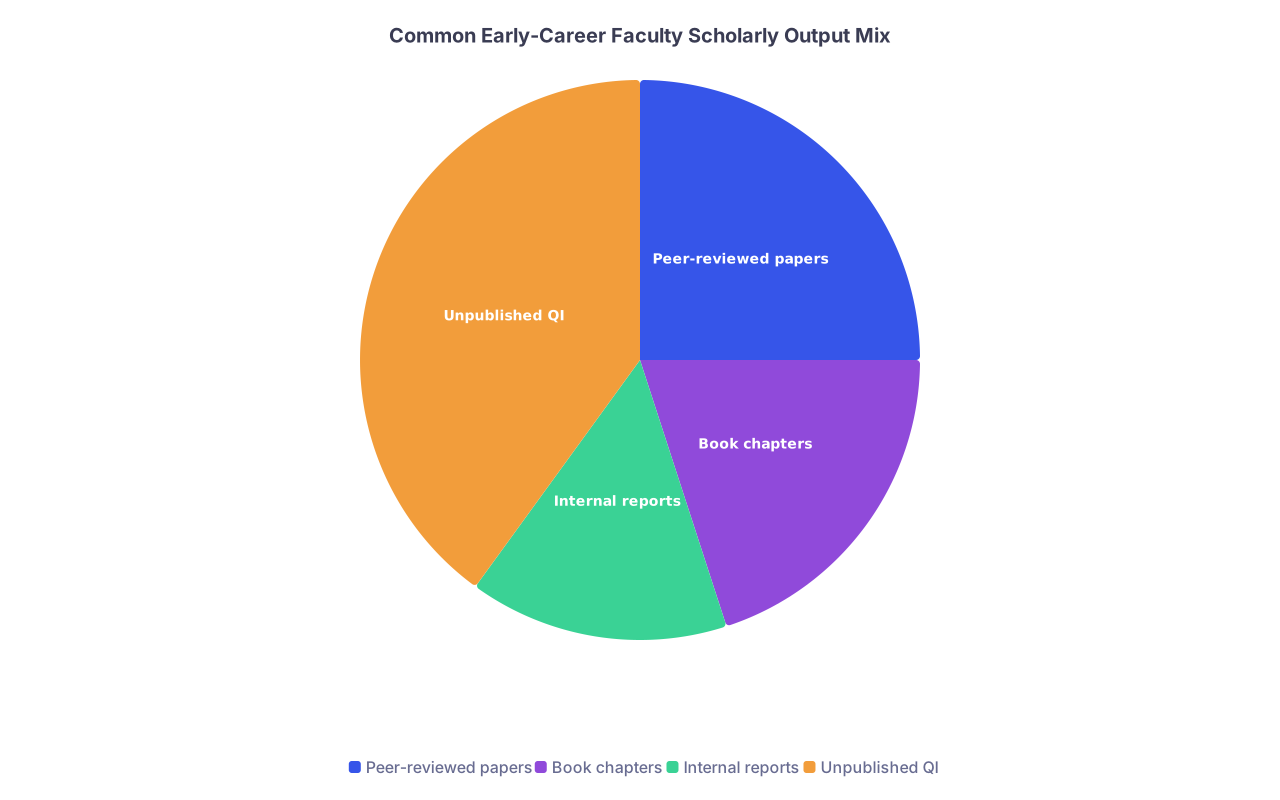
| Category | Value |
|---|---|
| Peer-reviewed papers | 25 |
| Book chapters | 20 |
| Internal reports | 15 |
| Unpublished QI | 40 |
That 40% “unpublished QI” and 15% “internal reports” are where promotions quietly die.
7. Mismanaging Time Like You’re Still a Trainee
Residents and fellows live in reactive mode: do what’s in front of you, respond to pages, handle today’s fires. New faculty who keep that mindset get buried.
Common time-management mistakes that wreck promotion chances:
- Living entirely on email and meetings:
- Your academic time becomes “reply to messages” instead of “create promotable work.”
- Never scheduling deep work blocks:
- Manuscripts, grant writing, curriculum design all need uninterrupted hours. You won’t “squeeze them in.”
- Accepting every recurring meeting without asking why you’re there:
- Weekly standing meeting with unclear agenda? That’s two hours a month you’ll never get back.
You’re not being judged on responsiveness. You’re being judged on output.
Fixes that actually work:
- Put fixed writing blocks into your calendar first. One 2–3 hour block per week is the bare minimum. Two is better.
- Turn off email during those blocks. Completely.
- Before accepting a meeting, ask yourself:
- “Is my presence necessary?”
- “Does this contribute to my promotion file?”
If not, decline or ask for summary notes.
- Batch non-academic tasks (forms, minor emails, scheduling) into short windows.
You will feel selfish doing this. Good. Academic success requires some selfishness with your time.
8. Ignoring Politics and Visibility – Being “Good but Invisible”
Some of the most technically skilled, hardworking junior faculty never get promoted on time. Why? Because when the promotions committee meets, half the room says, “Who is this?”
Academia is not a pure meritocracy. If you act like it is, you lose.
Mistakes that make you invisible:
- Doing all your work inside your own unit and never presenting outside it.
- Skipping departmental events where informal decisions get made (faculty meetings, retreats, key grand rounds).
- Never asking to be considered for:
- Internal awards
- Speaking slots
- Institutional committees that do matter (P&T, curriculum committee, search committees)
You’re not gaming the system by being visible. You’re giving people the information they need to advocate for you.
You need:
- At least 1–2 talks per year outside your department or institution.
- A presence on at least one committee that leadership actually watches (education, promotions, strategic planning).
- A chair or section chief who:
- Knows your work well
- Can speak fluently about your contributions
- Actually likes and respects you enough to fight for you
If you’ve never heard your chair say, “This is what I’m going to highlight in your promotion letter,” that’s a problem. Ask them.
9. Not Tracking Your Own Progress – Blindly Marching Toward Review
New faculty often assume, “If I’m off track, someone will tell me.”
No. They won’t. People are busy. Some are conflict-avoidant. Others just assume you know the rules.
You are responsible for tracking your own trajectory.
Mistakes:
- Never doing a formal annual self-review against promotion criteria.
- Treating the mid-tenure or mid-promotion review as a formality instead of a reality check.
- Ignoring vague or polite warnings like “you might want to diversify your publications” or “we’d like to see more scholarship.”
Treat your career like a QI project. Check the data.
Build a simple yearly check-in:

| Step | Description |
|---|---|
| Step 1 | Start of Year |
| Step 2 | Review promotion criteria |
| Step 3 | Update CV |
| Step 4 | Increase depth of focus |
| Step 5 | Adjust workload and mentors |
| Step 6 | Add projects that produce outputs |
| Step 7 | Schedule mentor review |
| Step 8 | Midyear check |
| Step 9 | On track? |
Each year, ask:
- How many new peer-reviewed outputs did I add?
- Did I add anything that clearly moves me toward the next rank?
- Am I still doing anything that doesn’t contribute to promotion and could be dropped?
If you can’t answer that without guessing, you’re driving blind.
10. Believing Loyalty Will Be Rewarded
This is the quiet, painful one.
You stay late. You cover gaps. You say yes when others say no. You keep the service afloat. And you assume that when it’s time for promotion, people will remember all that and “take care of you.”
Sometimes they do. Often, they don’t.
Mistakes wrapped in “loyalty”:
- Staying in a toxic or exploitative environment because “I owe them” or “they hired me.”
- Accepting repeated promotion delays with vague promises like “next cycle for sure” or “we’re working on your case.”
- Never exploring outside opportunities because you don’t want to be “disloyal.”
Here’s the uncomfortable truth:
Departments respond faster when they’re afraid of losing you.
You protect yourself by:
- Keeping your CV updated and quietly testing the market every few years.
- Taking calls from other institutions. You don’t have to move, but knowing your value changes how you negotiate.
- Not being afraid to say, calmly and directly:
- “I’ve been here X years, and based on the criteria, I believe I’m ready for promotion. What is the timeline and process to make that happen?”
If the answers are evasive or dismissive, don’t double down on loyalty. Start planning an exit or major renegotiation.
Key Takeaways – If You Remember Nothing Else
Busy is not promotable. Say no to scattered, low-yield work. Say yes to roles and projects that produce concrete, promotable outcomes aligned with your track.
Your track rules your life. Know the written criteria for your specific track, and adjust your day-to-day work so it matches. Hope and “being a team player” will not carry you across the line.
Protect time and build output early. Clinical work and random tasks will expand forever. Guard your academic time, build a real portfolio (publications, curricula, leadership roles), and track your progress like your career depends on it—because it does.