
The fastest way to hate your first attending job is to believe what the ad implies instead of what the structure actually rewards.
You’re not just choosing a job. You’re choosing a set of incentives that will quietly control your time, your stress level, and your career trajectory. If you misread “research-heavy” vs “RVU-heavy” now, you’ll be stuck fighting a system that was never designed to give you what you thought you were signing up for.
Let me walk you through the traps I’ve seen people fall into, over and over, because they trusted vague phrases in postings instead of dissecting the numbers and expectations.
The Language in Job Ads That Will Burn You
Programs and hospitals know exactly what they’re doing with phrasing. You, fresh out of residency or fellowship, often do not.
You’ll see things like:
- “Research-friendly environment”
- “Opportunity to pursue scholarly work”
- “Balanced mix of clinical and academic responsibilities”
- “RVU-competitive compensation”
- “Protected time for academic activities”
On paper, all of that sounds lovely. But most of those phrases are legally meaningless unless they’re backed by:
- A clear FTE split (e.g., 0.6 clinical / 0.4 research)
- A written description of what counts as protected time
- A compensation model that matches the supposed priorities
The classic mistake: Taking “research-heavy” to mean “I’ll easily get time and support to build a real academic portfolio” when in fact it means “you’re still 0.9 clinical, but if you write papers at night we’ll be very proud of you.”
Flip side: Assuming “RVU-heavy” just means “I can make more if I work harder,” but not realizing that:
- Base salary is artificially low
- You’re functionally in production-only territory
- Every clinic patient you don’t see to write that paper? That’s direct income lost
Do not get hypnotized by adjectives. Research-heavy or RVU-heavy isn’t about vibes. It’s about how you’re actually paid and scheduled.
What “Research-Heavy” Really Looks Like (and How People Get Fooled)
True research-heavy jobs have concrete features. Pretend you’re auditing them like a skeptical accountant. Because you should be.

A genuine research-heavy role usually has most of these:
- Less than 0.7 clinical FTE (often 0.3–0.5)
- Explicit written “protected time” for research, teaching, or grants
- Promotion criteria that value publications, grants, presentations
- Access to infrastructure: coordinators, statisticians, IRB support
- Salary that isn’t entirely dependent on your clinical volume
The fake version? That’s where people regret signing:
- Ad says: “Strong support for research.”
- Contract says: “0.9 clinical FTE. Research as time allows.”
- Chair says at interview: “We’ll definitely find a way to protect time.”
- Then after hire: “We’re short-staffed right now; once we recruit more you’ll have more time.” (They never do.)
Here’s the painful pattern I’ve seen:
Year 1: You’re clinically slammed, trying to learn the system. Research is a fantasy.
Year 2: You pick up one tiny retrospective project. Nights and weekends only. You’re told it’s “a great start.”
Year 3: You’re still 0.9 clinical, have two posters, no first-author publication, and you’re up for contract renewal. Promotion? Nowhere in sight. You’re exhausted and starting to question if you even like academia.
The mistake wasn’t that you failed. The mistake was believing “research-heavy” meant anything when the actual clinical FTE and compensation model told a completely different story.
What “RVU-Heavy” Really Means (and Why It’s Not Always the Villain)
On the other end, RVU-heavy jobs get demonized. They’re not inherently bad. They’re dangerous when you misunderstand what you’re walking into.
RVU-heavy typically means:
- Low base salary
- Large proportion of income tied to productivity (RVUs)
- Minimal or no protected time
- Strong pressure to maximize volume
- Little patience for “non-billable” activities
The upside—if you’re honest with yourself about your goals:
- You can make a lot of money if you’re efficient, fast, and resilient
- You usually have more autonomy clinically
- There’s less pressure to publish or get grants
But here’s where people screw themselves:
They think they’re taking an RVU-heavy job “for a few years” while they “build their CV” for an academic move later. That’s fantasy in most cases.
An RVU-heavy environment will:
- Reward speed, not scholarship
- Penalize time spent on papers, QI, or education that doesn’t bill
- Fill your days with back-to-back patients and inbox work
- Leave you with zero bandwidth to build a serious research profile
By year 3 you’ve maybe written one case report on a Sunday. You’ve got excellent clinical chops, sure. But your academic competitiveness? Flat.
And promotion committees at research-intensive places don’t care how efficient your clinic throughput is.
The Hidden Math: Incentives Beat Intentions Every Time
You can want to do research as much as you like. Your department chair can enthusiastically say, “We love research here.” None of that matters if the compensation and workload structure punishes you for doing it.
Here’s where I want you to get brutally objective. Look at how different job structures reward or punish non-clinical work:
| Feature | Signals Research-Heavy | Signals RVU-Heavy |
|---|---|---|
| Clinical FTE | 0.3–0.7 | 0.8–1.0 |
| Protected time in contract | Yes, specified blocks | Vague or “as approved by chair” |
| Base salary vs bonus | Higher base, smaller bonus | Lower base, large production bonus |
| RVU expectations | Modest, often below national median | High, often above median |
| Promotion criteria | Publications, grants, teaching | RVUs, patient satisfaction, panel size |
| Support staff for research | Coordinators, statisticians, IRB | Basically none |
If the numbers and structure look RVU-heavy, you are not in a research-heavy job—no matter how many times they say “academic” in the brochure.
Classic Misreads of Job Ads (Concrete Examples)
Let me spell out the most common trap scenarios I’ve seen in post-residency job searches.
Trap #1: “Balanced” Academic Job That’s Not Balanced
Ad language:
“Join our dynamic academic department with a balanced mix of clinical and research responsibilities. Protected time available for scholarly activity.”
Reality:
- Contract says: 9 half-day clinics per week plus inpatient weeks
- No specific research blocks on the schedule
- RVU expectations are at or above community benchmarks
- “Protected time” has to be individually requested each quarter and is “subject to clinical needs”
End result: Your “balanced” job is 95% clinical. You’re trying to squeeze academic work in tiny cracks.
Trap #2: “RVU-Competitive” That’s Actually Volume or Starve
Ad language:
“Highly competitive RVU-based compensation with uncapped earnings potential.”
Reality:
- Base salary barely livable for your region
- RVU threshold set above what a normal human can reasonably generate in year one
- No ramp-up support, no guarantee clinics will be full
- Administrative time unpaid and invisible
End result: You’re working 60+ hours/week to hit mediocre income, cutting every corner you can just to keep up, and any dream of quality improvement or teaching is gone.
Trap #3: “Research Opportunities” That Don’t Exist Yet
Ad language:
“Significant opportunity to help build our research program in your field.”
Reality:
- No existing infrastructure
- No other investigators doing serious research
- No internal grant mechanisms
- No clear plan, timeline, or resources; they “hope” you’ll help create it
End result: You’re essentially being asked to build an academic department from scratch while still hitting full clinical metrics. You burn out, they shrug, and the next person gets hired into the same mess.
The RVU vs Research Crunch: How It Plays Out Day-to-Day
Forget mission statements. Think about Tuesday at 3:45 p.m.
If you’re in a research-heavy structure:
- You may literally be off the schedule two afternoons a week
- There’s a standing meeting with your study team
- You feel pressure to produce manuscripts and get grants
- People ask you for help on projects because it’s normal there
If you’re in an RVU-heavy structure:
- Your schedule is double-booked and behind
- Your inbox has 50+ messages
- There’s no “research afternoon”—just a theoretical expectation
- If you block time for a study, you take a direct financial and political hit
This is the part people underestimate: you won’t magically be different as an attending. If your environment makes academic work punishing or impossible, your “good intentions” will die fast.
Misalignment: When Your Career Goals and Job Type Don’t Match
The worst regrets I hear are from physicians who picked jobs based on location or salary and assumed they could “figure out the rest later.”
Here are four common misalignments:
You want an R01-level academic career.
You take an RVU-heavy job “to pay down loans first.”
Result: By the time you try to pivot, you have no competitive research record and are 5–7 years behind peers.You actually want a primarily clinical life with decent work-life balance.
You take a research-heavy job because “it sounds prestigious.”
Result: You resent the constant pressure to publish, hate grant writing, and feel like a failure for not “doing enough.”You want teaching and mentoring, but not hardcore research.
You take a job that calls itself “academic” but is functionally RVU-based with residents rotating through.
Result: Teaching is extra, not protected. Your evaluation says you’re “great with learners” but your bonus says, “see more patients.”You think a community job with “academic affiliation” equals true academic support.
Reality: That affiliation is often just permission to say the hospital’s name on your slide deck.
Result: You’re functionally in private practice with a branded badge.
You need to be brutally honest about what you actually want your day to look like in 3–5 years. Then match the job type, not the job ad language, to that picture.
Red Flags in “Research-Heavy” Job Ads
If you want real academic work and see these, do not rationalize them away.
- “Research time as approved by department leadership” with no baseline percentage
- No specific mention of FTE allocation for research/teaching
- RVU targets that look like full-time clinical expectations
- No mention of existing grants, investigators, or major studies
- Vague phrases like “plenty of opportunity to get involved” but no details
Also: if no one in the division has an R01, or K award, or consistent publication record, your odds of building that from zero as a brand-new attending while full-time clinical? Vanishingly small.
Red Flags in “RVU-Heavy” Job Ads
If you’re considering a production-heavy job, you still need to protect yourself from impossible expectations:
- RVU thresholds much higher than MGMA median for your specialty
- Short guarantee period (or none) in a new or unstable clinic
- No salary floor after the initial guarantee
- Heavy call burden with no RVU credit
- Administrative tasks (meetings, committees, documentation) not factored into RVU expectations
The subtle trap: they sell you on “top 10% income potential,” but the path to that is unsustainable throughput that will wreck your health and any chance of long-term career satisfaction.
The One Conversation People Skip (And Regret Skipping)
You should be doing this with every serious job offer, especially if you care about research vs. RVUs.
Ask to talk to:
- A junior faculty member 2–3 years ahead of you
- Someone who left in the past 1–2 years (if you can find them)
- The division chief or chair—twice, once for sales pitch, once for specifics
And then ask them questions that force numbers, not adjectives:
- “What is your actual clinical FTE? How many half-day clinics and inpatient weeks?”
- “How many full days per month do you have truly protected for research?”
- “What’s the average RVU production for physicians in my role? What is considered ‘meets expectations’?”
- “Of the last five junior faculty in this division, how many actually got promoted on a research track?”
- “How many active grants does the division hold right now, and who supports grant writing?”
If they dodge, minimize, or “don’t have those numbers handy,” that is your answer.
A Visual Reality Check: How Your Time Will Really Be Spent
Let’s be painfully concrete about different job types. This is what usually happens, regardless of what the ad promised.
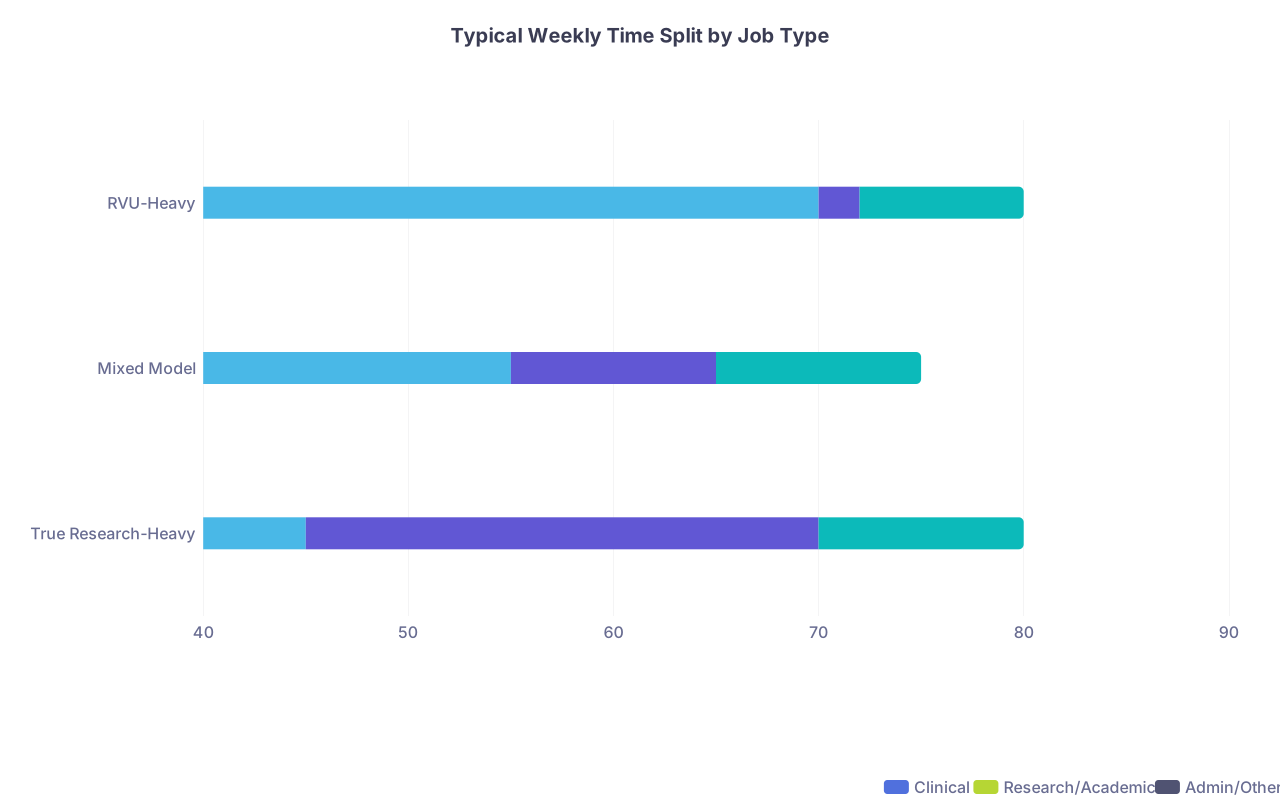
| Category | Clinical | Research/Academic | Admin/Other |
|---|---|---|---|
| True Research-Heavy | 45 | 25 | 10 |
| Mixed Model | 55 | 10 | 10 |
| RVU-Heavy | 70 | 2 | 8 |
In a true research-heavy job, you feel the research time. It’s not some theoretical “maybe Friday afternoon.”
In RVU-heavy, research is a rounding error. If the chart doesn’t match what you want your life to look like, do not sign.
How to Read a Job Ad Like a Skeptic (The Right Way)
You need to train yourself to translate fluffy language into concrete realities.
When you see:
- “Protected time available” → Ask: “Exactly how many hours per week? Written where?”
- “Competitive RVU compensation” → Ask: “What’s the base? What’s the threshold? What do current docs actually earn?”
- “Academic appointment” → Ask: “What are the promotion criteria? How many have actually been promoted recently?”
- “Research is encouraged but not required” → Read as: “You will get zero structural support for research.”
A job ad is marketing. Your job is to strip all the paint off and look at the bare metal: FTE, RVUs, schedule, compensation, promotion expectations.
Do Not Outsource This Judgment to Your Future Self
The comforting lie is: “I’ll just get in, see how it feels, and adjust later.” That’s how you wake up three years in, clinically exhausted, academically stalled, and boxed into a narrow career lane.
Your first attending job sets momentum:
- It sets your baseline CV trajectory
- It defines your network (community vs research vs hybrid)
- It shapes your skills (fast clinic machine vs funded investigator vs educator)
Changing lanes later is possible, but much harder than picking the right lane now. Especially if your loans, family, and lifestyle start depending on a particular income model.
Your Next Step (Do This Today)
Pull up one job ad you’re currently considering. Just one.
Now:
- Highlight every vague phrase: “balanced,” “competitive,” “opportunity,” “protected time,” “research-friendly.”
- In the margin (or in a separate document), write the specific question you need answered to convert each vague phrase into a number: FTE, RVUs, days per month, dollars, headcount.
- Draft an email to the recruiter or division chief asking for those specifics before you proceed to the next interview stage.
If they can’t—or won’t—give you straightforward answers, do not tell yourself a story that fills in the blanks in your favor. Walk away, or at least treat the job as what it actually is: a vague promise wrapped around an RVU engine.
That one exercise today can save you from three years of quietly regretting that you trusted adjectives more than incentives.