The worst career moves physicians make are usually not about the job. They’re about the relocation wrapped around it.
You think you’re chasing a better opportunity. More money, better schedule, nicer hospital. But if you mishandle the move, you can quietly sabotage your career, your finances, and your family life for years.
I’ve watched too many smart physicians make the same avoidable relocation mistakes—especially in the first 5–10 years after residency—because they were tired, flattered, and in a rush to escape their current situation. Do not be that story.
Let’s go through the big traps. The ones that actually hurt. And how to sidestep them before you sign anything or call a moving truck.
Mistake #1: Chasing Salary and Ignoring Total Life Cost
Everyone says they won’t do this. Then they see an extra $100k on an offer and lose their judgment.
The classic setup:
You’re finishing fellowship or 3–5 years into practice. A recruiter flashes a base salary that’s $75–150k higher than what you’ve seen locally. They talk “low cost of living” and “high demand area.” You think: slam-dunk.
Here’s the problem: you’re only looking at what hits your paycheck, not what hits your life.
Common ways this goes wrong:
- Higher salary in a city with brutal housing prices and property taxes
- “Low cost of living” town with one decent school and zero backup childcare
- State with punishing income tax when you’re used to none (or vice versa, but with stealth costs elsewhere)
- Long commute because the neighborhood you actually want to live in is 45 minutes from the hospital
The mistake isn’t considering money. The mistake is stopping at salary.
You should be asking:
- What’s the after-tax difference between my current job and this one?
- What’s the realistic cost of:
- Housing (buy vs rent, property taxes, HOA)
- Childcare (full-time, backup care, after-school)
- Commuting (time + gas + parking)
- Student loan repayment impact (PSLF eligibility, community/nonprofit vs for-profit)
- How quickly do physicians burn out and leave this system? High money often hides high churn.
Here’s a simple comparison structure you should insist on doing:
| Factor | Current Job | New Job A | New Job B |
|---|---|---|---|
| Base Salary | 300k | 380k | 340k |
| State Income Tax | 0% | 6% | 4% |
| Typical Rent/Mortgage | 2k | 4.5k | 3k |
| Commute (min, one way) | 15 | 45 | 25 |
| Childcare (per month) | 1.5k | 2.5k | 2k |
I’ve seen “huge” salary bumps vanish once someone actually did this math.
Avoid the mistake:
Before you emotionally attach to the bigger number:
- Pull up a cost-of-living calculator as a starting point, but do not trust it blindly. It misses real-world physician lifestyle costs.
- Talk to two local physicians who’ve been there at least 3 years. Ask what actually drains their money and time.
- Build a simple spreadsheet and compare take-home, housing, childcare, and commute across your real options.
Do not accept any job until you see the full financial picture side by side. On one page. In actual numbers.
Mistake #2: Underestimating Spouse/Partner Career Damage
Physicians regularly treat their partner’s career like it’s flexible decoration. Especially if the partner is “remote” or “can work anywhere.”
That’s a good way to blow up both your relocation and your relationship.
I’ve watched this play out:
- Dual-physician couples where one takes a “dream job,” the other ends up with slim pickings, bad call, and resentment.
- Non-physician spouse with a real career (engineering, law, tech, academia) moves to a small city where their field barely exists.
- Partners who “can work remotely” discover the new time zone crushes their collaboration or their company quietly prefers local employees for promotion.
Notice the pattern: time pressure + “we’ll figure it out later” = quiet disaster.
Do not relocate until your partner’s situation is fully clear:
- Do they have job options in that city that match their skill and seniority?
- What happens to their earning potential?
- How does call schedule + childcare reality collide with their work hours?
- If they’re academic, what happens to tenure clocks, research support, and promotion timelines?
This is not “supportive partner” territory. This is long-term life structure.
Avoid the mistake:
- Treat your partner’s career like yours: required, not optional.
- Make a shortlist of cities where both your careers can realistically function.
- For each serious job option, your partner should:
- Talk to 2–3 people in their field already in that city.
- Identify 2–3 actual companies or institutions where they’d want to work.
- Map out worst-case (no job for 6–12 months) and decide if that’s survivable.
If the only way your dream job works is your partner swallowing a permanent downgrade, be honest about that. Name it. Many couples move anyway, but at least go in with your eyes open instead of telling each other a fantasy.
Mistake #3: Believing the Recruiter’s Version of Reality
Recruiters are not your friends. They’re paid salespeople with quotas and scripts.
Some are decent and straightforward. Many are not. A common pattern I’ve heard in physician lounges:
“The recruiter said…” followed six months later by, “…but it’s not like that at all.”
Big recruiter lies and half-truths you should expect:
- “Everyone is done by 4 PM” (translation: once a week, on a light day, if nobody is sick and two partners are in town)
- “We really respect work–life balance” (translation: we’re short-staffed and you’ll be covering holes constantly)
- “We’re growing fast” (translation: churn is high and we keep hiring replacements)
- “You’ll be busy from day one” (translation: we’re dumping overflow and problem patients on you)
Never rely on recruiter descriptions for:
- Call burden
- Clinic volume
- Culture
- Administration support
- Turnover
- Compensation structure details
Their job is to get your signature on a contract, not to safeguard your life.
Avoid the mistake:
You need data from frontline people who don’t get paid if you sign.
- Talk to:
- New hires (0–3 years there)
- Mid-career physicians (5–10 years there)
- Someone who left in the last 1–3 years, if you can find them
- Ask specific questions, not “how is it?”
- “How many nights/weekends were you actually in the hospital over the last month?”
- “What was your RVU or wRVU last year and how hard did you have to work to get it?”
- “How many physicians left the group in the last 2–3 years? Why?”
- “Do you feel comfortable saying no when volume expectations are unreasonable?”
If the recruiter hesitates or blocks you from speaking to current physicians alone, that’s a giant red flag. Walk away. I’ve never seen that end well.
Mistake #4: Ignoring Contract Tethers: Noncompetes, Buyouts, and Clawbacks
Nothing traps a physician faster than a bad contract combined with a relocation.
Here’s what I hear all the time:
“I figured if I hated it, I’d just move to a different group in the same city.”
Then they discover:
- A 20–50 mile noncompete
- A 2-year restriction on practicing in that region
- A massive repayment obligation on sign-on bonus, relocation allowance, or loan forgiveness if they leave “early”
And now moving again means uprooting kids from schools again, partner changing jobs again, or staying in a toxic job to avoid a financial beating.
You cannot afford to skim the fine print. Especially when relocating.
Key landmines:
- Noncompete radius and duration
- What counts as “cause” vs “no cause” termination
- Repayment terms for sign-on, relocation, and loan repayment
- Hidden productivity cliffs (where your comp suddenly drops if you miss a target)
Avoid the mistake:
- Hire a physician-specific contract attorney who knows your state. This is not a DIY moment.
- Have them explain in plain English:
- “If you hate this job in 18 months, what are your options?”
- “What does it cost you—in money and geography—to leave?”
- “Are these terms normal for this specialty and region, or predatory?”
And do not get cute about this: if your plan is “I’ll sign and then negotiate later once they like me,” you’re playing yourself. You have the most leverage before you move, not after.
Mistake #5: Romanticizing the New City (And Not Cold-Testing Daily Life)
Every city looks good during a sunny interview day and a curated realtor tour. That’s intentional. You’re being sold.
Common physician relocation fantasy scripts:
- “The schools are great” (based solely on GreatSchools scores and what the realtor said)
- “We’ll hike all the time” (based on one weekend stroll on a well-groomed trail)
- “The commute isn’t that bad” (because you drove it once at 11 AM midweek)
- “We’ll make friends easily” (without understanding the actual social landscape)
Daily life is where relocations win or fail:
- How bad is traffic at 7:30 AM and 5 PM? In February rain? In August heat?
- What does a random Wednesday night feel like there? Dead? Overwhelming?
- Do you actually see families like yours around—age, culture, interests?
- How functional is the city if you’re post-call, exhausted, and need food, childcare help, or a dentist appointment quickly?
Avoid the mistake:
You need to pressure test the fantasy:
- Visit at a totally normal time:
- Midweek, not a holiday.
- Off-season, not peak tourist time.
- Do a mock day:
- Drive from the likely neighborhood to the hospital at actual commute time.
- Find grocery stores, daycare options, parks, gyms, and urgent care.
- Sit in two different coffee shops and just people-watch.
If you have kids, pay attention to what their life would actually look like: school travel time, after-school activities, weekend options that don’t involve you driving an hour each way.
If life seems like a hassle before you even start working there, it won’t magically improve once you’re exhausted from call.
Mistake #6: Ignoring Long-Term Career Trajectory for Short-Term Relief
Right after residency or a rough first job, you’re vulnerable. You want one thing: out.
That’s when big systems, rural hospitals, and understaffed groups happily wave:
- Big sign-on bonuses
- Loan repayment
- Light call (for now)
- “We’re desperate, we’ll make it work for you”
The trap is simple: you choose short-term comfort over long-term leverage.
I’ve seen this especially with:
- People who go from an academic environment to a tiny community hospital with no mentorship or growth path.
- Subspecialists who accept jobs where no one refers appropriately and their skills atrophy.
- Early-career physicians who take a “generalist” role that kills their fellowship training.
You must ask: What does this move do to my options five years from now?
If you leave:
- Will your skills still be sharp and relevant?
- Will your CV look coherent, or like you drifted?
- Will you have built connections that matter in your specialty?
Avoid the mistake:
Before you sign:
- Map out the next move, not just this one.
- Ask:
- “If I wanted to leave in 3–5 years, where would I realistically go from here?”
- “Will this job maintain or expand my skills, or narrow them?”
- “Does this institution have promotion/leadership/academic tracks that I care about—or am I signing up for a dead end?”
You’re allowed to take a “bridge” job for sanity. Just be honest that it’s a bridge and understand what it does to your future range of choices.
Mistake #7: Treating Relocation as a Personal Project Instead of a Negotiation Tool
Huge miss I see all the time: physicians accept relocation as a cost they personally manage, instead of a leverage point.
Relocating is expensive and disruptive:
- Moving companies
- Temporary housing
- Buying/selling a home
- License transfers, DEA, credentialing time you’re not being paid for
- Partner’s lost income during the transition
You are valuable. Your willingness to move is value. Don’t give it away for free.
Avoid the mistake:
Turn your relocation into structured negotiation:
- Ask for:
- Guaranteed relocation allowance (not “up to” with weird caps and rules)
- Temporary housing for 1–3 months
- Help with house-hunting visits (flights, hotel, rental car)
- Clear timeline for credentialing with income protection if delays are on their side
And then read the strings:
- Is the relocation bonus forgiven over time or repayable if you leave early?
- Are they grossing it up for taxes or are you eating that?
You should know the exact number you’re willing to move for and the exact conditions you require. If they won’t meet those, that’s data about how they value physicians. Believe it.
Mistake #8: Underestimating the Emotional and Social Cost of Starting Over
Physicians like to pretend they’re purely rational. Money, schedule, case mix. All that matters.
Then they move, and six months later they’re miserable—not because of the job, but because they have:
- No real friends locally
- No extended family for backup
- Kids who are struggling with the transition
- A spouse who hasn’t built a network
I’ve seen thriving, well-paid physicians leave objectively “great” jobs because their life outside the hospital never gelled.
Relocation is not just moving your stuff. It’s tearing out your social roots and hoping they replant easily somewhere else. Often they don’t. Or they take years.
Avoid the mistake:
Before you move, ruthlessly evaluate your support ecosystem:
- How much do you currently lean on:
- Nearby family
- Long-term friends
- Your kids’ established routines
- Familiar cultural or religious communities
Then ask: What’s the plan if all that vanishes?
Be realistic:
- If you’re already stretched thin, adding “build a new social life from scratch” might be the thing that breaks you.
- If you need strong cultural, language, or faith communities, check if they actually exist there in a meaningful way—not just on a website.
During negotiation, ask the employer concretely:
- How do you support new physicians and families integrating into the community?
- Are there established physician groups, spouse networks, or mentorship systems?
If their answer is essentially “you’ll figure it out,” that’s code for “you’re on your own.”
Mistake #9: Poor Timing With Kids, Schools, and Training Milestones
Physicians often time job moves around contract and academic cycles. They forget that life runs on different calendars.
Mis-timed relocations hurt the most vulnerable people in the family—your kids—and they create hidden stress you will feel at 2 AM on post-call days.
Common mistakes:
- Moving mid-school year because “the job starts in November”
- Uprooting a teenager in the middle of high school
- Switching states right as your kid finally got established services for special needs
- Relocating right before or after parental leave with zero support lined up
Avoid the mistake:
Align three calendars:
- Your contract dates
- School calendars (including major exams and transitions: starting middle school, high school)
- Family milestones (new babies, aging parents, known surgeries/illnesses)
You may need to:
- Ask for a delayed start date
- Request temporary remote work or part-time as you transition
- Leave money on the table to move at a family-friendly time
That’s not weakness. That’s long-term thinking. You will not care about an extra $20–30k if your kid is melting down for a year because you jerked them out of their world mid-year.
Mistake #10: Moving Because You’re Running Away, Not Because You’re Choosing Intentionally
This is the quiet, career-shaping mistake.
You’re burned out. You hate your current system. Admin is awful. Call is relentless. So any job that feels different looks good.
That’s how people go from bad to worse—because they never clarified what they’re actually moving toward.
They just know what they’re leaving.
If you don’t define your non-negotiables, you will repeat the same pattern in a new ZIP code.
Avoid the mistake:
Before you even talk to a recruiter, write two lists:
“Never again” list (specific, not vague):
- More than X nights of call per month
- RVU targets above Y
- No say in clinic template
- No protected time for Z
- Commute over N minutes
“Must have” list:
- At least one trusted colleague in my specialty
- Actual mentorship or growth path
- Real schedule control by year 2–3
- Reasonable chance my family will like living there
Then test every job and every city against those lists. If you compromise on everything because you’re desperate to leave, don’t be surprised when you end up just as unhappy, but now trapped by relocation and contracts.
A Quick Visual: How These Mistakes Compound
Here’s what tends to happen when you ignore multiple dimensions at once:
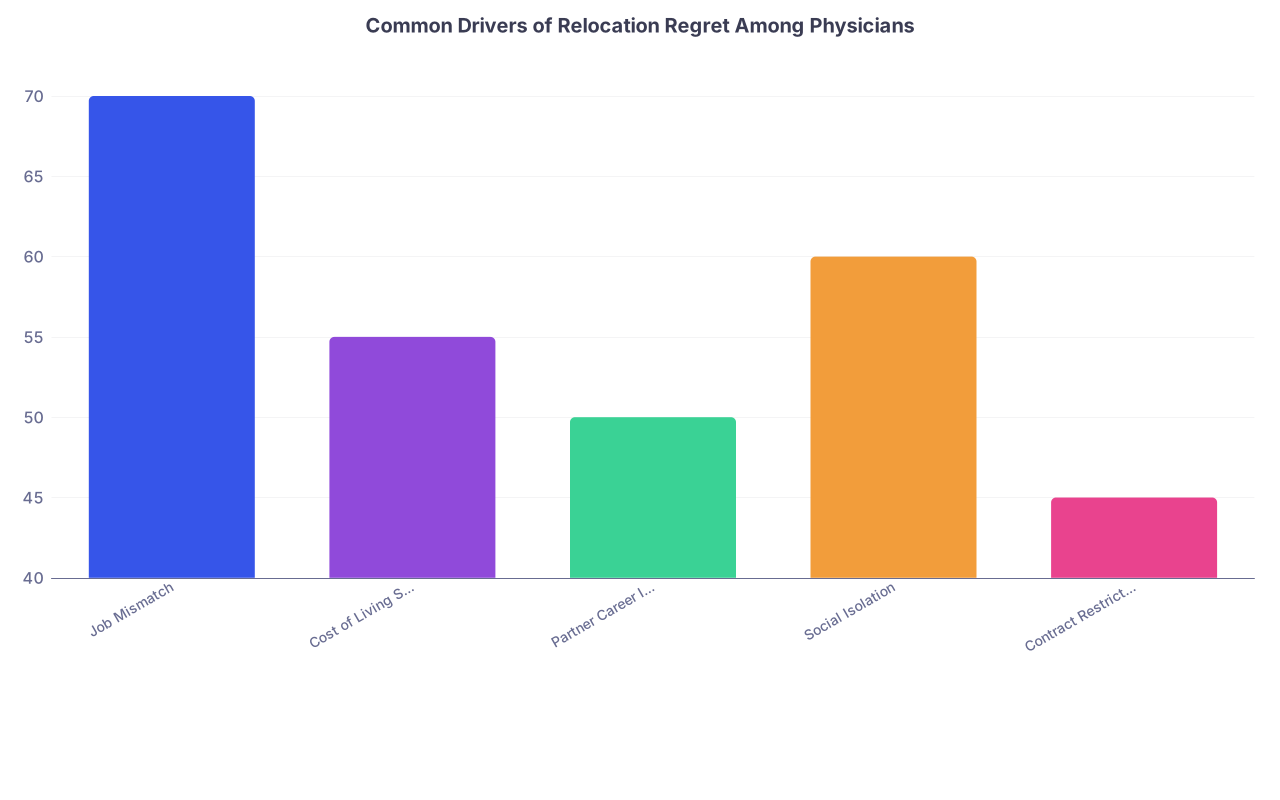
| Category | Value |
|---|---|
| Job Mismatch | 70 |
| Cost of Living Shock | 55 |
| Partner Career Issues | 50 |
| Social Isolation | 60 |
| Contract Restrictions | 45 |
(Percentages are illustrative, but the pattern is real: it’s rarely just “the job” that pushes physicians back onto the market. It’s the entire life package.)
How to Relocate Without Wrecking Your Life
Let me lay out a simple process most physicians skip, then realize later they desperately needed.

| Step | Description |
|---|---|
| Step 1 | Current Job Misfit |
| Step 2 | Define Must Haves and Never Again |
| Step 3 | Shortlist Cities for Whole Family |
| Step 4 | Screen Jobs Against Criteria |
| Step 5 | Visit and Stress Test Daily Life |
| Step 6 | Full Contract and Financial Review |
| Step 7 | Family Alignment Check |
| Step 8 | Negotiate Relocation Terms |
| Step 9 | Decide Move or Stay |
Most people jump from A to D and then to I. That’s how they end up back on the market in 18 months, more exhausted, more cynical, and more stuck.
You don’t need perfection. You do need discipline.
Your Immediate Next Step
Open a blank document and write two headings:
- “Non-negotiables for my next job”
- “Non-negotiables for our next city”
Under each, write at least five bullet points. Be specific. Be ruthless. Think about everything you’ve complained about for the last year.
Then, and only then, start evaluating relocation offers against those lists.
If an offer doesn’t meet at least 80% of what you wrote down, do not try to convince yourself you’re being “too picky.” You’re being appropriately protective of the only career and family you get.