
The biggest lie in physician contracts is that RVUs are “objective” and “fair.”
They are a weapon. And unless you understand exactly how hospital admins use them, you’re the one getting played.
You’re post-residency or about to finish. You’re looking at offers. Every recruiter is throwing around phrases like “competitive wRVU rate,” “fair market value,” “productivity bonus,” “quality incentives.” They make it sound standardized. Scientific. Almost boring.
Behind closed doors, RVU and bonus formulas are where the real money games happen. I’ve sat in those meetings. I’ve watched CMOs and CFOs tweak models line by line to squeeze another $30–50K of margin out of a new hire who thinks they’re getting a “great package.”
Let’s go through what actually happens.
The RVU Myth They Sell You
You’re told: “RVUs (really wRVUs) are a neutral measure of your work. You get paid X dollars per wRVU. Simple.”
No. The core move is this: they use “simple” to hide “manipulable.”
Here’s the basic sales pitch you’ll hear:
- A base salary “for stability”
- A wRVU target “based on MGMA benchmarks”
- A wRVU rate “competitive for the market”
- A productivity bonus “for exceeding target”
- Some quality incentives “to reward value-based care”
All technically true. And yet completely misleading.
Two things admins will not tell you up front:
- The same hospital system will pay wildly different wRVU rates to different docs in the same specialty, depending on leverage, timing, and how desperate they are.
- Almost every “benchmark-based” target they give you has been selectively chosen from a range of numbers that all sound official but tilt the risk to you and the profit to them.
Let me show you how the game is set up.
How They Quietly Rig Your “Target”
On paper, your RVU target is “based on MGMA” or “market data.” That sounds scientific. Objective. Trustworthy.
Here’s how the sausage is actually made.
In the comp meeting, the admin team pulls MGMA (or SullivanCotter, AMGA, etc.) and scrolls through something like this:
- 25th percentile wRVUs
- 50th percentile wRVUs
- 75th percentile wRVUs
- 90th percentile wRVUs
Same for compensation.
The trick: they mix and match percentiles in ways they will never spell out to you clearly.
| What They Choose | For You (Doc) | For Them (System) |
|---|---|---|
| Comp Percentile | 25th–50th | Low cost |
| RVU Target Percentile | 60th–75th | High output |
| wRVU Rate (per RVU) | Below median | Higher margin |
I’ve sat in a meeting where the CFO said, verbatim:
“Can we set the target at the 70th percentile RVUs and still keep comp at 40th percentile? That will pass fair‑market if we phrase it as ‘productivity-driven.’”
So on your side of the table, the recruiter tells you:
“We’ve pegged your target to MGMA benchmarks for your specialty.”
They do not say:
“We chose a high benchmark for your workload and a middle or low one for your pay.”
You see:
- Target: 6,000 wRVUs
- Salary: $260K
- wRVU rate: $45/wRVU
You’re thinking: Looks fine? I don’t really know what typical is. My friend in another state got 6,500 target, but their base is similar. Probably okay.
If you do not know exactly which percentile those numbers came from, you’re flying blind. And they know it.
The “wRVU Rate” Trick: Same Specialty, 30% Pay Gap
The most sensitive number in your offer is not the base salary. It’s the wRVU rate.
That $/wRVU is the lever they’ll use to pay you dramatically less than your colleague across town who’s doing the same work.
And yes, they do that. Routinely.
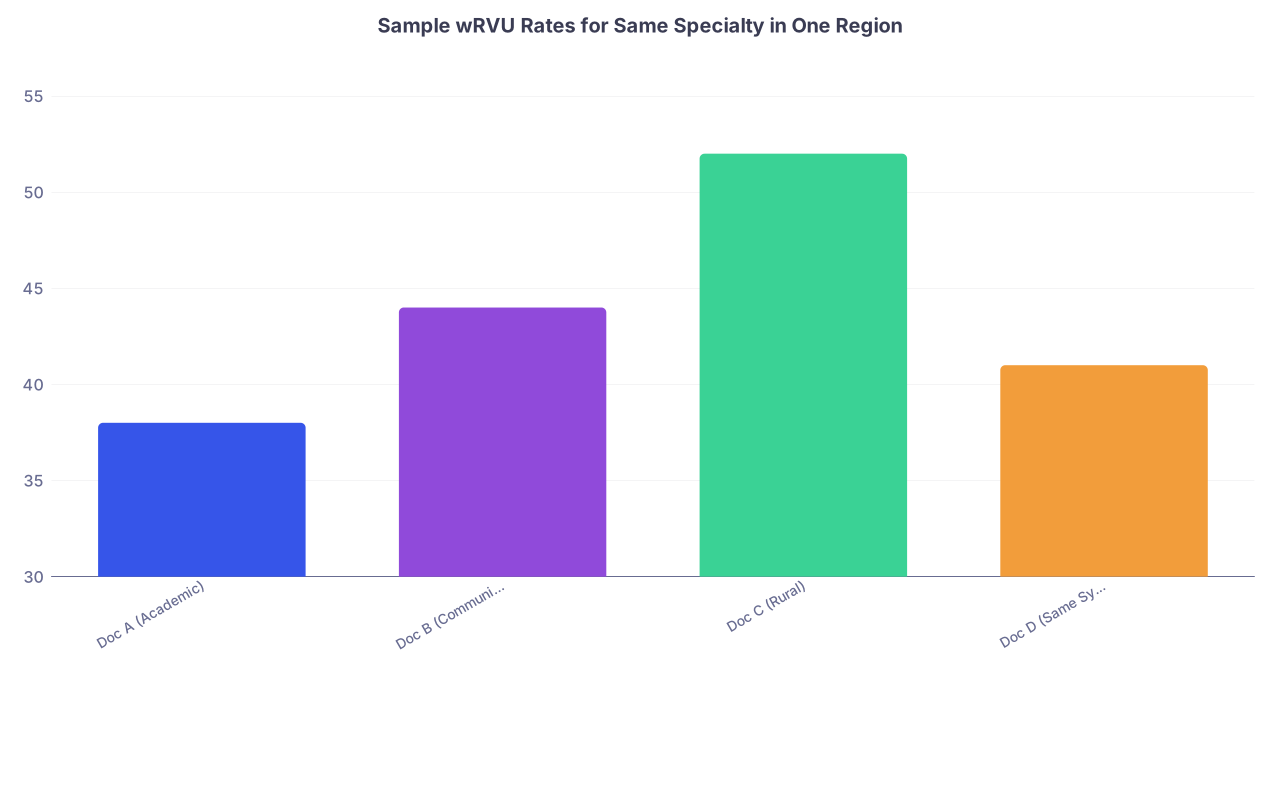
| Category | Value |
|---|---|
| Doc A (Academic) | 38 |
| Doc B (Community) | 44 |
| Doc C (Rural) | 52 |
| Doc D (Same System) | 41 |
Here’s what they’re never going to show you:
- Internal doc in same specialty: $52/wRVU (hired during crisis, hard to recruit)
- YOU: offered $41/wRVU with a big smile and “this is very competitive”
I sat in a comp committee where recruitment showed three current rates on the slide. One was an outlier (high) for a surgeon hired during COVID when volume was dying and ORs were half empty. The CFO literally said:
“Remove that one from the slide; we don’t want that setting the anchor.”
They then offered the new hire a rate $8/wRVU lower, same specialty, same hospital.
Over 8,000 wRVUs, that “little” gap is $64,000 per year. You will never see that number spelled out.
Base vs Productivity: How They Get You Chasing Volume
The standard modern play is this:
Year 1–2: guaranteed base, lower or no productivity pressure
Year 3+: shift heavily to RVU-based pay
Sounds fair. Get settled. Then your earnings track your work.
Reality: those initial years are loss-leaders. They’re buying your inertia.
By the time the guarantee falls off, you’ve:
- Built your life around that paycheck
- Bought a house
- Got kids in school
- Onboarded into their EHR and practice style
- Developed referral patterns tied to their system
Now they “true up” to productivity. I watched it happen with a hospitalist group: year 3, the shift hit, and 4 out of 12 docs saw effective pay drops of $30–40K. HR’s line: “This was always in the contract.” They knew nobody would actually leave.
They’re not stupid. They know the golden handcuffs kick in by year 3.
The Denominator You Don’t See: How They Inflate Targets
This one’s subtle, but it’s everywhere: they quote your targets using “loaded RVUs” but let your actual productivity be eroded by uncredited work.
Here’s what I mean.
In the MGMA table, those 60th–70th percentile RVUs assume certain conditions:
- High support staff
- Efficient coding and billing
- Well-run templates
- Minimal non-billable task burden
But admins will set your target to that number in a clinic where:
- You share an MA with another doc
- You do your own refills and portal messages
- Nursing triages are slow and bounce everything back to you
- You’re buried in pre-auths that don’t generate RVUs
So your “full-time” week starts to look like this:
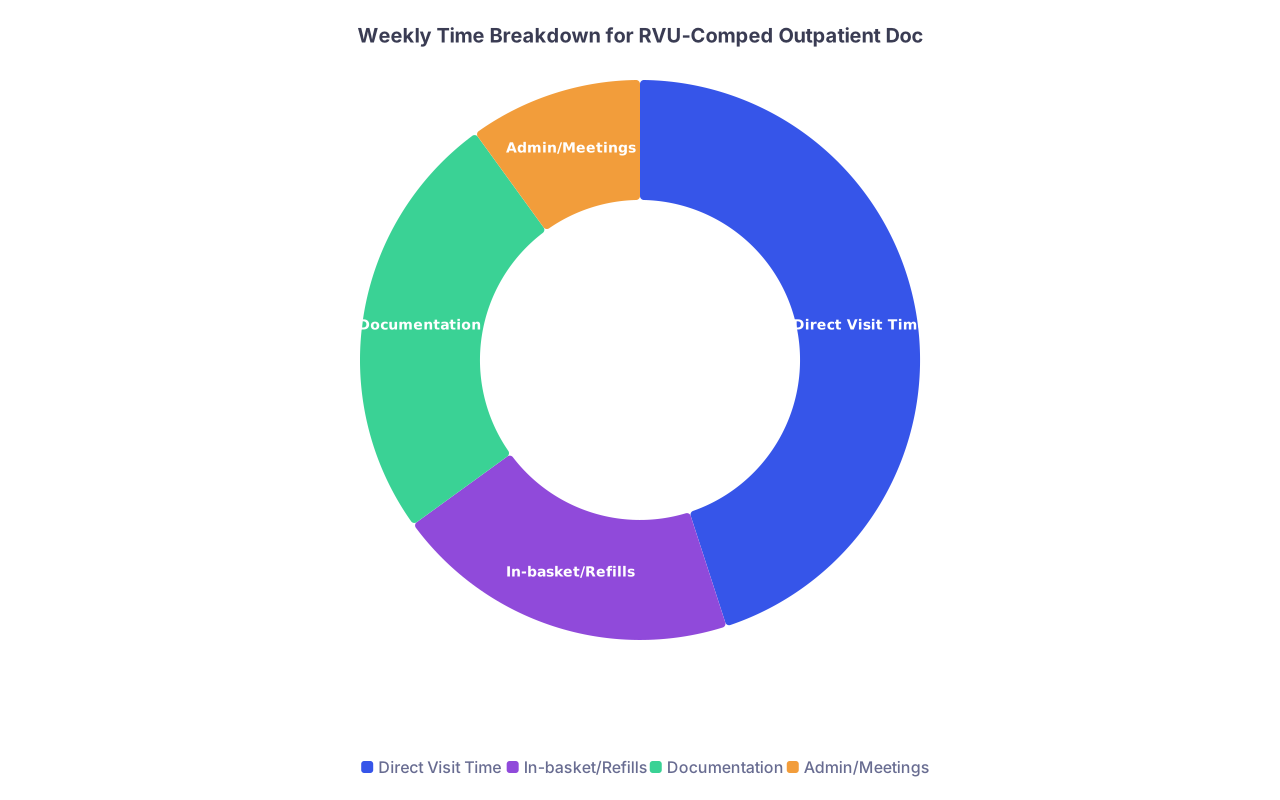
| Category | Value |
|---|---|
| Direct Visit Time | 45 |
| In-basket/Refills | 20 |
| Documentation | 25 |
| Admin/Meetings | 10 |
But only one slice – the direct visit time – actually generates work RVUs.
Behind closed doors, I’ve heard the CMO say:
“MGMA numbers assume 1:1 MA and no in-basket wasteland, but we’re not resourced for that. We’ll just need docs to be more ‘efficient.’”
Translation: We’re going to set your clinical productivity expectations based on an imaginary practice environment we don’t actually fund.
You don’t see that. You just see: “Target: 5,500 wRVUs. Should be doable.”
Quality and “Value” Bonuses: The Cheap PR Layer
Now the fun part: “Quality,” “safety,” and “value-based” bonuses. Great for marketing. Pretty weak for your wallet.
Here’s how they’re structured more often than not:
- 5–15% of your total comp “at risk” for quality
- A mix of system goals and individual or clinic-level metrics
- Cliff thresholds: 0%, 50%, 100% payout tiers
On admin slides, it looks progressive and modern. When they pitch it to you, it sounds like:
“You’ll get extra for doing the right thing for patients.”
What you actually get is:
- Several metrics you do not fully control (system delays, scheduling issues, IT failures)
- Group performance tied to the weakest link in your clinic
- Metrics that occasionally get changed mid-year when the system realizes they set the bar too low
I watched one system quietly ratchet the thresholds mid-year after realizing that 80% of docs were on track to hit 100% of their quality pool. Finance did the math, panicked, and magically the “stretch” targets…stretched even more.
They’ll call it “realigning to current performance to keep the plan meaningful.”
You call it what it is: moving the goalposts after the kick.
Why Your Bonus Never Looks Like the Recruiter’s Example
Every recruiter has the same slide: sunny example of a doc exceeding target and raking in a huge bonus.
“Target 5,800 wRVUs, actual 7,000, at $48/wRVU, plus quality!”
Then you see a big $80K+ bonus number.
Here’s what you don’t see in that slide:
- The starting target is often understated to make the math look juicy
- In reality, your contract may have a “threshold” below which nothing is paid
- Or they may only pay incremental RVUs above target, not all RVUs
Two very different worlds:
Scenario A (what you think):
You produce 7,000 RVUs. Target 5,800. Rate $48.
You expect: 7,000 × $48 = $336,000
Maybe base is $260K, so you think: “Around $76,000 bonus.”
Scenario B (what the contract actually says):
- Base salary = pay for hitting target (5,800 RVUs)
- Bonus is ONLY for excess RVUs above 5,800
- $48 × (7,000 − 5,800) = $57,600
Now layer on “budget neutrality” language. Some systems will quietly cap total comp relative to MGMA percentile, regardless of what the plain math says.
I’ve seen clauses like:
“Total compensation may be adjusted to remain consistent with fair market value per current benchmark data.”
You think that’s a legal boilerplate. They know it’s a release valve to deny the bonus when you actually crush it.
How They Use Call Pay to Patch a Bad RVU Deal
Underpay on RVU rate? There’s an easy workaround: throw call pay at you and call it a “blended package.”
I’ve seen this especially in surgical subspecialties and hospital-based practices. The conversation goes like this:
“Yeah, our wRVU rate is on the lower side, but you’ll make it up with generous call pay.”
Behind that statement:
- RVU rate is depressed by $6–10 below regional “hot market” offers
- Call pay is structured per shift or per 24 hours
- Actual call load is heavier than described, and half your calls don’t generate billable RVUs
You end up:
- Exhausted
- With an RVU rate you can’t renegotiate easily
- Trapped by “total comp” numbers that might look okay on paper but are built on you being constantly on call
In internal meetings, I’ve heard variations of:
“We can keep RVU rate down if we sweeten call. Docs tend to fixate on the per-shift rate and ignore the underlying comp structure.”
They’re betting you’ll focus on: “Wow, $1,200 for a 24-hour call!” rather than “Why am I at $44/wRVU when my colleague is at $54?”
EHR, Coding, and the Invisible RVU Leak
This part bugs me the most because it’s quiet and deniable.
Your contract assumes a certain coding profile. The wRVU tables in MGMA assume average coding behavior. But your actual RVU generation is tied to:
- How your EHR templates are set up
- Whether your group uses APPs and how they bill
- Whether coders upcode or downcode conservative
- How much support you get for complex visits and procedures
Admins know their own leakage points. They know, for example:
- Their coders are risk-averse and tend to default to lower levels
- Their EHR makes it harder to capture all billable procedures
- Their APP billing policy routes work RVUs to the wrong provider number
They do not correct your targets for that.
I’ve watched an internal discussion where the coding director said:
“Our audit shows we’re probably undercoding level 4s as 3s by about 10–15% in primary care.”
Did they lower targets for their PCPs to account for that? No. Did they adjust comp formulas? No.
They simply told docs: “We’ll do more education on documentation.”
So your target is based on an idealized world where your documentation + coders + EHR structure convert visits to RVUs at a certain efficiency. Your actual world falls short.
The admin line will always be: “If you document appropriately, you’ll be fine.” Translation: We’re pushing the risk and workload onto you.
The Real Power Play: Information Asymmetry
The biggest thing admins rely on is very simple: you don’t have good data.
They walk into comp design meetings with:
- Full reports on current RVU distributions by physician
- Burnout and turnover data
- Downstream revenue by specialty
- Local competitor offer intel (recruiters talk to each other)
You walk into your contract negotiation with:
- Stories from a couple of co-residents
- Maybe some crowd-sourced numbers on Reddit or Doximity
- A vague idea from MGMA snippets you saw during some lecture
That gap is where they make their money.

| Step | Description |
|---|---|
| Step 1 | Hospital Admins |
| Step 2 | Set RVU Targets |
| Step 3 | Set wRVU Rate |
| Step 4 | New Grad Physician |
| Step 5 | Accept Offer |
| Step 6 | High Output Expectation |
| Step 7 | Lower Cost per RVU |
| Step 8 | More RVUs Worked |
| Step 9 | Higher Margin for System |
I’ve seen internal dashboards where they compare each doc’s “contribution margin” (all hospital revenue tied to your work, minus your comp and direct costs). If your margin is huge, they do not proactively pay you more.
They brag about you in finance meetings.
How To Actually Protect Yourself
You can’t fix the whole system, but you can stop being the easy mark.
There are a few moves that actually work:
Get hard numbers in writing.
Ask: “What MGMA percentile is my base salary pegged to? What percentile is my RVU target? What percentile is my total comp at target?” If they won’t answer or hand-wave, that’s a flag.Insist on relative, not just absolute, numbers.
Ask: “What percent of your current physicians in this specialty are actually hitting target and earning bonuses?” If their answer is: “We don’t have that number,” they’re either lying or incompetent. Neither is good.Clarify whether the base is truly guaranteed.
Some contracts quietly include “deficit reconciliation” language after the guarantee period. That’s a poison pill. You want plain language: “No repayment or reconciliation of base salary will be required.”Ask to see the last year’s quality payout distribution.
Actual numbers. Not a description. Who got what percent of their at-risk pool? You’ll quickly see whether “quality bonus” is real money or window dressing.Read every clause about “fair market value” and “comp committee discretion” like it’s a pay cut waiting to happen.
Because it is. If they can “adjust to maintain FMV,” you need to know if that applies both up and down, and under what rules.Use an experienced health care attorney or consultant who sees many contracts in your specialty, in your region.
Not optional anymore. Admins have playbooks. You need your own.
One More Ugly Little Secret: They Expect You To Burn Out
This one’s not on the brochure, but it’s in the planning. They know:
- High-output RVU models will burn out a percentage of physicians
- Those docs will leave between years 3–7
- They’ll backfill with fresh grads and repeat the cycle
I’ve heard this sentiment, thinly disguised, in strategy sessions:
“We’ll probably see some turnover when we shift more to productivity, but the new hires will be accretive.”
You are not supposed to stay for 25 years in their economic model. You’re supposed to be maximally productive for 5–8, then either adapt or exit.
So if you’re looking at an offer thinking, “I can grind this out for 15 years,” understand: they didn’t build it that way.
Quick Reality Check: Are You Being Played?
Here’s a compact gut-check you can run on any RVU offer:
| Question | If Answer is... |
|---|---|
| Is my comp percentile > RVU target percentile? | If no → Red flag |
| Do most docs here hit target and bonus? | If vague → Red flag |
| Is there a cap tied to 'FMV adjustments'? | If yes → Red flag |
| Is wRVU rate clearly above local average? | If no → Negotiate more |
If you ask pointed questions and the recruiter gets uncomfortable, starts hand-waving “We treat everyone fairly,” or refuses to anchor in specific percentiles, they were counting on you being naïve.
FAQs
1. Is RVU-based compensation always bad?
No. When it’s transparent, fairly set, and backed by adequate staffing, RVU models can pay very well and reward efficient physicians. I’ve seen docs in cardiology, GI, ortho, and certain outpatient specialties legitimately crush RVU plans and earn way above median. The problem isn’t RVUs as a concept. It’s the way hospitals quietly manipulate the targets, the rates, and the environment around them to shift risk onto you.
2. How do I know if my wRVU rate is actually competitive?
You’ll never get the full picture from the hospital. You need triangulation: talk to recent grads in your specialty, use trusted specialty societies that sometimes share anonymized comp data, and, yes, talk to a healthcare attorney or consultant who reviews dozens of contracts like yours. If everyone around you is at $55–60/wRVU and you’re offered $44 with a smile, that’s your answer.
3. What’s the single most important contract clause to nail down?
After base and wRVU rate, the big one is any language about “reconciliation,” “deficit,” or “fair market value adjustments.” That’s where they sneak in the right to lower your pay or claw back income if your productivity doesn’t match their model. You want crystal clear language that your base is guaranteed for the stated period with no repayment, and that any FMV adjustments are not used to unilaterally slash your earnings after you sign.
If you remember nothing else, remember this:
- RVU and bonus formulas are designed, not discovered. Someone chose every number.
- Admins use information asymmetry to tilt risk and profit in their favor.
- Your only real defense is to drag those hidden choices into the light — in writing, with specific percentiles and past payout data — before you put your name on that contract.