
The rate you’re quoted for a locums job is not a reflection of your “worth.” It’s a reflection of who’s taking a cut off you before the money hits your account.
Let me walk you through how the sausage is actually made. Because if you’re just looking at that shiny “$275/hour!” email and thinking you’re getting a great deal, you’re missing half the story.
Locums is a three‑way game: hospital, agency, physician. Sometimes there’s a fourth player—your own ignorance. That’s the one that costs you the most.
The Money Trail: Where Every Dollar of Your Rate Goes
When a hospital says, “We’re paying $300 an hour for a hospitalist,” that is not what you’re seeing on your contract. You might be offered $210–230. The gap isn’t magic. It’s math.
Here’s the basic chain, simplified:
- Hospital sets a bill rate (what they pay the agency per hour).
- Agency sets a pay rate (what they offer you per hour).
- The difference covers:
- Agency margin (profit + overhead)
- Taxes, malpractice, travel, lodging, credentialing
The tricks live in the details.
| Step | Amount (per hour) |
|---|---|
| Hospital bill rate | $300 |
| Agency keeps (margin, etc.) | $70–90 |
| Effective cost of benefits | $5–10 |
| Physician pay rate | $200–225 |
That’s a normal spread. In some specialties and desperate situations, the spread is smaller. In other cases, the agency is quietly taking $100+ an hour on you and hoping you never find out.
Here’s what nobody tells you: the agency doesn’t start from “what’s fair for the doc?” They start from “what will the hospital tolerate?” and then reverse‑engineer your pay to hit their margin targets.
I’ve literally heard a regional director say on a call:
“If we go below a 30% margin on this contract, we don’t push it to candidates. We’ll just wait for a higher-need client.”
Translation: if they can’t make enough off you, they’d rather you sit at home and earn nothing.
How Hospitals Actually Decide What to Pay Agencies
Hospitals don’t pull numbers out of thin air. They’re following internal rules, politics, and pain points that you never see.
The main levers on the hospital side
Desperation level
- Rural ED with three unfilled FTEs and threats of closure? They’ll pay insane bill rates and barely blink.
- Nice suburban hospital in a saturated metro? They’ll cap the bill rate hard and reject higher quotes.
Specialty scarcity
- EM, anesthesia, psych, radiology, GI—these can command huge bill rates in the right geography.
- Outpatient IM in a major city? They know they’re holding the cards.
Budget vs. risk
- CFOs think in yearly cost, not hourly.
- They quietly compare locums cost with:
- Overtime for existing docs
- Signing a full‑time hire with a relocation bonus
- Losing revenue from closed beds/ORs
This is what it actually sounds like in a staffing meeting:
“Our full‑time hospitalists are making $175 base, with benefits. If we pay $300/hour to an agency and they’re here 14 shifts per month, that’s over $600K a year. That’s ugly, but closing beds is uglier. Approve it for 6 months.”
They’re not thinking: “Is $300/hour fair?”
They’re thinking: “Would I rather get killed in the press when we divert ambulances because we’re short‑staffed?”
Why they like agencies even when they complain
You’ll hear CMOs grumble: “We’re getting killed on locums costs.”
Then they sign a new agreement the same month.
Because agencies do the ugly work: recruitment, screening, credentialing, travel, last‑minute backfills, and taking the heat when someone no‑shows.
Hospitals know they’re overpaying at the bill rate. They accept it because it saves them internal headaches. That’s your leverage: when their headache is acute, your value jumps. If you know how they think, you negotiate better.
What Agencies Really Do With Your Rate
Let me be blunt: agencies are sales organizations first, “physician advocates” second.
I’ve sat in those offices. The whiteboard has columns:
Client name, specialty, bill rate, pay rate, margin, “hot need.”
The internal math
Here’s how a rep actually thinks about your job:
“Hospital is paying $320/hour. We want at least a 25–30% margin. So we need to keep about $80–100/hour. That gives us $220–240/hour for the doc. Let’s start them at $210 and see if they bite. If they push, we’ll ‘talk to our manager’ and go to $225.”
They always “go check.” 9 times out of 10, there’s no complicated approval involved. It’s theater. They already know the ceiling; they’re just testing how cheap you’ll sell.
Now layer in their costs:
- Malpractice (often claims‑made, sometimes occurrence)
- Payroll taxes if you’re W‑2 through the agency
- Recruiter commission and overhead
- Travel coordination, flights, rental car, hotel
- Credentialing staff time
All of that comes from the difference between the bill rate and the pay rate. That’s their spread. But do not kid yourself: there’s still plenty of room for profit after those costs.
The repertoire of lines they use on you
You’ll hear variations of these constantly:
“That’s at the top of the market right now.”
Often false. It’s at the top of their pay scale for that contract, not the market.“If we go higher, the hospital might pull the job.”
Usually not true unless they’re already hitting a strict contractual cap.“We’re actually taking a really small margin here.”
Maybe, but you have no visibility unless you pry.“We’re paying everyone the same rate.”
Absolutely not always true. Two docs at the same site can be separated by $30/hour or more.
Bill Rate vs Pay Rate: What You’re Not Supposed to See
Here’s the real guardrail: agencies do not want you to know the bill rate. That number is power. Your power.
Once you know hospital → agency → you, you start asking much sharper questions.
How big is the spread, really?
Let’s use a concrete example:
Community hospital in the Midwest, locums hospitalist, day shifts.
- Hospital bill rate: $275/hour
- Agency target margin: 25% ($68.75/hour)
- Budgeted soft costs (malpractice, taxes, travel): say $15/hour equivalent
- Theoretical floor for pay rate: $190–195/hour
- Likely advertised rate to you: $200–215/hour
- Realistic negotiable ceiling: $220–230/hour
They’ll start you at $200.
They’d like to keep it under $210.
You can probably get to $220+ if:
- The site is desperate
- You’re willing to commit to blocks
- You’re not a problem to credential or schedule
Now, in higher‑need situations, I’ve seen this:
- Hospital bill rate: $400/hour for EM in a rural site
- Agency offers you: $260/hour
- Spread: $140/hour
You push back hard, suddenly they find an extra $20–30/hour. Nothing changed at the hospital side. They just tested how low they could keep you.
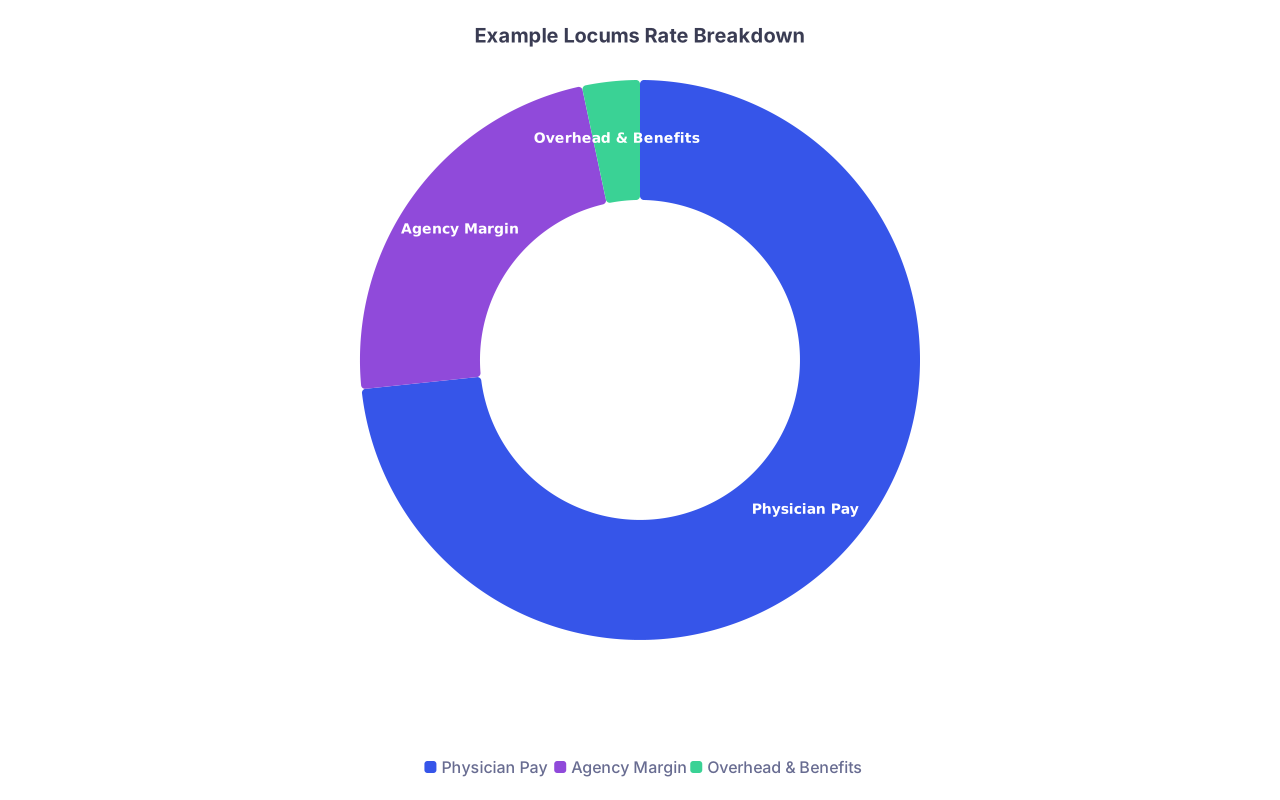
| Category | Value |
|---|---|
| Physician Pay | 220 |
| Agency Margin | 70 |
| Overhead & Benefits | 10 |
When you can find out the bill rate
You’re not totally blind:
- Sometimes hospital insiders slip: “We’re paying your company $320 an hour; I hope you’re getting most of that.”
- Occasionally, contracts or schedules left on printers show line‑item bill rates.
- Rarely, a smaller hospital administrator will just tell you outright if you’ve built trust.
Once you know, you can decide whether to stay, negotiate, or plan an exit to direct contracting.
All‑Inclusive vs Travel + Stipend: How They Hide Money
Here’s another quiet game: how they package your compensation.
Travel + Housing model
Classic setup:
- Hourly rate: $210/hour
- Housing: paid
- Travel: flights + rental car paid
- Malpractice: paid
Agency will talk like this is incredibly generous. But look closer.
Maybe the hospital is paying a flat $300/hour. Agency keeps $60–70/hour after covering your travel/housing. That’s fine if you’re coming from across the country, doing short stints, and you value simplicity.
But if you’re local? Or you’d happily stay in cheaper lodging? You’re subsidizing their margin.
“All‑inclusive” hourly rate
This is where it gets interesting.
You’ll see something like:
“$260/hour all‑inclusive, you handle your own travel and lodging.”
If, behind the scenes, the hospital is still paying $300–320/hour, now you’ve basically taken on the travel/housing risk in exchange for a much higher direct rate. For heavy users of a site (say you drive in and stay in a cheap Airbnb), this is often better.
The agency is fine because:
- Fewer receipts and logistics to manage
- Cleaner accounting
- They can disguise how much of that $260 is truly “yours” vs “right‑sized margin”
You can also sometimes negotiate tweaks here:
- “Keep the rate at $250/hour but give me a $1000 travel stipend per month.”
- “I’ll cover my own lodging but I want $15/hour more.”
They almost never open with these options. You have to suggest them.
How Your Credentials and Timing Change Your Price
Hospitals and agencies don’t pay you based on a philosophical view of your worth as a physician. They pay based on leverage.
What increases your leverage
- You have the right state license already in hand.
- You’re Board Certified, not just eligible, in a credential‑sensitive specialty.
- You can start quickly and commit to reliable recurring blocks (e.g., 7 on / 7 off for 3–6 months).
- You have niche skills they’re desperate for: procedures, ICU, OB coverage, peds in EM, etc.
I’ve seen the same hospital offer:
- $230/hour to someone needing a new license, starting in 4 months
- $260/hour to someone licensed and available in 3 weeks
Same job. Same hospital. Pure timing premium.
What decreases your leverage
- Multiple red flags: previous terminations, malpractice issues, big employment gaps.
- Needing complex schedule concessions: “I can only do weekdays, no nights, and I leave early on Fridays.”
- Requiring special accommodations the site doesn’t want to touch.
Agencies won’t always lower your rate on paper. They’ll just quietly push other candidates first and “can’t find you something as good.”
Negotiation: The Moves That Actually Work
You can’t strong‑arm your way to more money. You’re one doc in a massive database. But there are ways to stop leaving $20–50/hour on the table.
1. Force them to discuss the spread indirectly
You’ll probably never get the exact bill rate. But you can corner them on the margin.
Lines that work:
- “I’m not asking for every penny, but I do want to know: are you taking more than $70/hour on this?”
- “I don’t need your exact margin, but this feels light for the market. What’s your flexibility bandwidth—are we talking $5/hour or $30/hour?”
Once they admit they have “some room,” you know the starting offer wasn’t their max.
2. Always push on block commitment
Recruiters are trained to value stability. Use that.
Say you’re willing to commit to:
- 7–10 shifts per month, every month, for 6 months.
Then you say:
“For that level of commitment, I need $X/hour. Otherwise I’ll just keep my flexibility and pick up short‑term gigs elsewhere.”
You’re making them choose: better margin or better coverage. Hospitals care about coverage. Agencies know it.
3. Use competing offers, but be specific
“I have other offers” is useless. Everyone says that.
Instead:
“I’m looking at a similar hospitalist role in [region] at $250/hour, days, with housing. For your site, I’d need this in the $240–250 range to seriously prioritize it.”
That tells them your true walk‑away number without giving them your full hand.
4. Stop treating their first “no” as the end
You ask for $260. They say they can’t break $240. Too many docs fold right there.
Try:
- “Is that your cap, or is that what you’re comfortable offering?”
- “Would the hospital even look at a slightly higher rate if I committed to a longer block?”
You’re signaling that you know they’re often padding their answer. Recruiters will sometimes come back a day later with “good news” that magically found money that was always there.
Direct Contracting and Bypassing Agencies (The Quiet Fear)
Here’s the nightmare scenario for agencies: the hospital and the physician like each other enough to cut them out.
Most contracts between hospitals and agencies include conversion clauses. These say, in fancy legal language:
- If the hospital hires you directly (full‑time or as an independent contractor) within X months of your last shift, they owe the agency a large “finder’s fee” or must buy out the contract.
Typical numbers: 20–30% of your first‑year compensation, or a flat fee (e.g., $25–50K).
Agencies enforce these. Hard. They will absolutely threaten to sue a hospital over bypassing them. Hospitals hate that drama.
But over time, after you’ve been onsite for a while, administrators start doing their own math. They compare:
- Ongoing locums cost through the agency vs.
- Paying a one‑time fee and then dropping you to a direct hourly rate or salary.
That’s where you can quietly benefit, if you handle it like an adult and not like a cowboy.

| Step | Description |
|---|---|
| Step 1 | Start Locums via Agency |
| Step 2 | Build Good Reputation |
| Step 3 | Regular Shifts at Same Site |
| Step 4 | Informal Talk With Leadership |
| Step 5 | Stay Agency Locums |
| Step 6 | Explore Direct Contract Options |
| Step 7 | Hospital Reviews Conversion Clause |
| Step 8 | Negotiate Buyout or Wait Period |
| Step 9 | Direct Hire or IC Deal |
| Step 10 | Hospital Interested |
The key rules:
- Do not initiate “let’s cut out the agency” conversations early. It spooks everyone.
- Build trust first: be reliable, low‑drama, and clinically strong.
- Let them bring up the idea of “keeping you around long term” – then you explore options.
Sometimes you can land a direct IC contract at a higher hourly rate than you were seeing through the agency, even after the hospital eats the buyout. Because they’re saving money compared with the agency’s bill rate.
Where Locums Fits in Your Career (And How Not to Get Used)
Locums can be a fantastic tool right after residency or after your first employed job flames out:
- Pay off debt quickly with high‑rate, high‑volume assignments
- Test different practice settings before committing long‑term
- Escape toxic groups and take back control of your time
But if you do it naively, you just become a revenue stream for everyone else.
Here’s the honest pattern I’ve seen:
- Year 1–2: You’re so shocked by the rate compared to residency that you don’t realize how much you’re leaving on the table.
- Year 3–4: You start doing the math and get more aggressive with negotiation. You learn which agencies play fair and which don’t.
- Year 5+: You either:
- Transition into a long‑term direct job you’re happy with, or
- Build your own mini‑business of recurring locums sites, often mixing some direct contracts with a few agency gigs.
The goal isn’t to “win” against agencies. They’re not going anywhere. The goal is to stop being the easiest margin on their books.
FAQs
1. How much of a cut is “reasonable” for a locums agency to take?
If they’re taking $50–80/hour on a hospitalist or EM doc and covering malpractice, travel, payroll taxes, and recruiter overhead, that’s within the standard range. Once they’re regularly pocketing $100+/hour on you, you’re underpriced. You might not always be able to change it, but you should at least recognize when you’re being heavily marked up.
2. Can I just ask the hospital what they’re paying the agency?
You can, but you need to be smart about it. Directly asking a CMO “What’s my agency bill rate?” makes them nervous about contract breaches. Better approach: build rapport first, then have softer conversations about how they view locums costs and where they see rates heading. Occasionally someone will volunteer the numbers; more often you’ll get enough of a hint to understand the gap.
3. Is it better to be W‑2 through the agency or 1099 and run my own LLC?
From a pure hourly rate perspective, 1099 almost always wins; agencies will usually pay more when they’re not covering your taxes and benefits. But with that comes responsibility: estimated taxes, business expenses, retirement planning, malpractice clarity, and sometimes health insurance. If you treat 1099 as “free money” and never handle the back‑end, you’ll regret it at tax time. If you run it like a business, you come out ahead.
4. How do I know if my offer is truly “market rate” for a locums gig?
You don’t guess. You compare. Talk to multiple agencies for the same specialty and region. Ask bluntly: “What’s your best rate for a similar role within 200 miles of this site?” Watch how they squirm or answer. Look at trends in online forums, but do not rely solely on them—data there is heavily skewed by extremes. Over time, after a handful of offers, you’ll see the pattern. Once you can recognize the pattern, you’ll know when a quote is actually competitive and when you’re being lowballed.
Three things to remember. First, your quoted rate is not sacred—it’s a starting point, built around someone else’s profit margin. Second, hospitals think in terms of pain and risk, not fairness; when their pain is high, your leverage spikes. Third, agencies are not your enemy, but they are not your friends either. Treat locums like a business, not a favor they’re doing for you.