
The most dangerous part of locum tenens isn’t the medicine. It’s the paperwork you barely skim.
If you treat locums like a quick paycheck and ignore the fine print on billing, malpractice, and credentialing, you’re setting yourself up for clawbacks, lawsuits, and suddenly being “unhirable” at the exact hospital system you wanted a permanent job with.
I’ve watched excellent clinicians get burned because they assumed “the agency handles all that.” That assumption is how you end up with:
- Six months of unpaid claims
- Malpractice coverage that does not respond when you’re sued
- A credentialing delay that wipes out your income for an entire quarter
Let’s walk through the traps. Then you’ll know what to double‑check before you sign anything or step foot in a facility.
1. Billing Traps That Blow Up Months Later
The biggest locums billing mistake? Thinking you’re not involved because “you’re just the contractor.” Wrong. Your name and NPI are on those claims. If something’s wrong, the fallout will find you.
Trap 1: You Don’t Know Who’s Actually Billing Under What
Too many doctors never ask who is billing their services or under which NPI or tax ID. Then they’re shocked when:
- Their personal NPI ends up associated with locations they never remember working
- Payers flag them for “duplicate billing” or odd patterns
- They can’t get credentialed at a future employer because of messy billing history
Minimum questions you should force yourself to ask before starting a gig:
- Who submits the claims: hospital, group, or locums agency?
- Under what entity and tax ID?
- Is my individual NPI being used, or a supervising physician’s, or a group NPI?
- Who is responsible for documentation compliance if claims are audited?
If nobody can answer those clearly, that’s a red flag. Do not be the person who just shrugs and shows up.

Trap 2: Non‑Credentialed Billing (They See Patients Anyway)
This one is a career‑killer.
Scenario I’ve seen:
You’re told, “Your credentialing is pending, but we’re short; come in and we’ll bill under Dr. Smith until it’s done.” You’re tired, need the money, and trust them.
What actually happens:
- You see patients without being fully credentialed with certain payers
- Claims go out anyway under someone else’s NPI (or the group’s)
- Months later: payer audit, recoupment, accusations of fraud or misrepresentation
Guess whose name is attached to the records? Yours. Guess who looks either complicit or incompetent? Also you.
Hard rule:
If credentialing with major payers (Medicare, Medicaid, big commercial plans) isn’t done, you do not see scheduled patients whose visits will be billed under your work. Emergent care is one thing; routine clinic shifts “while we figure it out” is another.
Trap 3: You Don’t Track Your Own RVUs, Hours, or Cases
Agencies and hospitals make mistakes. Not always maliciously. But I’ve seen 10–20% discrepancies in RVUs and hours more times than I can count.
You avoid this trap by acting like a professional, not a temp:
- Keep your own log: date, site, shift start/end, number of encounters, key procedures.
- Take screenshots of scheduling software or daily census lists when possible.
- Reconcile your log with monthly statements from the agency or facility.
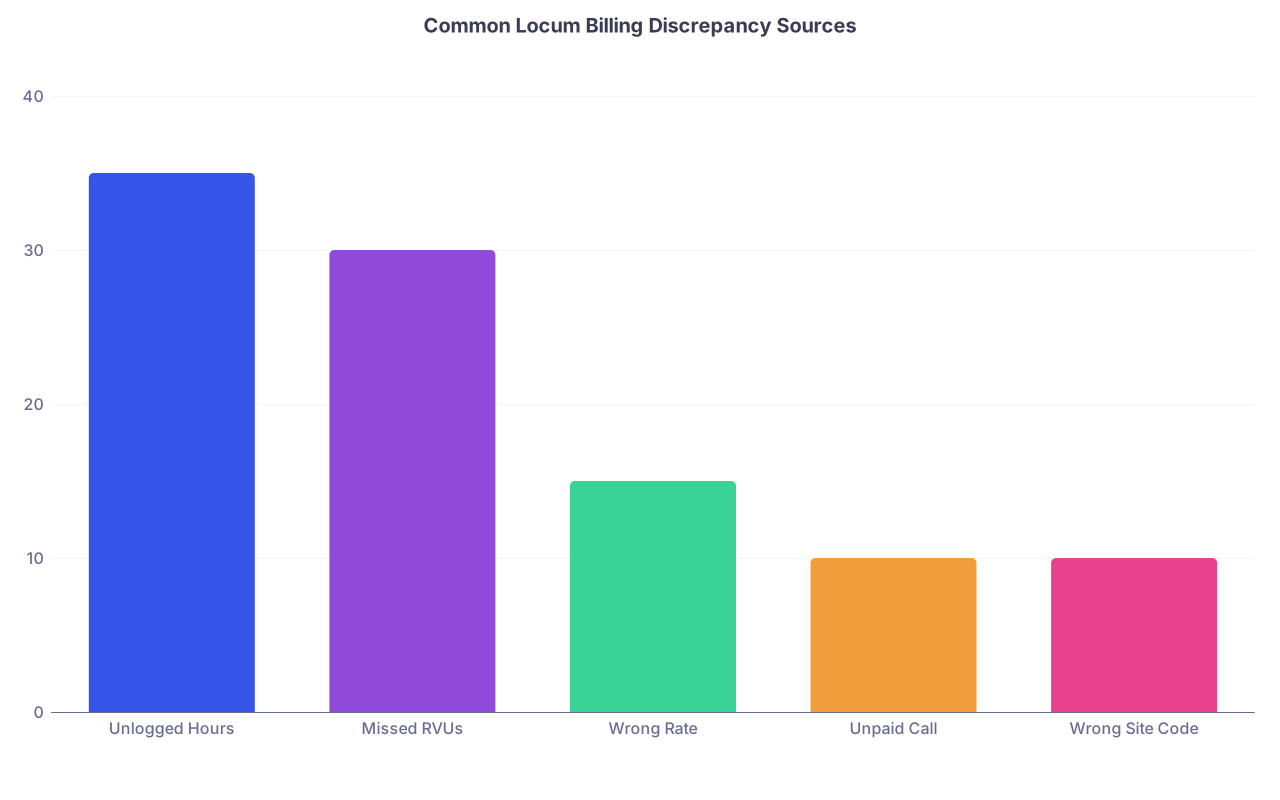
| Category | Value |
|---|---|
| Unlogged Hours | 35 |
| Missed RVUs | 30 |
| Wrong Rate | 15 |
| Unpaid Call | 10 |
| Wrong Site Code | 10 |
If your log and their numbers don’t match, you have leverage. Without it, you’re just complaining with no proof.
Trap 4: You Don’t Understand the Pay Schedule or Denial Risk
“I’ll make $2,000 a day, easy.” Maybe. But when?
Some contracts pay:
- By timesheet approval (every 2 weeks)
- By successfully collected revenue (after payer reimbursement)
- After a 60–90 day lag, “subject to payer denials”
If anything in the contract ties your pay to “collections” without a minimum guarantee, you’re accepting payer risk you probably don’t realize. If their billing department is sloppy, you’re punished.
What you want, in writing:
- Clear frequency (e.g., every 2 weeks, NET 15 or NET 30)
- Pay based on work performed, not just claims collected
- No vague “subject to payer adjudication” language governing your base pay
2. Malpractice Coverage Tricks That Leave You Exposed
The second major trap: assuming “malpractice is covered” means “I’m safe.” That’s naive. The details matter, especially with locums where you’re bouncing across states and systems.
Trap 5: You Don’t Know If You Have Claims‑Made or Occurrence
If you do not know whether your locums malpractice coverage is claims‑made or occurrence, you’re gambling with your future.
Quick breakdown:
- Occurrence: Covers incidents that happened during the policy period, no matter when the claim is filed.
- Claims‑made: Covers claims filed while the policy is active, usually only if the incident also occurred during coverage AND you have the right retro/ tail.
Locums agencies often use claims‑made for cost reasons. Then they end your contract, coverage stops, and the clock starts ticking for any patient to sue.
If your coverage is claims‑made and there’s no tail, and you’re sued 18 months after a high‑risk consult you did on assignment? You can be standing there alone.

You must ask:
- Is my coverage claims‑made or occurrence?
- If claims‑made, who pays for tail when the assignment ends?
- Is tail automatic, or “may be made available”? (That word “may” is a trap.)
Get it in writing. Not in a verbal reassurance from a recruiter.
Trap 6: No Tail Coverage Plan When You Switch Agencies
Common scenario:
Year 1–2: Locums with Agency A (claims‑made, no tail explicitly promised)
Year 3–4: Switch to Agency B, different policy, different carrier
Year 5: Claim for a patient from your Agency A days. Agency A’s policy is long gone.
If no tail was bought for those Agency A years, you’re exposed. Agency B’s policy doesn’t go backward in time unless you’ve negotiated prior acts coverage (rare in agency setups).
This is one of the biggest long‑term locums hazards. You can work four different locums agencies in five years and create a landmine of gaps if you don’t track:
- Which dates are covered by which carrier
- Whether each period had tail or not when you left
- Whether any agreements require you to reimburse tail costs if you leave early
Make a simple coverage timeline for yourself and keep it updated.
| Year | Agency | Policy Type | Tail Covered? |
|---|---|---|---|
| 2023 | A | Claims-made | Yes, written |
| 2024 | A | Claims-made | Yes, written |
| 2025 | B | Occurrence | N/A |
| 2026 | C | Claims-made | No (danger) |
If you see any “No (danger)” in your own life, you fix that before taking on more work.
Trap 7: Coverage Limits and Exclusions You Never Read
You’d be surprised how low some locums policies go on:
- Per-claim limits
- Aggregate limits per year
- Coverage for procedures “outside standard scope”
And some policies sneak in exclusions like:
- Telemedicine across certain state lines
- Cosmetic or elective procedures
- Certain high‑risk OB, neurosurgery, or interventional procedures
If your specialty leans procedural, or you plan to moonlight in telehealth or urgent care, you can accidentally perform non‑covered services because you assumed “malpractice is malpractice.”
Don’t do that. Ask for:
- Declaration page showing limits per claim / per year
- Full policy or at least a summary of exclusions by specialty
- Written confirmation that your specific activities on that assignment are covered
If they resist sending you documentation? That’s the red flag. Plenty of other assignments out there.
3. Credentialing & Licensing Mistakes That Stall Your Income
Credentialing errors don’t just delay start dates. They can also taint your professional record with “incomplete,” “denied,” or “flagged” statuses that follow you into permanent jobs.
Trap 8: You Rely Entirely on the Agency for Licensing and Credentialing
Locums recruiters will tell you, “We handle everything.” They do a lot. They do not care as much as you do if:
- Your license app is missing a malpractice explanation
- Your DEA address is wrong
- Your CV dates don’t line up, triggering an HR red flag
Their job is to fill shifts. Your job is to protect your name.
You must personally:
- Keep a master CV with accurate, gap‑free dates (month/year)
- Maintain a document folder with diplomas, board certs, licenses, DEA, prior malpractice info
- Review every application they pre‑fill for you, especially yes/no questions about discipline, malpractice, or investigations
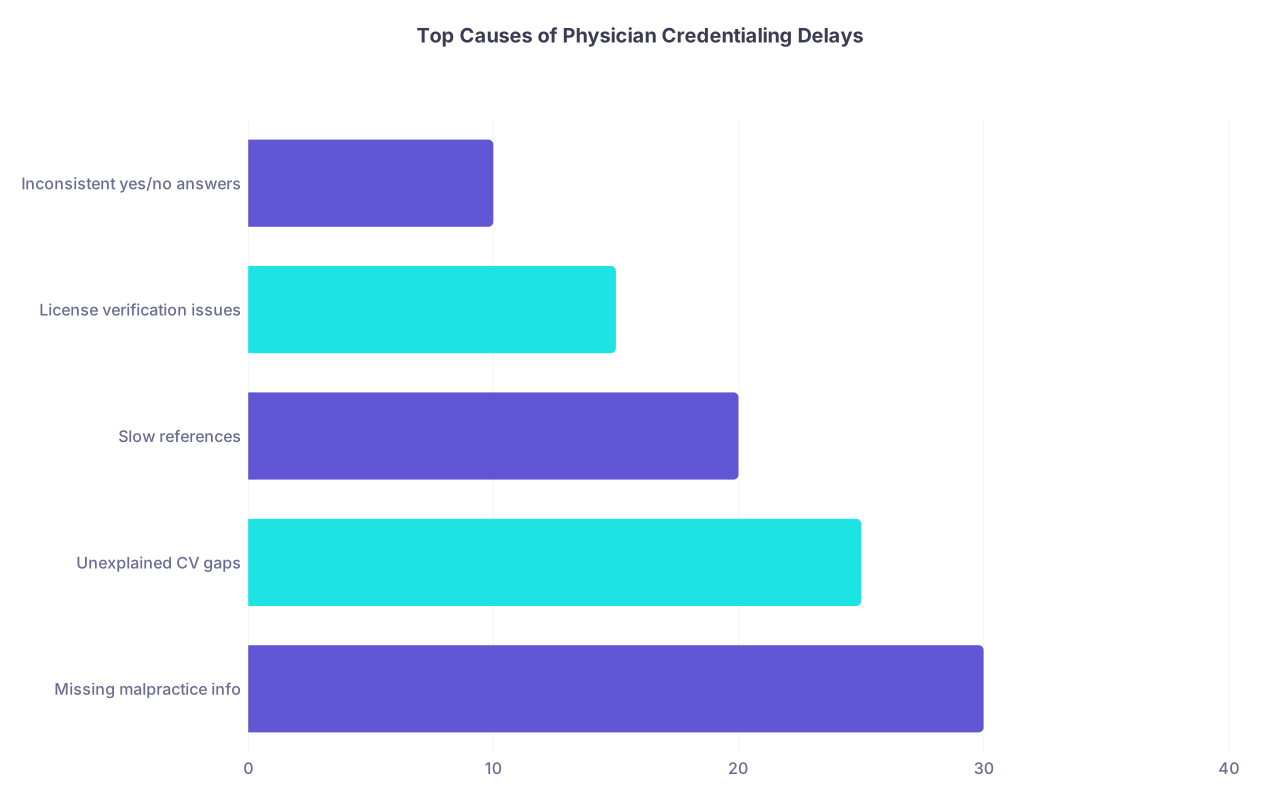
| Category | Value |
|---|---|
| Missing malpractice info | 30 |
| Unexplained CV gaps | 25 |
| Slow references | 20 |
| License verification issues | 15 |
| Inconsistent yes/no answers | 10 |
If you’ve ever had a board investigation, malpractice settlement, license restriction, or termination “without cause,” that needs to be answered consistently the same way on every form. Inconsistency looks like lying, and some credentialing committees never forget that.
Trap 9: You Ignore State Law Differences for Supervision and Scope
Different states have very different rules for:
- APP supervision
- Telehealth across state lines
- Specific procedural privileges
- Call responsibilities and immediate availability
If you assume “this is how we did it at my residency hospital” and behave the same way in a different state, you can violate:
- State medical board regulations
- Facility bylaws
- Payer contracts
For example:
You’re an anesthesiologist accustomed to a particular ratio of CRNA supervision. In another state, that ratio is tightly regulated and different. If you let the staffing office push you into unsafe ratios “because that’s what we do,” you’re the one on the hook if there’s an adverse event.
Before starting, ask explicitly:
- Are there state‑specific rules I should know about for supervision or scope?
- How are those reflected in the bylaws and your privileging?
- Can I get a copy of the relevant bylaws/privilege delineation before day one?
This takes you from “warm body” to actual professional.
4. Contract Gotchas That Tie All Three Together
The truly nasty locum tenens traps sit in the contracts that connect billing, malpractice, and credentialing. Nobody reads them. Until there’s a problem.
Trap 10: Indemnification Clauses That Turn You Into the Insurer
Some locums contracts have language like:
“You agree to indemnify and hold harmless the Company and Facility from any liabilities, claims, or expenses arising from your acts or omissions, including but not limited to payer recoupments, billing audits, and malpractice claims.”
That’s legalese for: if something goes wrong, we can send the bill to you.
You want this narrowed. At minimum, push for:
- Your indemnification limited to your own proven negligence or misconduct
- Exclusion of things outside your control (billing errors by them, credentialing mishandling, their HR screwups)
- Clear statement that their malpractice policy is primary and they cannot subrogate against you except for fraud/intentional acts
If that feels too legal, fine. But get a physician‑focused attorney to look at any contract where indemnification language feels broad and one‑sided. Paying $400 once to save six figures later is not a bad trade.
Trap 11: Non‑Competes That Block Future Jobs
This one is subtle and ugly.
You do a locums gig at a hospital system you actually like. A year later, they want to hire you permanently. You accept. Then the agency reminds you:
“Per your contract, you owe us a $40k fee if you accept employment at that facility within 2 years.”
Or worse, the facility is barred from hiring you directly at all for that period. You’re now toxic to a place that loves your clinical work.
Watch for:
- Non‑compete or “conversion fee” language tying you to a site or system
- Time period (12–24 months is common)
- Whether the facility can “buy you out” and whether they realistically will
If your main goal is to test‑drive potential permanent sites, overly aggressive non‑competes make that impossible.
Trap 12: “Corrective Action” and Termination Language That Follows You
Locums contracts sometimes give the facility broad power to:
- Remove you from the schedule for any reason
- Label your departure as “for cause” or “due to concerns about clinical performance”
- Report you to the NPDB or state boards
A single bad fit plus sloppy language can poison future credentialing. You want:
- Clear distinction between administrative termination (low volume, restructuring, personality mismatch) and true clinical concerns
- Requirement for notice and some form of due process or investigation before they label it “for cause”
- Clarification on when they may or must report to NPDB or boards
If a recruiter says, “Oh, they’d never do that,” ignore them. I’ve watched facilities throw locums under the bus to protect their own reputation.
5. How to Protect Yourself Without Losing Your Mind
You don’t need a law degree. You do need a system and a spine.
Build a Simple Locums “Control Center”
One folder (cloud or physical) with:
- Master CV (gap‑free, month/year)
- Copies of all licenses, DEA, board certs, ACLS/BLS, etc.
- Malpractice declaration pages and tail confirmations by year/agency
- Copies of every locums contract you sign
- Personal shift/billing log (spreadsheet is fine)

| Step | Description |
|---|---|
| Step 1 | Consider Assignment |
| Step 2 | Request Contract and Malpractice Details |
| Step 3 | Review Billing Terms and Pay Schedule |
| Step 4 | Check Non Compete and Indemnification |
| Step 5 | Confirm Credentialing Plan |
| Step 6 | Track Shifts and RVUs |
| Step 7 | Verify Pay and Coverage Timeline |
This is not busywork. It’s your defense file.
Know When to Walk Away
Red flags you should not rationalize away:
- Nobody will give you malpractice paperwork “because it’s standard.”
- They ask you to start seeing patients while payer credentialing is “still pending.”
- Contract says pay is “based on collections” with no floor.
- Non‑compete blocks you from a whole region or large health system.
- Indemnification language is broad and they refuse edits.
If a recruiter gets annoyed that you’re asking questions, that’s your answer.
FAQ (Exactly 4 Questions)
1. Do I really need my own attorney to review every locums contract?
Not every single one, but you absolutely should have at least your first contract in each “pattern” reviewed so you understand the traps. For example, one review for a typical hospitalist contract, one for telemedicine, one for high‑risk procedural work. After that, you’ll know what clauses to look for and what’s unacceptable. Think of it as an inoculation: a small cost upfront to avoid a much bigger problem later.
2. What’s the fastest way to spot a dangerous malpractice setup in a locums offer?
Ask three blunt questions: Is the policy claims‑made or occurrence? If claims‑made, who pays for tail and is that stated in writing? And can you send me the declaration page and summary of exclusions? If they dodge, delay, or send vague answers, you’re looking at risk they don’t want you to see. That’s usually your cue to move on.
3. How far back do I need to disclose malpractice or disciplinary issues for credentialing?
Assume forever unless the question clearly limits the timeframe. If the form says “ever,” they mean it. Consistency matters more than the specific incident in many cases; committees get far more suspicious about inconsistent answers than about a single, honestly explained malpractice settlement from residency. Keep a standard, carefully worded explanation ready and use the same version every time.
4. What’s one thing I can do this week to avoid a future locum tenens disaster?
Create a one‑page summary of your current professional risk: list every agency you’ve worked with, dates of coverage, what kind of malpractice policy you had (claims‑made vs occurrence), and whether tail is confirmed. If you can’t fill that in confidently, start emailing agencies for documentation. Do that now—before you accept the next “amazing” assignment that quietly adds another hole to your safety net.
Open your last (or current) locums contract today and find the sections on malpractice, billing/payment, and termination. Highlight anything you don’t fully understand. If you can’t explain it in your own words, you don’t actually know what you’ve agreed to—and that’s the mistake you fix before you sign the next one.