
The decision to make you a partner is almost never about what they tell you it is.
Partnership offers in private groups are decided in side conversations, quiet votes, and hallway impressions you never see. By the time anyone formally “evaluates” you, the real decision is usually already made.
Let me walk you through how it actually works—what’s being said in that closed-door meeting with your name on the agenda, and why some people “mysteriously” get passed over even when they check every obvious box.
The myth vs. the real decision
On paper, groups talk about partnership like this:
- Meet your RVU/collections targets
- Be clinically competent
- Be a “team player”
- Stay out of trouble
That’s the mythology.
Behind the scenes, the calculus is far sharper:
“Does adding this person as an owner make my life easier, safer, and more profitable for the next decade?”
If the silent answer around the table is “yes,” the rest gets rationalized. If the answer is “no,” people pull out performance reports like weapons.
Here’s what they’re really weighing:
- Are you a financial asset or liability to the group’s future?
- Are you going to stir up drama, politics, or risk?
- Can they see you sitting at that table for 10–20 years without regretting it?
- Are you loyal—to the group—or just shopping for the next shiny thing?
Nobody writes this in the bylaws. But I’ve watched partners from anesthesia to EM to subspecialty surgery run this exact script.
What actually happens in the closed-door meeting
Let’s pull back the curtain on that night when your fate is decided.
The partners schedule a “business meeting.” You’re not there. They might say, “We’ll review partnership candidates next month.” By the time that meeting starts, everyone in the room already has a narrative about you.
There’s usually a structure:
The group president or managing partner opens:
“We need to decide about Dr. X. Their partnership date is July 1. Let’s talk.”Your “sponsor” talks first.
This is the senior physician who likes you, the one who has taken you to lunch, defended you once, or been your informal mentor. If you do not have a sponsor, that’s already a problem.Then the dissenters surface.
There is almost always at least one. The person who will say, “I’m not convinced.” The significance of that dissent depends on who says it.
After that, it’s no longer about fairness. It’s about power and risk tolerance. Here’s a simplified version of what’s really getting argued.
The quiet categories you’re evaluated on
They’re not pulling up a competency-based rubric. They’re mentally slotting you into categories like this:
| Category | Question They Ask |
|---|---|
| Money Maker | Do they increase group revenue? |
| Safe Pair of Hands | Do I worry when they’re on call? |
| Culture Fit | Do they match how we actually operate? |
| Flight Risk | Will they leave after we vest them? |
| Drama Risk | Will this person create headaches? |
Nobody calls it that, but this is the lens.
If you’re a clear “Money Maker + Safe + Culture Fit + Low Risk,” you’re in. That’s the partner they brag about recruiting.
If you’re “technically good but high-risk politically/dramatically/flakiness-wise,” they start looking for an excuse to delay or deny.
I’ve heard actual lines in those rooms like:
- “He’s fine clinically, but I don’t trust him with our books.”
- “She’s very bright. I’m just not sure she’s with us long term.”
- “I don’t want another person in here who’s going to challenge every decision.”
- “We’re about to sell to private equity—why would we cut her in now?”
Notice what’s missing: “Her lap chole time” or “his knowledge of the latest guideline.” Clinical skill is assumed. It’s the price of entry, not the reason for partnership.
The financial truth they rarely explain to you
You becoming a partner is a financial event for everyone else. They’re not doing you a favor out of mentorship spirit; they’re deciding whether to share the pie with you.
There are three big financial levers that matter:
- Buy-in amount and structure
- Impact on existing partners’ income
- Timing with big events (hospital contracts, PE deals, mergers)
Let’s break that down.
The buy-in conversation you never really hear
On paper, they’ll tell you, “Partnership buy-in is $X over 3–5 years.” You assume that’s some precise, principled valuation of the practice.
Inside the room, it sounds more like this:
- “We can’t price it too low or we’re giving away decades of sweat equity.”
- “If we price it too high, we scare away talent—we’re already short bodies.”
- “We’re thinking about a sale in 3 years; if we bring them in now, we dilute our payout.”
No one will spell out that last one, but I’ve heard it in exactly those words.
Groups about to sell to private equity will often do one of three things:
- Freeze new partners: “We’re not adding partners for a while; the market’s uncertain.”
- Delay your decision: “Let’s extend your associate period another year, just to be sure.”
- Fast-track their favorites: “We’ll make an exception and accelerate your partnership timeline.”
Same practice. Same bylaws. Different rules for different people because the financial timing favors some and not others.
You need to understand you’re being evaluated relative to an exit strategy, not some abstract ideal.
Why “Are they worth diluting for?” is the real question
If the group is stable, profitable, and happy, admitting a new partner is dilution. Your presence reduces each existing partner’s slice in the short term.
So they ask themselves:
- Will this person bring in enough volume?
- Will they make us more efficient, cover more call, expand services?
- Or are we just increasing the number of people who will want a say, a share, and a schedule preference?
If they see you as a “coverage solution” but not a long-term value add, they’ll happily keep you as an employed workhorse. Full stop.
This is why you see that pattern where someone is “indispensable” as an employee but “not quite ready” for partnership, conveniently, every year.
They’re ready. The group just likes the margin better with them on the outside.
The invisible file on you: what really influences the vote
Most people think their partnership fate depends on performance reviews or some formal metric.
No. It’s your reputation dossier—a rolling, informal mental file built from 100 small interactions.
Here’s what actually goes into it.
1. How you behave when nobody’s watching
Partners pay far more attention to your unstructured behavior than your polished moments.
Examples I’ve watched swing votes:
- The surgeon who quietly stayed late three nights in a row to help an older partner with a disaster call list, never complaining.
- The hospitalist who made a point of learning the names of every long-time MA and unit clerk—and never snapped when things got busy.
- The anesthesiologist who, when OR times were tight, started sending polite, clear communication about delays so partners weren’t blindsided on their cases.
These details get retold at the table:
“Look, I’ve seen her take tough calls; she never dumps on people.”
“I’ve never seen him lose his temper with staff—that matters.”
Nurses, techs, OR schedulers, clinic supervisors—they all have quiet influence. When an office manager tells the managing partner, “We love working with Dr. X,” that sticks.
2. Your alignment with the actual culture (not the brochure version)
Every group has a real culture that’s different from their website copy.
Some are “grind and money,” others are “lifestyle and collegiality,” some are “political players with the hospital.” Show up with the wrong value set and you’ll be labeled “bad fit” no matter how skilled you are.
I’ve seen:
- A high-RVU, very aggressive proceduralist join a laid-back GI group and get quietly blackballed because he wanted to expand into every niche and push volumes past what the older partners wanted. They saw him as a future mutineer.
- A very collaborative, quality-focused hospitalist fail partnership in a group that prided itself on RVUs and rapid discharges. They said all the right words to her face. Behind closed doors: “She’s not one of us.”
Your job from year one is to decode what actually gets praised in your group. Who gets promoted, protected, given cushy call deals? That’s the culture. Align with that—or accept that partnership there may not be in the cards, and plan accordingly.
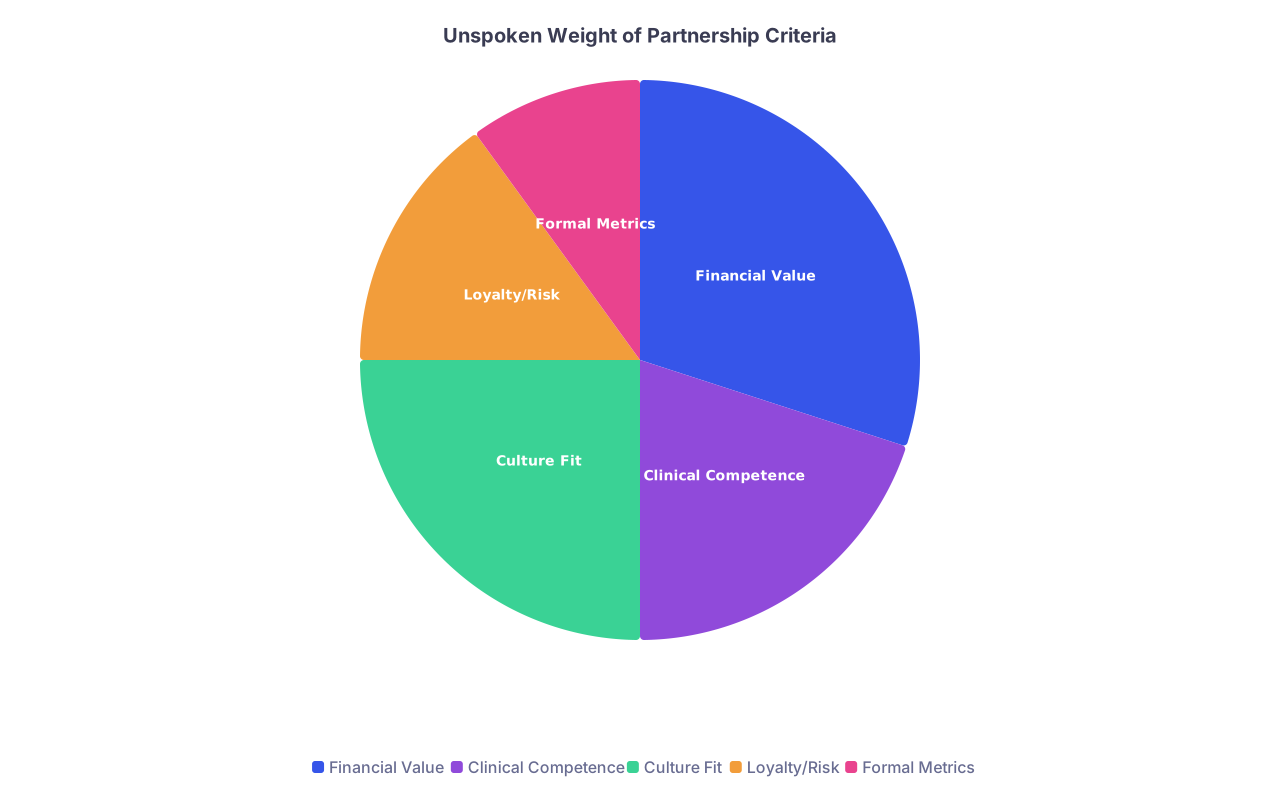
| Category | Value |
|---|---|
| Financial Value | 30 |
| Clinical Competence | 20 |
| Culture Fit | 25 |
| Loyalty/Risk | 15 |
| Formal Metrics | 10 |
Who in the room really decides
Here’s another truth: not all votes are equal, even if bylaws pretend they are.
In most private groups, three power centers matter:
- The Founders / Senior Rainmakers
- The Informal Politician – the partner everyone vents to
- The Hospital Liaison / Medical Director type
If any one of those three is strongly opposed to you, you’re in trouble. If two are, it’s over.
The dynamic goes like this:
- Your sponsor presents you positively.
- A senior or powerful partner raises a concern: “I’m not sure about X.”
- The room watches who speaks next. If another power center co-signs that doubt, your chances drop by half before anyone brings up your RVUs.
Sometimes they’ll paper over it: “We should revisit in a year.” That’s soft denial.
The “one-vote veto” nobody tells you about
Even in groups that claim “partnership decisions are by majority,” in reality there’s often an unspoken veto. A single highly influential partner who says, “Absolutely not,” and everyone quietly falls in line.
I’ve heard it plain:
- “If he’s a partner, I’m out.”
- “I’m not sharing financials with her.”
That’s the nuclear option. Almost no one will say it on the record. But when they do, that’s it. You’re done.
Your strategy, then, is simple: from early on, identify who in your group has that kind of pull and make sure you are never on their wrong side. You do not need to brown-nose. You do need to avoid being their problem.
Red flags that get you quietly blacklisted
Let’s talk about the real landmines.
These are the patterns that, once they attach to your name, are hard to shake:
- Chronically late charts or sloppy documentation – not one-off bad weeks; I mean months of being the person coding has to chase. Partners think: “She’ll cost us audits and headaches.”
- Frequent schedule drama – excessive trading, lots of “I can’t that day,” or consistent avoidance of ugly shifts. Reads as selfish and unreliable.
- Bad behavior with staff – snapping at nurses, talking down to MAs, arguing with schedulers. Word gets back. It always does.
- Uncontrolled gossiping or divisiveness – picking favorites, starting “us vs. them” narratives.
- Litigation magnet – even if cases are defensible, if your name shows up too many times, partners wonder: “Do we want this liability as an owner?”
- Overt disloyalty – openly trashing the group to hospital administrators, hinting you’re interviewing elsewhere, constantly comparing your job to some “better” gig.
One story sticks with me: a very sharp cardiologist, outproducing everyone, technically flawless. But for two years, every time a schedule wasn’t favorable, he complained loudly to the nurse manager: “Other groups don’t do this.” That nurse had coffee every week with one of the partners’ wives. Guess what the living room conversation sounded like.
Inside that partnership meeting, the line was: “He’s great, but he’s not our guy.” Translation: persistent low-grade disloyalty sank him.

| Step | Description |
|---|---|
| Step 1 | Associate Hired |
| Step 2 | Reputation Builds |
| Step 3 | Remain Employee |
| Step 4 | Closed Door Review |
| Step 5 | Delay or Deny |
| Step 6 | Offer Partnership |
| Step 7 | Extend Associate Period |
| Step 8 | Sponsor Secured |
| Step 9 | Any Strong Objection |
How to quietly stack the deck in your favor
Now the part you actually care about: how to tilt that closed-door conversation.
You are not going to “logic” your way into partnership with metrics and a PowerPoint. The work is done long before any of that. Here’s what actually moves the needle.
1. Get a real sponsor early
Do not assume “my performance will speak for itself.” It won’t. People speak for you.
Your sponsor is the person who, in that room, will say:
“I’ve worked with her on nights. She shows up, she handles tough cases, she owns her mistakes. I’m comfortable sharing a balance sheet with her.”
You cultivate that by:
- Taking unglamorous call with them—and performing.
- Asking targeted questions about how the group really works, then listening.
- Being visibly reliable when they’re on: don’t disappear, don’t dump, don’t make them chase you.
This isn’t mentorship theater. It’s a political ally.
2. Signal long-term alignment without sounding trapped
Groups are acutely sensitive to flight risk. They’re about to hand you access to sensitive financials, governance, and a share of their equity. If they suspect you’ll leave in 2–3 years, they’d rather keep you outside.
Signals that help:
- Anchors: local family ties, spouse’s job, kids in school, a house purchase after you’ve decided the group is decent.
- Statements that tie your future to the group’s: “If I buy in, I want to be here building this for the long haul.”
- Visible involvement: volunteering for a committee, showing up to partner retreats as invited, actually reading the documents they give you and asking thoughtful questions.
You don’t have to swear a blood oath. You do need to look like someone building a career, not a 2-year arbitrage.
3. Solve one real problem for the group
This might be the most underrated move.
Find a pain point and quietly fix or improve it. Something like:
- Taking ownership of an underperforming clinic site and stabilizing it.
- Streamlining pre-op clearance communication so cases run smoother.
- Leading a small QI project that actually reduces bounce-backs or LOS—and making sure the data is visible.
Then, when your name comes up in that meeting, somebody has a specific story:
“Remember when Mondays in clinic were a disaster? Since she took over that schedule, complaints have plummeted.”
Stories beat spreadsheets.
4. Clean up your bureaucratic footprint
Make it boring to manage you.
- Charts closed on time.
- Bills coded appropriately.
- Compliance modules done without nagging.
- Credentialing stuff submitted early.
No partner wants to hand equity to the person who is always “on the list” of outstanding issues. You want the practice manager to say, “Oh, Dr. X? They’re easy.”
5. Don’t overplay your leverage
This one burns a lot of candidates.
Yes, in a tight market you might have other offers. No, you should not use them as a blunt instrument right before partnership decisions.
“I have an offer across town paying X more” sounds like a threat, not a negotiation, in that moment. What partners hear is: “If we make them a partner, they’ll hold us hostage every time they see a shinier number.”
If you’re negotiating buy-in terms or compensation structure, do it calmly, early, and with an attitude of “I want this to work for all of us,” not “Match this or I walk.”
One EM group I watched denied partnership to a very competent doc a month before vesting, explicitly because he came in hot with, “Another group will make me partner with less buy-in.” Partners decided he was a future problem. They replaced him with someone slightly less productive but more predictable.
Why some obviously qualified people still get “not yet”
Sometimes the decision really is a close call. I’ve seen groups waffle for reasons that, from the outside, seem petty but from inside feel real.
Common subtext behind “We want to see another year”:
- The group is financially nervous: contract up for renewal, hospital merger, declining volumes. They want optionality.
- You had a stretch of high-profile complications, even if not your fault. Partners are skittish.
- Another associate is up at the same time, and they’ve decided to stagger buy-ins. They’re choosing.
- One key partner is on the fence about retiring and doesn’t want to split equity until they know their own timeline.
They are rarely going to tell you this honestly. Instead you’ll hear:
“We just want to see continued growth.”
“We’re revising our partnership model.”
“We think an additional year will be beneficial for everyone.”
Sometimes that buys you time to change minds. Sometimes it’s a slow no. Your job is to read the pattern, not the words.
If they keep moving the goalposts—“Hit this RVU number; okay, now hit this patient sat number; okay, now let’s wait another year”—accept the reality: they don’t want you as a partner, they want you as labor.
At that point, your smartest move may be to look elsewhere rather than begging to be included in a game that’s rigged against you.
Final blunt truths
I’ll leave you with the three realities I’ve seen hold across specialties and regions:
Partnership decisions are mostly about trust and alignment, not metrics.
Your numbers get you to the table. Your reputation, loyalty signals, and cultural fit decide the vote.You need someone in that room fighting for you.
A true sponsor who’s worked with you, believes in you, and can neutralize the inevitable concerns. Without that, you’re relying on inertia. And inertia favors the status quo.If a group repeatedly delays or muddies your path, believe their actions, not their promises.
They’ve already decided what role you play in their story. If it’s not “future partner,” have the self-respect to find somewhere that sees you as an owner, not just a shift-filler.