
It’s your second year out of residency. You’re sitting in a clinic workroom at 6:45 pm, charting on your eighth add-on of the day. Down the hall, one of your co-hires — same graduation year, similar training — just left early to “jump on a quick call with the managing partners.”
Six months later, you hear it: he’s being “considered for early partnership track.” You? Still “doing great, just keep it up.” Vague smiles. No specifics. No timeline.
You didn’t suddenly become less smart in two years. So what actually happened?
Let me walk you through what really goes on behind those closed-door partner meetings, because I’ve sat in them, heard the unfiltered comments, and watched people get quietly vaulted to the top while others are told to “be patient” until they give up and leave.
This is not about fair. It’s about how the game is actually played.
First Reality Check: Partnership Is Not a Reward for Good Medicine
Every resident walks out thinking the same thing: “If I work hard, take good care of patients, and don’t piss people off, I’ll make partner on time.”
That’s not how decision-makers think.
Inside a partner meeting, the conversation doesn’t start with:
“Is she a good doctor?”
That’s assumed. If you’re dangerous, you’re gone long before the partnership conversation.
The real first questions sound like this (I’ve heard almost these exact lines):
- “What’s his collections trend the last 6 quarters?”
- “Does she keep the staff or are people requesting not to work with her?”
- “Is this someone I’d want to share a call schedule and a balance sheet with for the next 15 years?”
Partnership is not about clinical competency. It’s about business compatibility and risk.
You can be the most clinically gifted person in the building and still get quietly stalled for years because partners are not afraid you’ll hurt a patient; they’re afraid you’ll hurt their income, culture, or exit strategy.
So if you’re confused why someone with weaker clinical skills is moving faster than you, that might be exactly why. They’re being assessed on a different axis than the one residency trained you to care about.
The Metrics That Actually Move the Needle
Let me be very clear: no one gets fast-tracked to partnership simply because they “work hard.” Everyone works hard. On the inside, partners look at a completely different set of signals.
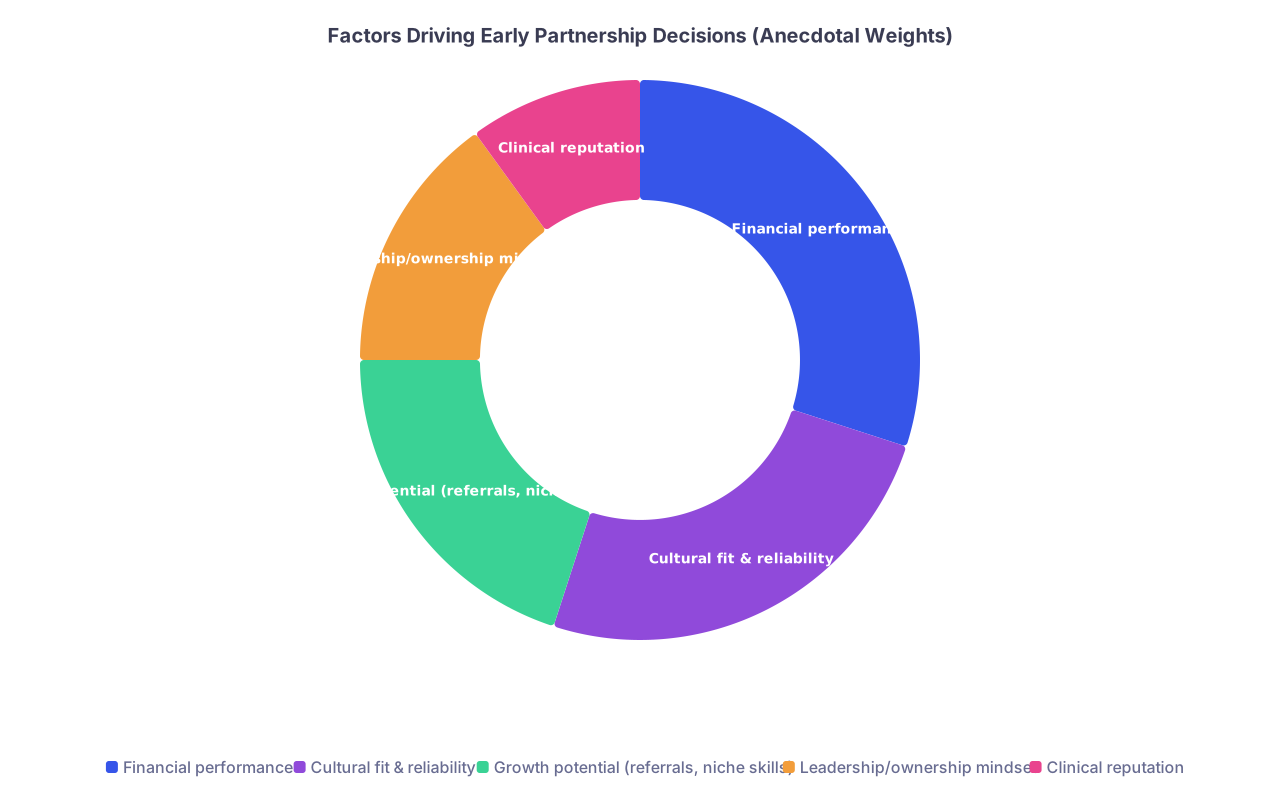
| Category | Value |
|---|---|
| Financial performance | 30 |
| Cultural fit & reliability | 25 |
| Growth potential (referrals, niche skills) | 20 |
| Leadership/ownership mindset | 15 |
| Clinical reputation | 10 |
1. Financial performance (collections, not just RVUs)
Nobody will say this out loud at the town hall meeting, but I’ve seen the spreadsheet on the projector.
The fastest-tracked residents-turned-associates have one thing in common: their collections per clinical FTE climb consistently. Partners are obsessed with trends, not one good quarter.
They look at:
- Collections relative to overhead
- Payer mix (are you mostly Medicaid, or are you bringing in commercially insured patients?)
- How much work they don’t have to redo after you
I watched an associate get bumped up a full year early for partnership consideration in a radiology group because his collections per FTE were in the top 25% of the group by his second year… and he never complained about the call schedule. The official language was “recognition of sustained excellence.” The real reason was on the income statement.
You do not need to be the absolute top earner. But if the graph of your collections looks flat or noisy while your co-hire’s line goes steadily up, guess whose name gets floated first.
2. Cultural reliability: are you “low-friction” or “drama”?
There’s always one name that makes the room groan when partnership comes up. Not because they’re bad clinically. Because they’re exhausting.
Examples I’ve heard in deliberations:
- “He’s always involved in some conflict with staff.”
- “She’s great with patients but every scheduling issue becomes a federal case.”
- “He’ll argue over 1 RVU. I don’t want that energy in partner meetings.”
Your partners don’t want to spend the next decade litigating your grievances.
The fast-tracked ones are almost boring in the best way: they show up, do the work, don’t dump problems without trying to fix them first, and they don’t make everything about themselves.
If your name keeps showing up in sentences that start with “Yeah, but…” you’re not getting fast-tracked. You’re getting “let’s give it another year and reassess.”
3. Staff loyalty: who do the nurses and MAs choose?
I cannot overstate this part. Residents underestimate it every time.
In closed-door meetings, I’ve watched senior partners turn to the practice manager and say:
“Who do the staff want to work with?”
Then they shut up and listen.
If the answer is, “Oh, they love Dr. X, they’ll swap shifts to be with her,” that carries more weight than your last abstract or lecture. Staff loyalty is a proxy for how you impact clinic morale and throughput.
Flip side: if the practice manager says, “We’ve had several techs ask not to be assigned to him,” you’re done. Officially it never appears in your file. Informally, your partnership timeline just got stretched another 2–3 years.
Ask yourself: if the charge nurse or office manager had to pick three people to build a new clinic with, would you be on that list? That’s the level you want.
4. Ownership mindset vs employee mindset
This is where a lot of residents stall and have no idea why.
You can feel an ownership mindset a mile away. They talk differently. They ask different questions.
Employee questions sound like:
- “Why am I not getting more block time?”
- “When do my vacation days reset?”
- “Can we hire more NPs so my life is easier?”
Ownership questions sound like:
- “What’s our payor mix trend? Are we too exposed to one insurer?”
- “If we added an NP, what’s the ROI and how fast would they ramp up?”
- “If I take on that satellite clinic, can we tie a percentage of its profits to my comp?”
Partners fast-track people who already think like owners before they are owners. Because training someone to be clinically competent is easier than training them to care about P&L.
If in your meetings you only talk about call fairness, vacation, and schedule, while your co-hire is talking about referral patterns, imaging leakage, or downstream revenue… do not be surprised when they’re the one quietly getting early consideration.
The Quiet Power Factors No One Puts in Writing
Now we get to the stuff even fewer people will admit. There are entirely unofficial variables that warp timelines.
The mentor-sponsor effect
Every fast-tracked associate has at least one senior partner who is actively championing them. Not just “likes them.” Actively spends political capital on them.
That sounds like:
- “I’ll vouch for her. She took over my clinic days without a hiccup.”
- “He saved my ass on call last month when I was double-booked. We want him in this group long term.”
- “If we don’t move on her now, she’ll get scooped by the group across town. I’ve already heard they’re sniffing around.”

| Step | Description |
|---|---|
| Step 1 | New Associate |
| Step 2 | Find senior ally |
| Step 3 | Prove reliability |
| Step 4 | Get informal advocacy |
| Step 5 | Included in strategy talks |
| Step 6 | Early partnership push |
Without a sponsor, you’re an item on an agenda. With a sponsor, you’re someone’s project.
Notice I said sponsor, not mentor. A mentor gives advice. A sponsor uses their reputation to pull you up. The people getting fast-tracked? They have sponsors.
If no senior partner would stick their neck out and say, “We should not risk losing her,” you’re not on a fast track. You’re on autopilot.
Being strategically useful at the right time
Timing is dirty but real.
Your co-hire gets fast-tracked… right after the group signs a new hospital coverage contract that needs more bodies. He happens to be the one who said, “Sure, I’ll take that site. I’ll make it work.”
You? You fought to stay in the main clinic because the satellite was “too far” and “too disorganized.”
Who do you think partners view as more strategically valuable?
I’ve watched this happen in:
- Neurology groups opening an EMU and pushing the epileptologist who volunteered into early partnership
- GI practices buying an ASC and fast-tracking the associate who said, “I’ll help build out that endoscopy block, even if it’s extra work this year”
- Hospitalist groups taking on an LTAC or SNF service and bumping up the doc who stabilized that dumpster fire
You want to be fast-tracked? Be the answer to a problem that affects partner income.
Social integration: yes, it still matters
Everyone wants to believe we’re purely meritocratic. We’re not. Humans like working with people they like.
I’ve seen the “Friday golf group” dictate more career trajectories than all the CVs combined.
Does that mean you need to drink or golf or fake hobbies? No. But if you’re the phantom associate who never shows face at:
- Department dinners
- Retreats
- Strategy sessions
- Informal post-call breakfasts
Then when your name comes up, people don’t have a real picture of you. Nobody fights for a ghost.
The fast-tracked ones are not always the most social butterflies, but they’re present. They know people’s kids’ names. They’ve had real conversations with decision-makers outside of EMR messages.
Why Some People Stall for Years (And Are Never Told Why)
Stalling is almost never framed honestly. You’ll hear “We just need more data” or “It’s a competitive year.” Inside the room, it’s usually one of these:
| Surface Explanation | Real Internal Reason |
|---|---|
| "We want another year of productivity data." | Collections are mediocre and trending flat. |
| "We’re reassessing our partnership structure." | Partners do not want to dilute profits yet. |
| "There have been some staff concerns, we’ll revisit." | Staff actively dislike working with you. |
| "We need to see more leadership involvement." | You act like an employee, not an owner. |
| "Right now margins are tight, timing is bad." | They don’t see you as worth the financial risk. |
1. Your revenue-to-hassle ratio is off
Every associate gets informally graded on this:
“Dollar value generated” divided by “headache created.”
High revenue / low headache? Fast-track candidate.
Medium revenue / low headache? Standard timeline, maybe slightly delayed.
High headache in any category? Stall.
The “headache” bucket includes:
- Constant schedule complaining
- Chronic lateness to OR, clinic, or sign-out
- Slow documentation that forces others to stay late
- Passive-aggressive behavior with staff
No one quantifies this in your review. But when someone says, “I just don’t see him as a partner yet,” this is often what they mean.
2. You never learned the numbers
I’ve seen smart, capable physicians stall purely because they treated all business discussions as noise.
They couldn’t tell you:
- What their own collections were last quarter
- What percentage of their panel is Medicare vs commercial
- How their no-show rate compares to the group’s baseline
- How overhead is allocated in their practice
In partner meetings, that reads as:
“Great doc. Totally dependent on us to think for them.”
Nobody rushes to bring in another person to argue about clinical minutiae while they themselves carry all the business thinking.
If your eyes glaze over when your medical director talks about payer contract renegotiations, you’re waving a flag: “I’m an employee forever.” People believe you.
3. Someone already told them “I would not share a balance sheet with this person”
This is the quiet veto that derails fast-tracking.
All it takes is one or two influential partners saying, “I’m fine with them as an associate, but I would not bring them into the partnership.” That’s it. You’re in the long game now.
Reasons they say that:
- They’ve seen you blow up at staff
- They’ve watched you dodge responsibility when something goes wrong
- They think you’re careless with documentation or compliance
- They see you as mercenary (constantly shopping offers, threatening to leave)
You won’t hear that sentence. You’ll just feel the slow-rolling fog of “maybe next year.”
If You Want to Be Fast-Tracked, Do This Differently
Let’s cut the fluff. Here’s how the people who get accelerated actually behave.
1. They learn the business in year one, not year five
They ask for:
- A breakdown of how their compensation is calculated
- Quarterly reports on their collections, payor mix, and overhead allocation
- A seat (even silently at first) in any practice operations or finance meetings they can get into
Then they start tying their asks to business rationale.
Not: “Can I get more block time?”
But: “If I can secure another afternoon block, here’s what I think it does to monthly collections and patient throughput. Can we trial it for three months and review?”
Partners hear that and think, “This one is already thinking like us.”
2. They pick one strategic problem and quietly fix it
Fast-tracked people rarely try to fix everything. They pick one high-value problem and own it.
Examples I’ve seen:
- In an ortho group: one associate took ownership of reducing same-day surgery cancellations by working with pre-op, PCPs, and patient education. Cancellations dropped. OR efficiency improved. Everyone noticed.
- In an outpatient psych group: a new hire tackled the referral backlog with a triage system and NP integration. Wait times fell. Referring PCPs stopped complaining to the partners.
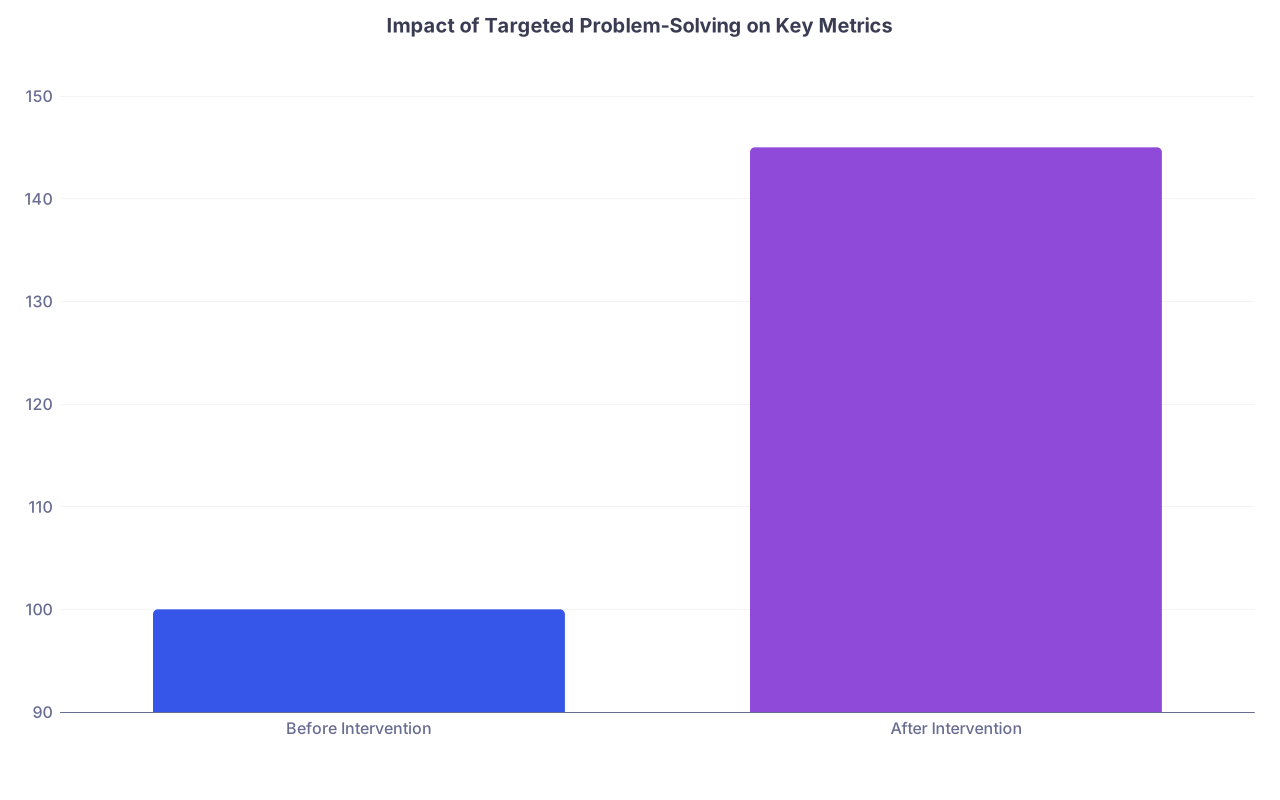
| Category | Value |
|---|---|
| Before Intervention | 100 |
| After Intervention | 145 |
Nobody announced “You’re now the Director of X.” They just took responsibility and delivered results. Senior docs love that. It screams partnership material.
3. They cultivate one or two real sponsors
Not mass networking. Targeted sponsorship.
They:
- Choose 1–2 senior partners whose values and style they respect
- Consistently make those partners’ lives easier (covering when needed, following through on tasks, not dropping balls)
- Periodically ask for direct feedback: “If I want to be a partner in 3–4 years, what am I NOT doing yet?”
Then — and this is the hard part — they act on that feedback, and circle back later: “You told me last year I needed to be more visible in operations; here’s what I’ve done.”
At that point, your sponsor doesn’t just like you. They’re invested in your trajectory.
4. They make themselves hard to lose
Partnership decisions get a lot simpler when the question shifts from “Should we make them a partner?” to “Can we afford to lose them?”
You become hard to lose when:
- You own key service lines, sites, or referral relationships
- Patients and referring physicians specifically seek you out
- You’re the one who always shows up when there’s a disaster: EMR go-live, staffing crisis, new site opening
I’ve seen offers get accelerated fast when a competing group starts recruiting a productive, well-liked associate who controls a meaningful chunk of the practice’s future growth.
No one says, “We’re scared of losing her, so let’s promote her.” Officially it’s “retention of top talent.” Same thing.
FAQs
1. How early should I start asking about partnership at my first job?
Earlier than you think, but with the right tone. In your first 3–6 months, you should already know:
- What the default timeline is (3 years, 5 years, etc.)
- What objective and subjective criteria they use
- How many associates in the last 5–10 years actually made partner on time
Ask once like a professional: “I want to align my efforts with what the group values. Can you walk me through what the last few successful partnership candidates did well?” Then stop asking and start acting. Begging or repeatedly bringing it up makes you look needy, not serious.
2. What if my group’s partnership track is obviously a sham?
If you see a pattern — decade-long associates, “market changes” always used as excuses, zero transparency on the numbers — believe the pattern.
At that point, your play is not to work yourself to death hoping you’re the exception. Your play is:
- Build portable value: skills, volume, and relationships that other groups will pay for
- Quietly explore options where partnership is real, with verifiable examples
- Either negotiate clear, written milestones with your current group or prepare to leave
You’re not “disloyal” for protecting your career. They’re not being loyal to you if they’re dangling a carrot they never plan to let you eat.
3. I’m introverted and hate politics. Am I doomed to be stalled?
No. But you cannot hide.
You don’t need to be the life of the party. You do need enough visibility and relationship capital that, when your name comes up, people have a real sense of who you are.
For introverts, that usually means:
- One-on-one coffees with key partners instead of big social events
- Taking on visible, discrete projects (EMR optimizations, quality committees) where your work is unmistakable
- Communicating clearly and reliably — answering messages, closing loops, not disappearing
Partnership is not awarded to ghosts. But it absolutely can be awarded to quiet, competent, solid people who show up.
4. How do I know if I’m on a fast track or just imagining it?
Look at behavior, not compliments.
You’re likely on an accelerated path if you see:
- Inclusion in higher-level meetings or strategy discussions before peers
- Senior partners proactively asking your opinion on non-clinical decisions
- Real opportunities flowing your way: new sites, service lines, leadership posts
- Concrete conversations about timeline and expectations, not just “you’re doing great”
If you’re getting praise but no increased responsibility, no transparency, and no specific milestones? You’re being kept comfortable, not groomed.
Bottom line? Residents get fast-tracked to partnership when they prove three things, early: they grow the pie, they lower friction, and they think like owners. Everyone else may be “great to work with” and “clinically strong,” but they’ll sit in the holding pattern until someone needs them… or not. You do not control politics, but you control your revenue signal, your headache score, and who would actually fight to keep you. Focus there.