
What exactly are you agreeing to when you sign that “standard” first-job contract they want back in 48 hours?
If you cannot answer that in detail, you’re the exact person these clauses are designed to trap.
I’ve watched new attendings walk into jobs that looked fantastic on the surface—great salary, decent location, “supportive” group—and then get crushed by the fine print. Non-competes that wiped out an entire metro area. Productivity formulas that never paid out. Call schedules that magically doubled after signing.
They all had one thing in common: they trusted the contract more than they understood it.
Let’s walk through seven of the most dangerous clauses that quietly turn “dream jobs” into exit strategies you cannot afford.
1. The Non-Compete That Quietly Owns Your Zip Code (and the Next Three)
This is the landmine almost everyone underestimates.
A non-compete (restrictive covenant) says: if you leave, you cannot practice within X miles of Y locations for Z time. Sounds reasonable until you realize:
- “X miles” is from every location the employer owns or may own.
- “Y locations” includes clinics that don’t exist yet.
- “Z time” is 12–24 months—long enough to wreck your life.
I’ve literally seen:
- 50-mile radius around every practice site (including satellites)
- 2-year duration
- Applies even if they terminate you “without cause”
That’s not protection. That’s a cage.
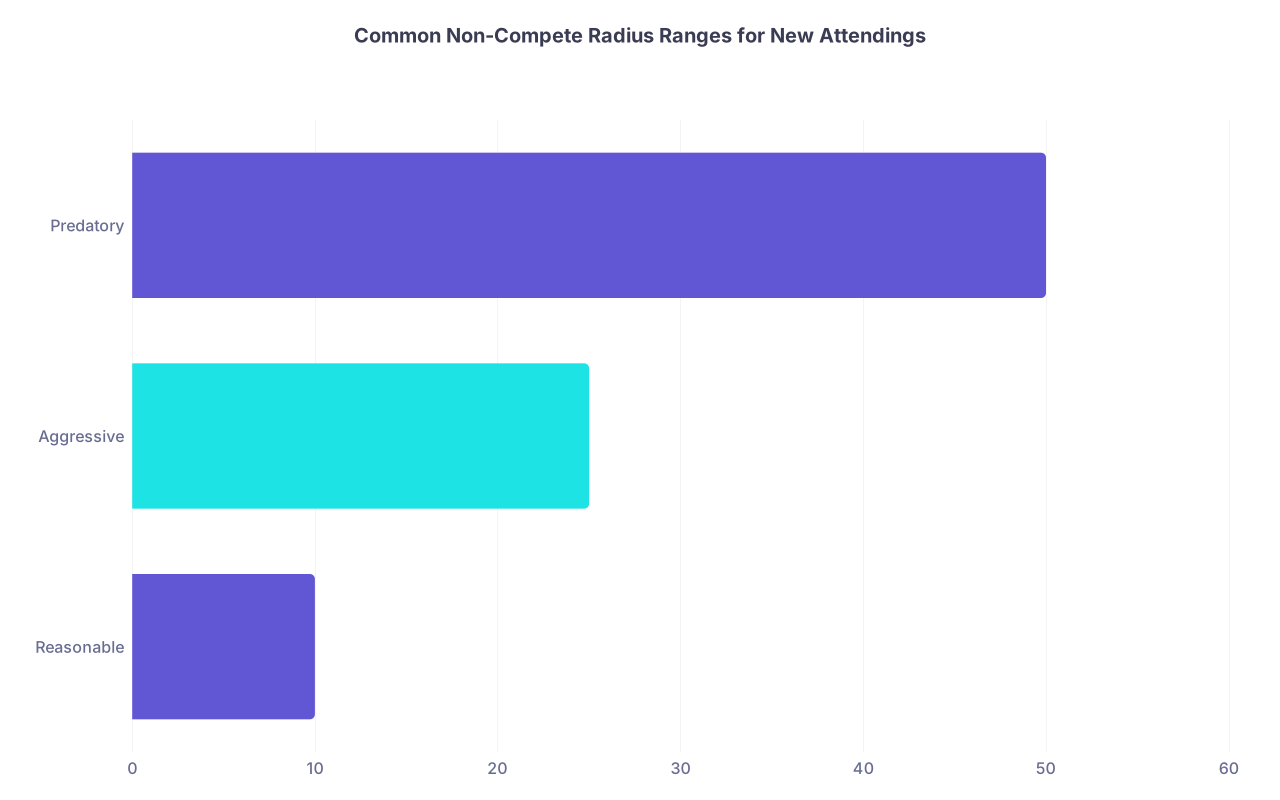
| Category | Value |
|---|---|
| Reasonable | 10 |
| Aggressive | 25 |
| Predatory | 50 |
Red flags you’re about to trap yourself:
- Radius > 15 miles in urban/suburban areas or > 50 miles rural
- Time > 12 months
- Applies after any termination (including layoff or non-renewal)
- Counts future locations, affiliates, “any entity under common control”
- Restricts both employment and independent practice/telemedicine
Biggest mistake: Residents assume, “If I hate it, I’ll just switch groups across town.” Your contract might literally make that illegal.
How to protect yourself:
- Push for:
- 5–10 miles in urban
- 10–25 miles suburban
- 25–50 rural
- 6–12 months duration, not more
- Limit it to:
- Specific named practice sites
- Or your primary clinical site only
- Tie enforceability to who ends the relationship:
- No non-compete if they terminate you without cause
- No non-compete if you leave for cause (they breach, unsafe practice, etc.)
And no, “Everyone signs this” is not a justification. It’s a script.
2. The “Competitive” Salary That Never Actually Materializes
The starting salary looks great. Until you discover it’s a teaser rate, or it’s tied to impossible RVU targets, or “productivity bonus” is a myth like Bigfoot.
Common trap patterns:
Short guarantee period
12–24 months of “base salary,” then you drop to pure RVU comp you do not control.Unrealistic RVU thresholds
They quote MGMA 75th percentile numbers but don’t tell you their clinic flow supports 40th percentile volume.Opaque “discretionary” bonuses
Translation: leadership decides when you’re “a team player” and when the budget is “too tight.”
| Component | Trap Contract | Reasonable Contract |
|---|---|---|
| Guarantee Length | 12 months | 24–36 months |
| Year 2 Compensation | Pure RVU, no floor | Lower base + RVU with floor |
| RVU Target | 8,000 for full bonus | 5,500–6,000 for full bonus |
| Data Transparency | No written benchmarks | MGMA data & internal averages |
| Reconciliation | Annual, employer-favorable only | Clear upside & downside rules |
Silent killer: “Reconciliation” language.
You think guarantee = safety. They may claw back overpayments if your RVUs don’t justify what they paid.
I’ve seen a hospital system hand a new attending a $40k “you owe us” bill after year one. That’ll ruin a young family very quickly.
What you must get in writing:
- Length of guarantee (24–36 months is safer for first jobs)
- Exact RVU target numbers and conversion factor (e.g., $55/RVU)
- Whether there is any downside reconciliation—and cap it or delete it
- Whether the base drops after guarantee and to what amount
- Exactly how and when bonuses are calculated and paid
Don’t accept hand-wavy words like “competitive,” “market-based,” “aligned to MGMA.”
If they won’t put the numbers on paper, assume the numbers will not favor you.
3. The “Standard” Call Schedule That Becomes Your Whole Life
Call is where the glossy brochure fantasy dies.
Every recruiter says the same thing:
- “Shared evenly”
- “Very manageable”
- “Typical for the specialty”
Then you sign. Suddenly, two partners retire, one goes on extended leave, and the locums budget “disappears.” You’re covering 1:3 call with no additional pay.
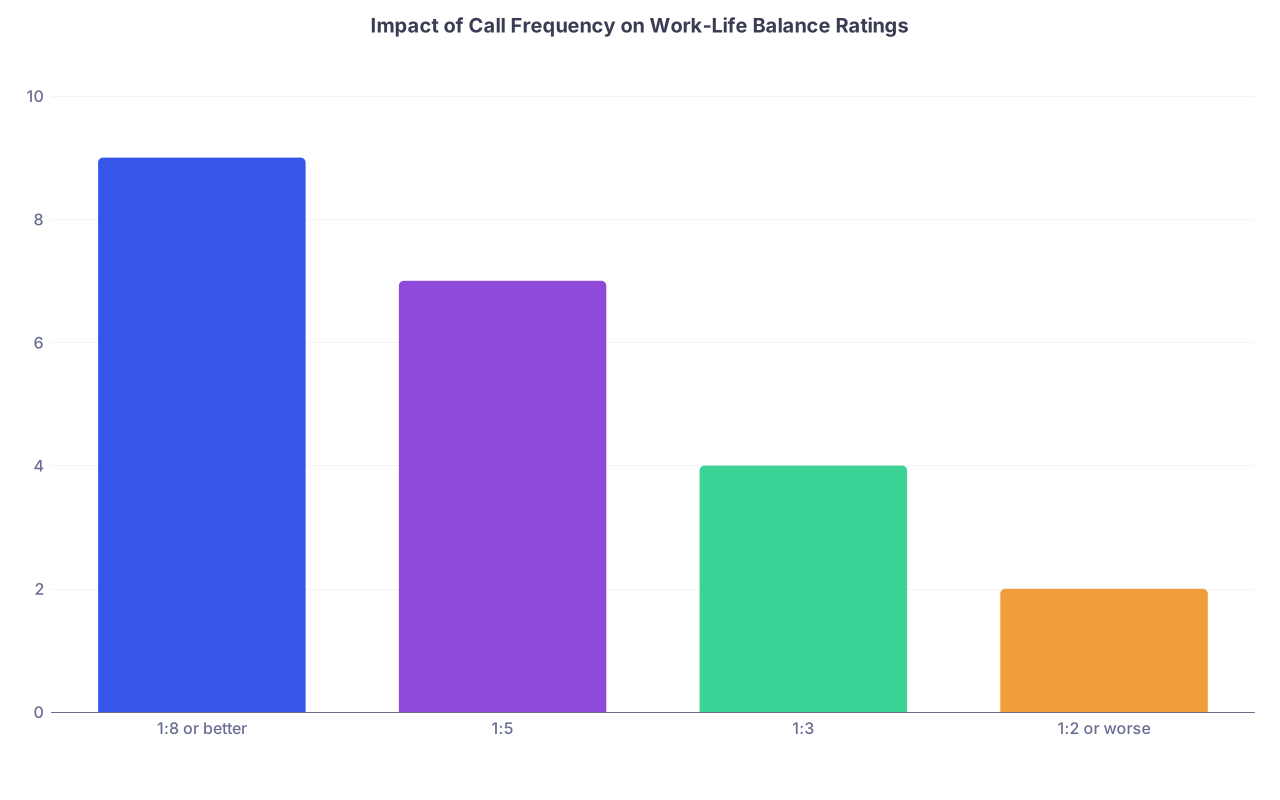
| Category | Value |
|---|---|
| 1:8 or better | 9 |
| 1:5 | 7 |
| 1:3 | 4 |
| 1:2 or worse | 2 |
Call clause traps I see all the time:
No specific ratio or maximum call frequency
Just: “as assigned by the group” or “equitable as determined by employer.”No extra pay for extra call
So when coverage shrinks, you absorb the load for free.Mandatory q4 or worse in writing with no escape clause
In hospitalist, OB, surgery, EM—this burns people out fast.Mandatory holiday coverage with no compensation or comp time
Questions you absolutely need answered in writing:
- What is my starting call ratio (e.g., 1:6 weekday, 1:8 weekend)?
- What triggers call pay? Extra call beyond what baseline?
- Is there a written cap on number of calls per month?
- What happens if the group shrinks (retirements, quits, FMLA, new sites)?
- Who covers unassigned or uncovered shifts? At what rate?
Do not accept: “We don’t usually put that in the contract; we handle it internally.”
Internal = changeable. Contract = leverage.
4. The “Without Cause” Termination Clause That Only Works One Way
Most new attendings think “without cause termination” is just legal boilerplate. It’s not. It determines how trapped you are.
Typical wording: either party may terminate without cause with 90–180 days’ notice.
So far, fine.
The traps hide in the details:
Asymmetrical rights
Employer can terminate you without cause on 60 days’ notice.
You must give 180–365 days if you want to leave.Tied to non-compete
Even if they fire you without cause, your non-compete still fully applies. Madness.Automatic termination for credentialing issues
Lose hospital privileges (for politics, not poor care)? Automatically fired with immediate non-compete enforcement.

| Step | Description |
|---|---|
| Step 1 | New Attending Signs Contract |
| Step 2 | Short notice, full non-compete |
| Step 3 | Long notice, full non-compete |
| Step 4 | Limited ability to work locally |
| Step 5 | Stuck working under bad conditions |
| Step 6 | Who ends job |
Nasty little add-ons:
- Liquidated damages if you leave early (e.g., fixed penalty fee)
- Requirement to pay back signing bonus, relocation, CME if you depart before X years
- No tail insurance if termination is “for cause” (which they define broadly)
What you want instead:
- Symmetric no-cause termination: same notice for both sides (60–90 days is reasonable)
- Non-compete not enforceable if:
- They terminate you without cause
- They materially breach contract and fail to fix it
- Reasonable, clearly defined “for cause” list (e.g., loss of license, DEA revocation, documented gross misconduct)
- Pro-rated or time-limited repayment of bonuses/relocation, not all-or-nothing
If the clause reads like they can drop you anytime but you’re welded to them for years, that’s not a partnership. That’s ownership.
5. The Tail Coverage Time Bomb Hidden in One Sentence
This one burns people who absolutely should know better. Residents barely think about malpractice at all. New attendings think, “Employer covers me, so I’m fine.”
Wrong. The question is: who covers you after you leave?
If the job uses claims-made coverage (most private practices, many hospital groups), you need “tail coverage” when you exit. This pays for claims that arise after you leave for care you provided during employment.
Tail can cost:
- 150–300% of your annual premium
- Often $30k–$80k depending on specialty and risk
- More for OB, surgery, EM, anesthesia
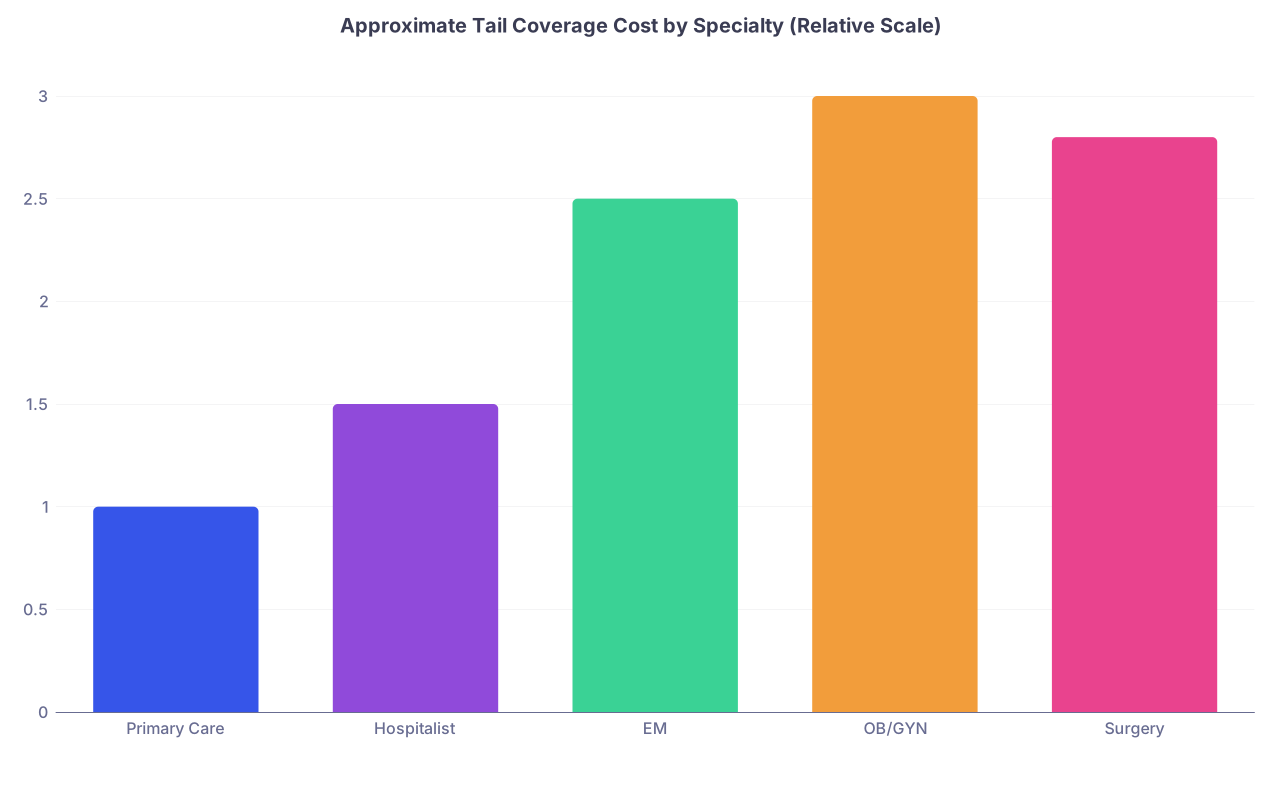
| Category | Value |
|---|---|
| Primary Care | 1 |
| Hospitalist | 1.5 |
| EM | 2.5 |
| OB/GYN | 3 |
| Surgery | 2.8 |
Classic trap language:
- “Employer shall provide malpractice insurance during the term of this Agreement. Upon termination, Physician shall be responsible for securing and paying for any extended reporting endorsement (tail coverage).”
One line. You might skim right over it. But that’s a used-car-level bill waiting for you at the exit.
Worse variants:
- Tail required even if they terminate you without cause
- Tail required even if they breach and you leave for cause
- No specification of claims-made vs occurrence (so you don’t realize tail is even an issue)
Safer setup:
- Employer pays tail if:
- They terminate you without cause
- They non-renew your contract
- Cost sharing or split responsibility if you leave voluntarily before a set time:
- Example:
- Year 1: you pay 100%
- Year 2: you pay 50%
- Year 3+: employer pays 100%
- Example:
- Or best of all: occurrence-based coverage (no tail needed, but usually lower salary to compensate)
If you do not explicitly understand how what you’re signing will handle tail coverage, you’re gambling with tens of thousands of dollars you don’t have yet.
6. The “We Own Your Life” Moonlighting & Outside Work Restrictions
First-job contracts increasingly contain non-moonlighting, non-solicitation, and “intellectual property” clauses that are way too broad for what you’re actually doing.
Let’s be blunt: some systems write these like they own you, not just your job.
Common overreaches:
Total ban on any outside work, even if:
- It’s non-clinical
- It’s in another state
- It’s a medical-legal consult on your own time
- It’s a side business unrelated to medicine
All intellectual property created while employed belongs to them
That little side app you’re coding? That textbook chapter? That course? Legally theirs, if you’re not careful.No moonlighting even within the same health system
So you can’t pick up an extra shift in the ED or at an affiliated hospital for extra cash.

Why this matters:
Early-career attendings often need:
- Additional income (student loans, new mortgage, kids)
- Diverse experience (locums, telemed, urgent care)
- Freedom to build side projects that may become bigger later
If you ever want:
- To start a practice
- To build a consulting business
- To create educational content …and your employer owns all your “inventions” and “works of authorship,” you’re building on their land, not yours.
Contract language to demand:
Reasonable outside work allowed if:
- It doesn’t interfere with your primary job
- It doesn’t compete directly within the non-compete radius
- It doesn’t use employer resources or staff without agreement
IP clarification:
- Employer owns what you create using their resources or as part of defined duties
- You own everything else, especially:
- Materials created on your own time, on your own equipment
- Projects outside the specific scope of employment
Explicit permission for:
- Academic writing, speaking, teaching
- Professional societies, guideline committees
- Reasonable consulting work
If they’re trying to own your nights, weekends, and ideas forever, that’s not a job; that’s feudalism.
7. The Vague “Duties” Clause That Lets Them Triple Your Workload
You’d think your job duties are obvious: see patients, maybe some call, some admin. But what your contract says controls what they can jam into your schedule later.
This is where I see people get slowly buried.
Watch for language like:
- “Physician shall perform such duties as are reasonably assigned by Employer”
- “Including but not limited to clinical care, call, administrative, teaching, and outreach responsibilities as determined by Employer”
Sounds flexible. Translates into:
- Adding clinic sessions without compensation
- Mandatory outreach clinics 60–90 minutes away
- Committee overload, “quality projects,” EMR build work, all unpaid
- Suddenly becoming the program director or department chair with no protected time

| Step | Description |
|---|---|
| Step 1 | Start Job |
| Step 2 | Clear clinic + call |
| Step 3 | Vague duties language |
| Step 4 | Extra clinics added |
| Step 5 | New admin roles |
| Step 6 | Burnout and reduced autonomy |
Particularly dangerous in academic or hybrid jobs:
- “75% clinical, 25% academic” with no defined FTE
- No guarantee of protected time
- No clarity on how academic promotion or RVU expectations adjust
So you end up at 100% clinical, plus research, plus teaching. On “your own time.”
What you want in the contract:
Specific clinical expectations:
- Sessions per week
- Half-days or FTE
- Inpatient vs outpatient breakdown
Specific non-clinical expectations with time assigned:
- X hours/week for admin
- Y hours/week for teaching or research
Any material changes to duties require:
- Mutual agreement
- Or written notice and your right to decline or renegotiate
If they want “flexibility,” that’s fine. Put limits around that flexibility. Otherwise, you’re promising to do “whatever we say” for the same check.
Quick Comparison: Safe vs Risky First-Job Contract Patterns
| Area | Safer Pattern | Risky Pattern |
|---|---|---|
| Non-compete | 5–15 mi, 6–12 mo, limited sites | 25–50+ mi, 18–24 mo, all current/future sites |
| Compensation | 2–3 yr guarantee, clear RVU, no clawback | 1 yr guarantee, vague RVU, reconciliation against you |
| Call | Written ratio, extra call pay, clear cap | “As assigned,” no pay, no limit |
| Termination | Symmetric notice, NC waived if fired | Short notice for them, long for you, NC always applies |
| Malpractice | Employer covers tail in most exit scenarios | You always buy tail, even if they fire you |
| Moonlighting | Reasonable non-compete, side work allowed | Total ban, broad IP/ownership language |
| Duties | Defined FTE and roles, change needs consent | “As assigned,” unlimited admin/clinic creep |
How to Not Get Rolled on Your First Contract
You cannot “trust” your way out of a bad contract. You can only negotiate and walk away if they will not fix the worst parts.
Bare minimum steps to not make the common mistakes:
Get a physician-focused contract attorney.
Not your cousin who handled your home purchase. Someone who reads physician contracts weekly and knows local norms.Refuse to feel rushed.
“We need this back in 48 hours” is a pressure tactic. Say you’re having it reviewed. If they punish you for that, that’s data: don’t work there.Negotiate the structural stuff, not just the money.
The traps are:- Non-compete
- Termination
- Tail
- Duties
- Call
Then worry about the signing bonus.
Know your walk-away points.
For example:- Non-compete > 20 miles urban → no
- You always pay full tail → no
- Vague duties + heavy call + weak pay → no
If a place truly values you, they’ll be flexible on unreasonable clauses. If they won’t budge on anything, that’s exactly how they’ll treat you when you’re stuck there.

Final Takeaways
- The shiny parts of a first-job offer—salary, bonus, location—are not what ruin people. It’s the fine print: non-compete, tail, duties, and termination.
- If a clause gives them sweeping flexibility and gives you nothing concrete in return, assume they’ll eventually use that flexibility in their own favor, not yours.
- Spend real time and a little money getting your first contract right. It’s cheaper than paying for tail, moving your family twice, or spending two years in a job you should’ve never signed for.