
The real reason so many junior faculty burn out or get pushed out by year three is simple: the job you’re sold and the job you’re evaluated on are not the same job.
What you’re promised: “protected” time, mentorship, a path to promotion, and a culture that “values wellness.”
What actually happens: you’re hired to solve their coverage problem, then judged on grant dollars and publications you were never truly given the time or support to produce. And by the time you realize the game you’re in, your clock is already ticking.
Let me walk you through what really happens on the inside.
The Hidden Contract You Never Signed
Faculty offers look formal, but the real agreement is informal and mostly unwritten. Chairs and division chiefs know exactly what they need from you in years 0–3, and it’s not “develop as a scholar.”
They care about three things, in this order:
- Service coverage and RVUs
- Bringing in money (grants, clinical revenue, industry)
- Reputation metrics (publications, patient satisfaction scores, awards)
They’ll talk endlessly about mentorship and academic growth. But when budgets get tight, when someone goes out on maternity leave, when a senior faculty member negotiates out of call? Your “protected time” is the first thing sacrificed. And they do it with a straight face.
Here’s the part people do not say out loud: many departments assume 30–50% of junior faculty will not make it to promotion anyway. You are, in their mind, semi-disposable. A three- to five-year solution to a service problem. If you succeed academically, great. If you burn out or leave? They’ll backfill with the next eager fellow.
I have sat in those closed-door meetings. I’ve heard the phrases:
- “We just need them to cover nights for a few years.”
- “If they’re really academic material, they’ll rise above.”
- “We’ll see who pans out.”
That’s the backdrop to your “dream job.”
Year 1: The Bait-and-Switch on “Protected Time”
Year one looks good on paper. Maybe you start at 0.4 FTE research / 0.6 clinical. Or “one full day a week” of academic time. That’s the sales pitch.
Here’s how it actually plays out.
You arrive. The schedule is already built. The service is short. The division chief comes to you in month two:
“Just for this year, can you help us cover Wednesdays? Once we’re fully staffed, we’ll protect your research day again.”
You say yes because you’re new, you want to be a team player, and your mentorship talk is still fresh in your mind.
Your “0.4” FTE research becomes:
- Morning meetings that mysteriously land on your “protected” day
- Trainees needing supervision during your “research” blocks
- Committee work because “you’re the junior person with more flexibility”
And the hours you actually have left for research? Nights and weekends. Which you do, for a while, because you’re used to suffering from residency and fellowship. You assume this is temporary.
Here’s the insider truth: whatever clinical load and non-promotable tasks you accept in the first 6–12 months will become your baseline. The system has no mechanism to spontaneously hand you back that time. Once they see you can carry that 1.0 FTE clinical load or take that extra clinic, they’ll build next year’s budget around it.
You think you’re proving yourself. What you’re actually doing is resetting their expectation of how much free labor they can extract from you.
The Evaluation Mismatch: What You’re Measured On vs What You’re Asked to Do
Here’s where people get blindsided around year two or three. You spend your first two years being the “go-to” person. Filling gaps. Picking up extra shifts. Being told “we really appreciate how flexible you’ve been.”
Then your first serious faculty review happens. Sometimes it’s called a “third-year review,” sometimes an annual review with teeth. Suddenly the tone shifts.
Now you’re being evaluated on:
- Publications per year
- Grant submissions and funding track record
- Teaching evaluations and “educational output”
- Evidence of “trajectory toward promotion”
And you’re sitting there thinking: I was on service 18 weeks last year, I covered extra call, I took every student and resident, and I wrote two case reports on my own time. How is that not enough?
On the other side of the table, I promise you, there are comments like:
- “They’re a solid clinician, but I’m not seeing the academic drive.”
- “They don’t seem to have a clear scholarly focus.”
- “I’m concerned about their promotion trajectory.”
No one is connecting your lack of output to the fact that they’ve systematically bled away your time. They act like your CV is a reflection of your talent and work ethic, not of the structure they built around you.
This is the core mismatch that destroys people. You’re rewarded day-to-day for clinical heroics and “helping out,” but your career is judged on the work that requires uninterrupted, protected time. You’re being incentivized and evaluated in opposite directions.
The Quiet Politics That Decide Who Gets Pushed Out
People like to imagine faculty outcomes are primarily about merit. They are not. They’re about alignment and politics. Especially by year three.
Here are the questions people are asking about you in promotion and planning meetings that no one repeats to your face:
“Are they easy to work with?”
Translation: Do they say yes when we need coverage and avoid causing administrative headaches?“Whose person are they?”
Translation: Which senior faculty or powerful mentor is willing to go to bat for them?“Are they on a path to bring in money?”
Translation: Are they realistically going to land grants or generate RVUs above their salary cost?“Could we replace them easily?”
Translation: Is there a fellow or external candidate waiting who’d be cheaper or hungrier?
You do not hear this. What you hear is: “We’d like to see more scholarly output before we can support promotion.” Or, worse, silence—no feedback at all until your contract is quietly not renewed.
The faculty who survive—who get real protection and support—usually have at least one senior person who has decided, often by year one, “They’re one of ours.” That’s what changes the calculus.
Without that, you become a utility player. Useful, appreciated, supposedly “valued.” And utterly expendable.
The Real Burnout Drivers (It’s Not Just “Too Busy”)
Burnout among junior faculty is not just about the long hours. Residents do more hours and don’t crack the same way. What breaks people is the combination of three things:
Loss of control
Your schedule changes with minimal warning. Your “protected time” is negotiable. Projects you start grind to a halt because some committee restructured. You can’t plan your week, much less your life.Identity mismatch
You thought you were an academic. A clinician-scientist. An educator. But your actual day is 90% throughput and 10% paperwork. After a couple of years, you start wondering if the problem is you. Maybe you’re not cut out for real scholarship. That self-doubt is corrosive.Invisible work with no credit
You spend hours on “academic” work that does not move your CV:
- Internal QI projects with no plan for publication
- Endless revisions on clinical pathways
- Teaching that is not documented or aggregated properly
- Committee roles that no one outside the committee cares about
You’re working constantly and still “underperforming” by the metrics that matter for promotion. That’s an exquisitely demoralizing experience.
This is how you end up with 32-year-olds saying things like, “I’m just tired of medicine” when what they’re actually tired of is playing a rigged game with no clear rules.
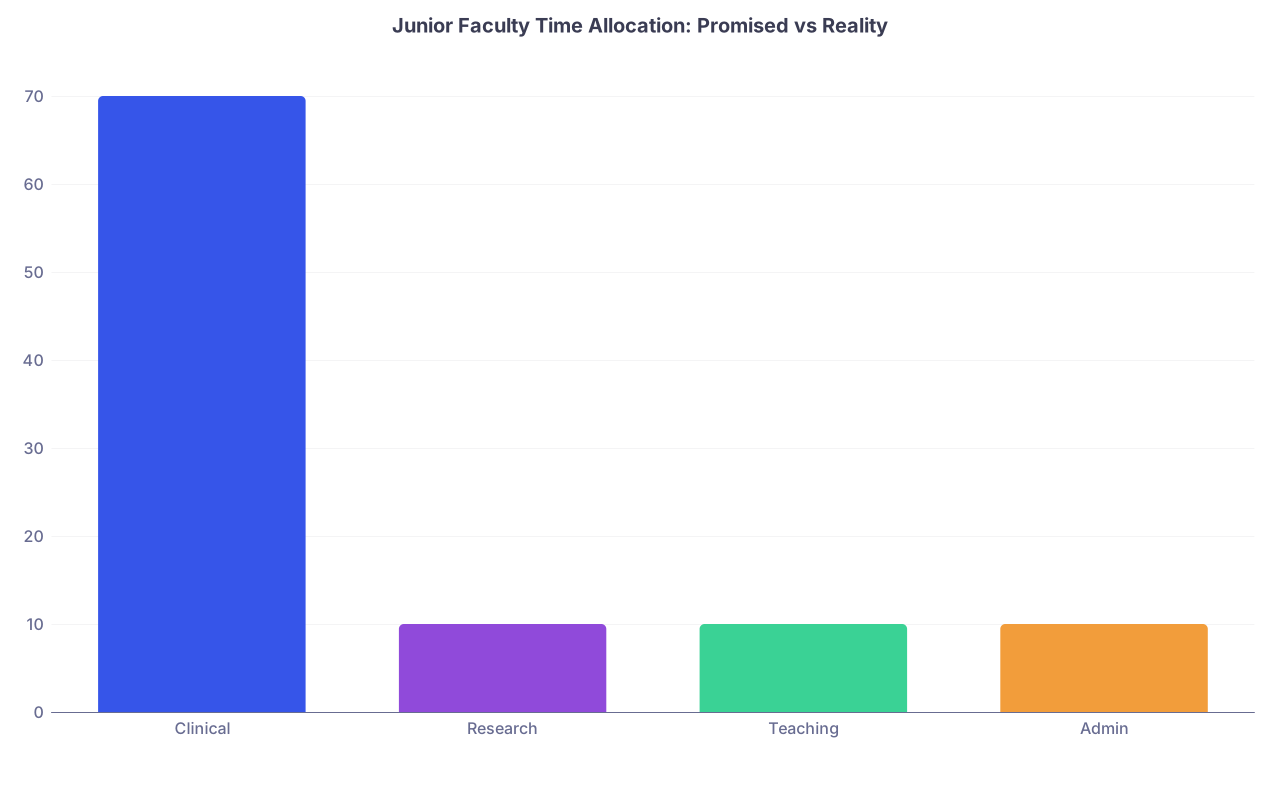
| Category | Value |
|---|---|
| Clinical | 70 |
| Research | 10 |
| Teaching | 10 |
| Admin | 10 |
(What’s advertised: 50/30/10/10. What I actually see by year two looks a lot more like the chart above.)
The Structural Traps that Force People Out by Year 3
By the third year, several structural traps converge. If you’re not aware of them from day one, they sneak up on you.
The Soft-Money Trap
Any job with significant “soft money” expectations (grant-funded salary) puts a timer on your head. You might start at 70% hard money, 30% soft. The message is usually:
“We’ll cover you for the first 2–3 years while you get your grants going.”
Translation: By year three, they expect clear evidence you’re grant-viable. That means:
- At least one serious (R01-level or equivalent) submission, even if unfunded
- Some small or foundation grants, pilot awards, or career development applications
- A publication record that makes your future funding plausible
If you spend those first two years drowning in service and “small” projects that never lead to submissions, you hit that third year with:
- No grant submissions
- Maybe 1–2 low-impact papers
- No clear funding pipeline
At that point, the internal conversation becomes: “We can’t keep carrying this line indefinitely.”
That’s how people get pushed toward “more clinical” roles which are then coded as “not on promotion path,” or simply told their contract will not be renewed when the current cycle ends.

The “Good Soldier” Trap
Another pattern I have seen over and over: the junior faculty member who is too good at saying yes.
They:
- Take extra call
- Cover colleagues’ clinics
- Serve on every ad hoc committee
- Volunteer for “new initiatives” that sound exciting but have no clear academic output
They become the department’s shock absorber. Everyone likes them. Chairs say things like, “We’d be lost without them.”
Then, during review:
- “They’re so valuable clinically, I worry research is not realistic for them.”
- “They haven’t developed a coherent academic niche.”
Instead of giving them the kind of hardcore protection and advocacy that could salvage their academic path, the institution quietly reclassifies them (mentally) as “primarily clinical.” Translation: no serious investment, replaceable over time.
By the time the person realizes this, they’re already exhausted and demoralized. Many leave voluntarily at that point, usually thinking the problem is them rather than the system.
The Invisible Rubrics
The standards for “on track” are rarely clearly communicated. You might hear informal things like “aim for 2–3 papers per year.” That’s not a rubric. That’s a soundbite.
Behind closed doors, I’ve heard much more specific (and unforgiving) benchmarks discussed:
| Domain | Quietly Expected by Year 3 |
|---|---|
| Publications | 5–8 total, with 2–3 as first/senior |
| Grants | 1–2 major submissions, plus pilots |
| Teaching | Documented roles + 1–2 innovations |
| National Role | Abstracts, panels, or committee |
| Reputation | At least regional name recognition |
Do people make exceptions? Yes. For the ones they’ve already decided to champion. For everyone else, these whispers become the bar used to justify why “it’s not quite enough to support promotion” or why “we can’t justify renewing the current track.”
If no one is telling you where your current trajectory sits against those unwritten standards by the end of year one, that’s a warning sign.
The Mentorship Mirage
On paper, you have a “primary mentor” and maybe a “mentoring committee.” Half the time, this is a check-the-box exercise to satisfy some institutional requirement.
Signs the mentorship structure is fake:
- Your mentor is too senior and too busy, and you meet twice a year for coffee
- There’s no specific timeline for tangible outputs (paper submitted, grant submitted)
- No one is willing to say “Drop that” when you take on low-yield work
- They talk about “broad exposure” more than concrete deliverables
Real mentorship in the first three years is brutally practical:
- “These are the 2–3 projects you should actually do.”
- “Say no to that committee; it won’t count.”
- “This question is fundable; that other one is just interesting.”
- “If you don’t get X by month Y, we need to pivot your role.”
Without this, you drift. Busy, tired, and somehow still behind.

| Step | Description |
|---|---|
| Step 1 | Start Junior Faculty |
| Step 2 | Service Heavy Clinician |
| Step 3 | On Track Academic |
| Step 4 | Busy but Stalled |
| Step 5 | Burnout or Role Shift |
| Step 6 | Promotion Path |
| Step 7 | Protected Time Honored |
| Step 8 | Real Mentor Champion |
The Subtle Ways People Get “Pushed Out”
Being pushed out is rarely dramatic. Institutions hate conflict. They prefer drift, hints, and “mutual decisions.”
Typical patterns:
The Contract Cliff
Your contract is “up for renewal” at year three. Suddenly, there’s talk of “restructuring” your role, or shifting you to a pure clinical line with no promotion expectations. It’s framed as a choice. It is not.The Opportunity Starvation
You notice others are getting invited to be on grants, join multi-site studies, give talks. You are not. You’re told, “We just assumed you were too busy clinically.” That isolation is often a prelude to exit.The Soft Exile
You get moved to a satellite clinic, or heavier community coverage, “to help grow that site.” Your academic activity predictably plummets. A year later: “It seems like your focus has become primarily clinical.”
Almost no one will say the quiet part out loud: we don’t see you as a long-term academic investment, so we’re reallocating resources and waiting for you to either accept a downgraded role or leave.

The Moves That Actually Protect You
This is the part people usually water down. I won’t.
If you’re in years 0–3, the single most important task isn’t “work hard.” It’s to make your daily work align with the metrics that will matter when they decide whether to invest in you or discard you.
A few concrete, un-pretty truths:
Saying yes to extra shifts is a short-term reputation boost with long-term career cost. You need a hard internal limit. Above that, the answer is no unless something else of equal size comes off your plate.
At any moment, you should be able to point to 1–2 “anchor” projects that clearly lead to either a strong paper or a fundable grant question. If you cannot, you’re in busywork land.
Mentors who are nice but vague will ruin you. You need at least one person willing to say, “If you keep doing what you’re doing, you will not be promoted here.”
Protecting time is not about Outlook blocks on your calendar. It’s about getting political cover so that when someone tries to schedule over that time, another powerful person pushes back for you.
You know who gets that kind of cover? The people a senior faculty member has explicitly claimed as “my junior.” If no one has done that for you by the end of year one, that should light a fire under you.
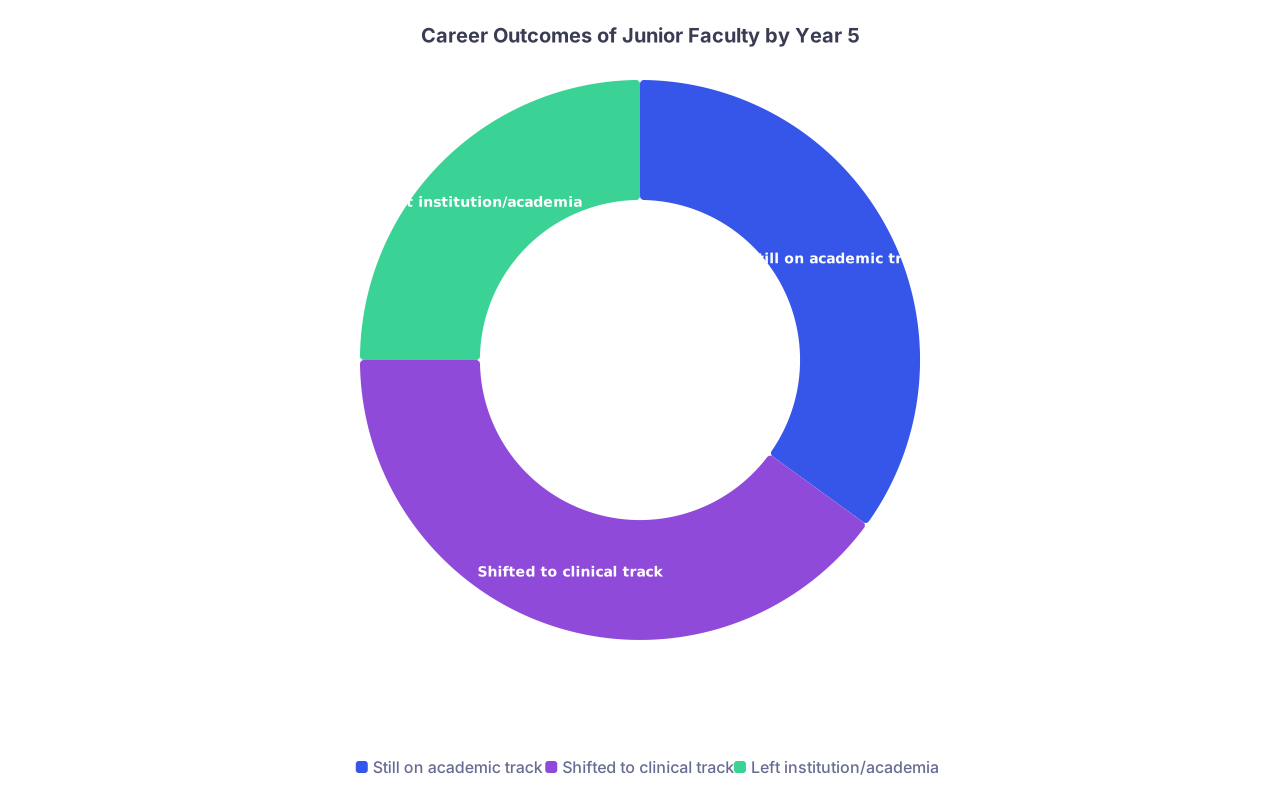
| Category | Value |
|---|---|
| Still on academic track | 35 |
| Shifted to clinical track | 40 |
| Left institution/academia | 25 |
The actual numbers vary by institution, but the pattern in that chart is real. A minority stay truly on the academic track they imagined. The rest slowly drift or are nudged elsewhere.
When Leaving Is Not Failure
Here’s another reality most insiders will only admit off the record: sometimes the healthiest and smartest move is to recognize the game at your institution is unwinnable for you and walk.
Not because you’re weak. Not because you “couldn’t hack it in academics.” But because the structure you’re in was never set up to let more than a few junior people truly succeed.
I’ve seen people leave “failed” academic jobs and go on to:
- Do high-level, impactful work in community settings with more control over their lives
- Join industry roles where their skills are appreciated and fairly compensated
- Return to academia later at a place that actually invested in them from day one
Ten years later, the ones who are okay aren’t the ones who clung longest to a broken setup. They’re the ones who read the signals early and refused to spend their thirties trying to prove themselves to an institution that had already quietly decided against them.

Years from now, you won’t remember the exact language of your third-year review letter. You’ll remember whether you learned to see the system clearly and made courageous choices based on reality, not on the story you were sold on interview day.