
The worst career moment of your life can become the best thing that ever happened to you—if you treat it like a project, not a personal indictment.
You lost a job. Your contract was not renewed. Maybe you were “not a good fit,” maybe there were “financial constraints,” maybe your new chair decided to “go in a different direction.” I have seen every version of that conversation in hallways, windowless conference rooms, and rushed Zoom calls. The words change. The impact does not.
Here is the blunt truth: your medical career is not over. But your old approach to jobs is. You cannot just “apply more” and hope the sting goes away. You need a structured, ruthless, and practical playbook.
This is that playbook.
Step 1: Stabilize Your Immediate Risk (First 2 Weeks)
Before you start rewriting your narrative or blasting your CV everywhere, you need to protect your basics: money, license, reputation, mental bandwidth.
1. Get Clear on the Facts—In Writing
Verbal explanations are useless when emotions are high and memories get fuzzy. You want records.
Ask (calmly, in writing if possible):
- What is the official reason for non-renewal or termination?
- What will be documented in HR records?
- What will be shown in verification letters to future employers and credentialing bodies?
- What is the last day of employment and last day of benefits (health, malpractice, disability, life insurance)?
- Will the organization respond to reference checks, and if so, how?
You are not arguing right now. You are gathering data. Think like a lawyer building a file.
If they are vague (“restructuring,” “performance concerns”), ask politely for clarification. Sometimes they back off sharp language if they know it will be on paper.
2. Read Your Contract Like a Litigator
Do not skim. Sit down with a pen and mark it up.
Look for:
- Termination clauses: “without cause,” “for cause,” and notice requirements.
- Severance: amount, conditions, and whether it is contingent on a release.
- Restrictive covenants: non-compete radius and duration, non-solicitation of patients or staff.
- Tail coverage: who pays for malpractice tail and under what conditions.
- Repayment clauses: sign-on bonus, relocation, loan repayment, CME, or retention bonuses.
- PTO payout: how unused vacation is handled.
- Arbitration / dispute resolution: what recourse exists.
If the language is thick and full of landmines, get a physician-contract lawyer. Not your cousin who does real estate. A real healthcare employment attorney.
3. Protect Cash Flow Immediately
You cannot think clearly about long-term strategy when you are panicking about rent or your kid’s tuition.
Do three things:
- Build a 3–6 month financial runway plan.
- List current savings and accessible funds.
- List all recurring expenses.
- Cut nonessential recurring costs today. Not in three months.
- Apply for unemployment if eligible.
- Many physicians never consider this. If you were an employee (W-2) and not fired “for cause” under state rules, you may qualify.
- Inventory potential short-term income.
- Locums
- Telemedicine
- Per diem urgent care / ED shifts
- Chart review / utilization management
You are not “above” any of these. You are buying time and leverage.

| Category | Value |
|---|---|
| Locums Hospitalist | 200 |
| Telemedicine | 120 |
| Urgent Care Per Diem | 160 |
| Chart Review | 110 |
| Clinic Moonlighting | 150 |
4. Damage Control on Reputation
You cannot control what leadership says behind closed doors, but you can control your side of the story.
Do not:
- Vent on social media.
- Send emotional emails to colleagues.
- Threaten litigation to everyone in earshot.
Do:
- Tell a small circle of trusted colleagues the situation, calmly and honestly.
- Ask 2–4 of them (especially senior, respected physicians) if they would be willing to serve as references focusing on your clinical performance, reliability, and teamwork.
- Document any clear misrepresentations or retaliatory behavior privately for potential legal review.
You are preserving reference capital. You will need it.
Step 2: Rewrite Your Narrative Before It Writes You
If you do not define your story now, programs and employers will define it for you. And they will default to the worst-case scenario.
1. Craft a Clean, Controlled Explanation
You need three versions of your story:
One-sentence version (for casual questions):
“My previous group decided not to renew my contract after a restructuring that shifted their priorities, and I am now looking for a role that aligns better with my clinical strengths and goals.”Two–three sentence version (for recruiters, screenings):
“My contract was not renewed due to a combination of leadership changes and shifting expectations around RVU production that were not aligned with the original role I was hired into. I received strong patient feedback and positive evaluations from colleagues, but the practice model changed significantly. I am now focusing on positions where the expectations, support, and metrics are clearly defined from day one.”Deeper version (for live interviews):
- What you were hired to do
- What changed (volume expectations, leadership, call, scope)
- Points of friction or mismatch
- What you learned and what you would look for / clarify up front in your next role
Key rules:
- No trashing individuals or institutions.
- No self-immolation.
- You accept partial responsibility for fit, not for being a bad doctor.
2. Identify the Real Problem Under the Surface
Most non-renewals are not random. Common root issues I have seen:
- RVU or productivity expectations were unrealistic.
- You were not aligned with the culture (old guard vs new, academic vs RVU-driven).
- Weak onboarding → poor performance metrics early on.
- Documentation / coding issues that looked like low productivity.
- Communication problems with nursing or administration.
- Hidden quality or safety concerns that were never clearly addressed until too late.
Write it down brutally honestly for yourself, not for employers:
- “I underperformed on RVUs because I did not understand the expectations and did not ask enough questions.”
- “I clashed with leadership because I assumed autonomy I did not have.”
- “I ignored early feedback because I thought they would adapt to my style.”
Why? Because the next job is where you fix those patterns.
3. Decide Your Target Direction Before You Spray Applications
There are five broad paths for displaced physicians:
- Same job, better setting
- Same specialty and scope; different group/hospital/city.
- Modified clinical role
- Same specialty but different emphasis (e.g., inpatient only, outpatient only, telehealth dominant, academic vs community).
- Shift in specialty niche
- Example: Hospitalist → SNFist, ED fast track, observation medicine, post-acute care.
- Hybrid clinical–nonclinical
- Medical director roles, quality, informatics, utilization management, leadership-track jobs.
- Nonclinical pivot
- Industry (pharma, devices, informatics), insurance/UM, consulting, full-time telemedicine, etc.
Your next steps depend on which of these you are aiming for. Do not try to chase all five at once.
Step 3: Fix the Paper Trail—CV, References, Digital Footprint
Your paperwork is now under heavier scrutiny. You can still turn it into a strength.
1. Clean, Specific, and Honest CV
Make the timeline crystal clear. Do not try to hide gaps or the non-renewed role.
Structure:
- Education and training (reverse chronological).
- Employment history with:
- Exact dates (month/year).
- Clear titles.
- Scope of practice (e.g., “Outpatient internal medicine, 18–22 pts/day, no inpatient”).
- Leadership, committees, teaching.
- Quality or productivity metrics (only if they help you).
- Licensure and certifications.
If the role was short (e.g., 9 months), you still list it. Omitting it looks worse when credentialing checks see it later.
2. Build a Reference Arsenal
You need at least:
- 1–2 attending or departmental leaders from training.
- 1–3 colleagues from the non-renewed job (who will speak positively about your clinical competency and professionalism).
- If possible, 1 non-physician leader (nursing manager, practice manager) who respected you.
Prep them:
- Tell them directly your contract was not renewed.
- Share the language you are using to describe it.
- Ask them honestly what aspects they feel comfortable endorsing (clinical skills, teamwork, reliability, teaching, communication).
Respect boundaries. You want advocates, not grudging “well, yes, technically they worked here” people.
3. Scrub and Strengthen Your Online Presence
At minimum:
- LinkedIn up to date with:
- Clear headline (e.g., “Board-Certified Internist | Hospital Medicine | Quality Improvement”).
- Brief summary that emphasizes skills, interests, and what you are looking for next.
- No public rants about your former employer.
- Any physician-rating or patient-comment sites: check for anything catastrophic. You cannot erase most of them, but you need to know what is there in case someone asks.
Step 4: Build a Short-Term Bridge While Hunting the Right Role
You need time and leverage. A short-term bridge job is not failure. It is a tool.
1. Locums as Strategic Move, Not Random Filler
Locums gets dismissed by some academic types as “temporary” or “low prestige.” Ignore them. When you are displaced, locums can:
- Stabilize your income.
- Extend your runway.
- Expose you to different systems and practice models.
- Sometimes turn into permanent offers.
Look for:
- Assignments that match your skill set so you are not set up to fail.
- Contracts that cover travel, lodging, and malpractice with tail.
- 3–6 month commitments you can renew or leave.

2. Telemedicine and Remote Work
Telehealth is not a toy side gig anymore. For a displaced doc, it can do several things right now:
- Provide flexible income while you interview.
- Keep your clinical hours and recency intact (credentialers like that).
- Open doors to nonclinical transitions (UM, digital health, leadership in virtual care).
Common telemed fields:
- Primary care / urgent care.
- Psychiatry.
- Sleep medicine.
- Weight management / endocrine support.
- Chronic disease management.
Make sure you:
- Understand state licensing requirements.
- Clarify malpractice coverage.
- Ask how they manage quality reviews and documentation expectations.
3. Chart Review, UM, and Advisory Work
Utilization management and chart review often get you closer to industry and insurance roles.
Where to look:
- Major insurers’ careers pages (medical director, UM physician).
- Independent review organizations.
- Tele-review gigs advertised to physicians.
These can be:
- Part-time while you locums.
- A test drive for a full nonclinical career later.
Step 5: The Actual Job Search—High-Yield, Not Panic-Driven
Most displaced doctors fall into the trap of panic applying: 60+ applications, minimal customization, praying something hits. The hit rate is poor and often brings you back into the same kind of job that just spit you out.
You are going to be more surgical.
1. Prioritize Channels That Actually Work
The realistic order of value:
Warm connections
- Former co-residents, attendings, fellowship alumni.
- Senior residents now in practice.
- Faculty who know people across the country.
Targeted outreach to specific groups
- Hospitalist groups in your state.
- Specialty practices that are expanding.
- FQHCs or community health centers.
Physician recruiters
- Reputable firms with actual hospital clients.
- Internal recruiters at specific systems (not just agency spam).
Job boards
- Use them to find names and organizations, then go direct.
| Channel | Hit Quality | Speed | Typical Use Case |
|---|---|---|---|
| Personal Network | High | Medium | Best for trusted, realistic roles |
| Direct Outreach | High | Medium | Specific target locations/systems |
| Internal Recruiters | Medium | Fast | Large health systems, hospital jobs |
| Agency Recruiters | Variable | Fast | Locums, rural, hard-to-fill roles |
| Job Boards | Low | Slow | Market scan, leads for cold emails |
2. Your Outreach Script (Email or LinkedIn)
Stop sending generic “I’m looking for opportunities” messages. Use a tight script:
- Who you are (training, specialty).
- What you are looking for (type of role, location flexible or not).
- Two strengths.
- Neutral, controlled mention of transition (“my previous contract was not renewed after changes in the practice model, and I am now looking for X”).
Example:
I am a board-certified internist and recent hospitalist at [X Hospital], now seeking a stable hospital medicine position in [Region] with clear expectations around schedule and productivity. My clinical strengths are managing high-acuity internal medicine patients and collaborating closely with nursing and case management for safe discharges.
My previous position ended after leadership changes and a shift in practice expectations that were not aligned with the role I initially accepted. I am now focused on roles where metrics, coverage, and support are clearly defined up front. Would you be open to a brief conversation or able to connect me with your hospital medicine lead?
No drama. No oversharing. Just enough context.
3. Screen Jobs as Hard as They Screen You
Your last job burned you. Do not repeat that cycle.
On every serious opportunity, you must ask hard questions:
Volume and expectations
- What is the average patient load per day?
- How many new vs follow-ups?
- Expected RVUs per month/year?
- How many days until “full panel” or full schedule?
Support
- How many MAs/RNs per provider?
- Scribe support or not?
- How are call and cross-coverage handled?
- How is after-hours communication managed?
Onboarding and feedback
- How do you onboard new physicians?
- What metrics are reviewed, and how often?
- How are concerns addressed before contract decisions?
If they get defensive or vague, that is your red flag. Remember: your goal is not just to get hired. It is to not end up in the same spot a year from now.
Step 6: Interviewing When You Have a Non-Renewal in Your History
This is the part that makes people sweat. You will be asked about it. You must be ready.
1. The Question You Will Hear (In Some Form)
- “Can you tell me why you left your last position?”
- “I see you were only there 9 months; what happened?”
- “Why was your contract not renewed?”
Do not ramble. Use a three-part structure:
- Context
- Change / conflict
- What you learned and what you want now
Example:
I joined [Group] with the understanding that I would be working in a [describe practice model] seeing about [X] patients per day with support from [roles].
About six months in, leadership changed, and the practice shifted toward significantly higher RVU expectations, with less support and more call than was originally presented. I tried to adapt, but it became clear to both sides that our expectations were not aligned. The group decided not to renew my contract at the end of the initial term.
What I took from that experience is the importance of getting very clear, up front, about volume expectations, support staff, and how performance is evaluated. That is why I am asking detailed questions now, and why I am particularly interested in your group’s approach to onboarding and feedback.
Notice:
- You did not badmouth anyone.
- You acknowledged that fit and expectations, not incompetence or misconduct, were the issue.
- You showed insight and applied learning.
2. Handle Follow-up Probes Without Flinching
Prepare answers for:
“Were there any performance concerns?”
→ “I did receive feedback about [documentation speed / communication / volume] and worked on [specific steps]. However, even with improvements, the new expectations remained significantly different from what I had signed on for. There were no concerns about my clinical competence or safety.”“Would your previous group rehire you?”
→ If true and positive: “My understanding is that under the current model they are looking for a different profile of physician. I have colleagues there who have agreed to serve as references about my clinical work and teamwork, which I think speaks to our continuing positive relationship on that front.”
→ If negative or unknown: “The group moved in a distinct direction and has stayed there. I would not expect them to, and I am not seeking to go back into that model of practice.”
You are not perfect. But you are not radioactive. That is the tone.
Step 7: Contracting Better This Time—Non-Negotiable Clauses
If you walk back into another vague, lopsided contract, that is on you. You know better now.
Here is the minimum you fix in your next contract:
1. Clear Term and Renewal Language
- Length of initial term.
- Conditions for renewal and non-renewal.
- Notice requirements (ideally 90–180 days, not 30).
2. Termination “Without Cause” and Severance
If they insist on “at will” or generous “without cause” rights, you push for:
- Mirror-image ability for you to terminate without cause with similar notice.
- Reasonable severance if they terminate you without cause (especially if relocation or major life impact).
3. Specific, Written Expectations
Attach to the contract, if possible:
- Target patient volumes.
- Expected RVUs and how they are calculated.
- Call schedule details.
- Clinic session structure (new vs follow-up mix, blocked times, etc.).
- Support available (MAs, RNs, scribes).
If they refuse to specify any of this in writing, assume you are walking into your last job’s sequel.
4. Restrictive Covenants and Tail Coverage
You know this part already, but most docs still sign horrible terms.
- Non-compete radius and duration must be realistic.
- You must know exactly:
- Who pays for tail.
- What triggers loss of tail coverage (e.g., termination “for cause”).
Get a contract lawyer to review. It costs less than one month of being unemployed.
Step 8: Emotion, Identity, and Not Letting This Break You
Let me say something you probably have not heard from your former CMO: getting your contract non-renewed does not make you a bad physician. It makes you a physician who has collided with the messy reality of healthcare as a business.
But you do need to manage the emotional wreckage, or you will drag it into the next job.
1. Normalize the Experience
I have seen:
- Stellar hospitalists let go when groups lost contracts.
- Excellent surgeons pushed out after service line consolidation.
- Award-winning educators displaced when departments “restructured.”
Private equity, hospital mergers, politics, and ruthless metrics do not care about your evaluations. This is systemic, not personal pathology.
2. Process It, Then Park It
You need:
- One or two trusted people (spouse, friend, therapist, coach) where you can be unfiltered.
- A specific time box for venting and grief each week at first.
Outside that circle and time: you are professional, composed, forward-looking. Not fake. Just disciplined.
3. Rebuild a Sense of Agency
Action kills helplessness. Even small tasks help:
- One targeted outreach email a day.
- One application a day for roles you actually want.
- One call per week with someone already in a role you are aiming for (clinical or nonclinical).
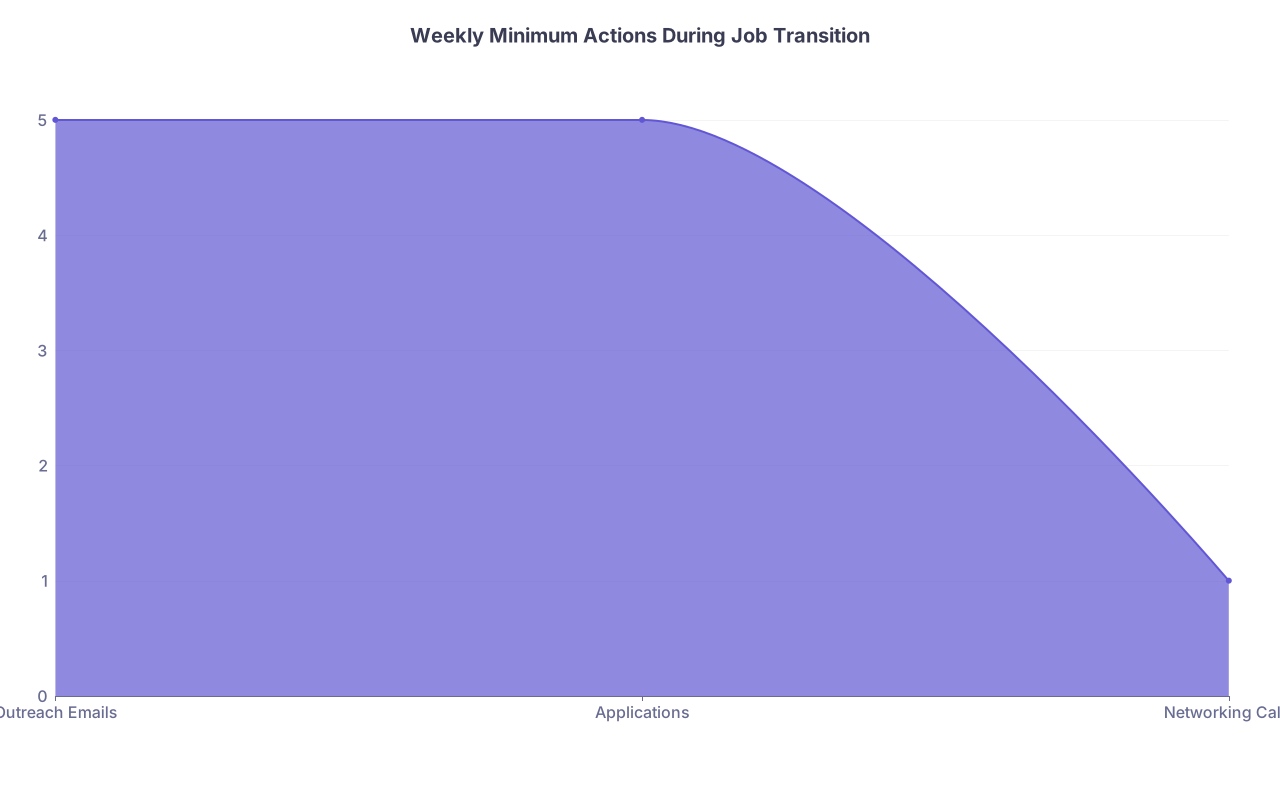
| Category | Value |
|---|---|
| Outreach Emails | 5 |
| Applications | 5 |
| Networking Calls | 1 |
These numbers are tiny on purpose. You can exceed them. But you must not do less.
Step 9: Considering a Nonclinical or Hybrid Pivot
Some of you are thinking, “I do not want to go back into a similar job at all.” That is legitimate.
Nonclinical pivots are not magical escapes. They are different jobs with different politics and expectations. But a non-renewal can be your forcing function to move.
1. Realistic Nonclinical Landing Spots
Most accessible to clinicians:
- Utilization management / insurance medical director
- Clinical documentation improvement (CDI)
- Pharma / biotech medical affairs
- Digital health / telehealth leadership
- Clinical informatics
- Medical writing / education / content

You will need:
- A retooled resume (not a CV) highlighting project work, collaboration with non-physicians, data use, and communication.
- A willingness to step down in salary initially in exchange for stability and better fit.
2. Hybrid Roles as Safer Experiments
Instead of a full leap, look for:
- 0.7–0.8 FTE clinical with 0.2–0.3 FTE:
- Quality improvement
- Medical directorship (SNFs, hospice, home health)
- Informatics (if your system has an Epic or Cerner physician builder team)
- Education roles
These give you nonclinical bullets on your CV and open future doors.
Step 10: Build a System So This Never Blindsides You Again
Once you land your next role, your work is not done. You are rebuilding a career that is resilient, not just employed.
1. Quarterly Career Check-ins
Every three months, ask yourself:
- Are expectations and metrics still clear?
- Are there early warning signs (subtle criticism, shifting schedules, “we need to talk” emails without clear agendas)?
- Are you documenting your wins and contributions?
- Are you maintaining your network or only reacting in crisis?
2. Maintain at Least One “Escape Hatch”
Always keep at least one of the following warm:
- A locums agency where you have already onboarded.
- A telemed platform where you are already credentialed.
- Relationships with two or three group leaders in other systems who have said, “If you ever think about moving, call me.”
That way, if lightning strikes again, you are stepping off a curb, not off a cliff.

| Step | Description |
|---|---|
| Step 1 | Non renewed contract |
| Step 2 | Stabilize finances and legal risk |
| Step 3 | Rewrite narrative and update CV |
| Step 4 | Short term bridge work |
| Step 5 | Targeted job search |
| Step 6 | Interview with clear story |
| Step 7 | Negotiate safer contract |
| Step 8 | Start new role |
| Step 9 | Quarterly review and maintain escape hatch |
Open your calendar and block 60 minutes in the next 24 hours labeled “Career Triage.” During that hour, do three things: pull up your contract, write a one-paragraph explanation of why your job ended, and list five people you can realistically ask for references. That is how you start turning a non-renewed contract into a better job.