
The standard advice about “pick academic or private practice” is outdated and lazy. You can have both—if you are deliberate and ruthless about structure.
You are not trying to be everything to everyone. You are trying to build a sustainable hybrid career that gives you:
- Enough protected time to teach, publish, or lead programs.
- Enough clinical volume and autonomy to generate real income and maintain skills.
- Enough control that you are not at the mercy of one department chair or one hospital CEO.
Here is the stepwise, no-nonsense way to actually do it.
Step 1: Decide What Kind of Hybrid Career You Actually Want
“Hybrid” sounds sexy until you realize it can mean 10 different animals. If you skip this step, you will end up overcommitted and underpaid.
You must pick your primary identity and your supporting identity:
- Academic-primary, private-supporting
- Private-primary, academic-supporting
There is no true 50/50 that works long-term without burnout or mediocrity on both sides. You choose a center of gravity.
Common Hybrid Models (Pick the Closest One)
Academic Core + Outside Clinic
- Employed by university or teaching hospital.
- One half-day to 2 days/week in private clinic (often revenue-sharing).
- You lean into teaching, research, committees. Private side exists for autonomy and extra income.
Private Core + Academic Title
- Employed by private group or solo practice.
- 0.1–0.3 FTE academic appointment for teaching clinics, lectures, or supervising residents.
- You are a workhorse clinician with defined academic contributions but minimal admin burden.
Dual Employed (Risky but Possible)
- Part-time academic contract.
- Part-time private group contract.
- Requires careful legal and scheduling boundaries. Easy to screw up; powerful when done well.
Hospitalist / Proceduralist Split
- Academic hospital shifts (e.g., 7-on/7-off, or defined blocks).
- Remaining time in private procedural practice or outpatient clinic.
You should be able to answer, in one sentence:
“I am primarily a(n) ____ who also ____.”
Example: “I am primarily an academic general internist who also runs a one-day-per-week concierge clinic.”
Or: “I am primarily a private cardiologist with a 0.2 FTE teaching appointment and a leadership role in the fellowship.”
If you cannot complete that sentence, you are not ready to negotiate anything.
Step 2: Build the Right Profile Before You Sign Your First Job
You do not bolt on a hybrid career from scratch five years out. You start engineering it during fellowship or chief year.
Concrete Pre-Attending Moves
Stack Academic Currency
- Write: at least 1–2 first-author or meaningful co-author papers.
- Teach: small groups, simulation sessions, board review. Get evaluations.
- Present: grand rounds, morbidity and mortality, local or regional conferences.
- Lead: a QI project, curriculum module, or workflow redesign.
Stack Private-Practice Currency
- Moonlight in:
- Community hospitals
- Urgent care
- Non-academic EDs or hospitalist roles
- Learn:
- Billing and coding
- RVUs and collections
- How clinic templates and overbooking decisions are made
- Moonlight in:
Collect Evidence, Not Platitudes
- Save:
- Teaching evaluations
- Thank-you emails from residents/students
- Documentation of QI projects and outcomes
- Track:
- Procedure volumes
- RVU generation
- On-time documentation and low no-show rates
- Save:
This is your leverage later. Hybrid jobs go to people who clearly bring value to both worlds.
Step 3: Map Your Local Market and Power Players
You cannot build a hybrid role in a vacuum. It lives in a specific market with real politics.
Do a Targeted Market Reconnaissance
Make a short list:
- 2–3 academic centers within commuting range
- 3–5 private groups or large multispecialty practices
- Relevant hospital systems that intersect with both
Then answer:
- Where do the academic faculty currently moonlight?
- Which private groups already have “clinical faculty” or “voluntary faculty” titles?
- Who controls:
- Residency program leadership (PD/APD)
- Division chiefs / section heads
- Service line directors at community hospitals
Ask direct questions during late residency or fellowship:
- “Who around here has a hybrid role—part academic, part private?”
- “Where do most of the faculty send patients when they need outside referrals?”
- “Which groups have the best relationship with the university?”
You are not looking for posted jobs yet. You are locating nodes of influence and understanding the local ecosystem.
Step 4: Choose and Define Your Initial FTE Structure
FTE (full-time equivalent) is the backbone. Get this wrong and everything else is a bandage.
Typical workable starting splits:
| Model | Academic FTE | Private FTE | Who It Fits |
|---|---|---|---|
| Academic-heavy | 0.7–0.9 | 0.1–0.3 | Aspiring promotion-track faculty |
| Balanced tilt | 0.6 | 0.4 | Strong clinicians who still want teaching and modest scholarship |
| Private-heavy | 0.2–0.3 | 0.7–0.8 | Income-focused with defined academic contributions |
| Shift-based | Variable | Variable | Hospitalists, ED, anesthesiology, some surgical fields |
Rules for FTE Sanity
One anchor employer.
One contract should hold your benefits, retirement, malpractice tail (if possible). The second role can be 1099 or limited-employee with minimal benefits.Non-overlapping core hours.
Do not let both employers claim your weekday daytime. For example:- Academic: Mon/Tue/Wed daytime + one half-day Fri.
- Private: Thu all day + one half-day Fri.
Pre-commit maximum weekly hours.
Decide a weekly ceiling (e.g., 55 hours average). If a proposed split forces you beyond that routinely, it is a bad design.Know if you are on promotion track.
Promotion-track (assistant → associate) demands time. If you accept that, your “private” side cannot quietly turn into a full second job.
Step 5: Build a Legally Clean, Conflict-Proof Structure
Conflict-of-interest and non-competes are where hybrid dreams go to die if you are careless.
You need three documents scrutinized:
- Academic employment contract
- Private practice employment or independent contractor agreement
- Hospital medical staff bylaws / policies
Non-Competes and Non-Solicitation
You must know:
- Geographic radius
- Duration (e.g., 1–2 years)
- Restricted activities (only same specialty? inpatient vs outpatient?)
Key moves:
Negotiate explicit carve-outs:
- “Physician may maintain a 0.2 FTE appointment at X University for the purposes of teaching and conducting non-compensated academic activity.”
- Or the reverse: “Physician may provide clinical services at Y Clinic for one day per week, not to exceed Z sessions annually.”
Clarify:
- Who owns which patients
- Whether you can refer from one setting to another
- Whether you can use your name and titles across roles
Malpractice Coverage
At minimum, you do not want gaps. Preferably:
- Academic job: claims-made policy with tail coverage guaranteed if terminated without cause or after certain tenure.
- Private side: either occurrence policy (cleanest) or claims-made with clear tail responsibility.
Ask bluntly:
- “If I leave, who pays for my tail?”
- “Does my policy cover moonlighting or outside clinical work?”
- “Is there any exclusion for telemedicine, procedures, or other locations?”
If the academic institution is risk-averse, a common solution: they let you be uncompensated volunteer faculty while your private employer holds malpractice for clinical work. You still get teaching, title, and access; they carry minimal risk.
Step 6: Design Your Weekly Schedule Like a System, Not a Patchwork
A hybrid career fails not on paper but on Tuesday at 4:30 pm when everyone thinks they own you.
You need a template, not vibes.
Build Around Fixed Blocks
Start with:
Academic fixed activities
- Required clinics
- Teaching conferences
- OR block time
- Call schedules
Private fixed activities
- Clinic days
- Procedural blocks
- Group call rotation
Then lay out a 4-week repeating schedule on paper.

| Step | Description |
|---|---|
| Step 1 | Mon Academic Clinic |
| Step 2 | Tue Academic Admin and Teaching |
| Step 3 | Wed Academic Inpatient or Procedures |
| Step 4 | Thu Private Clinic |
| Step 5 | Fri AM Academic, Fri PM Private or Flex |
Weekly reality check questions:
- Who covers your academic inpatients when you are at the private clinic?
- Who covers your private patients when you are on academic call?
- How are messages, results, and refills handled on your “off” days for each site?
You need written coverage policies. Not “we will figure it out.”
Protect Nonclinical Time Aggressively
Hybrid without nonclinical blocks becomes “two clinical jobs plus unpaid academic work.” That is a straight line to resentment.
Within your academic FTE, secure:
- At least 0.1–0.2 FTE labeled as:
- “Scholarly time”
- “Teaching administration”
- “Program development”
Then guard it. No last-minute clinic add-ons “just this once.” This is when you write, meet mentees, do QI, and maintain your academic value.
Step 7: Build Explicit Value Propositions for Each Side
You keep a hybrid career only if each side feels they are getting a good deal.
For the Academic Institution
Your pitch must sound like:
- “I bring in complex patients from the community to your teaching service.”
- “I give your residents continuity clinic in a high-efficiency private setting.”
- “I will run X rotation that exposes trainees to population Y you currently lack.”
- “I will lead a QI project at the community hospital that feeds data back to the university.”
Concrete deliverables:
- Number of teaching days per month
- Number of lectures or workshops per year
- Defined committee or program roles
- QI or scholarly output targets (reasonable, not fantasy)
For the Private Group
Your value is not “I have a title,” it is:
- Pipeline for good residents/fellows to join the practice
- Access to academic updates, protocols, and guidelines
- Easier collaboration for trials or registries
- Reputation lift: “We are the group that teaches at X University”
You reinforce this by:
- Regular case-based teaching sessions in the private clinic
- Co-branded lectures or patient education events
- Helping with protocols based on latest evidence
If both sides see clear upside, they will tolerate your complicated schedule.
Step 8: Start Narrow, Then Expand
The most common mistake: overbuilding in year one.
Better sequence:
Year 0–1:
- Choose a dominant base (academic or private).
- Add a small, clearly defined secondary role:
- 0.1–0.2 FTE teaching
- One half-day clinic
- Limited number of shifts per month
Year 2–3:
- Expand what is working:
- If your private day is fully booked with high-ROI patients → maybe add a second day.
- If you are getting strong teaching reviews → negotiate more protected time.
- Trim what is not:
- Committee work with no impact
- Low-yield volunteer projects
- Excess call with poor compensation
- Expand what is working:
Year 4–5:
- Reassess core identity:
- Are you progressing academically (promotion, grants, leadership)?
- Is your private panel robust and profitable?
- Then purposely rebalance FTE to align with reality, not the fantasy you had as a PGY-3.
- Reassess core identity:
Restructuring every 2–3 years is normal. That is not failure. That is optimization.
Step 9: Financial Architecture That Actually Works
You cannot wing the money if you plan to serve two masters.
Income Streams to Track Separately
Ideally, you track:
- Academic salary (often lower but stable)
- RVU or production bonuses (academic or private)
- Private practice draw/distributions
- Extra teaching stipends (CME talks, lecturing)
- Telemedicine or consulting income
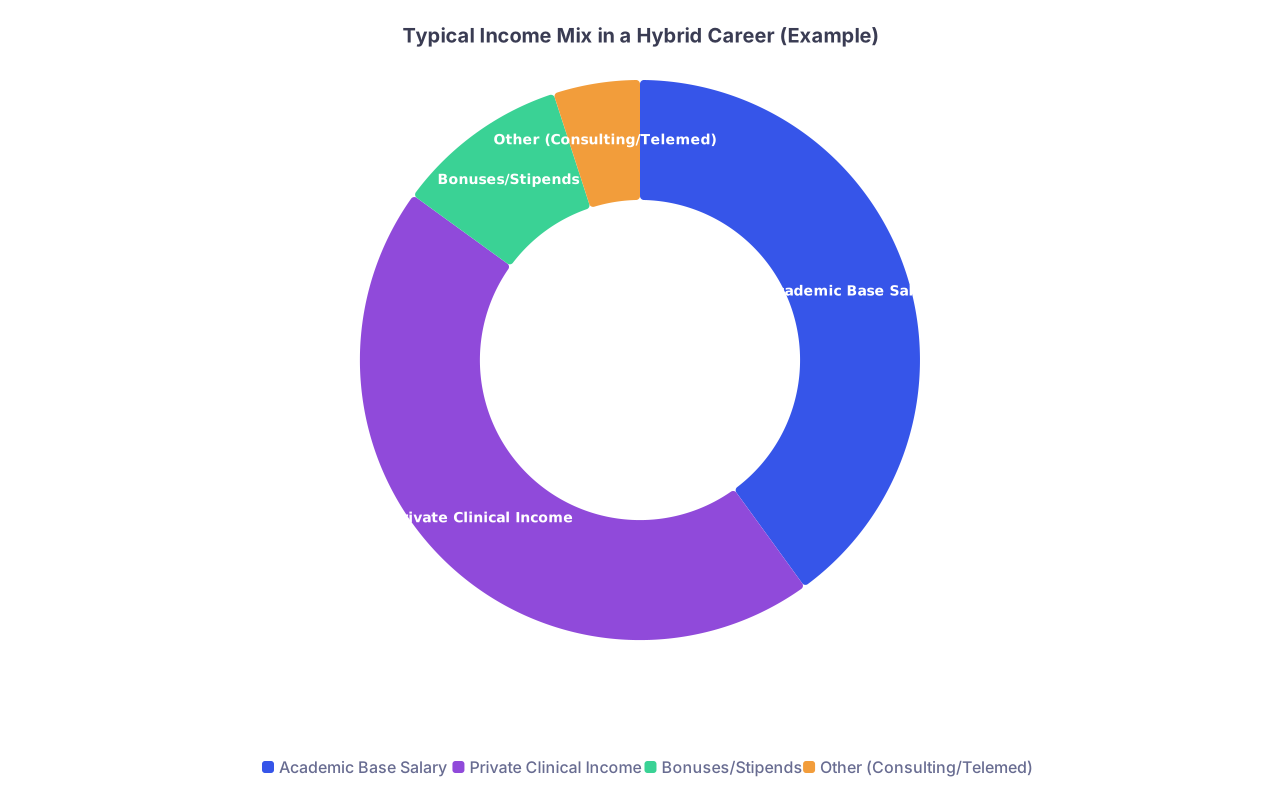
| Category | Value |
|---|---|
| Academic Base Salary | 40 |
| Private Clinical Income | 45 |
| Bonuses/Stipends | 10 |
| Other (Consulting/Telemed) | 5 |
Non-Negotiable Financial Practices
Separate accounts for separate roles.
- One check for academic W-2.
- One check for private W-2 or 1099 into a different account or sub-account.
Lets you see which side is pulling its weight.
Reserve for taxes if 1099.
- At least 25–30% of 1099 income into a tax reserve account.
Do not let April become a panic.
- At least 25–30% of 1099 income into a tax reserve account.
Value your time by hourly yield.
- Total annual hours on each role (including admin) vs. net income from each.
- If your academic hours yield $80/hr all-in and private yields $260/hr, you should know that. Then you can consciously choose to keep lower-yield work for non-monetary reasons, not out of ignorance.
Protect retirement and benefits.
- Confirm which employer offers:
- Health insurance
- Disability insurance
- 401(k) / 403(b) match
- Simplest: let your anchor employer carry the benefits. Private side is for upside.
- Confirm which employer offers:
Step 10: Manage Reputation and Politics on Both Sides
Hybrid docs get labeled quickly: “always busy,” “never fully here,” “doing side hustles.” You need a strategy.
Academic Reputation Rules
- Be visibly reliable when you are scheduled.
- Show up early for teaching.
- Answer emails on the days you are “on” for them.
- Publish something. Even if modest.
- Case series, QI paper, educational innovation.
- Say no to:
- Endless low-yield committees.
- “Just join this task force” unless it aligns with your track.
You want the narrative: “She is part-time but extremely productive and great with learners.”
Private Practice Reputation Rules
- Do not dump complex patients back to the group because “I need academic cases.”
- Do not name-drop your title every five minutes.
- Be present in:
- Call rotation
- Required meetings
- Practice-level QI
You want the narrative: “He teaches at the university and still pulls his weight here.”
Step 11: Build a Simple, Honest Communication Protocol
The only way a hybrid career survives is with deliberate communication.
Set standing check-ins:
- Twice yearly with:
- Academic division chief or program director
- Private practice managing partner or group lead
Agenda:
Workload:
- “Are you getting what you expected from me?”
- “Where am I underperforming your expectations?”
Value:
- “Here is what I have delivered the last 6 months.”
- Teaching hours, RVUs, projects, patient volume, pipeline contributions.
Future:
- “Here is one thing I want to expand and one thing I would like to reduce.”
Keep your own running brag file:
- Resident comments
- Patient compliments
- Volumes, metrics, awards
You do not rely on memory when it is time to renegotiate.
Step 12: Plan Exit Ramps and Failsafes
Hybrid careers evolve. You may end up going fully one way. You plan for that from the start.
Design Optionality into Your Contracts
Try to secure:
- Right of first refusal for:
- Increased FTE at academic center
- Partnership track in private group
- Mutually agreeable notice periods (90–180 days) so you can shift gradually.
Know your emergency plan:
- If academic leadership changes and your division is gutted:
- Can you scale up private days quickly?
- If private group sells to a corporate entity and conditions become unbearable:
- Can you expand academic FTE temporarily while you reassess?
This is why having strong performance and goodwill on both sides matters. It gives you landing spots.
Concrete Example: Building a Hybrid IM Career From Scratch
Let me walk through a realistic internal medicine scenario.
Year 0 (Final Year of Residency)
- Moonlight at a community hospital 2–3 shifts/month.
- Complete a QI project on readmissions with a faculty mentor.
- Give 2 noon conferences; get evaluations.
- Meet with:
- IM program director
- Two community hospitalist group leads
- Say explicitly: “I am interested in a career that blends teaching and community practice. What roles have worked for your past graduates?”
Year 1–2 (Academic-Anchor Start)
- Sign 0.8 FTE academic hospitalist position:
- 14 shifts/month
- 0.1 FTE protected for QI/teaching.
- Negotiate clear language that you can moonlight externally up to X shifts/month.
- Start with:
- 2–3 community hospitalist shifts/month at a private group hospital (1099).
Focus:
- Build strong teaching reputation.
- Finish and publish the QI project.
- Learn local referral networks.
Year 3–4 (Formalize Hybrid)
- Approach the private group:
- “I have been working shifts here. I would like to establish a regular 0.3 FTE role—X shifts per month plus one outpatient clinic half-day.”
- Approach academic chief:
- “I want to maintain 0.5 FTE academic, with focus on teaching and QI. I have developed strong ties with this community group that could benefit the residency.”
Restructure:
- 0.5 FTE academic
- 0.5 FTE private (mix of hospitalist and clinic)
Now you are fully hybrid. One side provides benefits. The other side provides income expansion and practice diversity.
Year 5+
- Decide:
- Are you on track for academic promotion with satisfaction? If yes, lean 0.6–0.7 academic, keep a smaller but lucrative private niche.
- Or does private bring more satisfaction and income with enough teaching to keep you engaged? Then tilt 0.7 private, 0.3 academic.
You did not “pick” a binary track. You designed one.

Specialty-Specific Realities (Brief but Essential)
Not every specialty has the same hybrid options.
| Specialty | Hybrid Ease | Typical Hybrid Pattern |
|---|---|---|
| Internal Med / Family Med | High | Academic hospitalist + community clinic |
| EM | High | Academic shifts + community ED shifts |
| Anesthesia | Medium-High | Academic OR + community surgery center |
| Surgery subspecialties | Medium | Academic OR + private ASC days |
| Psych | High | Academic role + private telehealth or office practice |
| Radiology | Medium | Academic reads + teleradiology group |
If you are in a procedural or surgical field, the key constraint is OR time and facility privileges. Your hybrid plan must align with:
- Where you can book cases
- Who controls that access
- How block time is allocated
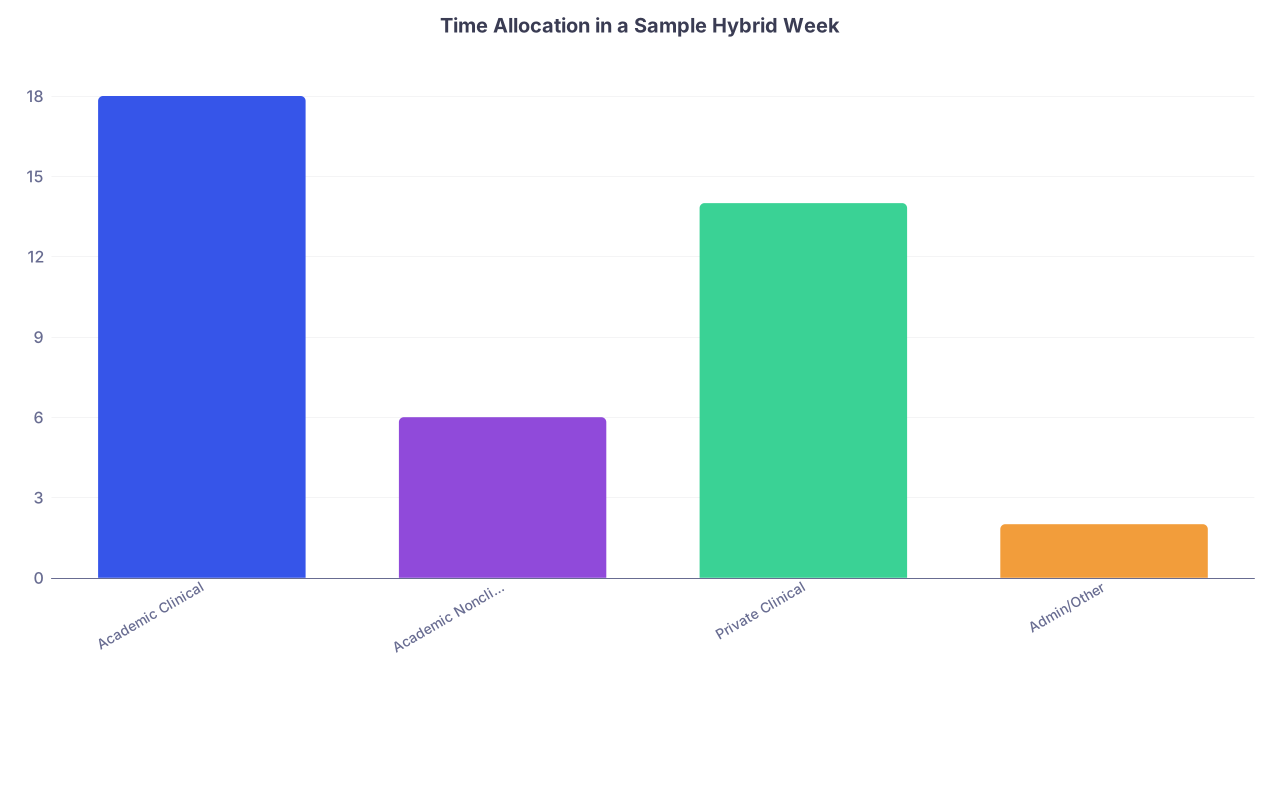
| Category | Value |
|---|---|
| Academic Clinical | 18 |
| Academic Nonclinical | 6 |
| Private Clinical | 14 |
| Admin/Other | 2 |

Final Checkpoints Before You Commit
Use this as a blunt instrument. If you cannot answer “yes” to most of these, pause.
| Question | Yes/No |
|---|---|
| Do I have a clear primary identity (academic or private)? | |
| Do I know my ideal FTE split for the next 2 years? | |
| Have I reviewed all non-competes and malpractice terms with a lawyer? | |
| Is there one employer clearly holding my benefits and tail coverage? | |
| Do I have written schedules and coverage plans for both roles? | |
| Can I state my value proposition to each side in 2–3 sentences? |
Fill that out honestly. If too many blanks are “no,” your hybrid plan is still a fantasy.
Bottom Line
Hybrid careers are not unicorns anymore. They are absolutely buildable if you:
- Pick a primary identity and a concrete FTE structure rather than chasing a vague 50/50 dream.
- Engineer clean contracts, schedules, and coverage policies so you are not constantly apologizing to both sides.
- Deliver obvious value to both academic and private partners and adjust the balance every few years based on reality, not ego.
Do that, and you will not be stuck choosing between “ivory tower” and “RVU factory.” You will run your own play.