
The way most academic jobs are structured is broken—and if you do not actively renegotiate, the system will happily burn you out.
You know the pattern. The job description promised “protected time for research,” “support for academic growth,” and “a culture that values work–life balance.” The reality: endless clinical sessions, teaching dumped on your calendar at the last minute, nights and weekends swallowed by notes and “just one more” committee. Your research? An afterthought. Your life? Collateral damage.
You do not fix this by working harder. You fix it by systematically renegotiating your role.
This is the playbook.
1. Diagnose Exactly How Lopsided Your Role Is
Do not walk into anyone’s office with vague complaints. Walk in with numbers.
Step 1: Capture a brutally honest 4–6 week snapshot
For the next month (or pull from your calendar / EMR logs if you are looking backward), track:
- Direct clinical hours (in-room / on-service)
- Indirect clinical (notes, inbox, phone calls, refills)
- Teaching (scheduled sessions + prep)
- Administrative / committee work
- Research (writing, analysis, meetings, grants)
- Personal / family time (evenings, weekends, days off)
Do not “estimate.” That is how you stay stuck. Use:
- Your calendar
- EMR timestamps for notes and messages
- Email send times
- A simple spreadsheet or time-tracking app
Then quantify the weekly average.
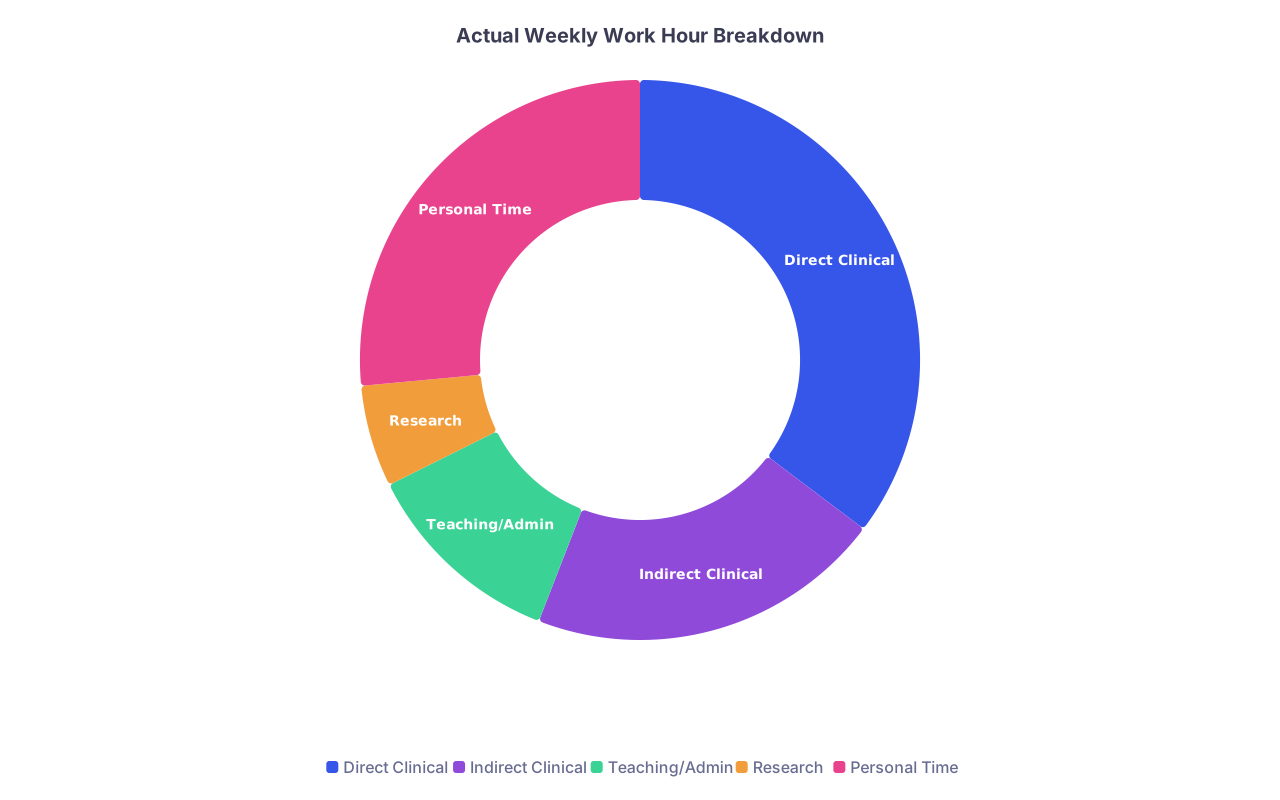
| Category | Value |
|---|---|
| Direct Clinical | 24 |
| Indirect Clinical | 14 |
| Teaching/Admin | 8 |
| Research | 4 |
| Personal Time | 18 |
If you are like most early- to mid-career academics, you will discover:
- Research time is fragmented into 30–60 minute scraps
- “Protected time” is porous; clinical work seeps into every gap
- Nights and weekends carry the hidden workload (notes, slides, IRB)
Step 2: Compare reality to what was promised
Pull out:
- Your offer letter
- Any written “workload distribution” document
- Division or department expectations (e.g., 70/20/10 clinical/research/teaching)
Create a simple side-by-side comparison.
| Category | Promised % | Actual % (Your Data) |
|---|---|---|
| Clinical (all) | 60 | 72 |
| Research | 30 | 10 |
| Teaching/Admin | 10 | 18 |
You are not going to argue from emotion. You are going to argue from misalignment between documented expectations and measured reality.
Step 3: Define what “fixed” looks like
You need a target, not just “less clinical” or “more time for research.”
For example:
- Clinical: 6 half-days outpatient + 8 weeks inpatient per year
- Research: 1.5 full days per week + 6 weeks per year of protected writing time
- Teaching: 10–15 lectures/small groups per year with predictable scheduling
- Home: At least 2 evenings fully off per week, 2 weekends per month truly free
Write down your desired:
- Percent effort for each domain (clinical / research / teaching / admin)
- Concrete schedule changes (clinic half-days to drop, weeks on service, etc.)
- Realistic research output you could achieve with that structure (grants, papers)
You will use this later in negotiation.
2. Decide What You Actually Want Long-Term
Before you start rearranging deck chairs, get clear on the ship you are on.
Clarify your career path
Post-residency in academics, your options usually boil down to a few archetypes:
- Clinician–Educator: Heavy clinical + teaching, modest or minimal research
- Clinician–Scientist: Major research component, clinical supports your science
- Hybrid Clinician–Investigator: Substantial but not majority research (e.g., 40–60%)
- Clinical leader / Administrator: Section chief, program director, quality roles
Each requires a different mix of time and institutional support. If you say you want to be an R01-funded PI but your schedule is 90% clinical, those two facts are in open conflict.
Be blunt:
- Where do you want to be in 5–7 years? (Promotion, grant level, leadership)
- How much do you actually enjoy patient care vs. research vs. teaching?
- What is burning you out right now: hours, unpredictability, lack of progress, or all of the above?
Decide your non-negotiables
You cannot optimize everything. You must choose.
Examples:
- “One full weekday with zero clinical every single week, non-negotiable.”
- “No weekend clinical work unless it is a scheduled service block.”
- “At least 40–50% of my professional time must be research if I am to stay here.”
Write 3–5 non-negotiables. They are the backbone of your renegotiation.
3. Map the Decision-Makers and Constraints
You are not just asking a single person for a favor. You are pushing against a system built on RVUs, coverage grids, and faculty headcount.
You need to know:
- Who controls your clinical schedule?
- Who controls your FTE allocation and salary?
- Who controls teaching assignments?
- Who controls research support (coordinators, statisticians, start-up)?
That might be:
- Division chief
- Vice chair for clinical affairs
- Vice chair for research
- Department chair
- Service line director
- Program director
Understand their pressures
If you were them, what would you care about?
- RVU targets and service coverage
- Patient access and wait times
- Accreditation / teaching coverage
- Departmental promotion metrics
- Grant indirects and research reputation
- Faculty retention (including you)
Your ask must be framed as:
“Here is how rebalancing my role will allow me to deliver more of what the department says it wants, in a sustainable way.”
Not:
“I am tired and want to work less.”
You may also need to understand funding constraints: hard money vs. soft money, percent effort from grants, institutional expectations for self-funding.
4. Build a Concrete, Defensible Rebalancing Plan
Walking in with “I need more time” is amateur. Walking in with a fully worked alternative is professional.
Step 1: Draft a new effort distribution
Example for a hybrid clinician–investigator:
- Clinical: 50% (down from 70%)
- Research: 40% (up from 20%)
- Teaching/Admin: 10% (stable)
Then translate percentage into hours and into actual schedule:
- 50% clinical → 5 half-day clinics + 6 inpatient weeks/year
- 40% research → 2 full days per week + 4 research-intensive weeks/year
- 10% teaching/admin → Equivalent of X lectures + 1 committee
Step 2: Offer offsets and solutions, not problems
You want to come in with ideas that make the chief’s life easier.
- Propose shifting from low-yield clinics to higher-acuity or specialized clinics that generate RVUs more efficiently.
- Offer to take defined blocks of coverage at high-need times in exchange for fully protected weeks at other times.
- Take on targeted educational roles that align with your interests and can be scheduled predictably (course co-director rather than endless one-off lectures).

Step 3: Align the plan with departmental goals
You need explicit linkage:
- “With 40% research time, I can reliably submit at least one K/R-level application per year.”
- “Reducing my outpatient sessions by 2 per week allows me to launch and run this funded clinical trial, which brings indirects and prestige.”
- “A predictable, protected research day will increase my scholarly output and help the division’s promotion metrics.”
Spell out:
- What grants you will target
- What papers you can realistically deliver
- What academic roles you will strengthen (e.g., directing a fellowship research curriculum)
5. Prepare Your Negotiation Dossier
Treat this like a promotion package meets a business plan.
Your packet should include:
Reality vs. promise
- Side-by-side table of promised vs. current effort distribution
- Actual hours from your 4–6 week snapshot
Evidence of impact despite bad structure
- List of publications, grants, teaching evaluations, clinical metrics
- Emphasize that you have been productive despite the lopsided role
Proposed new structure
- New percent effort breakdown
- Concrete schedule changes (down to clinic sessions and weeks on service)
- How clinical coverage will be maintained (proposed swaps/shifts, not just “someone else will do it”)
Projected returns (the business case)
- Grants you will pursue and realistic odds (K, R21, R01, foundation)
- Expected publications per year
- How this helps promotion, departmental prestige, and indirects
Boundaries and sustainability
- A brief statement that the current pattern is not sustainable and risks burnout and attrition, but framed professionally.

| Step | Description |
|---|---|
| Step 1 | Document Current Reality |
| Step 2 | Define Desired Role |
| Step 3 | Map Decision Makers |
| Step 4 | Draft Rebalancing Plan |
| Step 5 | Prepare Dossier |
| Step 6 | Negotiate with Division Chief |
| Step 7 | Implement and Protect Time |
| Step 8 | Escalate or Consider Exit |
| Step 9 | Agreement Reached |
6. Run the Actual Negotiation Conversation
This is where people freeze. Do not.
Step 1: Book a serious meeting
- 60 minutes, not “catching someone in the hallway”
- Clear subject: “Discussion of role distribution and academic time”
- Send your packet 24–48 hours in advance with a brief note:
“I would like to review my current workload and propose a revised effort distribution that better aligns with our division’s research and academic goals.”
Step 2: Open with data, not feelings
Example script:
“I wanted to review my current role because there is a significant mismatch between what is on paper and how my time is actually being used. Over the last 6 weeks, I tracked my hours. I am functioning at roughly 70% clinical effort, 10% research, 20% teaching/admin, whereas my offer letter and our division documents target 60/30/10. The way it is structured now is not sustainable and it is undermining my research progress—which I know is a priority for the department.”
Then pause. Let the numbers land.
Step 3: Present the future, not just the problem
Transition quickly:
“I have outlined a specific rebalancing plan that I believe will allow me to meet my clinical responsibilities while also building the research program we have talked about.”
Then walk through:
- New effort distribution
- Concrete clinic/session changes
- How coverage will still be met
- What you commit to deliver academically
Make it easy for them to say yes.
Step 4: Anticipate and answer the usual objections
You will hear variations of:
“We cannot reduce your clinical time because coverage is tight.”
Answer:- “I understand the coverage pressures. That is why I structured this around trading two low-yield clinic sessions for a block schedule and taking on X weeks of high-need service.”
- “If we do not protect some research time, my ability to bring in funding and stay here long-term is at risk. That is more costly than adjusting coverage.”
“We cannot change anything until you have more grant funding.”
Answer:- “That is the core problem. Without stable, protected time, writing competitive grants is nearly impossible. The literature on clinician–scientists is clear: you do not get grants then time; you need time to get the grants.”
- Offer a phased approach:
“Let us do a one-year pilot: shift me to 40% research with clear milestones (grant submission by month X, Y manuscripts). If I hit those, we extend. If not, we revisit.”
“Everyone is busy; this is just how it is.”
Answer:- “I recognize everyone is stretched. But my role was explicitly recruited as a research-focused academic position. Operating at 10% research is misaligned with the written expectations and with my promotion path. If we cannot align my role with what we agreed on, I will have to reconsider whether this is the right environment for me.”
That last sentence matters. Not as a threat, but as a boundary.
7. Lock In and Actually Protect Your Research Time
Assuming you get some movement (even if partial), your next job is to harden it against erosion.
Put everything in writing
- Follow up with an email summarizing:
- New effort distribution
- Schedule changes (which clinics dropped, which weeks protected)
- Start date and review date (e.g., 12-month trial)
- Expected academic milestones
If anything is vague, clarify now. Vague “protected time” evaporates.
Fix the calendar, then defend it
- Block your research days as “No Clinical – Protected Research”
Not “admin.” Not “open.” - Make sure schedulers and the EMR reflect zero patient slots on those days.
- Preemptively decline new committees/lectures that land on those blocks unless they are mission-critical and agreed on.
Your script for boundary enforcement:
“Thursdays are my protected research days per my agreement with Dr. X. I am not available for clinical or meetings then. Can we find another time?”
Say it without apology.

Build habits that make your research days actually productive
Do not squander the time you fought for.
- Treat it like a grant deadline day, every week
- No clinic email, no EMR inbox until a designated late-day check
- Pre-plan 2–3 concrete tasks for each research day (write section X of paper, finalize aims page, analyze dataset Y)
You need early wins (manuscript out, grant submitted) to validate the new structure when you hit your review point.
8. If They Will Not Fix It, Plan Your Exit Strategically
Sometimes you do everything right and still get stonewalled. “We hear you, but nothing can change.”
That is not a negotiation. That is a verdict.
You then shift from “fix it here” to “fix it by leaving.”
Be honest about the red lines
If, after a serious attempt to renegotiate, you hear:
- “We cannot commit to any protected time for research in writing.”
- “Maybe we can talk again in 3–5 years.”
- “Everyone here does research on their own time.”
Then this institution does not, in practice, support the career you want. Believing it will suddenly change is magical thinking.
Start a quiet external search
Target roles where:
- Effort distribution is explicit and enforced (e.g., 50% research supported by start-up)
- There is a track record of junior faculty getting promoted and funded
- Research days are truly protected (ask current faculty privately)
When interviewing, ask pointed questions:
- “How is protected time for research enforced in scheduling?”
- “In the last 5 years, how many assistant professors have successfully renewed their K or gotten an R-level grant?”
- “What is the typical clinical load for funded investigators here?”
And verify:
- Ask junior and mid-career faculty—not just the chair—how it actually works.
- Look at CVs for real output vs. marketing fluff.
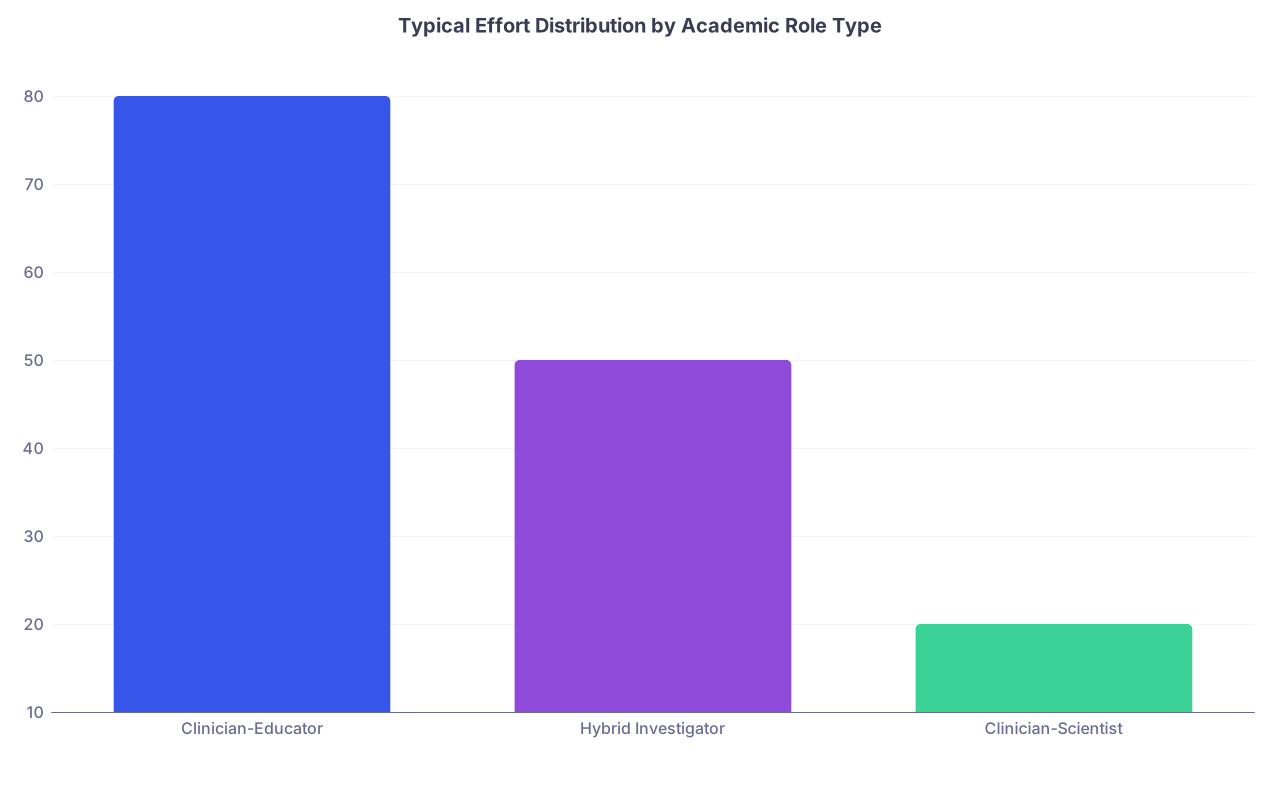
| Category | Value |
|---|---|
| Clinician-Educator | 80 |
| Hybrid Investigator | 50 |
| Clinician-Scientist | 20 |
(Values above approximate clinical %; rest is research/teaching/admin.)
9. Protect Your Life Outside Work as Aggressively as Your Research
One more hard truth: if you only renegotiate for research and ignore your life, you will still burn out.
You need explicit personal boundaries:
- Max hours per week you are willing to work on average (e.g., 50–55, not 70)
- Nights per week with no work at all
- Weekends per month you will keep completely off
Then do three things:
Stop doing heroic unpaid “fixes”.
- No more routinely doing the clinic work of 1.5 FTEs on a 1.0 FTE salary.
- No more pulling chronic 10–11 p.m. note sessions because scheduling is broken.
Use “no” as a strategic tool.
- Decline committees and teaching that do not advance your promotion or bring genuine satisfaction.
- When asked to “just take this one more clinic session,” respond:
“I am at my maximum safe clinical capacity. If we need to add this session, we will have to remove another or adjust my FTE.”
Schedule life first, then fit work around it.
- Fixed weekly activities that you protect—family dinner, exercise class, hobby group—give structure.
- If all your personal time is “leftover,” it will vanish.

You will get pushback. “But patients.” “But call.” “But coverage.” Remember: dead or broken physicians are not good for patient care either.
FAQ (Exactly 4 Questions)
1. What if my offer letter never specified concrete percentages for research versus clinical time?
Then you anchor the negotiation on institutional norms and verbal agreements. Pull any written departmental guidelines, job postings from similar roles at your institution, and emails where expectations were discussed. Say: “When I was recruited, the role was described as research-focused. My current distribution has evolved into 80–90% clinical work, which is misaligned with that understanding and with a viable academic promotion path. I would like to formalize an explicit effort distribution that matches what we originally discussed.” Lack of a prior written percentage is not an excuse to keep you at 10% research forever.
2. My chief says, “Once you bring in grant funding, we will give you protected time.” How do I respond?
You respond by calmly pointing out the circular trap: “To submit competitive grants, I need stable, protected time now. Without that, I have been writing at night and on weekends, which is not sustainable. I am proposing a 12–18 month rebalancing with clear milestones: one major grant submission, X manuscripts. If I do not hit those, we can revisit. But without any investment of protected time up front, the expectation of grant funding is unrealistic.” Offer a concrete trial period instead of accepting a vague future promise.
3. How much research time do I realistically need to be a successful clinician–investigator?
For serious, independent research (grants, multi-paper pipelines), anything under 30% is almost always inadequate long-term. Many successful clinician–scientists sit at 50–80% research effort, especially during early grant-building years. A hybrid model can work at 40% research if it is uninterrupted and enforced—for example, two full days per week plus periodic protected weeks. Fragmented 5–10% here and there is fine for small projects or education scholarship but not for major funded programs.
4. What if I am afraid that pushing for rebalance will label me as “not a team player”?
Staying silent while you slowly burn out is not team play; it is quiet self-destruction. The key is how you frame it. Lead with data, propose concrete solutions that protect coverage, and tie your request to institutional goals. Say: “I want to be here long-term and build a strong research program that benefits the department. To do that sustainably, my role needs to better match the expectations we set. Here is a specific plan that preserves clinical access while allowing me to deliver on that mission.” If reasonable, data-backed advocacy is branded as disloyal, that tells you a lot about whether this is a place you should invest your career.
Open your calendar and your EMR logs right now. Build a 4–6 week snapshot of where your time actually goes. Until you have those numbers in front of you, you are arguing feelings against a system that only responds to hard data.