
The most dangerous career move for a physician is not switching specialties. It is leaving a “safe” hospital-employed job for an independent group without a plan.
You can absolutely do it safely. But not by guessing and hoping.
What follows is a step‑by‑step playbook I would give a PGY-7 hospitalist or a burned‑out employed cardiologist thinking, “There has to be a better way.” This is not theory. It is the stuff that blows up contracts, wrecks marriages, or—done right—gives you control of your practice and your time.
Step 1: Get Honest About Why You Are Leaving
If you get this part wrong, you will just swap one bad situation for another.
Do not start with, “I hate admin.” That is a symptom, not a diagnosis. You need a precise problem list.
Spend 30 minutes and write three columns:
- What I must get away from
- What I must protect
- What I must gain
Examples I have actually seen:
Must get away from:
- RVU rat race with constantly rising “targets”
- 1:3 call with no post‑call day
- Service line director changing protocols every month
- Threats about “productivity” if you do not see 30+ patients a day
Must protect:
- Kids’ school district; spouse’s job
- My subspecialty skill set (e.g., advanced endoscopy, structural heart)
- Current income floor (within 10–15%)
Must gain:
- Some control over schedule
- Path to real ownership and profit sharing
- Say in clinical policies, not just being “a warm body”
If your “musts” are vague, you are not ready to move. Independent groups can be fantastic or a disaster. You need to know exactly what you are optimizing for.
Step 2: Map Your Local Market Like a Businessperson
You cannot jump safely if you do not understand the ground you are landing on.
Your questions:
- Who actually controls the patients?
- Who controls the call coverage?
- Who controls the OR time / cath lab / endoscopy block?
- Who is the 800‑pound gorilla (health system, insurer, or mega‑group)?
You are not just joining “an independent group.” You are stepping into a little ecosystem with real power dynamics.
Do this:
List all realistic independent options in your geographic range:
- Single‑specialty groups (e.g., GI, ortho, cardiology)
- Multi‑specialty groups with strong governance
- Hybrid models (private group with professional services agreement to hospital)
For each group, collect what you can quietly:
- Number of physicians and APPs
- Age spread (is it 6 partners in their late 60s looking for someone to buy them out?)
- Ownership of key assets (ASC, imaging, labs, office building)
- Main payers and referral streams
Use your informal intel channels:
- Ask subspecialists you trust: “Who are the good groups in town? Who should I avoid and why?”
- Talk to OR nurses, cath lab staff, clinic managers. They know which groups are constantly fighting and which are stable.
Watch for red flags:
- Constant recruiting—new doc cycling through every 2–3 years
- Groups that recently lost a big hospital contract
- Heavy dependence on one or two aging referrers
This is competitive intelligence. The goal is not just “find a job.” It is “find a group that can survive and pay you fairly for 10+ years.”
Step 3: Audit Your Current Contract and Non‑Compete (Before You Talk to Anyone)
The single fastest way to blow up your transition is to ignore your restrictive covenants.
Sit down with your employment agreement and a highlighter. You are hunting for:
- Non‑compete (covenant not to compete)
- Non‑solicitation (of patients, staff, referrers)
- Confidentiality / trade secrets
- Tail coverage requirements
- Notice requirements for resignation
- Any repayment obligations (sign‑on, relocation, stipend, loan repayment)
You want these specifics on one sheet of paper:
| Clause Type | What to Record |
|---|---|
| Non-compete | Radius, duration, and scope |
| Non-solicitation | Who you cannot solicit and for how long |
| Tail coverage | Who pays, estimated cost |
| Notice requirement | Days of notice and form (written, etc.) |
| Repayments | Amount and conditions to repay |
Now, do not guess about enforceability based on what colleagues say in the lounge. Get an attorney who does physician employment contracts in your state. Not a cousin who does wills.
Pay for 1–2 hours of their time and get concrete answers:
- How enforceable is this non‑compete in this state?
- What patterns have you seen with this health system? Do they actually enforce or just posture?
- Can I safely work for Group X if they practice at Hospital Y but my non‑compete references a radius from my “primary practice site”?
- What is my cheapest way out: buyout, release, or geographic move?
You are not looking for a law school lecture. You want decision rules:
- “You can work at Hospital B if it is more than 25 miles from Clinic A.”
- “Do not solicit any patients directly for 12 months. Do not send mailers.”
- “Budget $35–40k for tail if they refuse to cover it.”
If your current contract is terrible, you may still be able to get out with:
- A negotiated non‑compete release in exchange for:
- Longer notice
- Helping recruit your replacement
- Training APPs to fill some of your role
I have seen hospital systems quietly agree to releases when they are more worried about public blowback or service line gaps than about controlling one physician.
Step 4: Understand Exactly How Independent Group Economics Work
You cannot assess an offer if you do not understand the machine that pays you.
At a minimum, you need to know how this specific group handles:
- Collections and overhead
- Partner vs non‑partner splits
- Buy‑in and buy‑out formulas
- Ancillary revenue (ASC, imaging, labs, PT, etc.)
Ask for numbers, not adjectives. “We pay well” is useless.
Here is a simple mental model.
Year 1–2 (employee / associate):
- Usually:
- Base salary (guarantee) ± RVU or collections bonus
- Limited or no share in ancillaries
- Lower risk, lower upside
Partnership (after buy‑in):
- Compensation often equals:
- Your clinical collections
- your share of ancillaries
- – your share of expenses
- Adjusted by internal formulas
Watch some typical structures side by side:
| Model Type | Upside | Risk |
|---|---|---|
| Pure salary + RVU | Predictable early income | Limited autonomy and upside |
| Collections % | Higher pay if efficient | Income volatility |
| Equal partner share | Strong team culture possible | Resentment if productivity varies |
| Hybrid | Balance of stability and reward | Complex to understand |
You are looking for three things:
- Transparency: Can they show you last year’s partner distributions (de‑identified)? If not, why not?
- Stability: Have partner incomes been stable for 3–5 years, despite payer and hospital drama?
- Alignment: Do partners actually make more when the group does well, or is it a fake “partnership” where admin takes the upside?
Ask specific questions:
- “What was the median partner income last year? Range from 25th to 75th percentile?”
- “What portion of partner income comes from ancillaries?”
- “How do you handle a partner who produces half as much as the rest?”
If they cannot answer clearly, they either do not know their own business or they are hiding something. Both are bad.
Step 5: Evaluate Culture and Control Like Your Career Depends On It (Because It Does)
Doctors obsess about salary and forget that they are actually buying into a culture. That is how people get trapped.
You need to know:
- Who really makes decisions?
- How conflict is handled?
- Whether you will get a genuine voice or a cosmetic “seat at the table.”
Look for these markers:
Governance:
Written bylaws or operating agreement that:
- Define voting rights
- Define how new partners are accepted
- Define how partners are removed or bought out
Regular partner meetings with:
- Distributed agendas in advance
- Recorded minutes
If all decisions are “Dr. Smith decides because he built the group 25 years ago,” you know exactly what you are signing up for.
Workload and fairness:
- How is call split? Purely equal? Seniority based? Buy‑down options?
- Do any partners have “special deals” (e.g., no weekends) because of their friendships or history?
- How are new procedures, new clinics, or new service lines assigned?
Red flags I watch for:
- Former associates who left angry, and the partners trash them instead of explaining what they learned
- Staff turnover in the clinic—constant churn rarely means “we just expect excellence”
- Vague answers to: “Tell me about a conflict the group had in the last 2 years and how you solved it.”
You are trying to answer one blunt question: “If I join this group, will I be treated as an adult partner or as a highly paid employee with a different label?”
Step 6: De‑Risk the Financial Side Before You Jump
Independent practice can absolutely pay more over time. But the first 12–24 months can hurt if you are not prepared.
You need a transition budget. Think in 3 buckets:
One‑time costs
- Attorney fees for contract review
- Tail coverage (if you must pay it)
- Moving expenses (if relocating)
- Buy‑in deposit or initial capital contribution
Short‑term income dip
- Ramp‑up time: your clinic template will not be full on day 1
- Collections lag (60–90 days of AR before cash flows predictably)
- Loss of hospital system benefits (pension, 401(k) match, etc.)
Emergency buffer
- 3–6 months of living expenses in cash
- Line of credit if major unexpected cost appears
Put numbers on this. Do not hand‑wave.

| Category | Value |
|---|---|
| Legal & Consulting | 5000 |
| Tail Coverage | 30000 |
| Moving | 10000 |
| Initial Buy-in | 25000 |
| Emergency Fund | 40000 |
If this chart makes you nervous, that is the point. Better to be nervous now than insolvent later.
Ways to soften the blow:
- Negotiate tail coverage sharing with current employer as part of a cooperative departure.
- Ask the new group for:
- Income floor or guarantee for 12–24 months
- Staged buy‑in (over 3–5 years) instead of lump sum
- Signing bonus tied to staying X years (so they see it as a retention tool, not a gift)
You want your default scenario to be: “Even if collections start slower than expected, I can still pay my mortgage and avoid panic decisions.”
Step 7: Get the New Contract Right (This Is Where Most Physicians Get Burned)
Hospital contracts are usually standardized. Independent group contracts are not. That is both a blessing and a trap.
You must get these items nailed down in writing:
Role and expectations
- Clinical sites you will cover
- Inpatient vs outpatient mix
- Call responsibilities
- Expected clinics / OR days per week
- Non‑clinical duties (admin, education, quality projects) and how they are valued
Compensation structure with examples
- Base, bonus formula, and timing of payments
- Clear definition of “collections,” “expenses,” “overhead”
- Sample calculation using conservative numbers
Partnership track
- Exactly when you are eligible (years and performance metrics)
- Who votes and what threshold is required
- Criteria for denial and whether they must be given in writing
- Buy‑in amount and structure: cash, loan, sweat equity
Exit terms
- Non‑compete scope and geography
- Non‑solicitation expectations
- Buy‑out formula if you leave as a partner
- How they handle accounts receivable after departure
You should be able to answer:
- “If I am doing solid work, what must happen for me not to become a partner?”
- “If I leave in 5 years as a partner, what approximate check do I get, and how is it calculated?”
If the group tells you, “We always take associates into partnership at 2 years; we have never had a problem,” and refuses to commit that culture to paper, ask yourself why.
Bring back your contract attorney for this step. The $1–2k you spend now can save 6 figures later.
Step 8: Plan Your Exit Timing Strategically
Your move is not just “pick a date and resign.” There are several moving parts:
- Notice period from current contract (60–180 days)
- Hospital staffing cycles and coverage needs
- New group’s onboarding timeline
- Licensing and credentialing (state license updates, payers, hospital privileges)
Line it up so you:
- Do not violate your notice requirement
- Do not trigger a breach that gets you sued
- Have minimal gap in clinical practice
If your non‑compete is geographic and you are staying in the same city, timing becomes critical. You want to:
- Finish all work under the hospital contract
- Take any agreed‑upon noncompete “cooling off” period (if you negotiate one)
- Start the new job when you are legally in the clear
Use a simple project plan. Here is what that actually looks like:
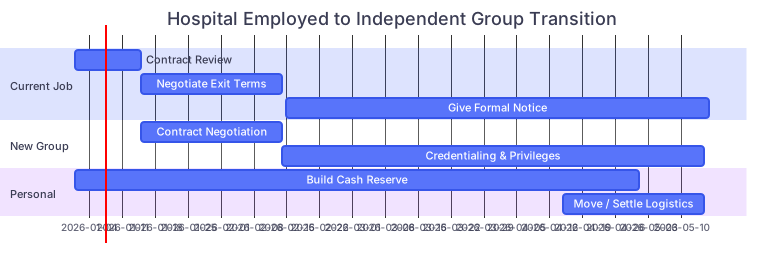
| Task | Details |
|---|---|
| Current Job: Contract Review | a1, 2026-01-01, 14d |
| Current Job: Negotiate Exit Terms | a2, after a1, 30d |
| Current Job: Give Formal Notice | a3, 2026-02-15, 90d |
| New Group: Contract Negotiation | b1, 2026-01-15, 30d |
| New Group: Credentialing & Privileges | b2, after b1, 90d |
| Personal: Build Cash Reserve | c1, 2026-01-01, 120d |
| Personal: Move / Settle Logistics | c2, 2026-04-15, 30d |
Do not rely on HR to “help you figure it out.” Their loyalty is to the employer. This is on you.
Step 9: Protect Your Relationships and Reputation During the Jump
Leaving a hospital job can get political. You want to walk out with your reputation intact.
Rules:
Do not trash your current employer in public or online. Private venting to trusted colleagues is one thing. Public bitterness will follow you.
Be disciplined about patient communication:
- Follow your contract’s rules about notifying patients
- Let the hospital send official notices
- If allowed, have a neutral line: “I will be practicing with X Group starting date Y.” No drama.
With colleagues:
- Tell key allies in person before the rumor mill beats you to it
- Emphasize what you are moving toward, not what you are fleeing
This matters for one reason: referrals.
Even if you have a non‑solicit restriction, many referrers will find you because they trust you. Do not give them a story that makes them question your judgment.
Step 10: Use Your First Year to Secure Your Position, Not Just Survive
Once you land in the independent group, the job is not “done.” You are in your probation year in a new system.
Your goals for Year 1:
Prove reliability
- Show up early
- Take reasonable call and pitch in on tough weeks
- Never be the one who regularly dumps work on partners
Learn the business
Sit with the office manager or practice administrator and actually look at:
- Payer mix
- Denial patterns
- Collections timelines
Understand the key CPT codes for your bread‑and‑butter work and how documentation affects payment
Build internal goodwill
- Treat staff well. Word travels fast. A doc who screams at schedulers does not get defended in partner meetings.
- Volunteer for one unsexy but important committee or project (e.g., EMR optimization, ASC quality).
Track your numbers
- Keep your own:
- Clinic volume
- Procedures
- Collections (ask for monthly statements)
- Compare to what you expected when you signed. If you are far off, have a calm, data‑driven discussion early, not in a panic at month 18.
- Keep your own:
Here is how your ramp‑up might realistically look:

| Category | Value |
|---|---|
| Month 1 | 40 |
| Month 3 | 70 |
| Month 6 | 90 |
| Month 9 | 105 |
| Month 12 | 120 |
If by month 6 the line is flat at 50 instead of rising, you do not wait. You sit down with group leadership and ask:
- “What are we missing on marketing / referrals?”
- “Are there access issues (scheduling, insurance) we can fix?”
- “Can we adjust my clinic template or sites?”
Your first year is the time to demonstrate you are a growth asset, not an expense.
Step 11: Know When Going Fully Independent (Solo or Micro‑Group) Actually Makes Sense
Most physicians considering a move only compare “hospital” vs “existing independent group.” There is a third option: build your own.
It is not for everyone. But for some, the numbers and autonomy are clearly better. Behaviorally, though, you need a high tolerance for risk and admin work.
Situations where starting your own practice can work:
- Rural or underserved markets with clear patient demand
- Niche or concierge models (e.g., DPC, lifestyle medicine, small cash‑pay ortho practice)
- Subspecialists with portable referrer loyalty and relatively low capital needs (e.g., some outpatient psych, derm, rheum)
Key added layers of risk:
- You personally sign leases, hire staff, deal with payroll, manage billing vendors
- You front the capital for equipment and buildout
- You negotiate payer contracts from scratch
The upside is what many physicians actually want: full control.
Here is the trade‑off in blunt form:
| Dimension | Hospital Employed | Independent Group | Solo / Micro-Group |
|---|---|---|---|
| Income ceiling | Moderate | High with ancillaries | Very high if successful |
| Income floor | High | Medium | Low in first 2 years |
| Autonomy | Low | Medium–High | Very high |
| Admin burden | Low–Medium | Medium | High |
| Risk | Low | Medium | High |
If you are considering this path, your transition plan must be even more deliberate: detailed pro forma, conservative assumptions, and likely a practice consultant who has built clinics before.
Step 12: Protect Yourself Against Future Regulatory and Market Shifts
You are not just planning for 2026. You are planning for the next decade of consolidation, value‑based care, and regulatory shifts around non‑competes.
Two strategic moves:
Diversify revenue streams where possible
- Ancillary services you control (ASC equity, in‑office diagnostics, PT)
- Professional services to multiple facilities (reduces dependence on one hospital)
- Upside in value‑based contracts if your group is sophisticated enough to manage risk
Keep optionality
- Avoid absurdly broad or long non‑competes that would trap you if the group sells to a private equity firm you hate in 3 years
- Maintain licensure in at least one additional state if telehealth or relocation becomes attractive
- Keep your CV updated and network alive so you are never cornered
I have seen excellent independent groups sell to large systems or PE. Some do it well and protect their docs. Some sell them out. Your only defense is a contract and career posture that gives you exits.
Putting It All Together
The move from hospital‑employed to independent group can be the best professional decision you ever make. It can also bankrupt you or chain you to a different kind of misery.
The difference is not luck. It is process.
Here is the condensed checklist:
- Clarify why you are leaving and what you refuse to compromise.
- Map your local market and identify serious, stable groups.
- Get a real legal read on your current non‑compete and exit terms.
- Understand the economics of each group; demand numbers.
- Evaluate culture and governance with the same seriousness as salary.
- Build a transition budget and cash buffer.
- Negotiate the new contract with precision, especially partnership terms.
- Time your exit and onboarding to avoid legal and financial gaps.
- Protect your reputation on the way out.
- Use your first year to lock in your value and trajectory.
- Consider whether true independence (solo/micro‑group) is right for you.
- Keep optionality for future market shifts.
Do not try to “feel your way” through this.
Your next step today is simple:
Pull out your current employment contract, go straight to the restrictive covenants section, and write down the exact language on non‑compete, non‑solicit, and notice. That one act will tell you how hard or easy your transition can be—and what kind of help you need to make it safe.