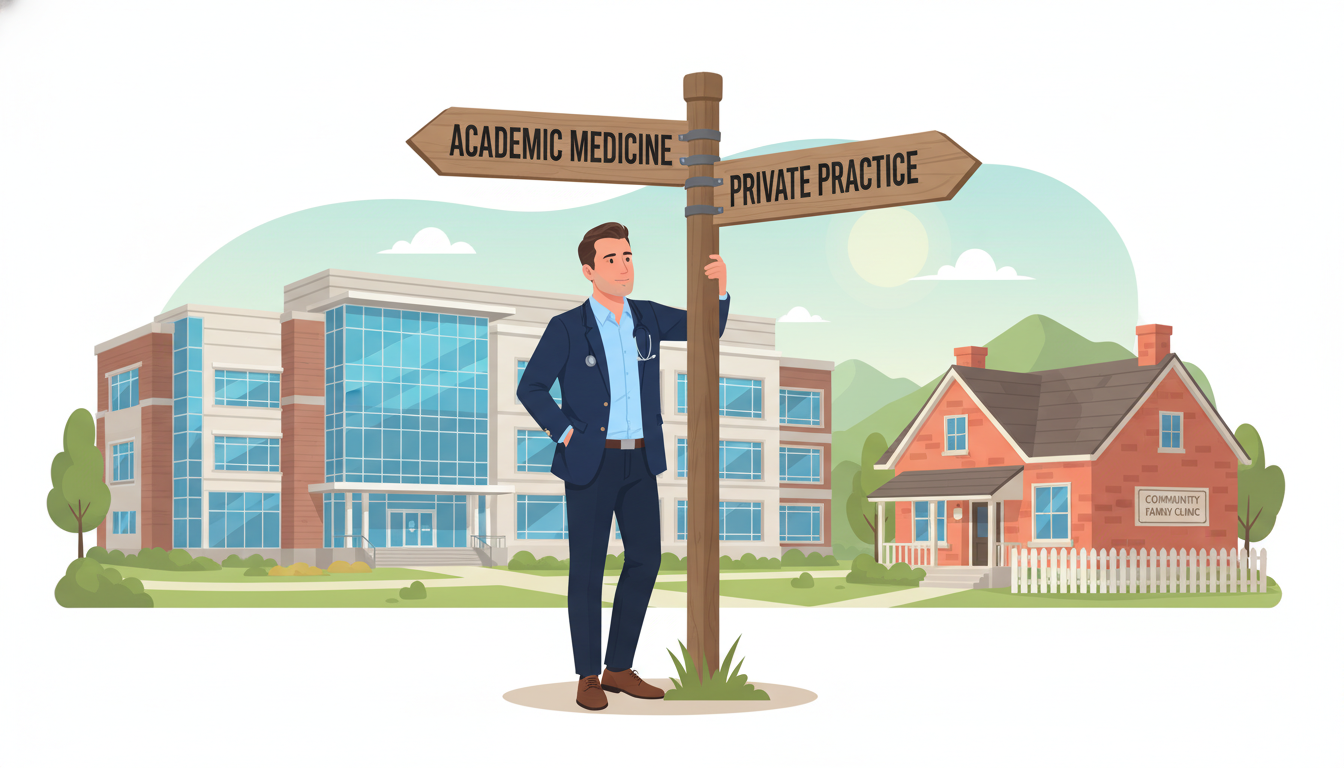
Understanding Your Options After Family Medicine Residency
As an MD graduate in family medicine, one of the first major decisions after residency is choosing between an academic medicine career and private practice. Both paths can lead to rewarding, sustainable careers—but they differ significantly in daily work, compensation, lifestyle, and long-term opportunities.
This article breaks down:
- How academic and private practice settings actually function
- Typical schedules, pay structures, and expectations
- How these choices affect your future career flexibility
- Practical steps to help you decide which path fits you best
We will focus specifically on the realities for a family medicine residency graduate coming from an allopathic medical school match (MD background), though much of this applies broadly.
Defining Academic Medicine vs Private Practice
Before comparing, it helps to clarify what these terms mean. The reality is more nuanced than “university job” vs “small clinic.”
What Is Academic Medicine in Family Medicine?
Academic medicine typically means being employed by:
- A university or medical school
- A teaching hospital or health system
- A community program with formal residency or student teaching
You’re usually part of a department of family medicine or a family medicine residency program. Common roles:
Clinician–Educator
- Sees patients in continuity clinic
- Precepts residents and students
- Attends on inpatient or OB services
- Participates in didactics, curriculum, and evaluations
Clinician–Scholar / Researcher
- Mix of clinic and funded research
- Involved in quality improvement, grants, or scholarly work
- May mentor residents and fellows on projects
Program or Medical School Leadership (later in career)
- Program director, clerkship director, vice chair/chair
- Administrative and leadership responsibilities
Academic roles usually come with faculty titles (e.g., Assistant Professor of Family Medicine) and a formal promotion track.
What Is Private Practice in Family Medicine?
“Private practice” covers a spectrum of arrangements outside of university-based academics:
- Small physician-owned group
- Solo practice
- Large multispecialty group
- Employment by a community hospital or health system (not formally academic)
- Direct primary care (DPC) or concierge model
- Federally Qualified Health Centers (FQHCs) or community health centers (often community-based, may or may not be academic)
The common themes:
- The primary mission is clinical care delivery
- You may have opportunities to teach, but it’s not the primary institutional focus
- There is greater emphasis on productivity and revenue generation
- Governance, compensation, and culture can vary widely from one practice to another

Daily Life: How Work Actually Feels in Each Path
To decide between academic vs private practice, it helps to visualize your day-to-day.
Clinical Workload and Patient Mix
Academic Medicine
- Clinic templates often slightly lighter:
- New patients: 40–60 minutes
- Follow-ups: 20–30 minutes
- Patient population:
- More medically complex, underserved, or safety-net populations
- Higher social complexity, more care coordination
- Supervisory responsibilities:
- Precepting residents and students: indirectly, you “see” more patients via supervision
- Balancing teaching with efficiency
Private Practice
- Templates often more volume-focused:
- Follow-ups commonly 15–20 minutes; sometimes less
- New patients: 30–40 minutes, depending on practice
- Patient population:
- More continuity with families over time
- Wide variety but often fewer “safety-net” dynamics unless in FQHC/community health center
- Less time teaching, more time directly seeing patients:
- Visit counts (18–25+ patients/day) often tied to productivity metrics
Teaching, Research, and Administration
Academic Medicine
- Teaching is part of the job description:
- Precepting clinic sessions
- Didactic lectures and workshops
- Bedside or team-based teaching on wards, L&D, or newborn nursery
- Scholarship:
- Quality improvement projects
- Case reports, educational research, clinical research (depending on role)
- Meetings:
- Residency faculty meetings
- Curriculum committees
- Department conferences and M&M
A typical academic family medicine week (1.0 FTE Clinician–Educator) might be:
- 6–7 half-days of clinic (some with residents)
- 1–2 half-days precepting
- 1–2 half-days of admin/teaching/scholarship
- Periodic inpatient/OB weeks or weekends
Private Practice
- Teaching:
- May precept students occasionally if affiliated with a medical school or PA program
- Less structured teaching; more “shadowing” in clinic
- Research and scholarship:
- Rare unless practice is connected to a research network
- Meetings:
- Business and operational meetings
- Quality and compliance meetings
- Focused on practice management rather than curriculum or scholarly work
A typical private practice week might be:
- 8–9 half-days of clinic
- 1–2 half-days of admin or catch-up (sometimes evenings instead)
- Rare formal teaching sessions
Work-Life Balance and Burnout Considerations
Academic Medicine
Pros:
- More job variety (teaching, clinic, projects) which can protect against burnout
- Often better protected time for non-clinical tasks
- Collegial environment of educators, with peer support
Cons:
- Lower compensation may require more years to reach financial goals
- Academic obligations (lectures, evaluations, committees) can spill into home time
- Promotion and scholarship expectations can be stressors
Private Practice
Pros:
- Potential for higher income and faster debt repayment
- More control over how many patients you see and how hard you push your schedule (in some models)
- Can tailor your practice niche (e.g., procedures, women’s health, geriatrics)
Cons:
- More vulnerable to productivity pressure and RVU targets
- Business and administrative tasks—even if you’re “just employed”—can be significant
- Less protected non-clinical time; charting and inbox work often shift to evenings
Compensation, Benefits, and Long-Term Financial Implications
For many MD graduate residency completers carrying significant educational debt, this is a central question: How does pay differ between academic and private practice?
Base Salary and Incentives
Academic Medicine (Family Medicine)
Typical patterns (varies by region and institution):
- Base salary: Often at or slightly below regional MGMA medians
- Incentive pay:
- RVU or productivity bonuses usually modest
- Non-RVU incentives: teaching, quality metrics, leadership roles
- Salary growth:
- Incremental with promotion (Assistant → Associate → Full Professor)
- Some bump with administrative titles (Program Director, Associate Program Director)
Pros:
- More predictable compensation
- Less direct dependence on RVU extremes
- Access to university-related retirement plans (often generous matching)
Cons:
- Typically lower overall compensation than high-productivity private practice
- Academic promotion may not translate into large salary jumps
Private Practice
Compensation structures vary widely:
- Employed by health system or group:
- Base salary + RVU bonus
- Sometimes a guaranteed salary for 1–2 years, then shift to heavier productivity component
- Partnership track in physician-owned practice:
- Lower initial salary, then buy-in and share of profits
- Potentially significantly higher long-term income
- Direct primary care/concierge:
- Membership fees, smaller panel
- Income linked to patient volume and pricing
Pros:
- Potential for substantially higher income, especially in partnership models
- Clear link between work output and earnings
- Autonomy to shape your financial trajectory (e.g., compress work for higher pay, or reduce volume for lifestyle)
Cons:
- More financial risk and variability
- Need to understand and negotiate contracts, RVU rates, bonuses, and non-compete clauses
- Practice viability and overhead management, particularly in smaller groups or ownership models
Benefits, Loans, and Job Security
Benefits
- Academic medicine:
- Often excellent retirement benefits (e.g., 403(b)/401(a) with strong match or pension components)
- Robust health insurance and institutional perks (CME funds, conference time, tuition benefits for dependents in some systems)
- Private practice:
- Health and retirement benefits depend heavily on the employer
- Smaller practices may offer less generous benefits but higher salary
Loan Repayment and PSLF
- If you’re pursuing Public Service Loan Forgiveness (PSLF):
- Academic hospitals and many safety-net institutions qualify as non-profit employers
- Some FQHCs and community health centers qualify and may be academically affiliated or not
- Private, for-profit practices generally do not qualify for PSLF
- National Health Service Corps (NHSC) and state programs may be available for both academic and non-academic safety-net settings
Job Security
- Academic positions often feel more stable, with large institutional backing
- Private practice stability depends on:
- Local market conditions
- Practice management
- Payer mix and contract negotiations
- Mergers, acquisitions, or changes in payer contracts can meaningfully impact job security in both sectors, but the impact is often more visible in private practice.

Career Growth, Identity, and Long-Term Trajectory
Your first job after the FM match does not have to be your forever job—but it often sets the tone for your professional identity.
Academic Medicine Career Path
If you imagine your “career path in medicine” including education, leadership, or scholarship, academic medicine offers structured paths.
Promotion and Titles
- Instructor → Assistant Professor → Associate Professor → Professor
- Criteria typically include:
- Teaching excellence
- Clinical excellence
- Scholarship (publications, presentations, curriculum development)
- Service and leadership
Leadership Opportunities
Over time, you might:
- Become a residency core faculty member
- Lead curriculum or quality improvement initiatives
- Serve as:
- Clerkship Director
- Associate Program Director
- Program Director
- Vice Chair or Department Chair
- Move into medical school or hospital leadership (e.g., Associate Dean, CMO)
Professional Identity
- Identity as a teacher and mentor is central
- You see your impact multiplied through residents and students you train
- Opportunity to shape the future of family medicine, influence curricula, and contribute to evidence-based primary care
Private Practice Career Path
If your primary professional satisfaction comes from longitudinal patient care, independence, and real-world problem-solving, private practice may be more aligned.
Growth and Advancement
- Becoming a partner/owner
- Leading quality initiatives within your group or network
- Developing niche areas:
- Office procedures (joint injections, skin procedures, vasectomy, etc.)
- Lifestyle medicine, obesity medicine, addiction medicine
- Women’s health, geriatrics, sports medicine
You can also:
- Take on medical director roles (SNFs, hospice, employer clinics)
- Serve on hospital committees or boards
- Combine private practice with local teaching: precepting students or residents part-time
Professional Identity
- Identity as a community physician and advocate
- Deep continuity with patients and families over years or decades
- The autonomy and satisfaction of seeing your practice grow and adapt over time
How to Decide: Matching the Path to Your Priorities
Choosing between academic medicine and private practice is not just about job ads; it’s about self-assessment and intentional planning.
Step 1: Clarify Your Core Motivators
Ask yourself:
What energizes me most?
- Explaining complex topics and coaching learners → academic leaning
- Efficiently solving clinical problems and building a panel → private practice leaning
How important is salary vs lifestyle vs mission?
- Need to aggressively pay off loans and build wealth → private practice often better suited
- Comfortable with moderate salary for greater mission-driven and teaching work → academic likely fits
How do I handle ambiguity and risk?
- Prefer institutional structure, predictable path → lean academic or large employed group
- Comfortable with business risk, negotiation, and market changes → open to private/ownership models
Step 2: Reflect on Your Training Experience
During your allopathic medical school match and family medicine residency, what did you enjoy?
- Did you love precepting junior residents and medical students, giving noon conferences, and creating teaching materials?
- Or did you feel most fulfilled on solo clinic days where you focused entirely on patient care?
Take note of:
- Rotations or electives that felt most natural
- Mentors whose careers you admired
- Settings where you felt least burned out
Step 3: Explore Hybrid and Transitional Options
The choice is not always binary.
Hybrid Models
- Community-based residency faculty:
- 60–80% clinical, 20–40% teaching/admin
- Employed by a hospital system that’s not fully “academic” but has a residency
- Private practice + adjunct academic role:
- Primary job in clinic, part-time teaching or precepting
- FQHC or community health center with academic affiliation:
- Safety-net clinical work with regular residents or students rotating through
These can offer:
- Higher income than full academic roles (in some cases)
- Meaningful teaching and mentoring
- A chance to “try out” academic responsibilities without fully committing to a university track
Step 4: Compare Specific Job Offers, Not Just General Concepts
When you have real offers, compare them concretely. For each:
Schedule and workload
- Clinic sessions per week
- Inpatient/OB call expectations
- Flexibility in scheduling (part-time, 4-day week, telemedicine options)
Compensation package
- Base salary, bonus structure
- RVU or productivity expectations
- Retirement match, loan repayment, PSLF eligibility
- CME funds, relocation, signing bonus
Professional development
- Mentorship availability
- Support for fellowship, certificates (e.g., teaching, leadership, QI)
- Protected time for scholarship or innovation (if academic)
Culture and fit
- How do physicians talk about leadership and administration?
- Do current faculty or partners seem burned out or supported?
- Are your values aligned with how care is delivered and measured?
Step 5: Remember that Your First Job Is Not Final
Many family physicians:
- Start in academic medicine, then move to private practice for higher income or different pace
- Begin in private practice, then move into academic medicine later to teach, reduce volume, or pursue leadership
Your skills from a family medicine residency are inherently portable. Try to avoid the pressure of needing to “get it perfect” on the first try; instead, aim for a good fit for the next 3–5 years that will help you grow.
FAQs: Academic vs Private Practice for Family Medicine MD Graduates
1. Does choosing academic medicine limit my future options?
Not necessarily. Many family medicine MDs move from academic to private practice later. Academic work:
- Builds teaching, leadership, and QI skills
- Keeps you engaged with current literature and guidelines
- Connects you to networks that can help you pivot later
If you keep your clinical skills broad and maintain full-spectrum or at least robust outpatient skills, you’ll remain marketable to private practices.
2. Can I make a competitive income in academic family medicine?
Yes, but typical income is lower than high-productivity private practice. However:
- Benefits (retirement match, health insurance, paid time off, CME) can be very strong
- Loan forgiveness (PSLF, state programs) can effectively boost long-term net income
- Leadership roles (Program Director, Chair) may increase compensation
If you prioritize mission and job variety and you manage finances strategically, academic medicine can be both fulfilling and financially sustainable.
3. Is it possible to teach if I choose private practice?
Absolutely. Options include:
- Serving as a community preceptor for medical students or PA/NP students
- Participating in longitudinal clerkships or rural training tracks
- Hosting residents from nearby programs for continuity or elective rotations
- Holding adjunct faculty appointments with a local medical school
You won’t have the same level of protected time or formal academic responsibilities, but you can still have a meaningful teaching role.
4. How early in residency should I decide between academic and private practice?
Use the first half of residency to explore broadly:
- Take on teaching opportunities with junior learners
- Get involved in at least one QI or scholarly project
- Rotate in both academic and community/hospital-employed settings
By PGY-2 to early PGY-3, start:
- Identifying mentors in both academic and private practice
- Attending networking events or career fairs
- Tailoring electives (e.g., teaching electives, practice management electives)
You don’t need a final decision until you start interviewing, but having a provisional direction by mid-PGY-2 helps you target the right opportunities.
Choosing between academic vs private practice after a family medicine residency is fundamentally about aligning your values, interests, and financial realities with the work environments that best support them. Whether your path leads you to university clinics and residency conferences or to a high-functioning private group caring for generations of families, your training as an MD graduate has prepared you for a wide range of fulfilling futures in family medicine.