
The official criteria for faculty hiring are a fiction. Division chiefs do not hire the “best” applicant on paper—they hire the person who best solves their problems while creating the fewest new ones.
Let me walk you through how they really rank fellowship graduates for faculty jobs, because the way this happens in closed-door meetings is nothing like the polished language you see in job postings.
What Division Chiefs Actually Optimize For
Publicly, they talk about “excellence in clinical care, teaching, and scholarship.” Privately? They’re solving a math problem that looks more like:
“How do I cover my call schedule, protect my rainmaker’s time, keep the chair off my back, grow the service line, and not hire a disaster?”
Every applicant gets mentally scored across a few buckets. There’s no formal rubric most of the time; it’s gut plus spreadsheet. But the buckets are remarkably consistent:
- Revenue and workload value
- Reputation and risk (will you embarrass them or elevate them?)
- Strategic alignment (do you fit the division’s real needs?)
- Political safety (will key people be happy or furious?)
- Trajectory (are you a future star or future problem?)
CVs, letters, and interviews are just tools to feed those buckets.
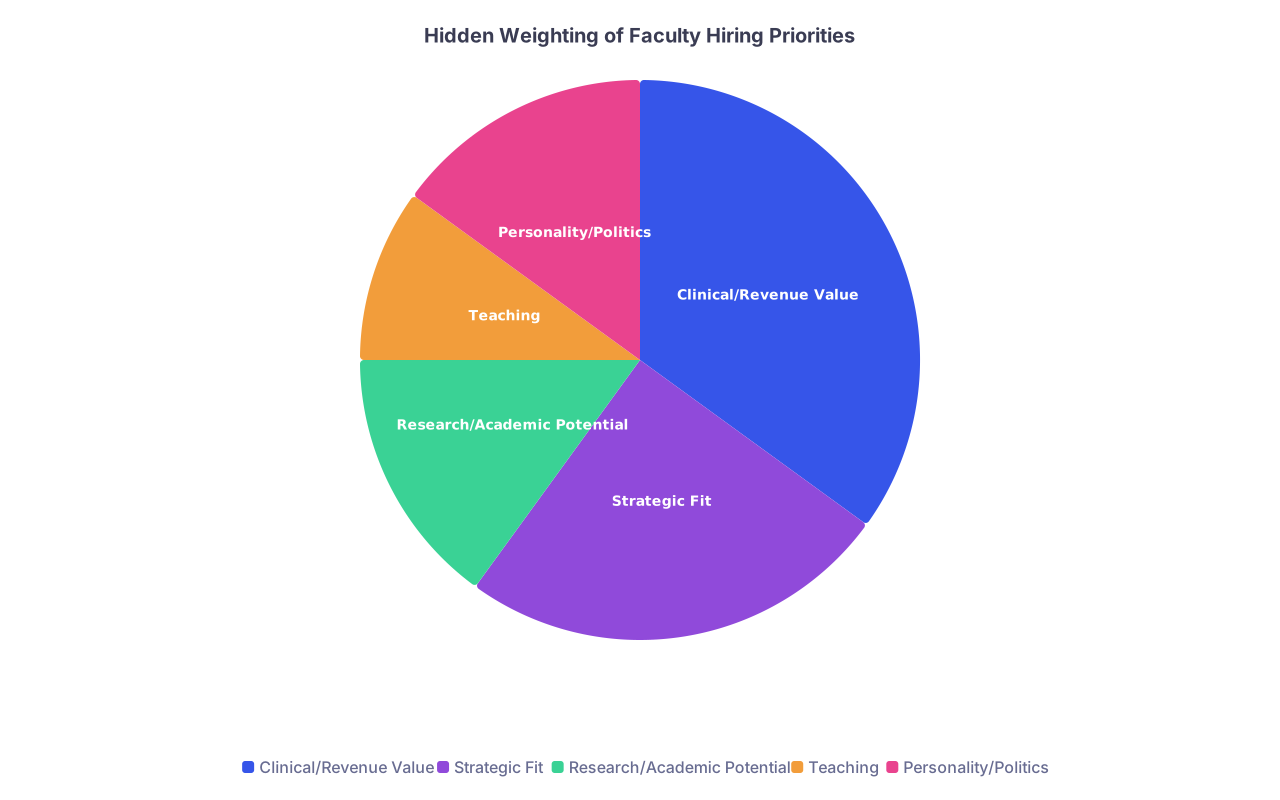
| Category | Value |
|---|---|
| Clinical/Revenue Value | 35 |
| Strategic Fit | 25 |
| Research/Academic Potential | 15 |
| Teaching | 10 |
| Personality/Politics | 15 |
They’ll never show you that pie chart, but versions of it are drawn on whiteboards in chief offices every hiring season.
Step 1: The Quiet Pre‑Screen Before You Even Know You’re Being Ranked
By the time you’re formally interviewed, you’ve already been pre-ranked informally. You just do not see it.
Here’s the actual sequence that plays out.
The email or text that starts everything
A job doesn’t begin with HR. It starts like this:
“Hey, we losing anyone next year?”
“Yup, Priya’s going to MD Anderson.”
“Shit. We need another malignant heme person. Maybe two.”
Then the chief (or service line director) does one of three things:
- Texts trusted faculty: “Any standout fellows we should look at for next year?”
- Emails fellowship directors: “Who are your top two people headed for academics?”
- Checks internal fellows: “Which of our folks are actually staying in academics vs private?”
Names show up long before applications.
If you’re not someone’s recommended name—your fellowship PD, a former attending, a collaborator—you’re already in the second tier unless the division is desperate.
The invisible short list
I’ve seen this done bluntly on a whiteboard:
- Column A: “Internal”
- Column B: “External – Known”
- Column C: “External – Cold”
Then they write names:
- Internal names get a baseline advantage because onboarding risk is lower.
- External-known are people someone in the department has worked with or strongly vouched for.
- External-cold are everyone else.
If there are 10–15 applicants, the chief might really be thinking about 4–6. The rest exist to convince the chair and HR this was a thorough search.
Step 2: How They Read Your CV (Not How You Think)
Division chiefs read CVs like triage notes, not like literature.
They’re scanning for answers to a few blunt questions.
1. Can this person do the work I actually need done?
They’re not asking “Are they qualified?” They assume baseline competence if you’ve finished fellowship in a real program. They’re asking:
- “Do they do bread-and-butter work or are they super subspecialized in something we barely see?”
- “Do their procedure numbers suggest they can be left alone on service?”
- “Can they take call without melting down?”
If you’re a cardiology fellow trying to sell yourself as “advanced multimodality imaging only, minimal call,” and the division desperately needs general cardiology and weekend coverage, you just quietly dropped several spots in their mental ranking, no matter how many posters you have.
2. Are they a revenue center or a cost center?
No one will say this out loud during your interview, but they’re thinking it every time they see:
- Niche clinics that don’t bill well
- Too much “protected time” expected straight out of fellowship
- A research portfolio with lots of effort and little funding
A fellow who can step into a high-volume clinic or procedural role starts much higher on the list than a fellow who needs a custom-built research niche and 60% protected time. Even at “academic” places.
3. Is their academic output directionally promising?
Most chiefs are not counting papers like bean counters. They’re asking:
- “Do they show a consistent trajectory of productivity?”
- “Are they first or last author on anything meaningful?”
- “Do they have at least one recognizable senior coauthor?”
- “Is there a clear niche forming, or it is all random?”
Someone with 5–10 solid, coherent projects in a focused area will rank higher than someone with 20 scattered case reports and low-impact odds and ends.
4. Did they train at places we trust?
This is where pedigree quietly matters.
There’s a mental shorthand: “We know what we get from UCSF GI or Brigham cards or UPenn heme-onc.” Same for strong regional programs. It reduces risk. If they’ve never heard of your fellowship, you’re not doomed, but you’re not starting with the same presumption of strength.
This is why you see people from the same fellowships cluster in certain departments. It’s not laziness; it’s risk management.
Step 3: Letters of Recommendation – The Code Behind the Fluff
Most fellows wildly overestimate letters. Chiefs don’t. They know 80% of letters are useless fluff.
Here’s how they really read them:
Who wrote it?
- Big name in your field they personally know or respect → that letter gets attention.
- Random associate professor from a small place → polite skim.
What’s the strongest claim in the letter?
They look for one or two sentences that actually commit to something, like:- “Top 5% of fellows I’ve worked with in 20 years.”
- “We made a serious effort to keep her on faculty.”
- “He already functions at the level of a junior faculty member.”
What’s missing that should be there?
If your letter from your PD is descriptive but never compares you to your peers, that’s noticed. I’ve heard chiefs say:
“If they won’t say ‘top’ anything, that means middle of the road. At best.”
Sometimes a weak or neutral letter quietly tanks you. The chief doesn’t tell HR “We’re rejecting because the PD wasn’t glowing.” They just nudge you down the list.
| Phrasing in Letter | How Chiefs Interpret It |
|---|---|
| "Top 5% / one of the best in X years" | True standout, top tier |
| "Top quarter / top 10–20%" | Strong, safe upper-middle |
| "Among the many excellent fellows..." | Middle of the pack |
| Purely descriptive, no comparisons | Weak or lukewarm |
| Emphasis on personality over skill | Concern about competence |
Step 4: The Off‑Record Backchannel That Overrides Everything
Here’s the part no one tells applicants: an off-record phone call from a trusted colleague is more powerful than your entire CV.
The chief will call people you don’t even realize:
- Your fellowship PD (even if not listed)
- Someone they know at your institution
- A mutual collaborator or coauthor
The questions are blunt and not always nice:
- “Would you hire them on your faculty?”
- “Any professionalism issues I should know about?”
- “How much hand-holding did they need as a fellow?”
- “Are they needy? High maintenance? Solid citizen?”
And then the killer one: “If you had to choose between them and [another known fellow], who would you pick?”
I’ve watched strong-on-paper candidates fall several slots because a PD said, “Brilliant, but a bit difficult to work with” in a slightly tired tone. That’s all it takes.
On the flip side, I’ve seen average-published fellows shoot to the top because someone said: “I’d take three of them if I could. Workhorse, zero drama.”
Step 5: The Shadow Scorecard – How Chiefs Rank You in Their Head
No one opens a meeting and says, “Let’s assign each fellow a weighted score.” But many chiefs mentally (or literally, in Excel) run a private scorecard.
Roughly, it looks like this behind closed doors:
| Category | Weight | What Top-Ranked Fellows Look Like |
|---|---|---|
| Clinical/workload value | High | Can cover critical services, reliable, efficient |
| Strategic fit | High | Fills needed niche (procedures, clinic, program) |
| Academic potential | Medium | Clear niche, some output, maybe early funding |
| Teaching/mentoring | Medium | Good evaluations, likes learners |
| Personality/politics | High | Low drama, adapts well, no red flags |
Let me translate that into what actually happens in the ranking discussion.
The ranking conversation in the chief’s office
Picture a slightly overworked chief sitting with 1–3 senior faculty. Names on a printout. Coffee that’s been reheated twice.
The conversation is not academic. It sounds like this:
“Okay, let’s start with Patel.”
“Rock solid. PD loves her. Can do general and advanced procedures. No attitude. We should grab her.”“Nguyen?”
“Crazy productive. Wants 60% research. We can’t support that right now. Maybe if we get that grant next year. I’d put him second or third.”“Smith?”
“… Nice guy. Letters are fine, but nobody’s really excited. Feels like middle-of-the-road. Backup if we strike out on the top two.”
By the end, they have a mental tier list:
- Tier 1: “We must try to land them.”
- Tier 2: “We’d be happy with them.”
- Tier 3: “Only if we strike out or need to fill a hole fast.”
You want to live in Tier 1 or the very top of Tier 2.
Step 6: Strategic Fit – The Piece Fellows Always Misread
Fellows talk about “fit” like it’s a vibe. Chiefs talk about fit like it’s a spreadsheet.
They’re juggling:
- Retirements and upcoming departures
- Call coverage patterns
- Clinic growth targets
- Procedure volumes
- Research mandates from the chair or dean
So when you come in saying, “I’d like 70% research, only breast, and no call,” at a division drowning in general inpatient service, you’re ranking yourself straight into Tier 3.
A few concrete patterns I’ve seen:
- In smaller or regional academic departments, a high-volume, broad-scope clinician who teaches well will outrank a subspecialized researcher nine times out of ten.
- In top research-heavy departments, a fellow with even a hint of real funding potential (K-award path, strong mentor ties) jumps the line past excellent clinicians who look like pure service.
- In divisions trying to launch a new program (e.g., cardio-onc, interventional pulm), they’ll over-prioritize anyone who can credibly build that niche, even if their overall profile is a bit weaker.
If you’re not paying attention to where the division is in its life cycle—growth, consolidation, survival—you’re flying blind.
Step 7: Personality and Politics – The Deciding Factor When It’s Close
When two candidates are similar on paper, chiefs choose based on personality and politics. Every time.
They’re running a mental risk calculation:
- “Will this person create drama?”
- “Will they fight with nursing? With other services?”
- “Are they someone I’d trust alone with a VIP patient?”
- “Will my senior faculty accept them or resent them?”
You get judged on:
- How you treat staff during your visit
- Whether you talk over people in group meetings
- How you discuss your fellowship program and mentors (do you trash-talk or show maturity?)
- How realistic you are about your own strengths and limits
One chief I know keeps a single private line on his interview notes: “Would I want to be stuck at the airport with this person for 6 hours?” If the answer is no, that candidate drops.
And politics: if your hire will offend a key internal candidate, undercut a powerful senior faculty member, or upset the chair’s pet initiative, your rank falls no matter how impressive you are.
Step 8: The Call, the Offer, and Who Gets Pushed Over the Finish Line
After they rank you, they still have to get approval up the chain.
Here’s where chiefs quietly adjust their strategy:
- Candidate they don’t want to lose: They push hard, exaggerate your value to the chair, secure a better package, move fast.
- Candidate they’re fine losing: They drag their feet, delay the offer, or give a lowball package they know may not be accepted.
You experience this as: “Wow, they seemed enthusiastic but the offer is weirdly slow.” Inside, the conversation is:
“We like her, but not enough to fight for more FTE or space. If she takes it, great. If she doesn’t, we go back to the list.”
Timing, speed of communication, and willingness to negotiate tell you exactly where you sat on their internal ranking.
How You Actually Move Up That Quiet Rank List
You cannot change everything about how chiefs think, but you can stack the deck.
A few levers that matter far more than fellows realize:
Your PD and senior mentors need a clear story about you.
If they can’t quickly say, “She’s our top person this year in X niche and we tried to keep her,” you’re losing free points.Align your ask with the division’s reality.
Early career? Lead with: “I’m ready to carry a solid clinical load and build [X niche] over the next few years. Long-term I’d like protected time, but I know I need to earn that here.” That line alone has bumped people up the invisible list.Signal low maintenance, high reliability.
Chiefs love phrases like: “I don’t need a lot of hand-holding. I just need clarity on expectations and I’ll run with it.”Invest in one or two strong backchannel advocates.
A respected attending picking up the phone and saying, “If you don’t hire her, you’re making a mistake,” is worth more than a dozen generic letters.Behave like a future colleague, not a visiting student.
Ask about program growth, pain points, what’s keeping the chief up at night. Then talk about how you can help. That’s what moves you mentally from “applicant” to “solution.”

| Step | Description |
|---|---|
| Step 1 | Service Needs Arise |
| Step 2 | Short List of Names |
| Step 3 | Screen CV and Letters |
| Step 4 | Backchannel Calls |
| Step 5 | Internal Ranking Tier 1-3 |
| Step 6 | Interviews for Top Tiers |
| Step 7 | Discussion and Final Rank |
| Step 8 | Chair Approval and Offer |
FAQs
1. If I’m not from a “top” fellowship, can I still rank highly?
Yes—if your fellowship PD and attendings are willing to go to bat for you and if you clearly solve a division’s problems. Strong backchannel advocacy, a coherent academic or clinical niche, and a reputation as a workhorse can easily beat someone from a brand-name program who looks high-maintenance or misaligned with the division’s needs.
2. How much do publications really matter for my first faculty job?
They matter less than you think for most clinical-heavy jobs and more than you think for true research-track roles. Chiefs look for trajectory and coherence, not raw count. A small, focused body of work in a clear niche with good mentors behind you will put you above someone with scattered case reports and no real direction.
3. Should I ask for protected time in my initial negotiations?
You should talk about long-term goals, but if you lead with “I need 50–70% protected time” without funding or a real plan, you drop in the ranking at many places. A better move: show willingness to carry a reasonable clinical load, describe a realistic research/academic pathway, and ask, “What have you successfully done for junior faculty in my situation?”
4. Do chiefs really call my fellowship PD even if I don’t list them as a reference?
All the time. And not just your PD. They’ll call anyone in your department they know or trust. That’s why your day-to-day behavior in fellowship matters more than you think—those informal reputational whispers carry huge weight in the final ranking.
5. How can I tell where I actually ranked if I get an offer?
Watch the behavior, not the words. Fast movement, clear enthusiasm, and willingness to negotiate usually mean you were near the top. Slow responses, vague timelines, or a rigid lowball offer often mean you were lower on the list and they’re not afraid to lose you. You will never see the list, but their urgency tells you most of what you need to know.
At the end of the day, remember three things. Chiefs are hiring solutions, not CVs. Backchannel comments outweigh anything written in your application. And the fellow who quietly fits the division’s real problems—clinically, politically, and culturally—wins the top spot more often than the one with the flashiest paper list.