

What if the real “wrong choice” in your career isn’t picking academic or private practice—but believing you have to pick one at all?
The clean fork in the road you were sold in training—academic vs. private, teaching vs. money, research vs. RVUs—is mostly fiction. It’s a simplified story attendings tell because it made their decisions easier to justify. Not because it describes what physicians are actually doing now.
Let me be blunt: the modern job market is already full of hybrid careers. You just do not hear about them during residency because most faculty only know their own lane and old talking points.
Let’s dismantle this.
The False Binary: Where This Myth Comes From
You were probably told some version of this:
- “If you care about teaching and research, you go academic.”
- “If you care about income and work‑life balance, you go private.”
- “Once you leave academics, it’s very hard to go back.”
- “Private is selling out; academic is noble.”
This framing is outdated. It made more sense 20–30 years ago when:
- Academic centers had clearer tenure tracks and protected research time.
- Private groups were more independent and less corporatized.
- Telemedicine, remote teaching, and cross-appointments barely existed.
Now?
- A huge chunk of “private practice” is actually hospital-employed or large system-employed.
- Many “academic” jobs are essentially high-volume clinical service with a teaching veneer and minimal real scholarly time.
- Side gigs and portfolio careers (locums, telehealth, consulting, medical education companies) are mainstream.
So the binary not only fails to describe reality. It actively harms people by pushing them into rigid boxes that no longer match how work is structured.
Here’s what the data and real careers actually look like.
What Physicians Really Do After Residency (Not the Brochure Version)
Let’s start with the big picture.
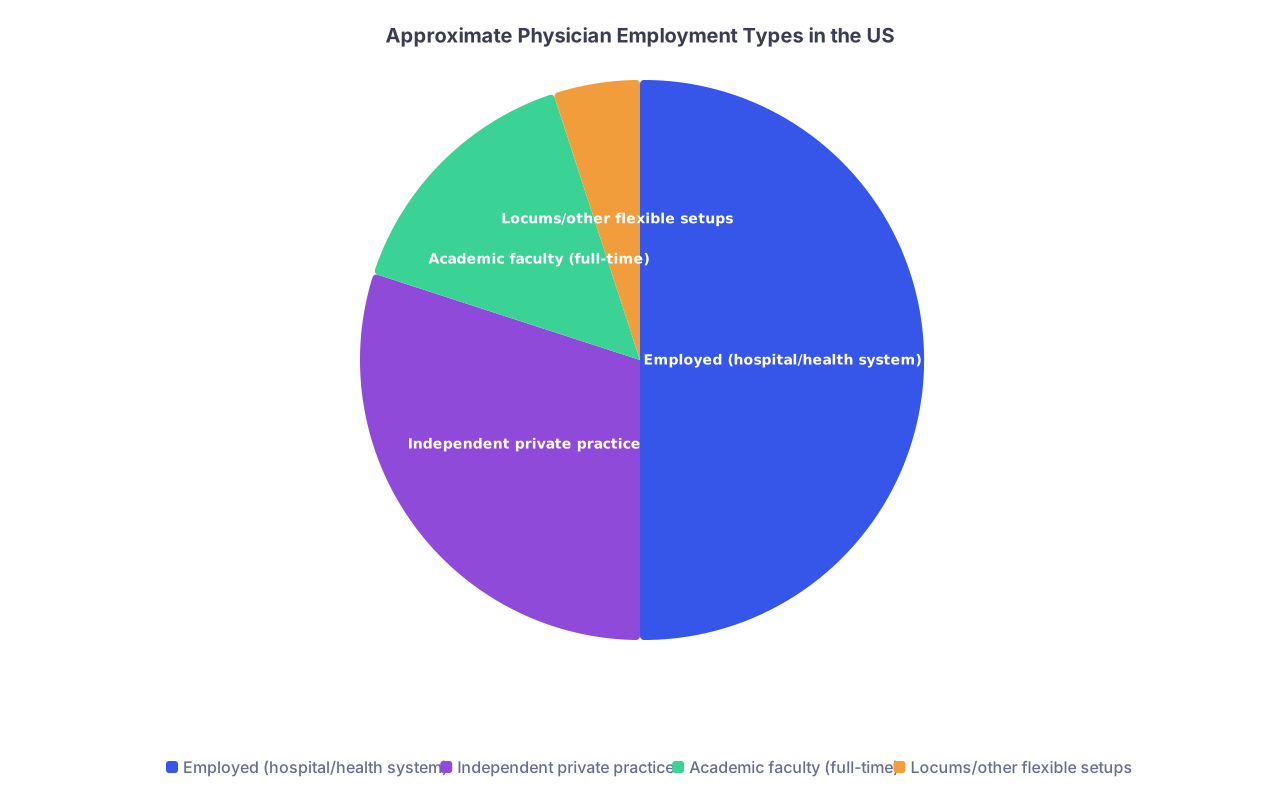
| Category | Value |
|---|---|
| Employed (hospital/health system) | 50 |
| Independent private practice | 30 |
| Academic faculty (full-time) | 15 |
| Locums/other flexible setups | 5 |
What this really means:
- Only a minority are in pure, classic academic jobs with substantial protected non-clinical time.
- Only a minority are in fully independent, solo or small-group, classic private practice.
- A large middle swath is “employed” but can tack on academic titles, teaching roles, or side businesses.
And the line between “academic” and “private” is extremely blurry:
- Community hospitals with residents and students but run like private practice.
- Academic centers hiring “clinical track” faculty who have 90–95% clinical time and RVU bonus structures indistinguishable from private jobs.
- Private groups that affiliate with med schools to host rotations and get voluntary faculty titles.
So if you’re still thinking “I have to choose one forever,” you’re using a map from about 1995 to navigate a 2026 landscape.
The Many Flavors of Hybrid Careers
Let’s go through specific models, because vague reassurance is useless. You need models you can actually copy or adapt.
1. Full-Time Clinical with Academic Add-Ons
This is extremely common and almost never advertised honestly to residents.
Setup looks like:
- You’re employed by a hospital or larger group.
- On paper, your job is 100% clinical.
- In reality, the hospital wants learners. So they encourage you to precept residents, supervise students, or teach on wards.
- You get a “clinical instructor” or “assistant professor” title at an affiliated med school.
You might:
- Teach 1–2 half-days a week in clinic with residents.
- Take a team on inpatient service a few weeks a year.
- Help with M&M conferences or board review.
You’re basically private/employed in workflow and compensation, with a side of academic identity and teaching that scratches that itch.
2. Academic Title, Private Practice Income
I’ve seen this pattern a lot in specialties like cards, GI, ortho, EM, anesthesia:
- Group is technically private or “private-equity backed,” but contracts with a medical school.
- Most partners and senior associates hold “voluntary” or “adjunct” academic titles.
- They host residents, give lectures, and sometimes participate in trials for devices or drugs.
Translation: they bill like private practice, get paid like private practice, but have just enough academic engagement to maintain a CV and a sense of professional legitimacy beyond RVUs.
Is it pure ivory tower research? No. Is it “not academic at all”? Also no.

3. Part-Time Academic + Part-Time Community or Private
This is where the myth really collapses.
Common versions:
- Three days a week as academic hospitalist; two days a week in a private clinic or telehealth.
- 0.7 FTE academic appointment with protected research effort; 0.3 FTE moonlighting or locums in community hospitals.
- Academic intensivist 1 week on/1 week off; during “off” weeks doing consulting, legal expert work, or outpatient private practice.
Faculty contracts increasingly allow 0.5–0.8 FTE arrangements, especially in fields like psychiatry, hospital medicine, radiology, EM.
And on the private side, many groups will happily take an extra 0.2–0.3 FTE of coverage from a known entity who brings academic credibility.
Is it administratively messy? Sometimes. Does it exist? Absolutely.
What the Data Actually Shows About “Choosing Wrong”
There are a few persistent scare stories:
- “If you go private, you’ll never get back into academics.”
- “If you go academic, your income will always lag massively behind.”
- “Hybrid careers are unstable or risky.”
Let’s walk through each.
1. Moving Between Academic and Private
People move both directions all the time. The trick is what you do while you’re in each lane.
I’ve watched:
- A hospitalist spend 5 years in community practice, then get hired as academic faculty at a university hospital because she’d slowly built a teaching portfolio and kept publishing QI projects from her community site.
- An EM doc who started in a university-based ED, moved into a democratic private group for 6 years, then got recruited back as an ED director at a teaching hospital explicitly for his operational experience.
The real barrier isn’t the label “private” or “academic.” It’s a dead CV.
If you leave academics and:
- Stop teaching entirely.
- Do no QI, no guideline work, no presentations, nothing beyond RVUs.
Then yes, 7 years later, your application to a research-heavy academic job will be a tough sell.
But if you:
- Maintain at least some teaching exposure.
- Keep your name on QI protocols, local projects, or collaborations.
- Occasionally speak at conferences or regional meetings.
Your “private” years become a selling point: you understand real-world volume, access issues, payer mix, and operations.
The academic market does not hate that. It increasingly loves it.
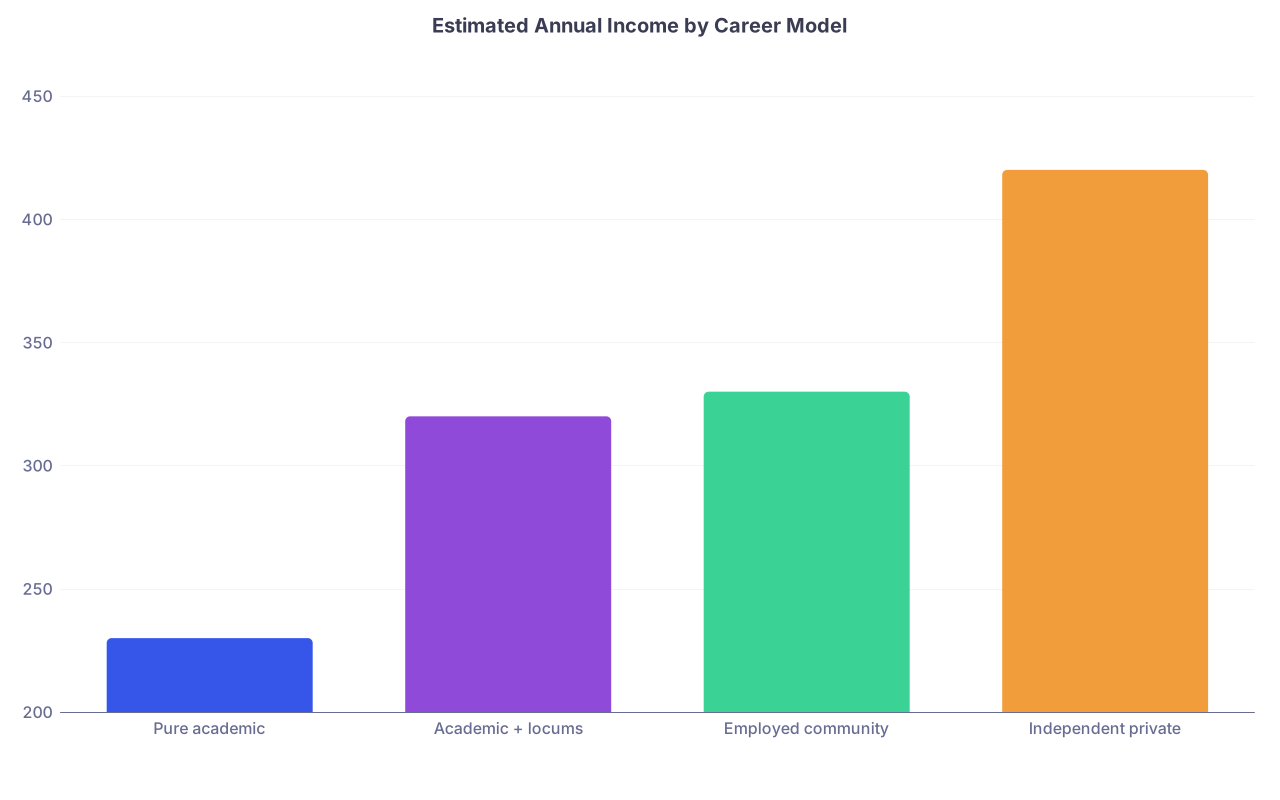
2. Income Differences Are Real—but Not Binary
Stop thinking “academic = poor, private = rich.” It’s lazy.
| Path Type | Example Total Compensation |
|---|---|
| Classic academic (early) | $200k–$260k |
| Academic clinical track | $250k–$350k |
| Employed community | $275k–$375k |
| Independent private | $300k–$500k+ |
Are these crude? Yes. But the overlap is obvious.
Three things that blow up the simple money myth:
- Many “academic clinical track” jobs now pay surprisingly close to community jobs, especially in high-need fields (psych, primary care, hospitalist, ICU).
- Many “private” jobs are now effectively hospital-employed with salary caps, quality bonuses, and only moderate upside.
- Hybrid setups can shift the needle dramatically.
Example I’ve seen more than once:
- Academic hospitalist 0.7 FTE making ~$220k salary.
- Locums 0.3 FTE at $180–220/hour, 3–4 shifts/month → another $80–120k.
- Net: $300–340k, plus teaching, plus benefits from the academic side.
Not private-practice cardiology money. But very far from the stereotype of “you’ll be broke in academics.”
| Category | Value |
|---|---|
| Pure academic | 230 |
| Academic + locums | 320 |
| Employed community | 330 |
| Independent private | 420 |
3. Stability and Risk: It’s Not Where You Work, It’s How You’re Structured
If you think academic = safe and private = risky, you haven’t been watching the last decade:
- Academic departments closing service lines and laying off faculty.
- RVU targets creeping up in both academic and private settings.
- Hospital-employed docs losing autonomy when systems merge.
The real variable is diversification.
Hybrid careers inherently diversify:
- Income sources (salary + moonlighting + consulting).
- Professional identity (teacher + clinician + something else).
- Geographic options (academic title at one site, telehealth licensed across states, etc.).
If your entire identity and income hinge on one department chair or one call group’s politics, you’re actually more fragile—even if your badge says “university.”
How People Quietly Build Hybrid Careers (While Everyone Talks in Binaries)
Let’s talk practical tactics. What do actual physicians do to blend academic and private work?
Step 1: Protect Optionality Early
Your first job does not have to be your forever job. Ignore the “one right decision” myth.
But your first 2–5 years do set your options.
If you start in private/employed:
- Volunteer to teach residents or students if your hospital has them.
- If it doesn’t, reach out to nearby med schools for community preceptor roles.
- Do small but real projects: QI initiatives, protocol development, local guidelines.
- Get your name on at least a few posters, talks, short papers, or online educational content.
If you start in academics:
- Get exposure to operations, billing, and productivity. Understand how RVUs and contracts work.
- Maintain your procedural skills and volume so you’re marketable in community settings.
- Consider occasional moonlighting in non-academic hospitals, urgent care, or telehealth.
The goal is simple: do not let your CV or your skill set become one-dimensional.

| Step | Description |
|---|---|
| Step 1 | Residency |
| Step 2 | Academic with moonlighting |
| Step 3 | Private with teaching role |
| Step 4 | Build teaching and research file |
| Step 5 | Build QI and leadership portfolio |
| Step 6 | Hybrid - Academic + community |
| Step 7 | First Job |
Step 2: Use Titles Strategically, Not Emotionally
“Assistant Professor” sounds fancy. “Partner” sounds powerful. Both are mostly labels wrapped around:
- Who pays you.
- What you actually do all day.
- What future doors they keep open.
In a hybrid world, you can:
- Hold a voluntary academic title while being primarily private.
- Be employed by a health system and still teach as “adjunct faculty.”
- Keep one foot in a med school while running a side LLC for consulting or telehealth.
Choose titles and roles that create future options, not ego sugar.

Step 3: Treat Non-Clinical Work Like Real Work
A lot of hybrid paths collapse because people treat teaching, research, or side gigs as an afterthought.
You want a true blend?
- Block time for it. In your calendar, like clinic.
- Track output. Lectures given, projects led, protocols written.
- Say no to unpaid, unfocused “extra” work that doesn’t build any coherent portfolio.
If you want a meaningful academic footprint while in private/employed practice, you can’t be the person who “helps out when needed” and leaves no trail.
You need visible, legible contributions.
The Psychological Trap: Identity Narratives That Box You In
There’s another reason this myth persists: identity.
Physicians cling to reductive career stories because the real landscape is messy and uncertain. Saying “I’m an academic surgeon” or “I’m a private practice internist” feels clean and legible—to yourself and others.
But here’s the uncomfortable truth: the job market doesn’t care about your neat identity statement. It cares about:
- Skills you use.
- Problems you solve.
- Value you create.
- Flexibility you offer.
Hybrid careers often feel “less pure” at first:
- The academic side might be heavy on teaching and light on prestigious R01-level research.
- The private side might be hospital-employed with corporate bureaucracy, not the mythical independent shop.
- The side gigs might be unsexy (QA, telehealth, chart review) rather than flashy media appearances.
But they are resilient. And they tend to match real human preferences: some prestige, some money, some control, some variety.
The purist stories—100% researcher or 100% high-volume RVU grinder—break more people than they fulfill.

How to Actually Decide Your Next Move (Without Falling for the Myth)
Instead of asking “academic or private?” ask:
- How much do I really care about formal research vs. just being involved in improvement and innovation?
- How much do I want to teach—and in what format? Bedside? Lectures? Online?
- How important is income above a certain baseline? Not in abstract, but in dollars.
- How much autonomy and flexibility do I want day to day?
- How allergic am I to bureaucracy, committees, and promotion packets?
Then you build a mix:
- Baseline job: covers your income floor and benefits.
- Academic/educational pieces: titles, teaching roles, projects layered on top.
- Optional side work: locums, telehealth, consulting, medico-legal, etc., to adjust income and variety.
You absolutely do not have to hit the perfect blend out of the gate. You just need to avoid jobs that close doors you may want later.
Red flag jobs:
- Contracts prohibiting any outside work or moonlighting, with no academic upside.
- Positions with punishing RVU targets that leave zero time/energy for teaching or projects.
- Academic roles where your “protected time” keeps getting swallowed by service and there’s no enforcement.
Hybrid careers live or die on control of your time. Protect that first.
FAQ (Exactly 4 Questions)
1. If I start in private practice, can I ever get a real academic job later?
Yes, if you treat your private years as academically productive, not academically dead. That means teaching learners, doing QI and implementation work you can present or publish, and staying connected to at least one academic institution or professional society. If you vanish into pure RVU production for 8–10 years with no scholarly or teaching record, then yes, it’s hard to pivot back to a research-heavy university role. But clinically-focused academic positions are very open to experienced community physicians with a clear track record of teaching and system improvement.
2. Is it realistic to have two employers (e.g., academic 0.7 FTE and community 0.3 FTE)?
It’s more realistic now than it has ever been, but it requires adult paperwork. You need to understand non-compete clauses, malpractice coverage, scheduling commitments, and how each employer views outside work. The cleanest hybrid setups often involve: one primary employer plus formalized moonlighting contracts; or an academic appointment tied to your primary clinical site, plus separately contracted locums work. Work with a lawyer on your first contract if you’re serious about this; the rookie mistake is signing away your ability to blend without even realizing it.
3. Do I need publications to count as “academic” in a hybrid career?
You need output, but it does not have to be traditional PubMed-heavy output unless you’re chasing R01-level research careers. For many clinical and teaching-focused faculty tracks, a mix of QI projects, case reports, education research, local guidelines, and regional talks is plenty. What matters is demonstrable contribution, not impact factor worship. If you like writing, great—leverage it. If you don’t, focus on being a go-to person for curriculum, simulation, protocols, or outcomes projects.
4. Will a hybrid path hurt my chances at promotions or leadership roles?
It can slow traditional academic promotion if your non-academic work displaces scholarship instead of complementing it. But hybrid backgrounds are increasingly valued for leadership roles: department chairs, service line directors, CMOs, quality leaders. People who’ve seen both academic and community sides, who understand revenue and operations, are extremely useful. If you want traditional academic promotion, you’ll need to be deliberate about documenting teaching, scholarship, and service. If you care more about leadership and influence than titles on the med school ladder, a well-constructed hybrid CV can actually be an advantage.
Key Takeaways
- “Academic vs. private” is a false binary. The market is already hybrid; the labels have just not caught up.
- Your options later depend less on your first job’s label and more on whether you keep teaching, leading, and producing visible work.
- The smartest move is not picking the “right” lane forever; it’s structuring your career so you can adjust the blend of academic and private elements as your life and priorities change.


