
Academic promotion is not “all about publications.” That line is lazy, demoralizing folklore that survives because people repeat it more than they read bylaws.
You do need scholarly productivity to advance. But the idea that promotions committees are just counting PubMed entries and h-indexes while ignoring teaching, clinical excellence, and leadership? That’s not what the data or actual promotion criteria show at most medical schools in 2024.
Let’s separate what people complain about in the workroom from what actually gets rewarded.
The Lore vs. The Documents
Every institution has two promotion systems:
- The myth system – what people say in the hallway.
- The documented system – what’s written in the promotion and tenure guidelines.
I’ve read enough actual promotion policies and seen enough dossiers to tell you: those two systems overlap, but they’re not the same beast.
Common hallway myths:
- “If you don’t have R01 funding, you’ll never make full professor.”
- “Teaching awards don’t matter; they’re just ‘nice to have.’”
- “Clinician-educator = dead end for promotion.”
- “Administration and leadership don’t count. It’s all about RVUs and publications.”
Now compare that to what’s written in many medical school promotion policies.
| Track | Scholarship Weight | Teaching Weight | Clinical/Service Weight |
|---|---|---|---|
| Tenure Research | Very High | Moderate | Low-Moderate |
| Clinician-Educator | Moderate | High | Moderate-High |
| Clinician-Scholar | High | Moderate | Moderate |
| Clinician (no P&T) | Low-Moderate | Moderate | High |
Do publications matter? Of course. But the type and amount that matter are completely track-dependent. That’s the part people conveniently skip when they say “it’s all about publications.”
What the Data Actually Show About What Predicts Promotion
Let’s look at what people have actually studied instead of what your most cynical colleague says.
1. Promotion is strongly track-dependent
Analysis of US medical schools repeatedly shows big differences:
Tenure/research tracks: Promotion is heavily tied to:
- Peer-reviewed publications
- Grant funding (especially federal: NIH, NSF)
- National/international reputation in a focused area
Clinician-educator / teaching tracks: Promotion criteria emphasize:
- Documented teaching excellence
- Educational scholarship (often not just RCTs or NEJM papers)
- Curricular leadership, program development
- Sometimes less emphasis on big grants, more on persistent scholarly output
Clinical-only or non-tenure tracks:
- Emphasis on clinical excellence, productivity, and institutional service
- Modest but consistent scholarship often expected for promotion to associate; less so to assistant
When actual promotion committees are studied, people who get promoted from clinician-educator tracks often have fewer total PubMed entries than research-track colleagues at the same rank—but they have very different portfolios: more teaching portfolios, more curriculum development, more educational leadership.
2. It’s publications + something, not publications alone
Whenever researchers model predictors of promotion in academic medicine, the pattern is very consistent: publications are necessary for many tracks, but they are not sufficient.
You see combinations like:
- Publications + grants + national reputation
- Publications + clear educational niche + program leadership
- Publications + sustained clinical excellence + regional leadership roles
In other words, the people who advance check multiple boxes.
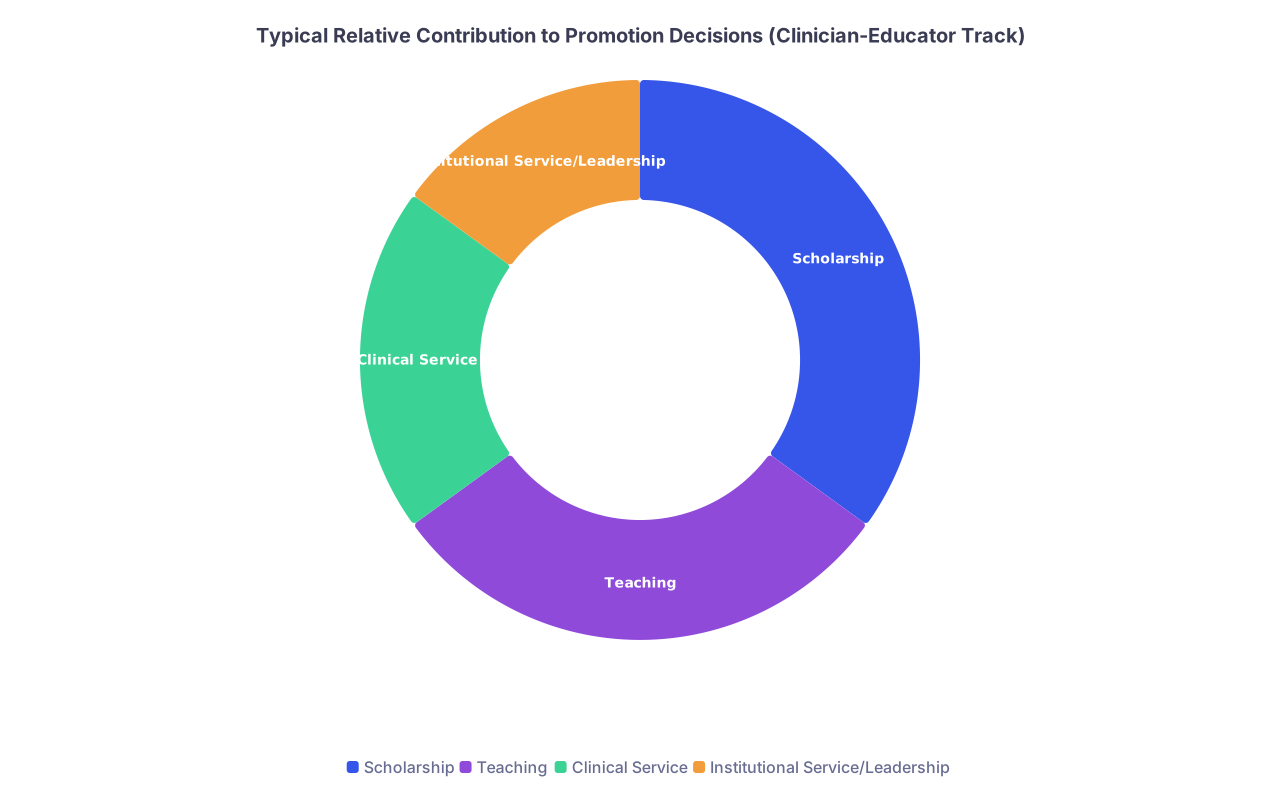
Here’s a rough composite from multi-institutional data and promotion case series (numbers are illustrative, but the pattern is real):
| Category | Value |
|---|---|
| Scholarship | 35 |
| Teaching | 30 |
| Clinical Service | 20 |
| Institutional Service/Leadership | 15 |
That’s not “all about publications.” That’s publications as a substantial but not dominant piece of a broader puzzle.
The Biggest Myth: “Teaching and Clinical Work Don’t Really Count”
This one annoys me because it discourages exactly the people institutions claim to value.
What schools say they value vs. what they actually count
Almost every medical school mission statement talks about:
- Excellence in patient care
- Outstanding education
- Advancing knowledge
But when faculty look for promotions advice, they often only hear about the third.
Here’s the reality in many places:
Teaching “counts” only if you document it.
If your CV just says “Taught residents on rounds” and “Did some lectures,” you will get no credit.
If your dossier shows:- Named course director roles
- Measured learner evaluations
- Peer teaching evaluations
- Teaching awards
- Evidence you improved a curriculum
then it starts to carry weight.
Clinical excellence counts when it’s more than ‘I work hard.’
Promotion committees see:- Quality metrics
- Letters describing unique clinical expertise (e.g., “She built our cardio-oncology program from zero”)
- Regional referral patterns
- Leadership in guidelines or quality initiatives
The myth that “teaching and clinical work don’t matter” persists because people are terrible at turning those activities into evidence. Committees cannot reward what you don’t show them.
The Publication Obsession: Quantity vs. Type vs. Trajectory
Now, let’s deal directly with the publication piece.
1. Raw count is the least sophisticated metric
You know who loves raw count? Applicants and insecure junior faculty.
You know who’s more nuanced? Most promotions committees.
They’ll look at:
- Authorship position – Are you first/senior anywhere, or always “middle-name syndrome”?
- Consistency – Did you do all 12 papers in your fellowship spike and then nothing?
- Coherence – Is there a recognizable area of focus, or a random grab bag of case reports and chart reviews across five specialties?
- Role – Are you actually leading projects or just lending your name as a “stats helper”?
People who get stuck at assistant often have a surprising number of papers but no story. No identity. “So what is this person known for?” is a real question in promotion meetings. If the only answer is “they publish,” that’s weaker than you think.
2. The “type” of scholarship is broader than you’ve been told
Educational scholarship, implementation science, quality improvement—these are legitimate domains. But many physicians treat them as second-class.
To promotions committees, the real issues are:
- Is it peer-reviewed?
- Is it disseminated beyond your institution?
- Is there some methodological rigor, even if it’s not RCT-level?
- Is there a program of work, not just one-off curiosities?
A well-done series of peer-reviewed education studies in MedEdPORTAL, Academic Medicine, or JGME can be more powerful for a clinician-educator dossier than three random subspecialty case reports in obscure journals.
What Actually Moves the Needle at Promotion Time
Let’s go from theory to the committee room.
When a candidate for promotion is discussed, the conversation usually circles around four questions. Publications matter, but they’re supporting evidence, not the entire answer.
1. Does this person have a clear academic identity?
Translation: “What is this person’s thing?”
- For a researcher: lung transplant immunology, health equity in stroke, AI for radiology triage.
- For an educator: simulation-based training in critical care, assessment reform in clerkships, point-of-care ultrasound curriculum.
- For a clinician-leader: building and leading an obesity medicine program, system-wide sepsis QI lead.
Scattered publications across 10 topics are less impressive than a focused 10–15-paper arc in one area with obvious deepening over time.
2. Are they recognized beyond their own hallway?
Committees look for external validation:
- Invited talks outside your institution
- Roles on national committees or guideline groups
- Reviewer or editorial board roles
- National teaching workshops
This is where many people over-focus on publications. A steady, reasonable volume of focused scholarship + strategic networking and leadership often beats a huge pile of lower-impact papers with zero national presence.

| Step | Description |
|---|---|
| Step 1 | New Assistant Professor |
| Step 2 | Choose Track and Focus Area |
| Step 3 | Build Scholarship Portfolio |
| Step 4 | Document Teaching and Clinical Role |
| Step 5 | Develop National or Regional Reputation |
| Step 6 | Promotion Review |
| Step 7 | Associate Professor |
| Step 8 | Reappointment with Plan |
Track Strategy: You’re Probably on the Wrong One (or Acting Like You Are)
A huge source of confusion: people’s behavior doesn’t match their track.
- Clinician-educators trying to behave like tenure-track bench scientists, burning out on RCT fantasies.
- Research-track faculty spending 80% time clinically “to help the department” and then wondering why promotion is hard.
- Clinician-track physicians thinking “no scholarship required,” then discovering their institution expects some dissemination.
Here’s the blunt truth: if your job description, resource allocation, and track are misaligned, publications will not save you.
You need:
- The right track for the career you actually want.
- The right mix of activities for that track.
- The right evidence portfolio to match the written criteria.
If your contract says 90% clinical and 10% “academic,” but your chair talks to you like you’re a future R01-funded star, that’s not ambition. That’s delusion.
Numbers Reality Check: Typical Output vs. Expectations
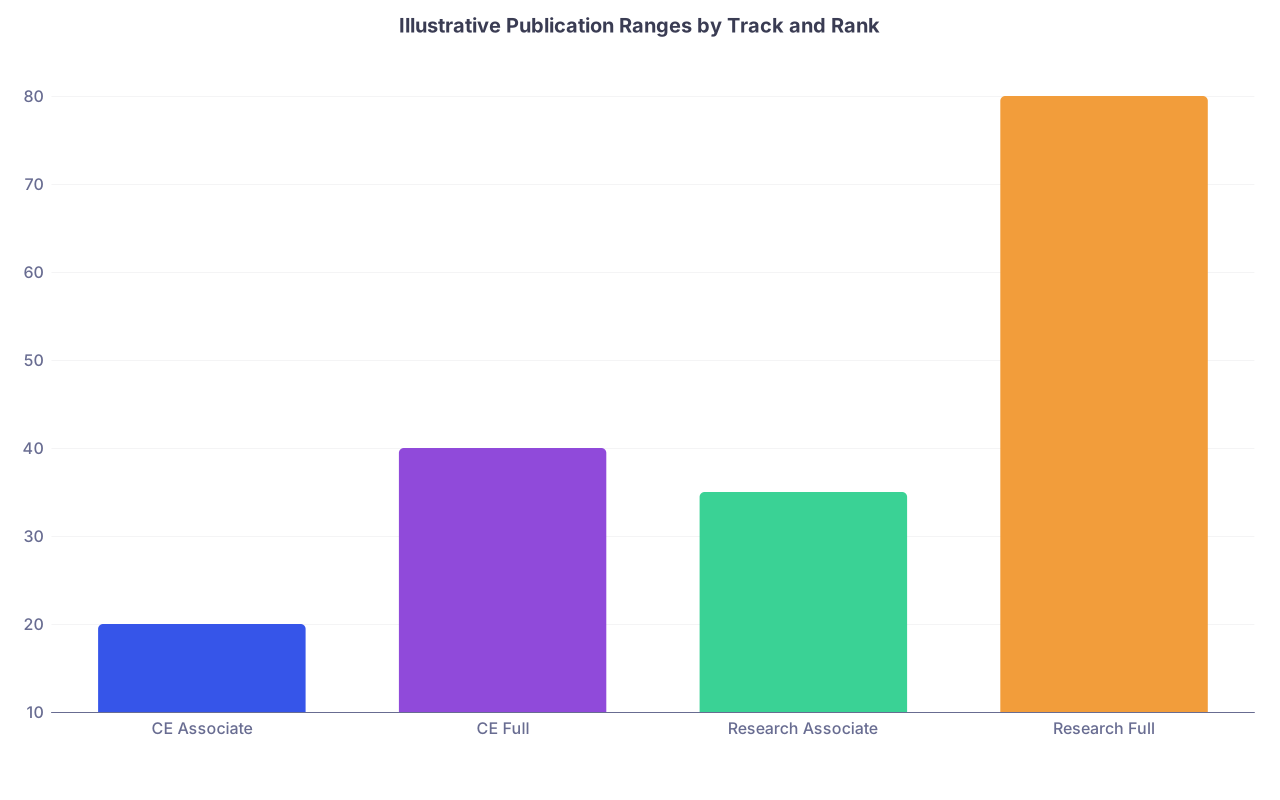
Promotion guidelines rarely state hard numbers, but you can reverse-engineer expectations from who actually gets promoted.
In many US academic centers:
Associate Professor, clinician-educator track (approximate, not gospel):
- 10–25 peer-reviewed publications total
- Some first/senior authorship
- A clear theme
- One or more significant curricular/program achievements
- Documented excellent teaching
Associate Professor, research/tenure track:
- 25–50+ peer-reviewed publications
- Multiple first/senior author papers
- One or more major grants as PI (often NIH or comparable)
- Recognized national presence
Full Professor, any track:
- Sustained output over many years
- Clear leadership in a field (not just productivity)
- External letters saying “This person is a leader in X” rather than “They’re hard-working and reliable.”
| Category | Value |
|---|---|
| CE Associate | 20 |
| CE Full | 40 |
| Research Associate | 35 |
| Research Full | 80 |
Again: these are rough patterns, not rigid cutoffs. But they show why “I have 10 papers, why am I not full professor?” is not a serious question at most institutions.
The Hidden Levers: External Letters, Narrative, and Reputation
One more inconvenient truth. When people with solid CVs fail to get promoted, it’s often not because of “too few publications.” It’s because of:
- Weak external letters that say “good citizen” instead of “field leader.”
- A muddled personal statement that fails to explain their trajectory and niche.
- No evidence of influence beyond their own department.
External reviewers are not asked: “How many papers does this person have?” They get asked things like:
- “How does this candidate compare with others at a similar stage in your institution?”
- “Has this individual made important contributions to their field?”
- “Is this candidate considered among the top people in their area?”
You don’t answer those questions with sheer volume. You answer with:
- Impactful, focused scholarship
- Recognizable leadership roles
- Coherent narrative of contribution
So What Should You Actually Do If You Want Promotion?
Let’s translate this from myth-busting to actionable strategy.
1. Stop asking “How many papers do I need?”
Wrong question. Ask:
- “In my track, what does a successful dossier look like at my institution?”
- “What are the last 3–5 successful promotions in my division, and what did their CVs look like?”
- “Where is my clear area of focus?”
2. Use the written criteria like a checklist
Seriously read your institution’s promotion guidelines. They are boring. Read them anyway.
Then build a living document or spreadsheet:
- Columns: Scholarship, Teaching, Clinical, Service/Leadership, Reputation
- Rows: Specific line items in your promotion criteria
- Fill in evidence as you go. Not just papers, but:
- Named roles
- Awards
- Invited talks
- Committees
- Program development

3. Build scholarly versions of what you already do
You’re likely leaving scholarship on the table. Examples:
- Turn a new curriculum into: needs assessment + pilot data + peer-reviewed innovation paper + MedEdPORTAL module.
- Turn a QI project into: conference abstract + peer-reviewed implementation study.
- Turn a clinical niche into: review articles + invited talks + clinical practice guidelines.
This is how clinician-educators and clinicians get promoted without pretending to be lab scientists.
The Uncomfortable Part: Institutional Culture Does Vary
Let me be fair. Some departments really do act like it’s only about publications, especially those:
- With a heavy NIH-funded bench tradition
- Where chairs are pure scientists with little interest in education or clinical work
- Where there’s a single “gold standard” tenure track and everything else is treated as second-class
If that’s your environment, you have three options:
- Play by their rules: focus heavily on research and publications, and negotiate protected time aggressively.
- Change local culture: build a visible, high-quality clinician-educator or clinician-scholar track with clear standards. Not easy.
- Leave: find an institution whose written criteria and actual behavior match your career type.
What you cannot do is stay in a research-dominant culture, ignore grants and publications, and then act surprised when promotion stalls.
Reality Check: Data vs. Lore
Let’s line it up plainly.
| Lore | Reality |
|---|---|
| It’s all about number of publications. | It’s about scholarship + teaching + service + reputation, track-based. |
| Teaching and clinical work don’t count. | They count when rigorously documented and linked to impact. |
| Only R01-funded people get promoted. | True for some tenure tracks; false for clinician-educator/clinical. |
| Case reports are worthless. | They’re weak alone, but fine as part of a coherent scholarly arc. |
| More journals = better. | Focus beats scatter; coherence and impact matter more than count. |

The bottom line: publications matter, but not in the cartoonish way people describe. Promotion is about convincing a group of senior people that:
- You’ve built and sustained a meaningful area of expertise.
- You’ve contributed to your field through some form of scholarship.
- You’ve had impact on learners, patients, or systems.
- Others outside your building recognize your work.
Papers are one piece of that argument. A big one, yes—but not the only one, and often not the decisive one when everything else is off.
Perspective: What You’ll Actually Remember
Years from now, you won’t be counting whether you had 23 or 27 PubMed entries at the time of promotion. You’ll remember whether you built a career that made sense—where your publications, your teaching, your clinical work, and your leadership actually lined up with who you wanted to be.
If you chase publications as a raw metric, you’ll always feel behind. If you build a coherent body of work and document it ruthlessly, promotion stops being a mystical black box and starts looking like what it actually is: a structured argument that you’ve become the kind of academic your institution claims to value.
Start building that argument now. And stop letting lazy lore dictate how you design a 30-year career.