

The usual “academic vs private practice lifestyle” talking points are lazy, outdated, and often flat‑out wrong.
You’ve heard the script:
Academic = relaxed pace, intellectual, lower pay, more time for family.
Private practice = grind, RVU factory, huge money, say goodbye to your life.
That dichotomy used to be closer to true twenty or thirty years ago. Today, it’s mostly mythology recycled on Reddit and in workroom gossip.
Let’s tear this apart properly.
The cartoon version you’ve been sold
Here’s the stereotype I hear residents repeat almost verbatim every year:
- “I want a life, so I’ll do academic medicine.”
- “I want to make real money, so I have to do private practice.”
- “Academics are 8–5 with teaching; private is 7–7 with no breaks.”
- “If I care about patients and education, I should go academic. If I care about money, private.”
This is the level of nuance people are using to make decisions that will dictate their next 10–20 years.
Reality: your lifestyle is much more determined by:
- Specialty
- Local market and payer mix
- Group structure (independent vs PE vs large health system)
- Call model
- Your own boundaries and negotiation skills
…than by whether your paycheck says “University Medical Group” or “XYZ Associates, LLC.”
Let me show you what the data and real-world structures actually look like.
Myth #1: “Academic jobs pay less but have better lifestyle”
The pay part is broadly true. The lifestyle part is often fantasy.
Public AAMC faculty salary benchmarks (for US academic centers) vs MGMA private/large-group benchmarks show a consistent pattern: academics usually pay less in most specialties at the median and upper quartiles. No surprise.
But people leap from that to: “So they must be buying me lifestyle, right?” Not necessarily.
Here’s a simplified snapshot for a few core specialties using typical US survey ranges (exact numbers vary by region and year, but the ratio pattern is consistent):
| Specialty | Academic Median ($k) | Private/Non-Academic Median ($k) |
|---|---|---|
| General IM | 230–260 | 280–350 |
| General Surgery | 380–450 | 500–650 |
| Cardiology | 500–600 | 650–800 |
| Anesthesiology | 380–450 | 500–600 |
| Heme/Onc | 350–420 | 450–550 |
Yes, academic pay is often 20–30% lower. But look at what’s not in that table:
- Nights and weekends
- In-basket burden
- Number of RVUs required
- “Invisible” work: committees, quality projects, teaching, research
- Administrative overhead and bureaucracy
That’s where the stereotype falls apart.
I’ve watched academic hospitalists work twelve 12‑hour shifts plus several committee meetings, QI projects, and student teaching, and then get scolded for not picking up “just two more” shifts this month. I’ve also seen community hospitalists on a 7-on/7-off schedule, genuinely off on their off week, making 40–60% more.
Who has the better lifestyle there?
It depends. And that’s the point.
Myth #2: “Academics = cushy 8–5; private practice = 60–80 hours”
The schedule stereotypes are anchored in a world that barely exists now.
Let me put the modern reality into something visual: how hours actually break down in real jobs. These are typical weekly patterns I’ve seen repeatedly (and yes, you’ll find exceptions in both directions).
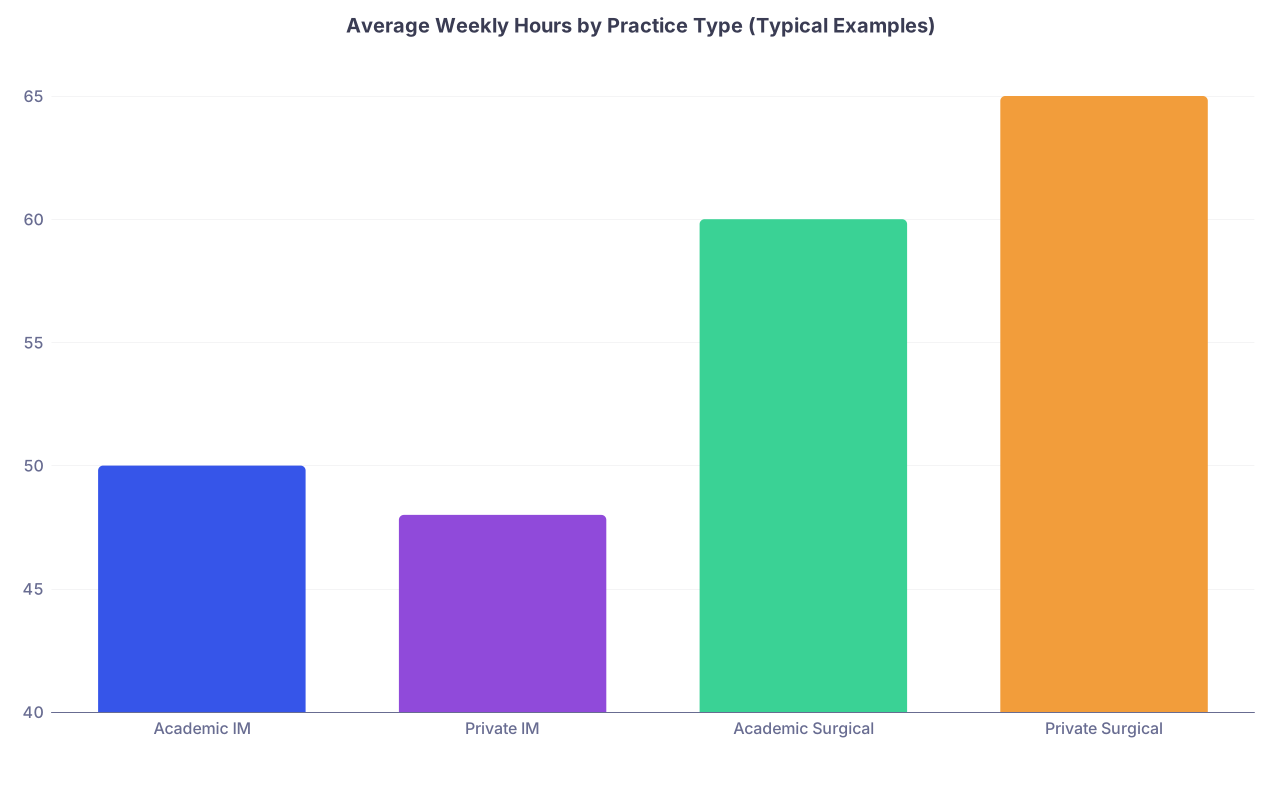
| Category | Value |
|---|---|
| Academic IM | 50 |
| Private IM | 48 |
| Academic Surgical | 60 |
| Private Surgical | 65 |
Those numbers are not abstract. Here’s what I’ve seen repeatedly on the ground.
Academic internal medicine attending:
- 8–10 half-day clinics or ward weeks that turn into 10–12 hour days
- Teaching (students, residents) added on top of full clinical days
- “Protected time” that evaporates under service needs
- 3–8 hours/week of meetings, committees, documentation training, quality projects
- Often unpaid evening work prepping lectures, answering resident messages, working on IRB stuff
Private practice internal medicine in a stable group:
- 4–4.5 days of clinic, reasonably efficient
- One late evening or early morning session
- Call shared among many partners or hospitalist coverage
- Minimal committees, little formal teaching
- Less “extras,” but also fewer academic brownie points or titles
In practice, that often translates into academic internists working more total hours but feeling noble about it because it’s “for education and the mission.”
If you’re in surgery, the story can be even muddier. Some academic surgeons are slammed with complex referrals, trauma call, research expectations, and admin work and end up living in the hospital. Some private surgeons, especially in less competitive markets, have lower case volume, less call, and more control over their schedule—especially once they’re partners.
The real lever isn’t academic vs private. It’s:
- Call frequency and intensity
- Clinic template design and support staff
- How much unpaid work is structurally expected
- Whether your group is desperate or adequately staffed
You’ve got academic hospitalists working 18 shifts/month and interns in community settings going home at 4 p.m. You’ve got academic cardiologists running two full-service lines and regional outreach, and private cardiologists doing mostly clinic with shared call. There is no universal rule anymore.
Myth #3: “Private practice is all about RVUs and money; academics is about patients and teaching”
Here’s where the romance really kicks in.
Residents love to say: “I’m going into academics because I care about teaching and not just RVUs.” Then they join an academic hospital that has quietly adopted a brutally RVU-driven model and they’re told their “citizenship” expectations are: X RVUs + Y committees + Z teaching hours.
On the flip side, I’ve seen private groups say, very bluntly: “We’re a patient-centered practice. You will see 16–18 patients a day, not 28, because we want you to think and do good medicine. We also pay you well. You will teach med students if you want, but it doesn’t change your pay.”
The supposed purity of academic medicine is also eroding under financial pressure. Many academic centers now:
- Have RVU targets that are only slightly lower than private practice
- Tie bonuses to productivity and patient satisfaction scores
- Press faculty to open more clinic slots or add service weeks
- Offload teaching and mentorship to fewer and fewer “good citizens” while others chase RVUs
Meanwhile, modern “private practice” often isn’t solo or small group anymore. It’s:
- Large multispecialty groups
- Hospital-employed physicians
- PE-backed practices
- Foundation models attached to big health systems
Most of these have formal quality programs, integrated EMRs, multidisciplinary care, and training affiliations. Translation: you can absolutely teach, run QI projects, and do serious patient-centered care in non-academic settings. You just won’t get a professorship out of it.
Myth #4: “Academics = job security, private = risky”
Maybe. Twenty years ago.
Now?
Academic centers are merging, closing service lines, and “restructuring” departments with shocking regularity. I’ve watched entire divisions get told: “Your FTE is being reduced unless you bring in more clinical revenue.” Grant funding is brutal. Soft-money research jobs can disappear in one bad funding cycle.
Private practice is not automatically more stable, but the pattern is not so simple:
- Small independent groups are vulnerable to buyouts and payer negotiations.
- PE-backed groups are vulnerable to debt and profit demands.
- Hospital-employed docs are vulnerable to “productivity realignment.”
But here’s the critical difference: a revenue-generating clinician in a needed specialty is almost always employable. Whether you’re academic or private.
Your real security is:
- Being in a specialty and geographic area with high demand
- Maintaining your volume and skill set
- Not burning out to the point you become unreliable
I’ve watched “secure” academic jobs evaporate when departments close services or shift care to advanced practice providers. At the same time, I’ve seen private docs walk across town and sign a better contract in two weeks after a group implodes.
Security is market-driven, not label-driven.
Myth #5: “If you want research or teaching, you must stay academic”
This one used to be almost true. It’s not anymore.
Medical schools and residencies are desperate for off-site teaching attendings. Many community hospitals are teaching hospitals now. Private groups precept students and residents all the time.
Want to teach? You can:
- Get a volunteer or adjunct faculty appointment
- Be a community preceptor site for residents or students
- Run CME talks and local educational events
- Mentor students informally through alumni or specialty organizations
Research-wise, you’re not going to run a massive NIH-funded basic science lab in a small community group. Fair. But clinical research, outcomes work, QI studies, registry-based projects? Those absolutely happen in non-academic systems, especially large integrated networks.
The reality:
- If you want research as your primary career and protected time, academia is still the main home.
- If you want some research and consistent teaching while being paid like a clinician, there are hybrid and community-affiliated roles everywhere now.
- If you want zero research and optional teaching, both environments can give you that too—plenty of academic “clinical track only” jobs are basically non-research.
So make the distinction sharper in your own head: you’re choosing degree and protection of scholarly time, not “only academics can think and teach.”
Myth #6: “Lifestyle is better in one; burnout is higher in the other”
Look at physician burnout surveys. The big annual ones (Medscape, specialty societies, institutional data) show something irritating: burnout is high almost everywhere, and the differences between academic and non-academic are small and inconsistent.
The drivers are depressingly universal:
- EMR overload
- Administrative burden
- Loss of autonomy
- Productivity pressure
- Moral injury: being forced to practice in systems that don’t match your values
Those exist in academic and private settings. They just wear different badges.
I’ve watched:
- Academic attendings drowning in committee work and endless email, feeling trapped because “I’ve invested so much in my academic CV.”
- Private docs feeling squeezed by ownership, call, and partnership politics, but with no teaching or mission-driven narrative to buffer the pain.
The best lifestyles I’ve seen share certain features, and they pop up in both worlds:
- Predictable and bounded call
- Reasonable patient volume with good support staff
- Leadership that actually protects non-clinical time (and means it)
- A culture that doesn’t punish you for saying no
Your burnout risk is much more about micro-environment than macro-label.
The part nobody tells you during residency: structure matters more than label
Let me be very specific about what you should be interrogating when you compare jobs, instead of just asking, “Is this academic or private?”
Things that actually dictate your life:
- Number of clinic sessions or shifts per week, and realistic patient volumes
- Call structure: in-house vs home, frequency, backup, and post-call expectations
- Teaching load: how much, when, and is it protected or layered on top
- Non-clinical expectations: committees, QI, documentation clean-up, “just one more taskforce”
- RVU targets or other productivity metrics, and what happens if you miss them
- In-basket volume and who deals with refills, messages, and results
- Autonomy to shape your schedule after 1–2 years
- Realistic path to a better schedule or reduced call with seniority
That’s where residents drop the ball. They’ll obsess over whether a job is “academic enough” or “private enough” and never directly ask, “How many hours do your attendings actually work? What time do people really leave? Who covers inbox on weekends?”
If you want to make a rational decision about lifestyle, you need to stop using “academic vs private” as the main proxy. It’s too crude.
A more honest way to think about the choice
Forget the marketing brochures and the prestige games for a minute. Boil it down to three questions that actually track with reality:
- How much am I willing to trade money for non-clinical work I truly care about (research, teaching, institutional leadership)?
- How much control do I want over my schedule, patient volume, and practice style?
- How important is academic identity (titles, promotion, grants) to my long-term satisfaction?
Then evaluate each concrete job—academic or private—against those, and against its actual structure.
To illustrate how wildly things can differ, here’s a simple comparison I’ve seen play out in the same city:
| Factor | Academic Hospitalist Job A | Community Hospitalist Job B |
|---|---|---|
| Shifts per month | 18 | 15 |
| Typical shift length | 12–13 hours | 10–12 hours |
| Nights | 1 in 4 | 1 in 6 |
| Teaching | Heavy | Moderate |
| Committees/QI | Required (unpaid) | Optional (small stipend) |
| Approx comp ($k) | 240 | 310 |
You tell me which one has the “better lifestyle.” It depends who you are and what you want.
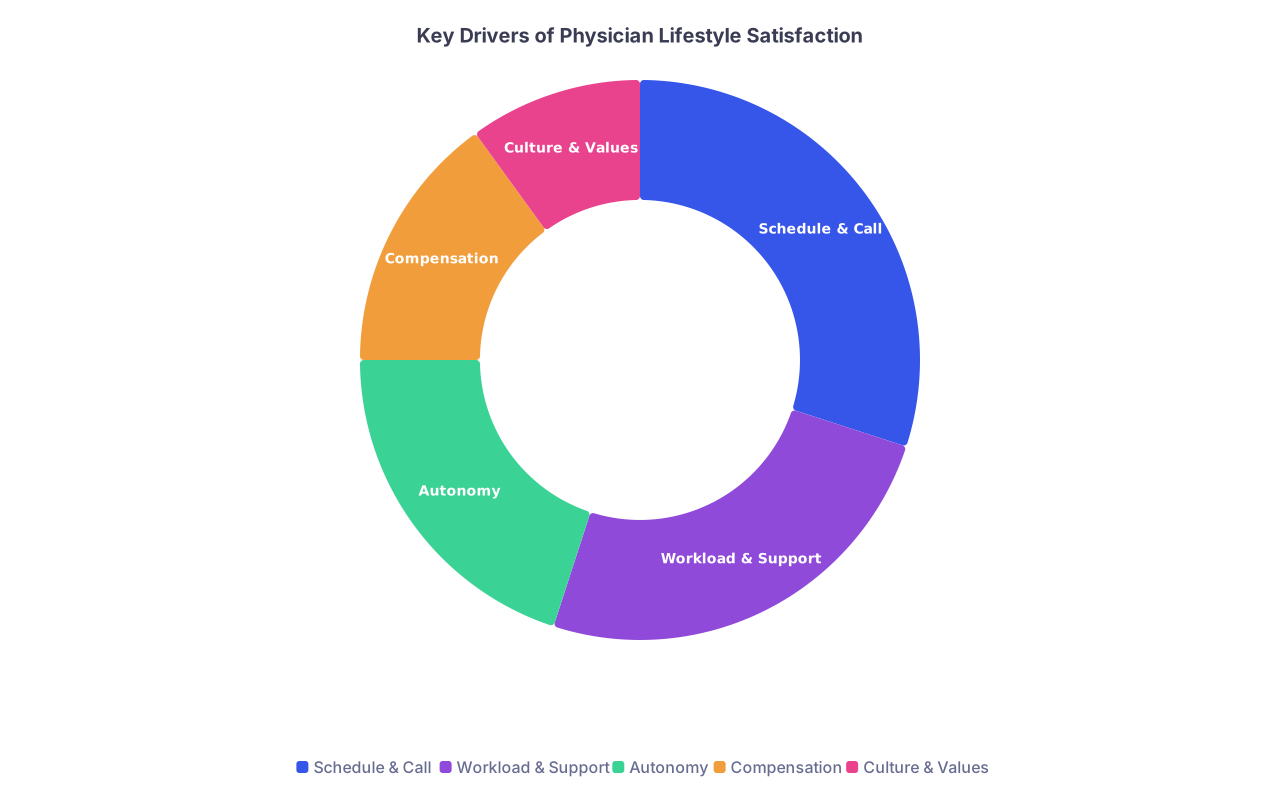
| Category | Value |
|---|---|
| Schedule & Call | 30 |
| Workload & Support | 25 |
| Autonomy | 20 |
| Compensation | 15 |
| Culture & Values | 10 |
That chart is not from a single study. It’s what shows up over and over when docs explain why they stayed or left a job. Practice type, by itself, is rarely the main story.

| Step | Description |
|---|---|
| Step 1 | Start Job Search |
| Step 2 | Focus on academic jobs |
| Step 3 | Include academic and teaching hospitals |
| Step 4 | High volume or procedural roles |
| Step 5 | Lower call, strong support staff |
| Step 6 | Compare actual hours and expectations |
| Step 7 | Choose best structure, not just label |
| Step 8 | Need protected research? |
| Step 9 | Teaching a must have? |
| Step 10 | Maximize income or lifestyle? |
What this means for your next step
Stop asking “academic vs private?” as if that alone will answer your lifestyle question. It will not.
Here’s the real bottom line:
The pay gap is real, but the idea that academics automatically buy you a gentler life is false. Many academic clinicians work more total hours for less money, trading some income for identity, mission, and intellectual environment—not necessarily for fewer hours.
Lifestyle is driven by structure, not brand. Call schedules, clinic templates, RVU targets, and support staff matter far more than whether the logo on your badge is a university seal or a group practice name.
Teaching, quality work, and good medicine are not exclusive to academia. You can build a meaningful, intellectually rich, patient-centered career in both spheres. The smart move is to interrogate each concrete job’s expectations instead of outsourcing your judgment to outdated stereotypes.


