

The “safe” hospital-employed job is not actually safe. It just centralizes the risk where you cannot see it—until it lands on your head.
For the last decade, residents have been sold one dominant story: private practice is dying, independence is “too risky,” and the smart move is to take the hospital-employed job with a steady salary and let the system handle the headaches. I hear this from chiefs at noon conferences, from faculty in “career advice” panels, and from recruiters who somehow always “just happen” to sponsor your residency dinner.
Here’s the problem: that story is outdated, financially biased, and not backed by current data on how hospital systems behave when budgets tighten.
You’re not choosing between “safe employed” and “risky independent.” You’re choosing between different types of risk:
– invisible, centralized, and largely out of your control (hospital employment), versus
– visible, distributed, and at least partially under your control (independent/partnership models, diversified work).
Let’s go through what the numbers and real-world restructuring events actually show.
The Myth of the “Secure” Hospital Paycheck
The core assumption goes like this: “If I’m employed by a large hospital or health system, they’re too big to fail. I’ll always have a job. Maybe the RVUs will creep up, but I won’t get fired.”
Reality has been uglier.
Between 2019 and 2022, multiple large systems—including Tenet, HCA, Ascension, and CommonSpirit affiliates—announced physician layoffs, practice closures, and service line consolidations. Community hospitals have shuttered OB units, closed ICUs, and outsourced anesthesiology and emergency medicine on short notice. Those “stable employed” doctors? Many got:
- Terminated without cause on 60–90 days’ notice
- Relocated within the system against their wishes
- Forced into new compensation models with massive RVU thresholds and lower base pay
Here’s what employed physicians typically underestimate: your job security is only as strong as the health system’s margin, debt load, and strategic plan. And you see none of that until the email hits your inbox.
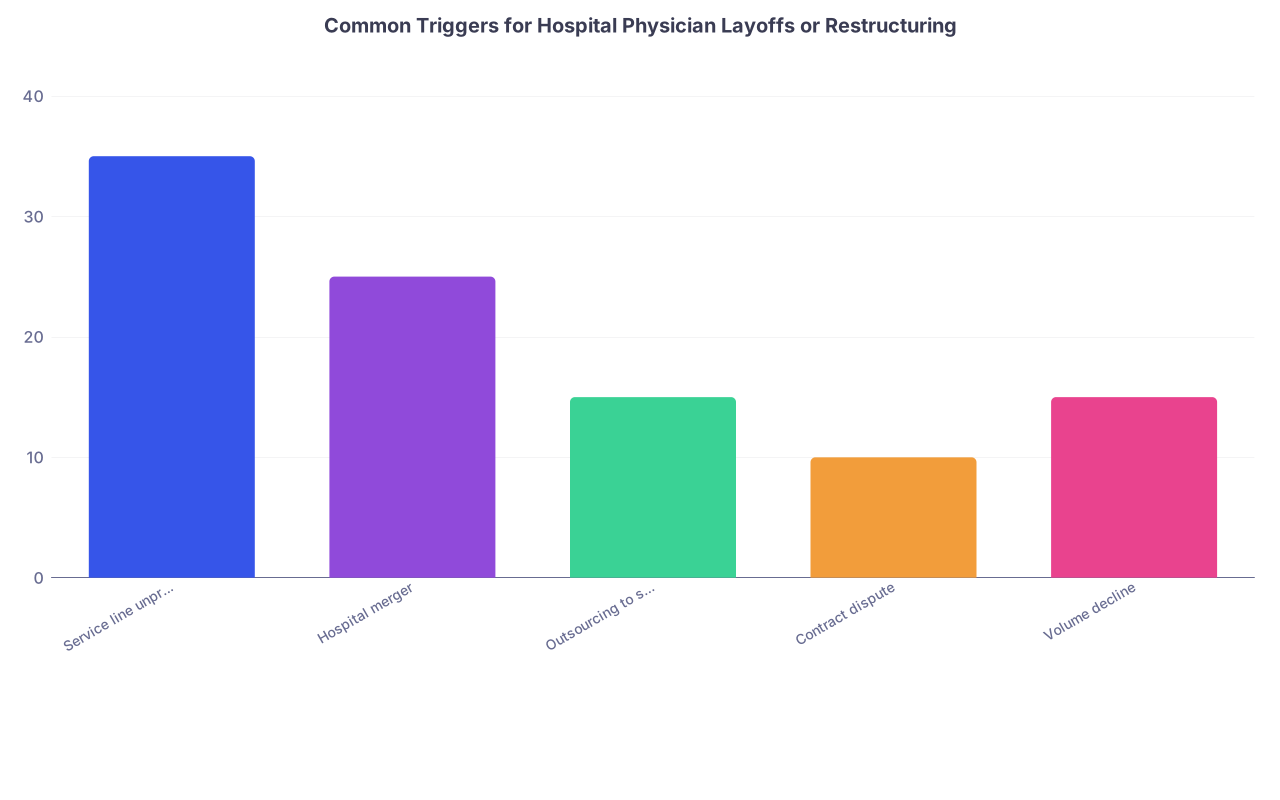
| Category | Value |
|---|---|
| Service line unprofitable | 35 |
| Hospital merger | 25 |
| Outsourcing to staffing firm | 15 |
| Contract dispute | 10 |
| Volume decline | 15 |
Those triggers are not rare edge cases. They’re baked into how modern healthcare corporations operate.
You think you’re joining a “family.” You’re actually an FTE line item that must justify its existence on a spreadsheet reviewed quarterly by people who have never held a retractor.
Control vs. Security: You’ve Been Sold the Wrong Tradeoff
Residents get told: “Private practice is risky; partners can push you out, reimbursements can drop, overhead is scary. Employment gives you security.”
Let me reframe that correctly:
- Employment gives you less control and more concentration of risk, not automatically more security.
- Ownership (even partial), multiple income streams, or diversified arrangements give you more control and more ways to adapt, even though the volatility is more obvious.
In a hospital job:
- The hospital controls your schedule, staffing, MA support, call burden, clinic templates, and often even how many new vs. follow-up patients you see.
- Administration can unilaterally change your RVU targets, bonus structure, and coverage expectations at contract renewal—or mid-contract if they invoke “productivity realignment” or “wage adjustment” clauses.
- If your department or site becomes strategically “unimportant,” they can close or sell it, and your contract often lets them terminate you “without cause” with a few months’ notice. Good luck fighting that.
In private or group practice with some ownership:
- You control your cost structure and can adjust: fewer staff, renegotiate leases, add services, adjust your patient mix, or join a larger group.
- If reimbursements shift, there’s at least some flexibility to pivot—ancillary services, new payers, coverage agreements, telehealth, or call coverage arrangements.
- Your primary risk is operational and financial, but there’s no single board meeting where someone decides you just “don’t fit the network strategy” anymore.
So no, employment is not magically safer. It just hides the risk in boardrooms and balance sheets instead of in your monthly P&L.
The Fine Print: How “Job Security” Actually Works in These Contracts
Most residents never really read their first contract. They skim the salary, sign-on bonus, relocation, and maybe the non-compete radius. Then they show it to “a friend’s dad who’s a lawyer,” who mostly checks for obvious abuses but doesn’t understand modern healthcare economics.
There are three clauses that quietly destroy the fantasy of job security:
“Without Cause” Termination
Nearly every hospital-employed contract includes language allowing either party to terminate “without cause” with 60–180 days’ notice.Translation:
– No, you don’t have protected employment.
– No, they do not need a reason to let you go.
– Yes, they can let you go even if your performance is fine, simply because the hospital is losing money or they want to outsource your service line.Compensation Tied to “Fair Market Value” (FMV)
Sounds reasonable, right? It’s actually a ratchet they can tighten.They’ll tell you: “We must adjust comp to stay in FMV range per Stark law.” That gives them cover to cut base salaries, change RVU conversion factors, or lower your guaranteed component, all under the banner of “compliance.”
Unilateral Changes in Duties or Location
A lot of contracts allow the system to change your primary practice site, call distribution, or service expectations “as needed to meet operational requirements.”When a nearby clinic closes or a partner leaves, guess who absorbs that load. You do. Without renegotiation.
| Dimension | Hospital-Employed | Independent/Group Practice |
|---|---|---|
| Termination control | System can end without cause | Partners/owners must agree |
| Income volatility | Hidden, lumpy at renewal | Ongoing, but more adjustable |
| Schedule/call control | Low | Moderate to high |
| Strategy risk | High (mergers, closures) | Moderate (local market) |
| Negotiation leverage | Low alone | Higher with ownership/group |
When you read those side by side, it’s obvious: you’re not picking “safe vs risky.” You’re picking who holds the kill switch.
Consolidation, Mergers, and the “We Have New Leadership” Problem
The other myth is that if you pick a “stable” system—big-name academic center, large nonprofit network, or national chain—you’re insulated. That assumption died years ago.
Healthcare is consolidating aggressively. The same consolidation that took out independent outpatient practices is now rearranging hospitals like chess pieces.
Patterns I’ve seen over and over:
- Community hospital gets acquired by a larger system → new system reviews service lines → decides OB, inpatient peds, or certain surgical subspecialties aren’t profitable enough → closes unit or contracts with a staffing firm. Employed physicians are either offered relocation (often across the state) or “we regret to inform you” letters.
- Academic departments “restructure” after new chair or dean arrives → comp plans are overhauled, RVU expectations go up, “protected time” quietly disappears, and low-volume faculty get marginalized or gently pushed out.
- Rural hospitals go bankrupt or convert to “freestanding ER” models; previously employed hospitalists and specialists are simply out of a job.

| Category | Still in same role | Role changed/location moved | Left system/laid off |
|---|---|---|---|
| Year 1 | 70 | 20 | 10 |
| Year 3 | 45 | 35 | 20 |
These numbers aren’t from a randomized trial—they come from merger case reports, local news coverage, and follow-up surveys of acquired groups. The consistent story: over a few years, a large chunk of the originally “stable” jobs don’t look anything like what was promised during recruiting.
The system is stable. Your specific job within it is not.
Compensation Volatility: It’s Just Delayed, Not Absent
Residents love the idea of a guaranteed salary. A clean number. Predictable.
Here’s what happens in reality with hospital-employed comp:
Year 1–2:
- Nice base pay, maybe some soft RVU targets you easily hit.
- Recruitment incentives: sign-on, relocation, maybe loan repayment.
- Admin says “we just want you to build your panel” or “don’t worry about RVUs the first year.”
Year 3–5:
- “We’re aligning with system-wide compensation.” Translation: your base gets adjusted, and your bonus is now almost entirely RVU or quality-metric driven.
- RVU thresholds quietly rise 10–20%.
- Support staff may be cut “to improve efficiency,” which directly tanks your throughput.
Year 5+:
- If volumes or reimbursements drop, your comp plan gets “reviewed” and you are strongly encouraged to “increase productivity” or “consider expanding access hours.”
- Admin starts comparing you to the 90th percentile MGMA numbers, despite you working in a worse payer mix or lower-demand region.
Meanwhile, your non-compete and repayment clauses (if you leave early) trap you geographically, which crushes your negotiating power.
Independent physicians absolutely face revenue volatility. But they typically see it month by month and adjust behavior: ramp up clinic, add procedures, tighten expenses. Employed physicians often get three years of false security then a brutal reset.
The Non-Compete Trap: Security That Locks You In
Another dirty secret: hospitals often push some of the harshest non-competes, precisely because they know once you’re in, they can change terms and you’ll have limited options.
Residents often sign:
- 10–25 mile non-compete radiuses around all practice sites they’ve ever worked
- 1–2 year durations
- Restrictions that cover not just the exact job, but any similar specialty practice in the region
Combined with repayment penalties for sign-on bonuses or relocation (often prorated over 3–5 years), this means:
- If they cut your pay, restructure your clinic, or bump your call load, leaving could cost you tens of thousands and force your family to move cities or states.
- If the hospital merges and your role becomes redundant or miserable, you can’t easily join a competing group across town.
So that “secure” job can quickly turn into a golden cage.
Who Actually Has More Resilience?
The real question you should ask is not “Which job feels safer on day one?” but “Which arrangement gives me more ways to survive and adapt over a 10–15 year horizon?”
Resilience looks like:
- Multiple income streams (clinical + call coverage + telehealth + procedures + maybe consulting or medical directorship)
- Ability to change practice setting without moving your entire life
- Some degree of ownership or at least real partnership where your voice affects strategy
- Skill set and professional network that are attractive to more than one employer or practice type
You won’t always get all of that at once. But you should evaluate offers based on which path builds resilience, not just which throws the biggest sign-on bonus at you.
The harsh truth: a single, full-time, hospital-employed W-2 job with a strict non-compete and “without cause” termination clause is one of the least resilient setups in modern healthcare. It looks neat from the outside. On the inside, it’s brittle.
How to Approach Hospital Jobs Realistically (Not Naively)
I’m not saying never take a hospital-employed job. I’m saying stop treating it as the “default safe choice.”
If you do consider it—and many should—approach it like this:
- Assume the comp model will change within 3–5 years. Ask directly: “How has this compensation plan changed in the last 5 years?” If they dodge, that’s your answer.
- Assume service lines can be closed or outsourced. Ask: “Have any physician groups or lines been closed, outsourced, or restructured here in the last 5 years?”
- Assume “without cause” termination is real. Would you still sign this if you knew there was a 10–15% chance your job disappears or changes drastically within 5 years?
- Treat non-compete radius and duration as core economic terms, not side notes. They might matter more than a $25–50k bonus.
- Get a healthcare-specific contract review, not just a generic lawyer glance. Someone who’s negotiated dozens of physician contracts, not just read a few.
And most importantly: keep your identity and skills portable. Maintain procedures, stay credentialed at more than one facility if possible, stay in touch with private groups, locums agencies, and regional competitors. Don’t disappear into the hospital basement and hope.
Years from now, you won’t remember the exact RVU threshold in your first contract. You will remember whether you built a career where a single administrator’s spreadsheet could uproot your life overnight—or whether you quietly designed something harder to break.


