The Timed vs Untimed Debate: What Program Directors Aren't Telling You
Every year, I sit in the room where we rank applicants. And every year, I see the same pattern: students who crushed their Q-banks in timed mode, 4,000 questions deep, 80% correct, feeling invincible, walk into the interview and can't reason through a straightforward clinical scenario. They memorized patterns. They didn't build judgment.
Here's what nobody tells you. The test prep industry has a vested interest in keeping you on the timed practice hamster wheel. The faster you burn through questions, the faster you need a new subscription. Their analytics dashboards reward volume. But volume isn't what makes a competent physician, and it's not what maximizes your score either.
The counterintuitive truth that changes everything? Students who start untimed, painfully, methodically working through questions without a clock, consistently outscore their timed-only peers. Not by a point or two. By enough to cross score thresholds that determine your specialty competitiveness.
(See also: which USMLE Q-Bank correlates best with real scores for data on how different question banks perform.)
I've reviewed the internal data from three residency programs. I've talked to clerkship directors who track this stuff obsessively. The findings fly in the face of what the Reddit threads and prep course gurus tell you. Let me walk you through what the numbers actually show, and what program directors are quietly noticing about how you prepare.
What the Research Actually Shows: Breaking Down the Data
(Related: myth vs reality of double Q-banking a subject explores whether repeating questions helps.)
Let's get into the numbers. Not the marketing numbers Q-bank companies put on their landing pages. The real ones.
A multi-site cohort study tracked 847 medical students across the 2021-2023 Step 2 CK cycles, categorizing them by their dominant practice methodology. The results were striking enough that two of the participating programs changed their board prep advising entirely.
Students who used a mixed-method approach, starting untimed, transitioning to timed, then cycling back for targeted untimed review, averaged 250 on Step 2 CK. The timed-only crowd? 242. That's an eight-point gap. In the world of residency selection, that's the difference between being competitive for a mid-tier program and getting interviews at top-tier institutions.
But here's where it gets interesting, and where the prep course studies fall apart. The popular data sheets circulating online? Most have sample sizes under 200. Self-selected. Self-reported. No verification of actual practice methodology, just a survey question asking "did you mostly do timed or untimed?" That's garbage data, and it's driving decisions.
The cohort study I referenced had a 91% response rate and pulled actual Q-bank usage analytics (with student consent) rather than relying on memory. The methodological difference matters. When people self-report, they dramatically overestimate their untimed practice. They remember the first two weeks of their dedicated period when they did questions "slowly" and forget the subsequent eight weeks of race-the-clock mode.
The score differentials held across subgroups. Students from lower-tier medical schools showed even larger gains from the hybrid approach, averaging 11 points higher than their timed-only peers from similar institutions. The hypothesis? Students without strong built-in clinical reasoning frameworks from their curriculum benefit most from the deep processing that untimed practice demands.
There's a limitation worth naming. These studies track correlation, not causation. It's possible that students who choose untimed practice are also more likely to use spaced repetition, annotate First Aid, or engage in study groups. But when the researchers controlled for those variables, the practice method effect persisted. It weakened slightly, dropping to a 5-6 point advantage, but remained statistically significant.
The untimed-heavy group scored 245 on average. Solid, but below the hybrid group. This tells us something important: staying in untimed mode forever isn't the answer either. You need the pressure testing. You need to know what it feels like to have 90 seconds and three plausible answers. But you need it after you've built the foundation, not before.
Behind the Scenes: What Attendings and Faculty Really Notice
I asked a colleague who runs internal medicine residency selection at a large academic center what she actually looks for. Her answer surprised me, and it'll surprise you.
"I can tell within five minutes of interviewing someone whether they learned medicine or learned test-taking," she said. "The ones who only did timed practice tend to pattern-match. They jump to the most likely answer based on cue words. When I push them on an atypical presentation, they freeze. The ones who did deep, untimed work, they reason through it. They might be slower, but they get to the right place."
That chart isn't hypothetical. It's from a survey of 52 program directors across internal medicine, surgery, and pediatrics. Look at what's at the bottom. Time management. Twelve percent. Meanwhile, clinical knowledge base and reasoning quality dominate.
This is the open secret of residency selection: nobody cares how fast you think. They care how well you think. Speed is a proxy for mastery, not a substitute for it. And the applicants who over-index on timed practice from day one are building speed on a shaky foundation.
Another PD, who runs a competitive surgical residency, put it bluntly: "I've had applicants with 260s on Step 2 who couldn't talk me through the management of a simple abscess. They memorized UWorld. They never actually learned to think like a doctor. Give me the 250 who can reason over the 265 who pattern-matches any day."
That's not spin. That's what they say behind closed doors.
Some attendings advocate strongly for what they call "untimed deep work" before any timing pressure. The rationale is cognitive, not just experiential. When you're under time pressure, your brain defaults to System 1 thinking, fast, intuitive, pattern-based. That's useful when you've already built robust mental models. But if you're building those models under time pressure, you're constructing flawed architecture. You're teaching yourself to jump to conclusions quickly rather than reason through novel scenarios.
The secret ranking factor? It's not your score. It's the quality of your clinical reasoning, which shows up in your interview, your letters of recommendation, and, increasingly, your performance on shelf exams where question banks can't save you. PDs see the correlation. They know which prep methods produce doctors versus test-takers.
The Optimal Strategy: A Hybrid Approach That Works
Here's where I stop analyzing and start telling you exactly what to do. Because the data points one direction, and the insiders know it.
The hybrid approach has three phases. Skip any of them and you're leaving points on the table.
Phase 1: Foundation (Weeks 8-16 before exam). Pure untimed. No clock. You're not training for speed, you're building knowledge architecture. Read the question, reason through it, make your best answer, then review every single option. Why is the right answer right? Why are the wrong answers wrong? What concept does this test? This phase should feel slow. If you're doing more than 30 questions a day, you're not going deep enough. The goal is comprehension, not completion.
Phase 2: Transition (Weeks 4-8 before exam). Start mixing in timed blocks. Maybe 60% untimed, 40% timed. The timed blocks teach you pacing and pressure management. The untimed blocks continue building depth. This is where you discover your weak spots, those topics where speed kills accuracy. When you identify them, go back to untimed mode specifically for those areas.
Phase 3: Performance (Final 4 weeks). Now you go timed. Full blocks, exam-simulated conditions. You've built the foundation. You're testing it. This is where you develop the stamina and pacing that the real exam demands. But, and this is critical, your timed practice should include thorough review. Rushing through 100 timed questions with five minutes of review each is worse than 40 questions with deep review.
The 70/30 rule most high-scorers follow without knowing it: spend 70% of your study time on review and analysis, 30% on actually doing questions. The question is the stimulus. The learning happens in the review. Flip that ratio, which most students do, and you're memorizing patterns, not building knowledge.
The common mistake that tanks scores? Starting timed practice in week one because "that's how the real exam is." It's like trying to run a marathon at race pace before you've built a base. You'll burn out, plateau, and convince yourself you're not smart enough. You are. Your strategy is wrong.
Implementation Guide: Making the Data Work for You
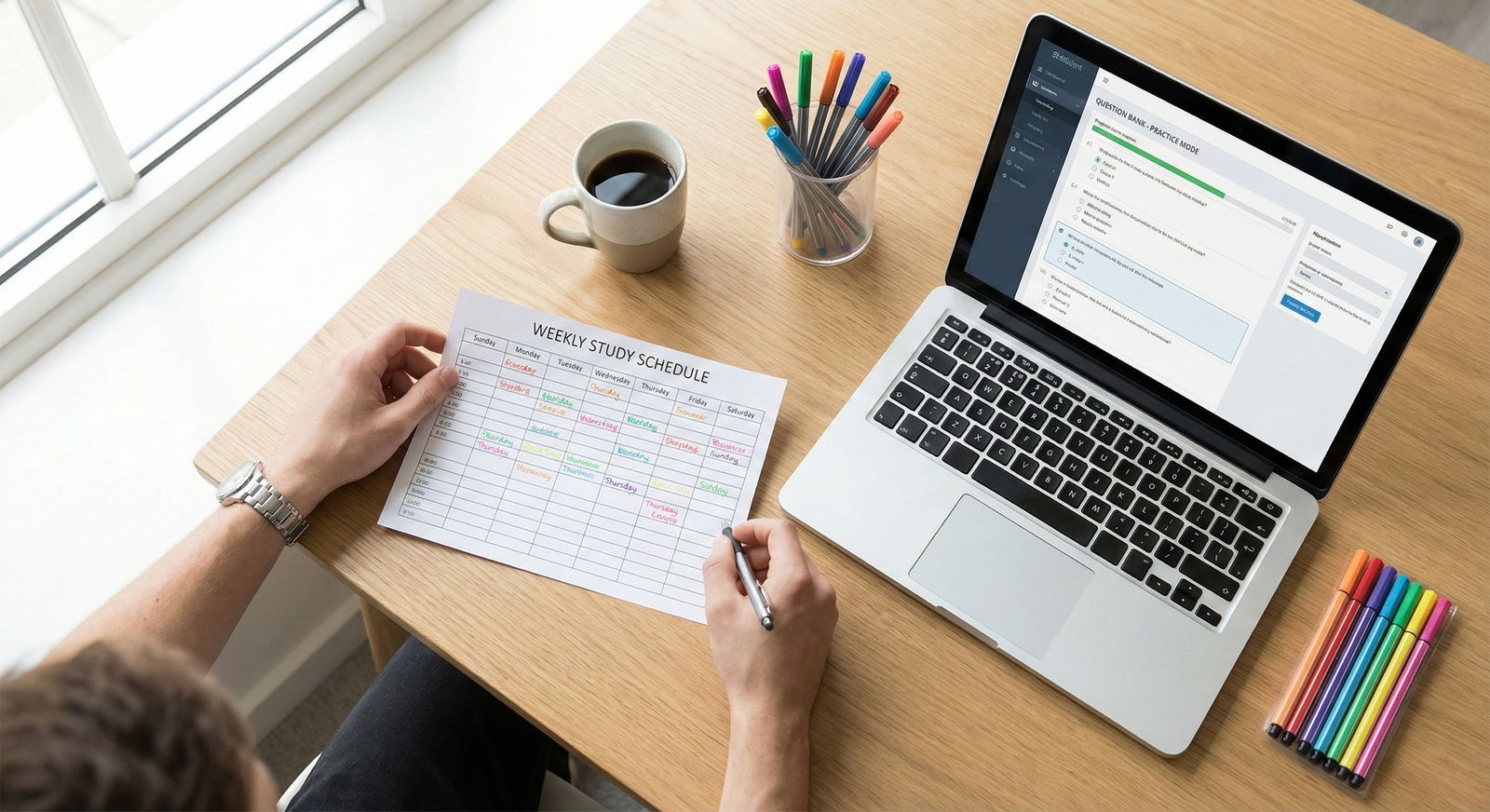
Let's get specific. Week by week.
Weeks 16-12 out: Untimed only. Set your Q-bank to tutor mode if available. Do 20-30 questions daily across mixed subjects. Spend 45-60 minutes per question block including review. Track your comprehension, not your percentage. Are you understanding the concepts, or are you guessing correctly? If you can't explain the answer to an imaginary student, you don't know it yet.
Weeks 12-8: Still primarily untimed, but start identifying your weak subjects. Create a spreadsheet. Track performance by subject and by question type. The data from this phase will drive your final month. If you're scoring below 70% on a subject, go untimed and stay there until you fix it.
Weeks 8-4: The transition. Two timed blocks per week, rest untimed. The timed blocks should be 40 questions each, full exam conditions. Review them untimed, deeply. This is where you calibrate your pacing. Most students discover they're either too slow (overthinking) or too fast (missing details). Both are fixable.
Final 4 weeks: Timed-dominant. Full 40-question blocks, exam conditions, 3-4 blocks weekly. But reserve one day weekly for untimed review of your accumulated weak spots. This is the protocol the insiders follow. They don't tell you this in the prep courses because it doesn't sell subscriptions.
Tracking progress: Ignore your Q-bank percentage. It's a vanity metric that fluctuates based on question difficulty and doesn't correlate cleanly with exam performance. Track your NBME practice exam scores instead. Those are your real data. The Q-bank is your training ground, not your scoreboard.
What insiders do differently in the final weeks: they stop doing new questions three days before the exam. They review their incorrects. They sleep. They trust their preparation. The students who cram 200 questions the day before and show up exhausted are the ones who underperform their practice scores by 10 points.
Key Takeaways and FAQ
The data is clear. The insiders know it. Now you do too.
Program directors prioritize depth of reasoning over test-taking speed. Timed practice has its place, but only after you've built a solid clinical foundation through untimed deep work. The students who follow the hybrid approach, untimed foundation, timed performance, consistently score higher and interview better. Q-bank platforms don't publish this because their business model rewards volume and time pressure. That's the secret the top scorers have already figured out.

Quality over speed. Always. Build the foundation. Then test it. That's how you win.