
Introduction: Why Textbooks Still Matter in the Age of Digital Study Resources
Preparing for medical board examinations is one of the most demanding phases of medical school life. Between lectures, clinical duties, question banks, and review videos, it can be hard to decide where to focus your time and money. In the era of high-yield online resources and board-style question platforms, some students wonder: Do I really need traditional Medical Textbooks anymore?
For most students, the answer is yes—if you choose and use them strategically.
Textbooks remain foundational tools in Medical Education because they:
- Build deep conceptual understanding that question banks alone can’t provide
- Offer organized, peer-reviewed explanations of complex topics
- Serve as long-term reference materials well beyond exam season
This guide walks through must-have textbooks for medical students preparing for boards, organized by discipline, and shows how to integrate them into a modern Board Exam Preparation strategy. You’ll also find practical tips for pairing textbooks with online Study Resources, plus a FAQ tailored to Student Success on exams like the USMLE and other national or international licensing exams.
Why Core Medical Textbooks Are Still Essential for Board Exam Preparation
Even as online platforms dominate board prep discussions, high-quality Medical Textbooks remain a backbone of exam success and professional competence.
Comprehensive Coverage vs. High-Yield Summaries
Question banks and review books are optimized to help you score points—fast. They’re critical for pattern recognition, timing, and test-taking strategies. But they can also:
- Oversimplify complex mechanisms
- Skip nuanced exceptions and variations
- Leave knowledge gaps that become obvious on wards or oral exams
Core textbooks, by contrast, provide:
- Systematic coverage of physiology, pathology, pharmacology, and clinical medicine
- Context for why diseases present and behave the way they do
- Integrated understanding across organ systems and disciplines
This deeper layer of understanding not only helps with tougher board questions (especially on Step 2/Level 2 and beyond) but also supports confident clinical decision-making.
Deep Learning and Long-Term Retention
Well-written textbooks are structured to promote durable learning:
- Clear chapter objectives and summaries
- High-quality figures and diagrams
- Tables that organize differential diagnoses, drug classes, and disease patterns
- Clinical cases that attach meaning to facts
Used properly, textbooks transform rote memorization into meaningful understanding—key for long-term retention and real-world application.
Lifelong Reference Material
Your board exams are only one milestone in your career. Many of the books listed below:
- Remain useful during residency and fellowship
- Help with preparing case presentations, journal clubs, and teaching
- Provide trusted references when you encounter complex cases
If you select wisely, your “board prep books” double as the start of your professional library.
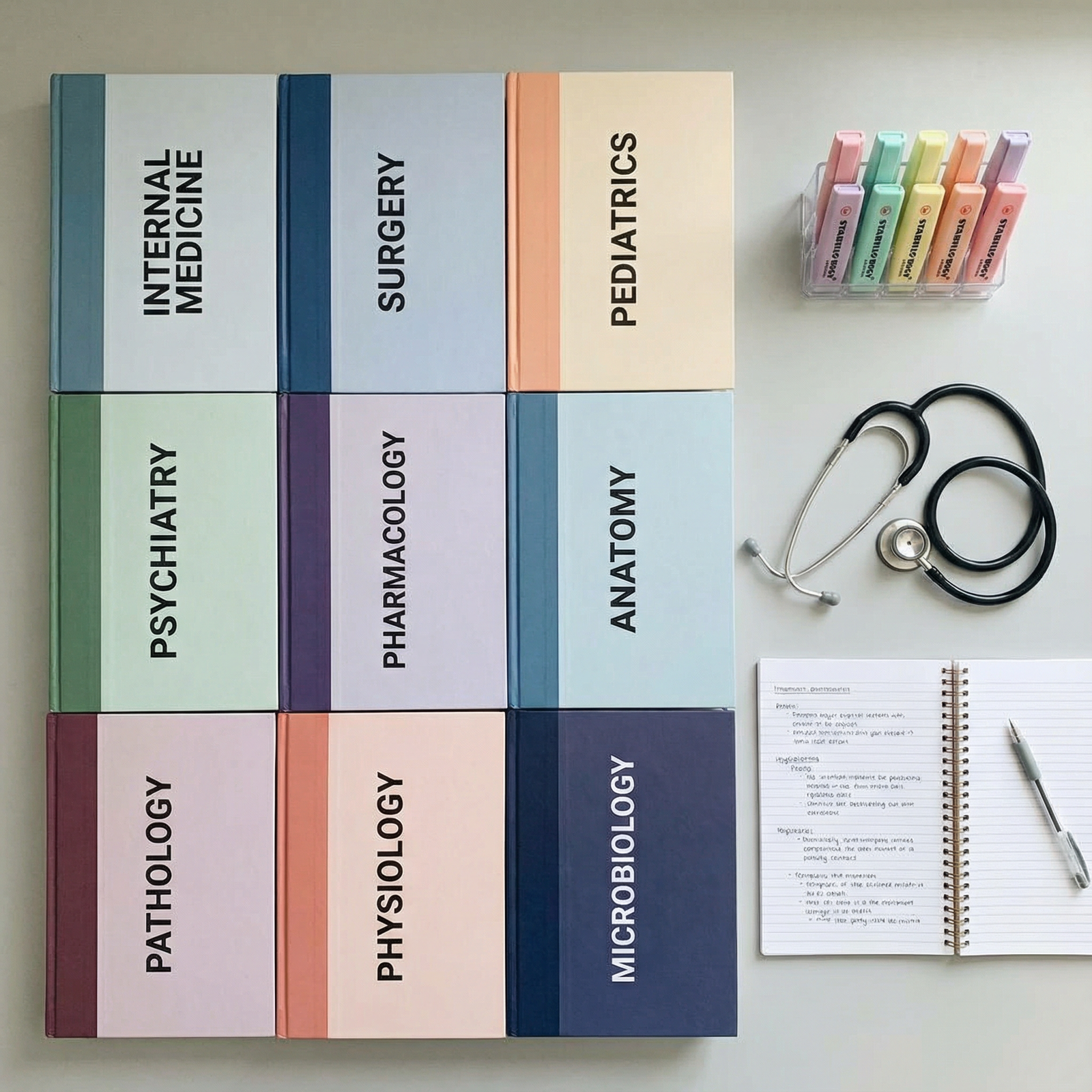
Essential Medical Textbooks by Discipline for Board Exam Success
Below is a curated list of core Medical Textbooks, organized by discipline, with commentary on how each resource fits into Board Exam Preparation and clinical training. You do not need to read every book cover-to-cover; instead, use them strategically alongside question banks and review resources.
Internal Medicine / General Medicine
Internal medicine forms the backbone of many licensing exams and is crucial for clinical rotations and residency.
“Clinical Medicine” – Parveen Kumar & Michael Clark
Best use: Core understanding of clinical presentations, diagnosis, and management.
- Offers a well-structured overview of adult medicine across organ systems
- Strong emphasis on clinical reasoning, decision-making, and management algorithms
- Useful for:
- Consolidating knowledge after completing a system in class or on rotation
- Clarifying topics that feel fragmented from lectures and notes
- Building a clinically oriented foundation for Step 2/Level 2 or final professional exams
Tip: Use it to revisit complex topics like heart failure, COPD, or chronic kidney disease after working through QBank questions—connect the “why” behind the “what.”
“Harrison’s Principles of Internal Medicine” – J. Larry Jameson et al.
Best use: Deep dive reference and advanced conceptual understanding.
- Considered the gold standard in internal medicine
- Exceptional for pathophysiology, rare diseases, and nuanced clinical details
- More detailed than you need for Step 1/Step 2–style questions but invaluable when:
- You want to truly understand complex diseases (e.g., vasculitis, interstitial lung disease)
- You’re preparing for internal medicine rotations or considering IM residency
- You need a trusted reference for presentations or case write-ups
Exam strategy: Don’t attempt to read Harrison’s cover-to-cover for boards. Instead, use it selectively when you encounter topics that feel fuzzy or overly simplified in review books.
Surgery
Surgical knowledge is less about memorizing operations and more about understanding pre-op, intra-op, and post-op care, plus acute management.
“Sheldon’s Operative Surgery” – J. C. K. Wong
Best use: Procedural orientation and surgical anatomy.
- Provides detailed descriptions of common operations
- Includes step-by-step approaches and relevant anatomy
- More helpful for:
- Surgical rotations
- Students considering surgical specialties
- Understanding what’s happening in the OR
For boards, focus on how operations relate to complications, indications, and contraindications rather than memorizing every surgical step.
“Current Diagnosis & Treatment: Surgery” – Gerard M. Doherty
Best use: Board-focused overview of surgical conditions.
- Concise, clinically oriented, and high-yield for exams
- Emphasizes:
- Initial assessment and stabilization
- Workup and differential diagnosis
- Evidence-based management
Practical approach: Use this as your primary surgery text during your surgical clerkship and Step 2/Level 2 prep. Pair chapters with relevant question blocks in a surgery QBank.
Pediatrics
Pediatrics is heavily tested on many board exams, especially regarding growth, development, and common pediatric diseases.
“Nelson Textbook of Pediatrics” – Robert M. Kliegman et al.
Best use: Comprehensive pediatric reference and deep dive resource.
- The authoritative text in pediatric medicine
- Thorough coverage of:
- Developmental milestones
- Congenital disorders
- Infectious diseases and immunization
- Chronic pediatric conditions
How to use it efficiently:
- For boards: Use Nelson as a reference when you need more detail than your review books provide
- For rotations: Read selected sections on common problems you see—e.g., bronchiolitis, asthma, neonatal jaundice, failure to thrive
Psychiatry
Psychiatric conditions and psychopharmacology are frequently tested and highly relevant clinically.
“Kaplan & Sadock’s Synopsis of Psychiatry” – Benjamin J. Sadock & Virginia A. Sadock
Best use: Comprehensive review of diagnoses, therapies, and psychopharmacology.
- Offers a balance between depth and conciseness
- Covers:
- DSM-based diagnostic criteria
- Psychotherapy types
- Psychopharmacology (mechanisms, indications, side effects)
- Special populations (child, geriatric, perinatal psychiatry)
Exam impact:
Mastery of this text will help you confidently tackle:
- Mood disorders
- Psychotic disorders
- Anxiety, OCD, PTSD
- Substance use disorders
- Personality disorders
Focus especially on drug mechanisms and side effect profiles, which are frequent board targets.
Pharmacology
Pharmacology is high-yield but often overwhelming. The right Medical Textbooks can make it manageable.
“Lippincott’s Illustrated Reviews: Pharmacology” – Karen Whalen et al.
Best use: Visual, high-yield pharmacology review.
- Highly visual with:
- Colorful diagrams
- Summary tables
- Flowcharts showing mechanisms and effects
- Excellent for:
- First-pass learning in preclinical years
- Rapid revision before exams
- Visual learners using spaced repetition
Strategy: Use Lippincott’s to build “big-picture” understanding of drug classes, then reinforce with flashcards and question banks.
“Rang & Dale’s Pharmacology” – James M. Ritter et al.
Best use: Deeper mechanistic understanding.
- Strong focus on pharmacokinetics and pharmacodynamics
- Good for students who:
- Want to truly understand how drugs work at the receptor and signaling level
- Are interested in research, pharmacology, or academic careers
For most board-focused students, Rang & Dale is best used as a supplement when you want more clarity beyond what Lippincott or review sources provide.
Anatomy
Solid anatomical knowledge underpins success in surgery, radiology, and many clinical specialties.
“Atlas of Human Anatomy” – Frank H. Netter
Best use: Gold-standard visual atlas.
- Clear, detailed, and clinically oriented anatomical illustrations
- Includes:
- Regional anatomy
- Common clinical correlations
- Surface anatomy references
How to use for exams:
- Pair Netter images with:
- Cadaver lab
- Radiology review (CT, MRI cross-sections)
- Neuroanatomy resources
- For Step/board questions, practice mentally rotating Netter’s images into imaging planes (axial, coronal, sagittal).
“Gray’s Anatomy for Students” – Richard L. Drake et al.
Best use: Narrated, student-friendly anatomy text.
- Focuses on exam-relevant anatomy with:
- Clear explanations
- Clinical boxes and cases
- Illustrations tied to function and pathology
Ideal for building foundational understanding in preclinical years and revising key regions (brachial plexus, lumbosacral plexus, abdominal wall, pelvis) before exams.
Pathology
Pathology is the bridge between basic science and clinical medicine and is central to nearly every board exam.
“Robbins & Cotran Pathologic Basis of Disease” – Vinay Kumar et al.
Best use: Comprehensive understanding of disease mechanisms.
- Widely regarded as the core pathology text
- Explains:
- Cellular injury and adaptation
- Inflammation and repair
- Neoplasia
- Systemic pathology by organ system
Board strategy:
- In-depth reading of the general pathology chapters (inflammation, neoplasia, immune system) pays off across multiple subjects
- For systems pathology, use Robbins more selectively to clarify mechanisms behind high-yield disease patterns tested in QBank questions
“Pathoma: Fundamentals of Pathology” – Husain A. Sattar
Best use: High-yield synthesis and exam orientation.
- Concise, highly board-focused text + video series
- Organizes pathology into digestible, concept-focused chapters
- Ideal for:
- First pass through pathology
- Rapid review in the final weeks before exams
- Creating mental frameworks before doing large numbers of questions
Power combo:
Use Pathoma for your initial overview and board-focused framework, then turn to Robbins when you need more depth or clarification.
Physiology
Physiology is central to understanding pathophysiology and pharmacology—and to scoring well on board-style questions that test mechanisms.
“Guyton & Hall Textbook of Medical Physiology” – John E. Hall
Best use: Foundational, clinically integrated physiology.
- Clear, narrative style with strong clinical connections
- Systematic coverage of all major organ systems
- Helpful diagrams, graphs, and summary tables
Exam use:
- Excellent for topics like cardiovascular, renal, and respiratory physiology—areas heavily tested on boards
- Use Guyton to troubleshoot topics you repeatedly miss in question banks (e.g., acid-base, Starling forces, autonomic regulation).
“Boron & Boulpaep Medical Physiology” – Walter F. Boron & Emile L. Boulpaep
Best use: Mechanistic, modern physiology.
- Strong emphasis on cellular and molecular mechanisms
- Particularly useful if:
- You’re interested in research or academic careers
- You want deeper insight into transporters, channels, and signaling pathways
For most students, this text works best as a supplement to Guyton when you want a mechanistic deep dive.
Microbiology and Immunology
These subjects can feel fact-heavy, but with the right texts and resources, they become more intuitive.
“Medical Microbiology” – Murray et al.
Best use: Comprehensive microbiology foundation.
- Balanced coverage of:
- Bacteria, viruses, fungi, and parasites
- Host-pathogen interactions
- Clinical syndromes
- Includes clinical cases and diagnostic algorithms
Exam approach:
- Focus on organism characteristics, transmission, disease patterns, and diagnostic tests
- Use Murray to deepen understanding after Sketchy/other memory aids, not instead of them.
“Janeway’s Immunobiology” – Kenneth Murphy et al.
Best use: Conceptual understanding of immunology.
- Clear explanations of:
- Innate and adaptive immunity
- Cytokine networks
- Immune tolerance and autoimmunity
- Hypersensitivity and immunodeficiency
While more detailed than strictly necessary for board exams, Janeway is ideal for:
- Clarifying confusing immunology concepts (e.g., complement, MHC, tolerance)
- Students interested in immunology, rheumatology, oncology, or research
Core Review Books and High-Yield Supplements
Textbooks give you depth; review books and board-centric resources help you translate that depth into points on exam day.
“First Aid for the USMLE Step 1” – Tao Le et al.
Best use: Central high-yield roadmap.
- Summarizes essential high-yield facts across all major basic science disciplines
- Serves as:
- A skeleton to which you attach details from lectures, textbooks, Pathoma, and UWorld
- A checklist to ensure you’ve reviewed all key exam topics
Practical tips:
- Annotate First Aid with explanations from your QBank and textbooks
- Don’t use it as your only resource—it’s a map, not the entire journey
“USMLE Step 2 Secrets” – Adam Brochert et al. (current authors may vary)
Best use: Concise, clinically focused Step 2/Level 2 review.
- Written in Q&A format, with mnemonics and clinical pearls
- Covers:
- Common presentations
- Workup strategies
- Management plans
Perfect for:
- Reading on commutes or short breaks
- Bringing together clinical knowledge near the end of third year
“Deja Review: USMLE Step 1” – Ryan Van Duzer
Best use: Rapid, last-minute review and self-testing.
- Organized in Q&A, “rapid-fire” style
- Forces active recall of key facts and associations
- Excellent for:
- Final 2–3 weeks before the exam
- Group review sessions with peers
Integrating Online Study Resources with Your Textbooks
Textbooks alone are not enough for modern board preparation. The most successful students blend deep learning from books with high-yield practice and feedback from digital platforms.
Commonly used online tools include:
- UWorld – gold-standard question bank for Step 1/2/Level 1/2
- AMBOSS – questions + integrated “library” with concise explanations
- Sketchy – visual mnemonics, especially useful for microbiology, pharmacology, and pathology
- Anki – spaced repetition flashcards for long-term retention
A Sample Integrated Study Workflow
- Learn the concept
- Read a focused section in a textbook (e.g., Guyton for renal physiology or Robbins for glomerulonephritis).
- Anchor with a high-yield framework
- Watch Pathoma for that pathology topic or review First Aid’s summary.
- Reinforce with questions
- Do related UWorld or AMBOSS questions. Analyze both correct and incorrect answers.
- Clarify gaps using textbooks
- Return to your Medical Textbooks to clarify points you missed or misunderstood.
- Retain with spaced repetition
- Add or review Anki cards based on your weak areas and UWorld explanations.
This approach aligns deep understanding with the pattern recognition needed for board-style testing and is a proven strategy for Student Success.
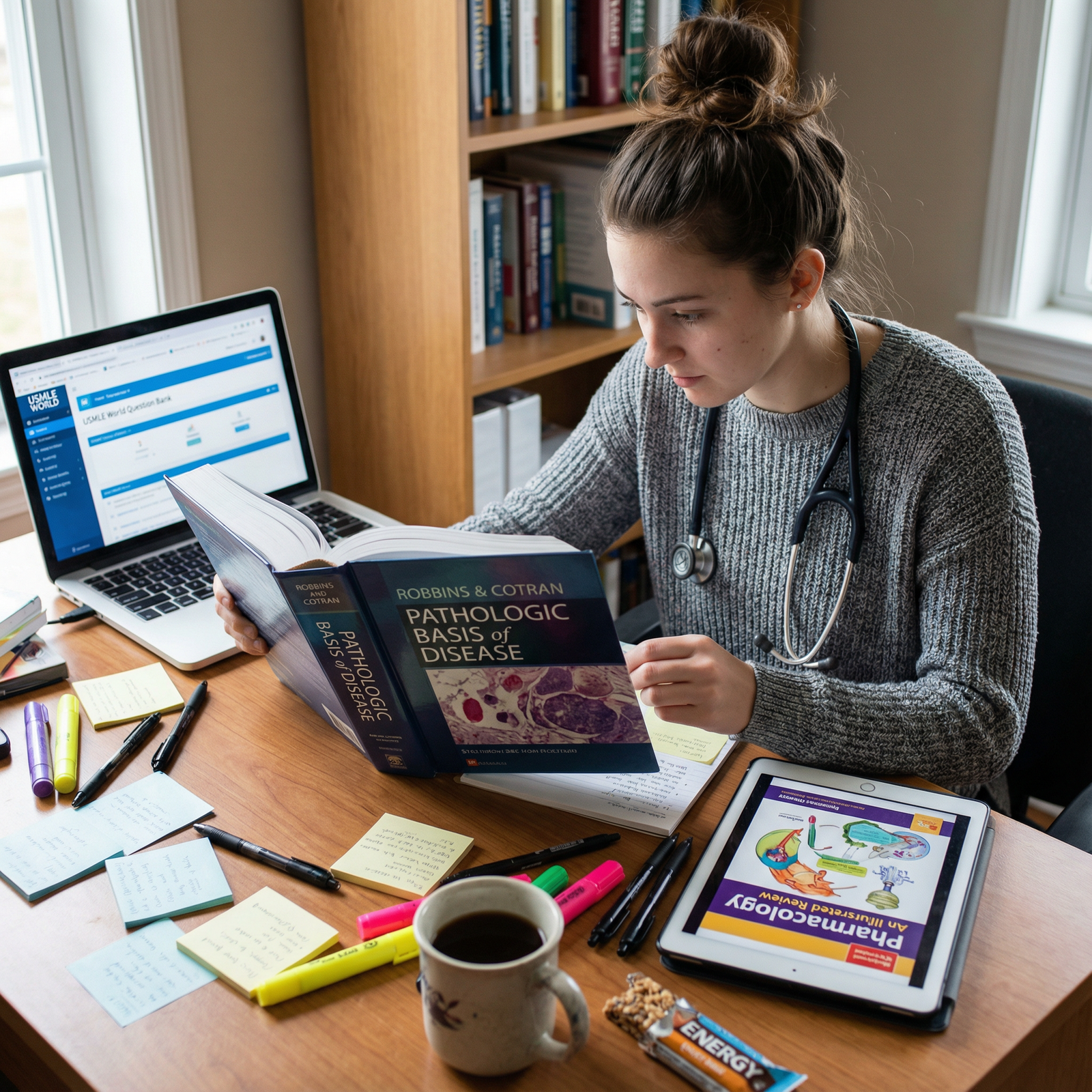
FAQ: Textbooks and Board Exam Preparation
1. Do I really need full textbooks if I’m already using question banks and review books?
For many students, yes, at least for key subjects (pathology, physiology, pharmacology, internal medicine). Question banks and review books are essential, but they primarily test and reinforce what you already understand. When you repeatedly miss questions on a topic or feel you “sort of get it,” a well-written textbook chapter often provides the clarity and conceptual depth you’re missing.
2. How should I decide which Medical Textbooks to actually purchase?
Consider:
- Curriculum alignment: Which books do your faculty and upperclassmen recommend for your specific school or exam board?
- Frequency of use: Core subjects (pathology, physiology, internal medicine) justify owning a copy, physical or digital.
- Learning style:
- Visual learners may prefer Lippincott’s, Netter, and illustrated reviews
- Conceptual learners may gravitate toward Guyton, Robbins, and Boron & Boulpaep
- Budget: You don’t need every recommended title. Start with 3–5 core texts you’ll use frequently, and access others via your library or institutional subscriptions.
3. What’s an efficient way to use textbooks without getting overwhelmed?
- Be selective: Don’t try to read entire texts cover-to-cover during board prep. Target chapters linked to your current block or your QBank weaknesses.
- Use chapter objectives: Skim learning objectives and summary boxes first to frame what matters.
- Time-box reading: Allocate 30–60 minutes for focused reading, then immediately follow with questions on that topic.
- Take minimal notes: Rather than rewriting the textbook, underline key points and annotate your high-yield review book (e.g., First Aid) with brief clarifications.
4. How can international medical graduates (IMGs) or students in non-US systems adapt this list?
The core sciences—anatomy, physiology, pathology, pharmacology—are universal. IMGs and students in other systems should:
- Use the same foundational textbooks (e.g., Robbins, Guyton, Lippincott, Netter) for conceptual understanding.
- Supplement with local or exam-specific resources aligned with their national exam blueprint.
- For USMLE or similar exams, pair these textbooks with First Aid, Pathoma, UWorld, and other US-oriented Study Resources.
5. When should I start using board-focused review books like First Aid and Pathoma?
- Year 1–2 (preclinical):
- Use Pathoma and First Aid as companions to your courses—review the relevant sections alongside your lectures.
- Dedicated board prep period (final 3–4 months before exam):
- Make First Aid, Pathoma, and your QBank your primary resources, using textbooks selectively to fill in gaps.
By curating a focused set of Medical Textbooks and integrating them thoughtfully with modern Board Exam Preparation tools, you can build a strong conceptual foundation, avoid common knowledge gaps, and position yourself for long-term Student Success—on exams, on the wards, and throughout your medical career.