
The Classic Q-Bank Mistakes That Lead to Shallow Learning
It is 11:37 p.m. You are on your third cup of coffee, UWorld / AMBOSS / Kaplan open, hammering through “just 40 more” questions because you promised yourself you would hit 80 today.
You are exhausted.
You skim the last stem, guess C, click “Next,” see a wall of explanation, scroll once, maybe twice, tell yourself “ok I knew that,” and move on.
You feel productive.
You are not actually learning much.
I have watched very smart students sabotage good Step and shelf potential this way. Not because they are lazy, but because they are using Q-banks in all the wrong ways. Q-banks are scalpels. Most people swing them like hammers.
Let me walk you through the classic mistakes that lead to shallow, brittle learning—the kind that collapses under a slightly twisted question—and how to avoid them before you waste months.
Mistake #1: Chasing Question Count Instead of Understanding
The most common and most destructive mistake: worshiping the number of questions done.
“I did 160 questions today.”
Then I ask, “Walk me through how you reviewed them.”
Answer is usually some variation of: “I read the explanation. It made sense.”
That is not review. That is exposure.
The trap
You start tracking:
- Total questions done
- Percent correct
- Blocks per day
And you treat those numbers like your progress report. So you:
- Rush through stems
- Skim answer choices
- Speed-read explanations
- Tell yourself you “kind of knew it” if you can retro-justify the correct answer after seeing it
You feel more confident because you are seeing more content. But your recall is shallow, context-dependent, and collapses outside that narrow framing.
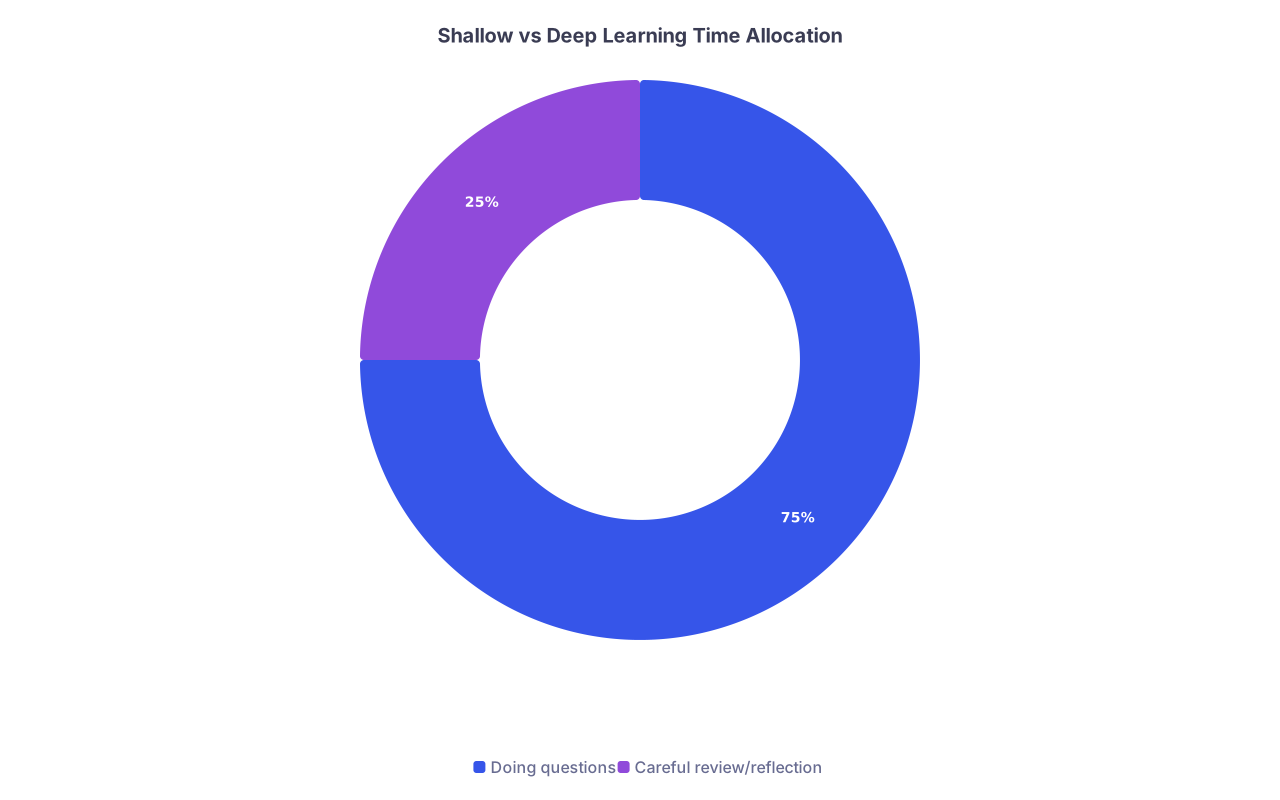
| Category | Value |
|---|---|
| Doing questions | 75 |
| Careful review/reflection | 25 |
Most students (wrongly) allocate 70–80% of their Q-bank time to “doing” and 20–30% to “review.” It should be much closer to 50/50—sometimes even 40/60 while you are building foundations.
How to fix it
- Aim for fewer questions, deeper review, especially early.
- A normal, solid pattern:
- 40–60 questions / day
- 2–3 hours of review on those questions
- For every question, ask:
- Why was the correct answer correct?
- Why was each wrong answer wrong?
- What concept or pattern does this test?
- If they changed X or Y in the stem, how would that change the answer?
If you cannot teach the underlying concept to a classmate from memory right after the question, you did not learn it. You just saw it.
Mistake #2: Memorizing Q-Bank Questions Instead of Concepts
You know this mistake. You have probably done it.
You see a question and think, “Oh yeah, this is the one with the alcoholic and macrocytic anemia, answer is B12 deficiency, boom.” You recognize the question. You do not truly understand the topic.
The trap
- Repeating blocks too soon “to improve your percentages”
- Using “marked” questions as your primary review set
- Treating Q-bank questions like flashcards
You start memorizing:
- Exact wording
- Lab values
- Order of bullet points in the explanatory text
So when a shelf or Step question uses a slightly different vignette for the same concept, you hesitate or miss it.
I have seen entire study plans blown because someone did UWorld twice back-to-back, “improved” from 54% to 80%, and thought they were ready. Their Step score said otherwise. Because the improvement was largely recall of patterns, not robust understanding.
How to fix it
When you see a question for the second time and recognize it, force yourself to ignore your memory of the answer and instead:
- Reconstruct the concept:
- “What is this really testing? Alcohol-related macrocytic anemia → could be folate or B12. How do I distinguish?”
- Deliberately explain the logic:
- “Neurologic findings → B12. Malnutrition vs malabsorption → what in the stem points which way?”
- Rewrite the stem in your head:
- “If this were a non-alcoholic vegan with neurologic symptoms, what would change? If he had jejunal resection, how would I reason through that?”
Your goal: be able to answer new, unseen questions on the same concept, not to crush the repeat ones.
Mistake #3: Treating Explanations Like Wikipedia Articles
Another classic: passive reading of explanations.
You miss a question. You scroll through 800 words of text. The logic kind of makes sense. You nod vaguely. Then you move on.
You are not interrogating anything. You are not testing recall. You are not integrating. You are absorbing prose like a novel.
This creates illusion of competence: “I read it, so I know it.”
The trap signals
- You read explanations only for questions you got wrong
- For questions you got right, you only check the correct answer box and move on
- You never close your eyes and re-state the core idea in your own words
- You do not check their explanation against a trusted primary resource (First Aid, B&B, Sketchy, class notes)
The explanation writers are not always perfectly clear. They are also not tailoring the content to your weak points. Blind acceptance is lazy.
How to fix it
For every question—right or wrong—do this:
- Before reading the explanation:
- State out loud (or in writing): “I picked X because…” or “I wasn’t sure between Y and Z because…”
- Then read the explanation critically:
- Where did your reasoning diverge?
- Did you miss a key word in the stem?
- Did you have a knowledge gap (e.g., did not truly know the side effects of a drug)?
- After reading:
- Close the window.
- On a scrap sheet or whiteboard, summarize in 1–2 sentences:
- The tested concept
- The “tell” in the stem
- One way they could trick you next time
If you cannot compress the explanation into a clean, memorable takeaway, you did not own it yet.
Mistake #4: Ignoring Your Wrong-Answer Patterns
Students love to track percent correct. They almost never track what kinds of mistakes they are making.
So six weeks later they are still falling for the same traps.
The real categories of wrong answers
When I review score reports, the errors usually fall into a small handful of buckets:
- Knowledge gap – you genuinely did not know the fact / pathway / drug
- Premature closure – you jumped on the first plausible answer
- Misread / missed detail – you ignored age, timeline, or key lab
- Test-taking flaw – you did not eliminate, you changed correct answers without reason
- Timing panic – rushed the last 5–10 questions in a block
| Error Type | Typical Fix |
|---|---|
| Knowledge gap | Add to Anki / focused content review |
| Premature closure | Force yourself to eliminate 3 choices |
| Misread detail | Underline or annotate stems |
| Test-taking flaw | Practice with timed mixed blocks |
| Timing panic | Shorten review time per question |
If you do not name the pattern, you will repeat it. Over and over.
How to fix it
Either in a spreadsheet, Notion, or a notebook, for every missed question, log:
- Topic
- The correct diagnosis / concept
- Your answer
- Why you missed it (choose one: knowledge, misread, premature closure, timing, etc.)
You will start seeing uncomfortable patterns.
Then you can target:
- If 40% of your misses are knowledge gaps in nephro → you need a dedicated nephro review week
- If 30% are misreads → you slow down and mark stems more aggressively
- If you always miss endocrine pharm second and third-order questions → you drill those with a smaller resource
This is how you convert Q-bank pain into score gain. Without this layer, you are just suffering in circles.
Mistake #5: Using Tutor Mode as a Crutch (or Timed Mode as a Weapon)
Both extremes are bad.
The “Tutor Mode Forever” crowd
These students:
- Do every single question in untimed tutor mode
- Check the answer immediately after each question
- Never simulate a real block of 40–60 questions under time pressure
Their pattern recognition improves a little, but on exam day:
- They are mentally exhausted by question 25
- Their pacing is off
- They panic when they cannot check if they are right instantly
You cannot cram timing skills into the last 3 days.
The “Always Timed, Never Review Properly” crowd
At the other end: people who do everything timed, “to simulate the real exam,” but then are too burnt out to review deeply.
They brag about “4 timed blocks today” but their review is shallow or rushed. They are training speed, not understanding.
How to fix it
Use a phased approach:
- Early phase (foundations):
- 50–70% tutor mode, mixed or by system
- Focus on concept building and review quality
- Mid phase:
- Shift to ~50% timed blocks, 50% tutor
- Start training endurance with 40-question blocks
- Final 3–4 weeks:
- Majority timed blocks (40–60 questions)
- Review still non-negotiable, but you accept maybe slightly fewer questions / day
The mistake is not tutor vs timed per se. The mistake is hiding in one mode because it feels comfortable.
Mistake #6: Staying in “By System” Mode for Way Too Long
Yes, doing cardiology questions right after you reviewed cardiology content feels great. Your percentages jump. Your ego thanks you.
But the exam is not organized by system. It is mixed. On purpose.
The trap
- Spending 6 weeks going: cardio → pulm → GI → renal → endocrine
- Doing each system’s questions only in that system’s window
- Never forcing yourself to switch gears within a block
You are building “chapter-based” memory. Real exams demand context-switching memory.
On Step and shelves, the cognitive load comes partly from:
- Jumping from psych to heme-onc to OB to renal in the same hour
- Holding onto multiple frameworks at once
If you never practice that, you will feel much dumber on exam day than you actually are.
How to fix it
- Start with some by-system blocks in your weakest systems early
- But transition to mixed blocks sooner than feels comfortable:
- For Step: by 6–8 weeks out, at least 70–80% of your blocks should be mixed
- For shelves: last 2–3 weeks before each exam, mix heavily with that shelf’s primary content
- When reviewing mixed blocks, explicitly label the topic shift:
- “Question 1: psych axis. 2: heme. 3: GI. 4: pharm.”
That trains your brain to re-orient faster.
- “Question 1: psych axis. 2: heme. 3: GI. 4: pharm.”
Mistake #7: Letting Q-Banks Replace Primary Learning Resources
This one creeps up on people.
You start using Q-banks “to reinforce what I learned in lecture.”
Then lectures feel useless. Videos feel slow. Q-banks are more “high-yield.”
So you quietly decide, “I’ll just learn from questions.”
You can get away with this in a few areas if you are gifted. But usually what happens:
- Huge holes in low-frequency topics (ethics nuances, biostats corners, odd genetic diseases)
- Weak frameworks in pathophysiology
- Confusion when explanations assume knowledge you never actually acquired
Q-banks are fantastic for testing and refining knowledge. They are not the best first-line architecture for building it.
Signs you are doing this
- When you miss a question, you only reread the explanation, never go back to a structured source
- You cannot explain a disease or mechanism from scratch unless you have recently seen a question about it
- Certain subjects (biostats, ethics, basic science) feel like a random collection of facts instead of connected ideas
How to fix it
Use a simple rule: Q-banks push; primary resources anchor.
- When you see a concept you do not fully get:
- Flag it
- That same day, or at worst next morning, open your core resource (First Aid, B&B, Pathoma, school notes) and rebuild the concept from the ground up
- If a topic keeps showing up in questions and you keep getting variants wrong:
- Schedule a 1–2 hour mini-block: just you, a notebook, and your primary resource
- No questions. Just build a clean, connected framework
Q-banks should drive what you review deeper, not be the only place you ever see the material.
Mistake #8: No System for Capturing and Revisiting What You Learn
This is the “leaky bucket” problem.
You do questions. You learn things. You forget 70% of it within a week because you have no review pipeline.
The trap
- Highlighting in explanations like crazy
- Telling yourself “I’ll remember this, it is obvious”
- Not using any form of spaced repetition
- Relying on vague exposure from more and more questions to “reteach” you
This is how you can do thousands of questions and still feel like you are constantly re-learning the same stuff.
How to fix it
You need a capture → organize → revisit system. It does not have to be elaborate.
A reasonable minimum:
- Capture
- For any missed or “guessed right” question with a concept you are shaky on:
- Write down a 1–2 line summary of the key idea, plus a short example
- For any missed or “guessed right” question with a concept you are shaky on:
- Organize
- Group by system or discipline (e.g., renal, cardio, biostats, ethics)
- Keep it in:
- Anki
- A running Google Doc
- A Notion database
- A small handwritten notebook
- Revisit
- 15–30 minutes at the start or end of each day:
- Rapid review of yesterday’s (or 2 days ago’s) captures
- Once a week:
- Skim your weakest system’s notes; quiz yourself
- 15–30 minutes at the start or end of each day:
The mistake is believing that “seeing enough questions” substitutes for systematic review. It does not. Volume without spaced reinforcement is just controlled forgetting.
Mistake #9: Obsessing Over Percent Correct and Self-Punishing on Bad Days
You know this cycle:
- One bad block (50–55%) → “I am dumb, this is not working”
- Spend 45 minutes spiraling on Reddit or looking up other people’s percentiles
- Overcorrect by trying to do 120 questions the next day
- Burnout, shallow review, more bad blocks
Percent correct is a lagging, noisy metric. It is influenced by:
- Difficulty of the block
- Systems you happened to get that day
- Simple fatigue or distraction
If you obsess over it, you make emotional decisions instead of rational adjustments.
How to fix it
Track trends, not single blocks:
- Look at rolling averages across 100–200 questions, not each 40-question set
- Pay more attention to:
- Error patterns (see earlier)
- Whether your concept explanations are getting cleaner and faster
- How you perform on fresh sources (NBMEs, new Q-banks)
And on bad days?
- Do fewer new questions
- Spend more time on high-quality review of what went wrong
- Adjust your study plan based on patterns, not mood
Punishing yourself with more volume is how you turn one bad day into three wasted ones.
Mistake #10: Ignoring Mental Fatigue and Treating Q-Banks Like a Grindstone
Students often think more suffering = more learning. Wrong.
Exhausted brains:
- Miss obvious clues
- Misread stems
- Struggle to transfer information to long-term memory
If you are doing blocks at 1 a.m. and then “reviewing” them half-asleep, you are practicing bad habits and encoding very little.
How to fix it
- Protect your best cognitive hours (usually mornings) for:
- New questions
- Hard systems
- Deep review
- Use lower-energy periods for:
- Light Anki
- Skimming notes
- Quick recaps of prior errors
And if you notice:
- You are re-reading the same line in an explanation three times
- You are making dumb calculation errors
- You cannot articulate why an answer is correct even when you get it right
That is your signal to stop or switch to light work. Not to push through another block.
Key Takeaways
- Do not measure progress by question count or percent correct alone. Measure it by how clearly you can explain concepts and how often you repeat the same mistakes.
- Q-banks are for testing and deepening knowledge, not replacing primary learning. Use them with structured review, error tracking, and some form of spaced reinforcement.
- Avoid comfort traps: endless tutor mode, by-system-only blocks, passive explanation reading, and late-night zombie questions. Those habits feel productive but build shallow, fragile learning that will not hold up under real exam pressure.