
You’re sitting in the library, and you overhear it again: “Yeah, I’m on my second pass of UWorld.” Someone else: “UWorld or fail, man.” You look down at your iPad, where not UWorld is open, and your stomach just… drops.
You start doing the math in your head: Everyone uses UWorld. I don’t. Does that mean I’m already behind? Did I just quietly sabotage my board score without realizing it?
Let me just say this flat out so you don’t have to skim and panic:
No — not using UWorld does not automatically doom your boards.
But yes — there are ways to mess this up if you handle it badly.
Let’s talk about both.
Why UWorld Feels Like a Cult (And Why That Freaks You Out)
You’re not imagining it. The UWorld hype is real.
People talk about it like:
- “UWorld is the exam.”
- “If it’s not in UWorld, it’s not on the test.”
- “Just do UWorld twice and you’re fine.”
And you’re thinking: cool, that’s great for the people who can drop hundreds of dollars on a qbank subscription at the “right” time and somehow perfectly time their dedicated. But that’s… not you.
Maybe:
- You couldn’t afford it this year and went with AMBOSS/USMLE-Rx/Boards & Beyond qbank instead
- Your school bought a different institutional qbank and you thought, “OK, that’s enough, right?”
- You started late and felt overwhelmed, so you just stuck to Anki + free questions
- You’re an OMS student and everyone around you is talking COMBANK/TrueLearn instead
And now you’re stuck in this mental loop:
If everyone who scores high used UWorld… and I didn’t… what does that say about me?
Here’s the uncomfortable truth: high-scorers talk about UWorld a lot because it’s a simple story. “I used UWorld, did X passes, scored 250.” It sounds like magic.
But what nobody tells you is this:
- There are people who used UWorld and still bombed.
- There are people who didn’t touch UWorld and passed (and some even crushed it).
- The obsession with the brand completely ignores the real reason qbanks work (or don’t).
Let me show you what actually matters.
What Actually Predicts Board Performance (Spoiler: It’s Not a Logo)
Instead of asking, “Did you use UWorld?” a more honest question is:
“How many good questions did you actively learn from, consistently, over months?”
Notice the missing word? Brand.
Every big qbank is doing the same basic job:
- Test your application of knowledge
- Force you to think in board-style patterns
- Expose your blind spots
- Make you wrestle with ambiguity
Is UWorld very good at this? Yes. I’d be lying if I said it wasn’t. But is it the only one capable of doing this? No. That’s the brainworm that’s stressing you out.
Here’s how your situation actually stacks up, brand aside:
| Factor | Weak / Risky | Strong / Protective |
|---|---|---|
| Total questions done | < 800 | 1500–3000+ |
| Review depth | Just checking answers | Carefully reviewing every explanation |
| Timeline | Cramming last 3–4 weeks | Steady questions over 3–6+ months |
| Integration with content | Qs alone, no First Aid/Pathoma/Anki | Linking misses to resources + spaced review |
| Honest self-assessment | Avoiding hard topics | Targeting weak areas on purpose |
If you’re weak in most of the “strong” column and you’re not using UWorld?
Yeah, then you’re in a risky spot.
If you’re solid in the “strong” column, with a non-UWorld qbank? You’re way, way safer than you feel.
But Is UWorld Actually Better? Am I Missing Secret Sauce?
Let me be blunt: UWorld is very good. It’s well-written, highly detailed, and tuned to the real exam in a way that’s hard to fake.
But this is where people twist the logic:
“People who score well often used UWorld”
becomes
“Using UWorld is why they scored well.”
Correlation vs causation. You know the drill.
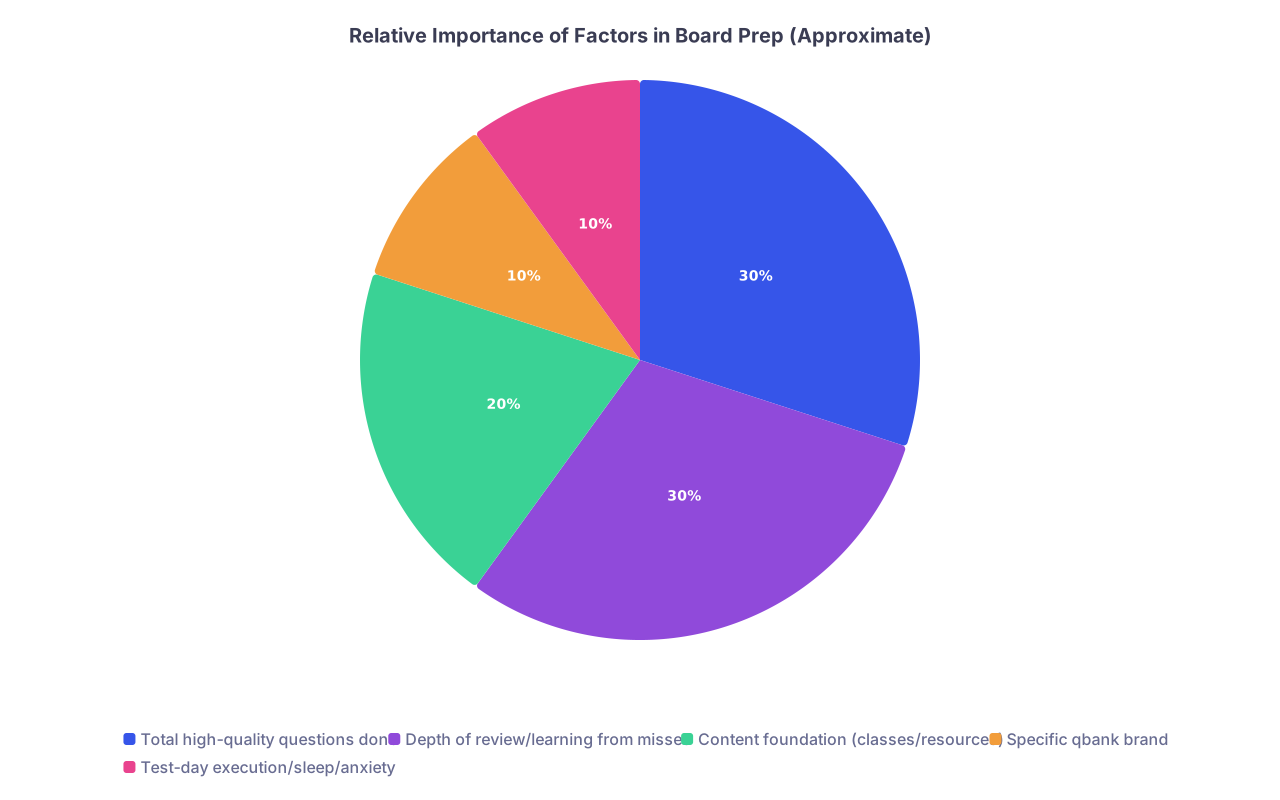
Here’s a more honest look:
| Category | Value |
|---|---|
| Total high-quality questions done | 30 |
| Depth of review/learning from misses | 30 |
| Content foundation (classes/resources) | 20 |
| Specific qbank brand | 10 |
| Test-day execution/sleep/anxiety | 10 |
Is brand irrelevant? No. Badly written questions can hurt you or at least waste time.
But most big names — AMBOSS, TrueLearn, Kaplan, USMLE-Rx, COMBANK, etc. — are good enough to pass with if used properly.
Where UWorld tends to shine:
- Question stems and answer choices feel very “exam-flavored”
- Explanations are detailed and often teach mini-lessons
- The difficulty is calibrated so you get used to being slightly uncomfortable
You know what else can do that? Any solid qbank + ruthless review + active learning.
So if you’re thinking, “I don’t have UWorld, so nothing I do matters,” that’s just self-sabotage disguised as realism.
Worst-Case Scenarios (And How Not to Walk Into Them)
This is the stuff you’re actually afraid of. Let’s name it.
Scenario 1: You never get UWorld and your current prep is sloppy
What this looks like in real life:
- You’re using a free or cheaper qbank
- You’re doing random blocks here and there when you “have time”
- You’re skimming explanations, not understanding why wrong answers are wrong
- You’re not tracking weak areas
- You’re not tying misses back to First Aid/Boards & Beyond/Pathoma/Anki
Then yeah, I’d worry. But I wouldn’t worry because of the missing UWorld.
I’d worry because the system is bad.
Fix:
Without changing qbanks at all, you can massively upgrade your value:
- Do timed, random, mixed blocks regularly
- After each block, deeply review: why each answer choice is right or wrong
- Make flashcards or short notes from your misses, then actually review them
- Specifically target weak systems (renal, neuro, cardio, etc.) with more questions
Scenario 2: You panic and switch to UWorld too late
This one is very common.
You’re a month out from your exam. Everyone’s flexing their UWorld stats. You think, “I guess I need it,” and buy a subscription when your brain is already on fire.
Then you:
- Have no time to do a full pass
- Try to cram 80–120 questions/day
- Don’t review properly because you’re rushing
- End up more anxious because your percentages look bad
This is an actual downgrade. Not because UWorld is bad, but because your timing is.
If you’re late in the game and your current qbank is familiar, switching just to “join the cult” can hurt more than help.
Scenario 3: You use UWorld… badly
The nightmare you’re not considering: it’s absolutely possible to have UWorld, worship UWorld, base your identity on UWorld… and still be underprepared.
Concrete example I’ve seen more than once:
- Student does 100% of UWorld in tutor mode
- Stares at explanations but never synthesizes
- Doesn’t do many timed blocks or full-length practice tests
- Doesn’t track patterns in their errors
- Finishes UWorld, feels “done,” doesn’t circle back to weak topics
They walk into the exam proud of “I did all of UWorld” and then get blindsided by timing, fatigue, or slightly different question styles.
The brand didn’t save them. Because it was never going to.
How to Make Non‑UWorld Prep Actually Work
Let’s say you’re committed: you don’t have UWorld right now, or you genuinely can’t get it. What now?
You focus on method over myth.
1. Treat whatever qbank you have like it’s sacred
Not joking. Pick your main qbank and decide: “This is my UWorld.”
Then:
- Aim for at least 1500–2500 questions by test day if you’re in a USMD/DO program
- Do as many as you can in timed, random, mixed mode (not just system-based) once you’re out of pure content review
- Use tutor mode early in the year, but gradually switch to timed blocks as you get closer
2. Squeeze every drop of learning out of each question
You’re not just checking if you got it right. You’re training your brain how to think like the exam.
For every question, especially the ones you miss:
- Why is the right answer right — pathophys, keywords, next best step?
- Why is each wrong answer wrong? Too early? Too late? Wrong disease?
- What “trigger words” in the stem should’ve pointed you elsewhere?
- What general rule or pattern can you extract and reuse on other questions?
If your current qbank’s explanations are weak, patch the holes:
- Pair it with AMBOSS library / UpToDate / textbooks
- Look up confusing concepts in First Aid/Boards & Beyond/Pathoma
- Make your own explanation in your own words as a flashcard/note
3. Use a feedback loop, not vibes
Don’t just “feel” like you’re weak in cardiology. Prove it.
Most qbanks will show you performance by system and topic. Use that:
- Low in renal? Schedule 3–5 extra renal-heavy blocks that week
- Keep missing pharm? Build a dedicated pharm flashcard deck from your misses
- Timing killing you? Commit to strict 40-question timed blocks and accept the discomfort
This is the grown-up version of board prep. It’s not sexy, but it works.
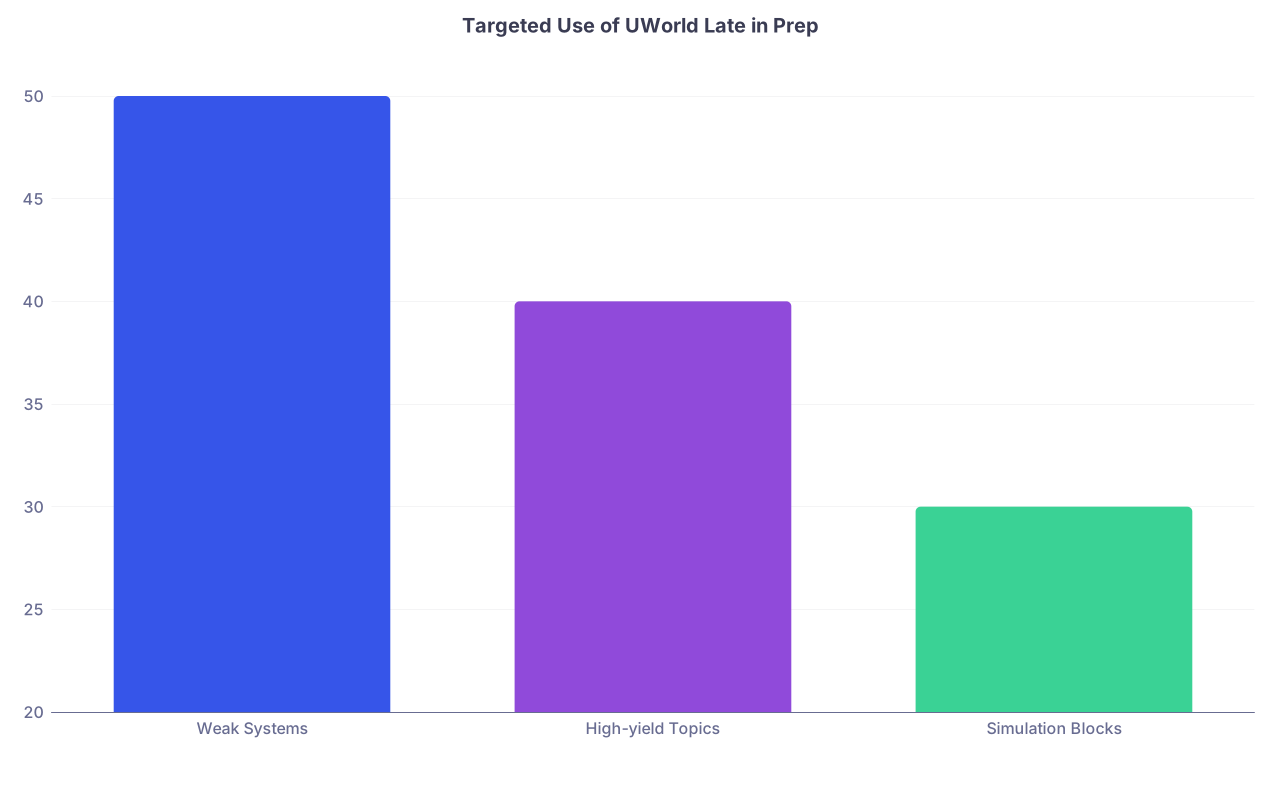
4. If you can add UWorld late, be surgical about it
If you end up being able to afford UWorld or get temporary access close to your exam, don’t treat it like “now I must grind all 3000 questions or die.”
Instead, be strategic:
| Category | Value |
|---|---|
| Weak Systems | 50 |
| High-yield Topics | 40 |
| Simulation Blocks | 30 |
That could look like:
- Doing 1–2 blocks per day focusing only on your 2–3 weakest systems
- Doing mixed timed blocks to simulate the real exam and get used to the style
- Using UWorld explanations to clean up lingering confusion, not as your first exposure
Think “refinement,” not “reinvention.”
The Psychological Part: Feeling Behind Because You’re Different
Honestly, the content is only half the problem. The other half is the constant comparison.
Your class group chat is full of:
- “What’s your UWorld %?”
- “How many blocks have you done?”
- “Second pass yet?”
And you’re there like, “I… used AMBOSS?” and it feels like saying “I studied with crayons.”
You’re not actually behind just because your path looks different. You’re behind if:
- You’re secretly doing way fewer questions than your peers
- You’re not getting consistent feedback on your performance
- You’re not building endurance with timed blocks and practice exams
One thing I’ve seen help anxious students a lot:

| Step | Description |
|---|---|
| Step 1 | Pick main qbank |
| Step 2 | Do 40 Qs/day, 5x/week |
| Step 3 | Deep review of explanations |
| Step 4 | Track weak areas by system |
| Step 5 | Target weak areas with extra blocks |
| Step 6 | Add 1-2 NBME/COMSAE practice tests |
| Step 7 | Adjust schedule based on results |
You’ll notice what’s missing in that flowchart: the word “UWorld.”
Because the process is what actually moves the needle.
When You Should Seriously Consider Getting UWorld
I’m not anti-UWorld. I’m anti-“if you don’t have UWorld you’re screwed forever.”
There are times where I’d say: yeah, if you can possibly swing it, it’s worth it:
- You’re 2–4 months out and haven’t done any serious qbank yet
- Your current qbank is truly low quality (recycled old items, unclear explanations, questions that feel nothing like modern boards)
- Your practice scores (NBME/COMSAE/COMSAE/Free 120) are significantly below where you need them (e.g., clearly at risk of failing), and your school/advisor specifically recommends UWorld as an upgrade
But even then, UWorld is a tool, not a cure. If you throw it at the problem without changing your habits, you’ll just have more expensive anxiety.
Quick Sanity Check: Are You Actually Doomed?
Ask yourself a few brutal yes/no questions:
- Have I done at least ~1000+ board-style questions so far?
- Do I spend at least as much time reviewing explanations as I do answering questions?
- Have I taken at least one practice exam (NBME/COMSAE/Free 120) under exam-like conditions?
- Do I have a specific plan for weak areas instead of just hoping they get better?
If you’re mostly “yes” — you are not doomed. Even without UWorld.
If you’re mostly “no” — the problem isn’t what qbank brand you’re using. It’s that you haven’t been truly preparing. And the best time to fix that is now, not after you buy a different logo.
FAQ (Exactly 5 Questions)
1. Be honest: Can I pass without ever touching UWorld?
Yes. I’ve seen people pass comfortably using AMBOSS only, or TrueLearn/COMBANK only, or even a mix of smaller qbanks + NBME practice exams. What mattered was: they did thousands of questions, reviewed them obsessively, and used practice tests to course-correct. If your current qbank is reasonably good and you use it well, passing is absolutely realistic without UWorld.
2. Is UWorld basically required if I want a super high score (e.g., 250+)?
Required? No. Common among that crowd? Yes. Many high scorers use UWorld because it’s high-yield and aligns well with the exam. But the real common threads in high scorers are: ruthless consistency, brutal honesty about weaknesses, and deep learning from explanations. If you’re not doing those things, UWorld won’t magically turn you into a 250. If you are, then UWorld can help — but it’s not the sole gatekeeper.
3. I’m 4–6 weeks out. I’ve been using a different qbank. Is it too late to switch to UWorld now?
Usually, yeah, it’s too late to fully switch and get full value. At that point, I’d only bring in UWorld (if at all) as a supplement: a few timed mixed blocks, focus on weak systems, use explanations to polish gaps. Completely abandoning your current qbank at T‑minus 4 weeks is almost always a mistake. You don’t need a new religion right before the exam; you need execution and refinement.
4. My friends all compare UWorld percentages. How do I even know if I’m on track without that benchmark?
Use what actually matters: practice exams. For USMLE: NBMEs + Free 120. For COMLEX: COMSAE/COMBANK self-assessments. Your qbank percentage — UWorld or not — is a trash predictor if used alone. Look at: practice exam scores, trends over time, and whether your misses are getting more nuanced (going from “no idea” to “between two answers”). That’s your real barometer.
5. I can’t afford UWorld right now. Is it worth going into debt/credit card for it?
This is messy, but I’ll be straightforward: I wouldn’t go into serious debt purely for UWorld if you already have access to another solid qbank and can also afford practice exams. If you had no qbank at all and were months out, I’d lean more toward “yes, it might be worth stretching for.” But for most students, the upgrade from “decent qbank used well” to “UWorld” is marginal compared to how you study. Don’t wreck your financial sanity for a brand when disciplined use of what you already have can get you where you need to go.
You’re not behind just because you’re not doing what “everyone” is doing. You’re behind if you’re not steadily doing high-quality questions, learning from them, and adjusting based on real feedback.
UWorld is a powerful tool. It’s not a magic spell. Your boards aren’t doomed — unless you let the anxiety paralyze you instead of fixing your process.