
The way med students buy Q-banks right now is financially reckless.
Let me say the quiet part out loud: a lot of us are going broke buying question banks we don’t have the time or mental energy to actually use. But we hit “purchase” anyway, because what if that one question bank is the thing that makes or breaks Step 1 or Step 2?
You know the feeling. You’re sleep-deprived, scrolling Reddit or Discord at 1 a.m., and someone casually posts, “Honestly you NEED UWorld + AMBOSS + Kaplan + Rx + Anki + NBME + [insert new shiny thing] to be competitive now.”
And suddenly you’re doing mental math with your bank account and your future.
“If I don’t buy all of these, am I basically choosing to fail?”
Let’s pull this apart like an actual problem, not a panic spiral.
The Core Fear: “If I Don’t Buy Everything, I’ll Fall Behind”
This is the ugliest thought most of us don’t say out loud:
“I’m not naturally smart enough. I need extra resources just to keep up with everyone else.”
So Q-banks become this weird psychological crutch. Not just tools. Proof that we’re “doing everything possible.”
Here’s the uncomfortable truth I’ve seen over and over:
Most people don’t fail exams because they didn’t own enough question banks.
They fail because they didn’t deeply use one of them.
I’ve watched classmates spend $800+ on subscriptions and then barely get past 30–40% of any single bank. Timers off. Mixed systems “later.” Half-finished blocks. Review “when I have more time.” They don’t have a resource problem. They have a reality problem.
Reality = You have limited time, limited focus, and limited willpower.
And also, yes, limited money.
So the real question isn’t “Which Q-banks should I buy?”
It’s “How many questions can I actually do and review properly in the time I have?”
Because once you do that math honestly, the number of Q-banks you “need” shrinks fast.
What Q-Banks Actually Do (And What They Don’t)
Q-banks are not magic. They’re pattern-recognition trainers.
They teach you:
- what high-yield looks like
- how questions are asked, not just what you “know”
- how to think through a scenario under time pressure
What they don’t do:
- fix massive content gaps automatically
- compensate for never reviewing your mistakes
- make up for chronic burnout and 4 hours of sleep
If you’re barely holding your schedule together, buying a 3rd or 4th bank isn’t “being thorough.” It’s delusion dressed up as productivity.
Most med students can realistically do about 2,000–4,000 high-quality questions with full review in a dedicated period without destroying their brain. Some do more, sure. But sustained, careful review of that many questions is already brutal.
Now look at this:
| Q-Bank | Approx # of Questions |
|---|---|
| UWorld | 3,800–4,200 |
| AMBOSS | 4,000+ |
| Kaplan | 2,000–2,500 |
| USMLE-Rx | 2,000–2,500 |
| NBME Self-Assessments | 200–800 total |
If you buy two big banks and try to “do all of them,” you’re already at 7,000–8,000+ questions. And that’s before you even touch school exams, Anki, or practice NBMEs.
Tell me honestly: with your current life and stress levels, are you really using all that?
The Money Panic: “Am I Paying to Pass… or Paying for Guilt?”
Let’s talk about money, because pretending it’s not a factor is fake.
You’re staring at subscriptions like:
- UWorld: hundreds
- AMBOSS: more hundreds
- Kaplan/Rx/etc.: another chunk
- NBMEs: not cheap
- Plus maybe COMBANK or TrueLearn for COMLEX, specialty-specific banks later…
And the messed-up part? Every single one feels like a moral decision.
“If I don’t buy UWorld, I’m irresponsible.”
“If I don’t get AMBOSS too, I’m handicapping myself.”
“If I skip those extra NBMEs, I’m gambling with my future.”
You’re not just afraid of failing. You’re afraid of looking back and thinking,
“I failed because I tried to save $200.”
Here’s the line I draw, and I’m going to be blunt.
You need:
- One primary, high-quality Q-bank for the big exam (Step 1/2, COMLEX)
- Practice exams (NBMEs, UWSAs, etc.) to calibrate your score and timing
You might benefit from one secondary bank if:
- You finish most of your primary bank with real review
- You’re early enough in your timeline to actually use more practice
- You’re not going into financial meltdown over it
You’re wasting money if:
- You’re buying a second or third Q-bank while you’re only 20–40% into your main one
- You don’t have a consistent schedule for doing and reviewing questions
- You already know you won’t realistically finish them but want “access just in case”
Buying Q-banks you can’t use isn’t “investing in your future.”
It’s paying extra to feel guilty every time you log in.
Time vs Questions: What Can You Actually Do?
Let’s get brutally concrete. How many questions can you realistically handle?
Assume you’re in a dedicated study period.
If you do:
- 40 questions/day, full review → 2–3 hours
- 60 questions/day, full review → 3–4 hours
- 80 questions/day, full review → 4–6 hours (for most people, this is rough)
Even at 60 questions per day:
- In 6 weeks (42 days) → you can do about 2,520 questions
- In 8 weeks (56 days) → around 3,360 questions
That’s one big Q-bank almost fully done. With real review.
Now add in:
- NBME practice exams (takes a day to do + review properly)
- School content / rotations / life tasks
- Days where your brain just refuses to cooperate
You see the problem. The limiting factor is time and cognitive stamina, not the number of banks.
Here’s what usually actually happens (I’ve watched this play out again and again):
- Student buys 2–3 Q-banks because “everyone” says so.
- Starts UWorld. Gets to 35–40% complete, slow review.
- Panic sets in: “I still haven’t touched AMBOSS/Kaplan, I’m so behind.”
- They sample the second bank a little. Feel overwhelmed by different styles.
- Ends up with two half-finished question banks and no deep mastery of either.
Meanwhile, another student just grinds UWorld to 80–90% complete, reviews every mistake, does several NBMEs, and uses Anki or notes for weak topics.
Guess who feels more prepared two weeks before the exam?
Popular Q-Bank Combos: What’s Reasonable vs Overkill
Let’s zoom out and compare what people are actually doing versus what’s probably enough.
| Strategy | Reality Check |
|---|---|
| Single primary bank (UWorld) | Enough for most if used deeply |
| UWorld + practice NBMEs | Solid, common, not excessive |
| UWorld + AMBOSS | Good if you finish most of UWorld first |
| 3+ Q-banks (UWorld + AMBOSS + Kaplan/Rx) | Overkill for most, often leads to shallow use |
| Only school-provided questions | Risky unless your school is known for strong banks |
Most people who score well do not fully complete 3+ commercial banks. They might:
- use one as their main bank
- use another as a targeted resource:
“I’ll do 20–30 cardiology questions on AMBOSS for weak spots”
or
“I’ll hit some extra ethics/biostats on Kaplan”
That is very different from thinking you need to purchase and exhaustively complete multiple full banks or you’re doomed.
The Psychological Trap: “More Resources = More Safety”
There’s this brutal thought loop:
“I’m anxious → I buy another resource → I still feel underprepared → Maybe I need another resource.”
You’re not actually buying better prep at that point. You’re buying temporary relief from panic. Like pressing “snooze” on a fire alarm.
I’ve seen people with every possible subscription still sit there two weeks before their exam saying, “I feel like I haven’t done enough.” Not because they didn’t own enough. But because they never committed to a plan and followed it.
Here’s the part nobody likes:
Safety is not in the number of resources. It’s in the quality of your repetition and review.
- Doing 2,000 questions with full, painful, detailed review = real learning
- Doing 5,000 questions with superficial click-through and no notes = mostly noise
And your brain knows when you’re faking it. That’s why the anxiety doesn’t go away even after you throw hundreds of dollars at more subscriptions.
A Simple, Honest Framework: How Much Do You Really Need?
If I strip away the panic and FOMO, this is the framework I come back to.
Pick one primary Q-bank.
For USMLE: Usually UWorld. For COMLEX: a COMLEX-focused bank (TrueLearn, COMBANK), plus ideally some UWorld or AMBOSS to clean up clinical reasoning.Commit to using it properly before buying anything else.
Timed, exam-style blocks. Mixed mode once you’re further along. Detailed review of every single question, right or wrong, especially for concepts you guessed on.Add practice exams early enough to adjust.
NBME forms, UWSAs, COMSAEs, etc. Use them to guide your weaknesses, not just to get a number.Only then ask: do I actually have time and energy left to benefit from a second bank?
If your exam is in 5 weeks and you’re 20% through your first bank, the answer is no.
If you’re the kind of person who wants a graphic timeline in your head:

| Step | Description |
|---|---|
| Step 1 | Pick primary Q-bank |
| Step 2 | Plan daily question volume |
| Step 3 | Do & fully review 50-80% of bank |
| Step 4 | Take practice exam |
| Step 5 | Target weak topics using same bank or small second bank |
| Step 6 | Continue primary bank + practice exams |
| Step 7 | Reassess with practice exam |
| Step 8 | Weak areas? |
Notice this doesn’t say “Buy everything in sight” anywhere.
The Budget Reality: Choosing Without Hating Yourself
If you’re already stretched thin financially, the pressure is brutal. You’re not just choosing study tools. You’re choosing between:
- Another month of groceries vs a Q-bank
- Paying less interest on loans vs buying all the “recommended” resources
Here’s the line I won’t cross:
You should not be skipping rent, food, or basic stability to buy a second or third Q-bank.
One good bank + practice tests + some form of content review (videos, notes, school lectures, or Anki) is enough foundation to pass and often to score well. The rest is optimization, not oxygen.
If you’re scared that “everyone else has everything,” remember this: you’re not seeing the people on Reddit who quietly used one Q-bank, studied hard, took their exam, and moved on with their lives. You’re hearing from the most anxious, the most intense, and honestly, sometimes the most wasteful.
The loudest people are rarely the most efficient.
Quick Reality Check with Data
Just to make this less abstract, imagine this distribution:
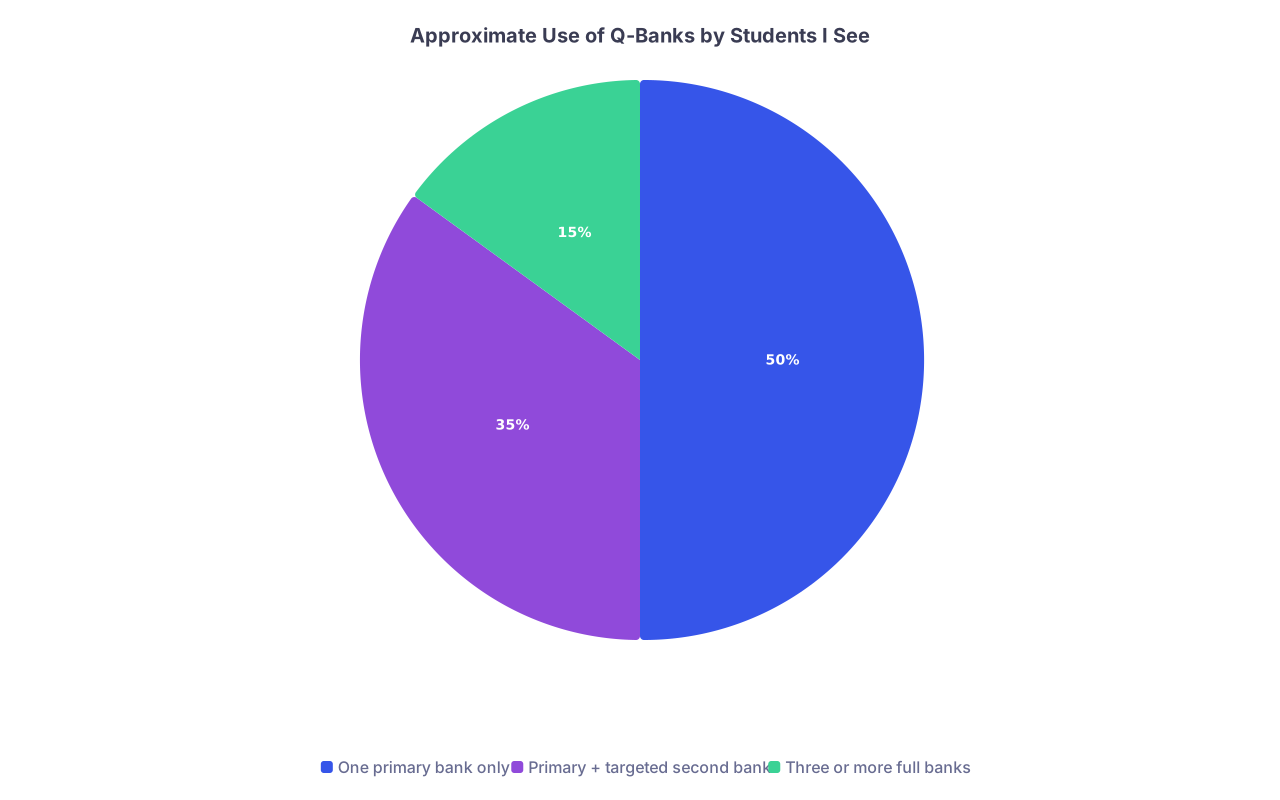
| Category | Value |
|---|---|
| One primary bank only | 50 |
| Primary + targeted second bank | 35 |
| Three or more full banks | 15 |
Most people are not actually completing three full banks. The ones that try usually burn out or end up half-finishing them.
So if you’re sitting there panicking because you “only” have UWorld and NBMEs, that doesn’t make you reckless. That makes you normal.
The Deepest Fear: “What If I Regret Not Buying More?”
Here’s the nightmare script playing in your head:
You take the exam. Score comes back lower than you wanted. Immediately your brain:
“It’s because I didn’t buy AMBOSS.”
“It’s because I didn’t get those extra practice tests.”
“It’s because I tried to save money.”
Here’s the harder, more honest possibility:
Even if you’d bought every Q-bank on earth, you’d still be thinking,
“I should have started earlier. Reviewed better. Slept more. Focused more.”
Human brains always rewrite the story to blame the one thing we didn’t do. It’s a defense mechanism. It feels more controllable to think, “I could have bought another resource,” than, “I was operating at my real limit.”
You’re never going to reach a point where you think, “Yes, I have bought exactly the perfect number of resources. No more, no less. I feel fully secure now.” That’s not how this process works.
You pick a reasonable set. You use it well. You accept that you’re human, not a machine.
Years later, what will matter is not whether you owned 1 or 3 Q-banks.
It’ll be whether you protected your sanity enough to keep moving forward in this career.
FAQ (Exactly 4 Questions)
1. If I can only afford one Q-bank for Step, which one should it be?
For USMLE-style exams, UWorld is still the safest single choice for most people because its style and difficulty are closest to the real exam and its explanations are strong. For COMLEX, you’ll usually want a COMLEX-specific bank like TrueLearn/COMBANK as your base, and if you can add UWorld for reasoning and breadth, great—but if you can’t, don’t spiral. One solid bank, used deeply, is better than three banks you barely touch.
2. Is it a bad idea to start with a “easier” Q-bank before UWorld?
It’s not automatically bad, but it’s risky if you have limited time. If you’re a first- or early second-year using something like USMLE-Rx or Kaplan slowly alongside classes, that can be fine. But if you’re in dedicated and your exam is within a few months, you don’t want to spend so long in a “starter” bank that you never get to fully grind your main one. The worst-case scenario is splitting your time across banks and never mastering the one that actually resembles the real test most closely.
3. Do I need a separate Q-bank just for my school exams?
Usually, no. Most people can prep for both school exams and boards using the same main Q-bank plus class-specific material. Some schools have internal question banks that match their style; those are worth using if available. But buying a whole separate commercial Q-bank only for school exams, on top of your board prep bank, is rarely necessary unless your school’s exams are wildly off-standard and high stakes.
4. How do I know if I should add a second Q-bank or just redo questions in the first one?
Ask yourself three things: Have you finished at least ~70–80% of your main bank with real review? Do you still have at least a few weeks left before your exam? Are there clear patterns of weakness that aren’t improving with re-exposure? If yes to all three, a small, targeted use of a second bank can help. If not, you’ll usually get more benefit from redoing incorrects, re-reviewing explanations, and tightening core concepts than spreading yourself thinner with a brand new bank.
Years from now, you won’t remember whether you owned UWorld alone or UWorld plus three other shiny platforms. You’ll remember how you handled being scared, broke, and overwhelmed—and still chose a plan you could actually live with.