
The default advice of “always buy the newest edition” is lazy and expensive.
Here’s the truth: sometimes the latest edition is absolutely worth your money. Often it’s a waste. The trick is knowing which is which.
Let’s break it down like a sane person who has actually studied for boards, watched friends panic-order new editions in February, and seen zero difference in their scores.
The Core Answer: When Is It Worth Buying the New Edition?
You’re asking: “Is it worth buying updated editions of my board review books?”
The answer is: it depends on three things
- The exam you’re prepping for
- The type of resource (summary book vs question book vs guidelines-heavy book)
- How old your current edition is
If you want a blunt rule of thumb:
- If your edition is 0–2 years old: usually keep it
- If it’s 3–5 years old: depends on the book type
- If it’s >5 years old: for major boards, usually upgrade
Now let’s get specific.
What Actually Changes Between Editions?
Most students assume new edition = totally new content.
Usually wrong.
Here’s what publishers typically do when they “update”:
- Shuffle chapters around
- Fix some errors
- Add or remove a few images or tables
- Reword high-yield facts they already covered
- Update some drug names and guidelines (sometimes important, sometimes cosmetic)
For major board prep (USMLE Step 1/2, COMLEX Level 1/2):
- The exam blueprint changes slowly
- Truly new, testable science emerges slowly
- Practice patterns and guidelines (especially for Step 2/Level 2) change faster
That means:
- For basic science books (anatomy, biochem, physio): older editions often work fine
- For clinical management books (IM, OB, peds, pharm, ID): newer guidelines can matter more
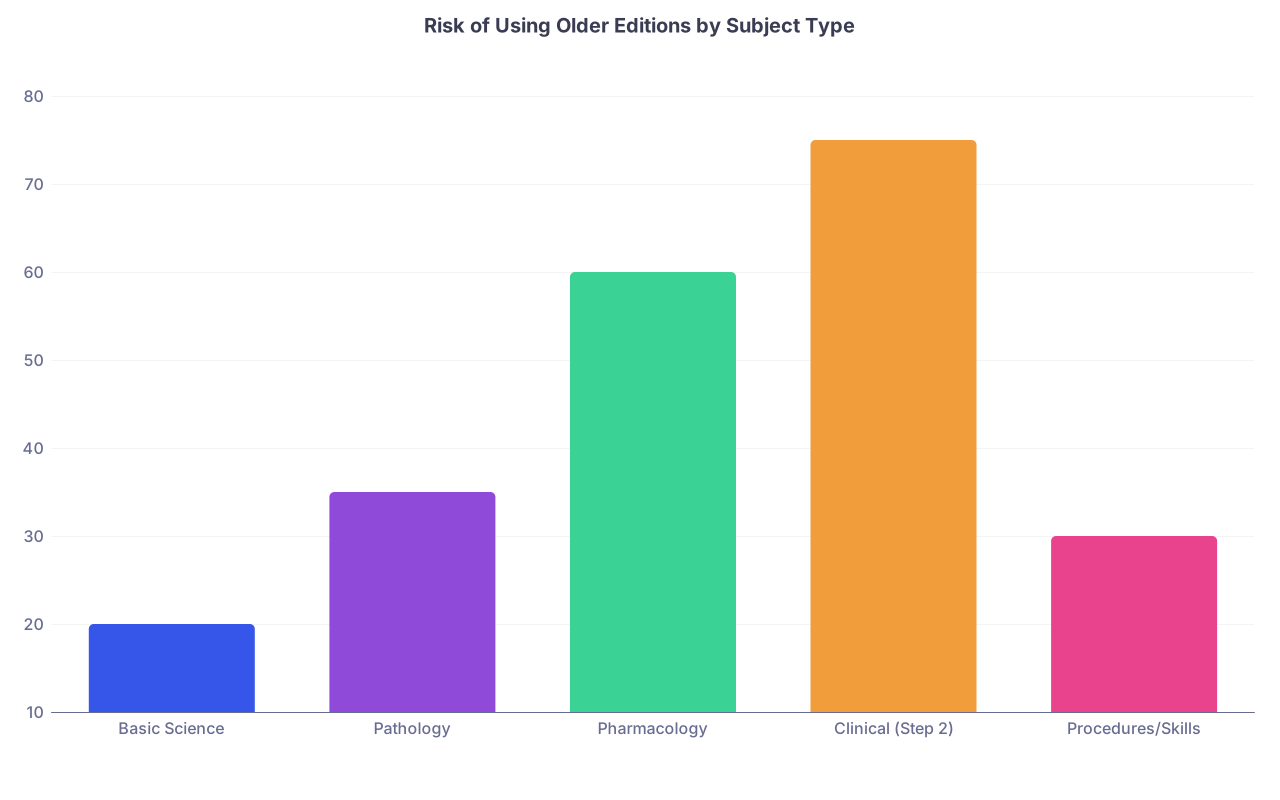
| Category | Value |
|---|---|
| Basic Science | 20 |
| Pathology | 35 |
| Pharmacology | 60 |
| Clinical (Step 2) | 75 |
| Procedures/Skills | 30 |
(Values = rough “risk” percentage that outdated info could matter on boards. Not exact, but you get the idea: pharm and clinical change fast.)
Book-by-Book: What You Should Actually Upgrade
This is where people screw it up. They either replace nothing (bad) or replace everything (worse for your bank account and honestly for your sanity).
1. Comprehensive Review Books (e.g., First Aid, Boards & Beyond notes you printed, big systems books)
For USMLE Step 1 / COMLEX Level 1 style resources:
- If your First Aid or equivalent is 1–2 years old:
- Keep it
- Use errata online
- Supplement with question banks (which update much faster)
- If it’s 3–4 years old:
- If money is tight → you can still survive with it, especially if you’re using UWorld/AMBOSS heavily
- If you can spare the cash → new edition is nice but not mandatory
- If it’s 5+ years old:
- I’d upgrade, especially for pharm, micro, and anything with lots of small details
For Step 2 CK / Level 2 clinical review books:
- Exams are more guideline- and management-heavy
- If your clinical review book is >3 years old, you’re pushing it
- New hypertension, sepsis, diabetes, anticoagulation, and OB protocols roll in regularly
- You do not want to memorize old treatment thresholds
Verdict:
New edition is optional for Step 1-style basics if your book is relatively recent.
New edition is more important for Step 2-style clinical management if your book is more than a few years old.
2. Question Books (Kaplan, case books, printed question compilations)
Honestly: this is where new editions are usually least worth it.
Most serious prep now happens in online question banks:
- UWorld
- AMBOSS
- Kaplan Qbank
- COMBANK / TrueLearn for COMLEX
These are updated incrementally, not in big “editions.”
Physical question books:
- Often reuse a lot of old questions
- Are rarely as well maintained as online banks
- Don’t adapt to exam trends as quickly
If you already own a question book that’s 2–3 years old:
- Use it for extra practice or content review, not as your main prep
- Do not pay big money for a slightly newer edition with 50 extra questions
Verdict: Unless you know a specific question book has been heavily overhauled, don’t bother upgrading. Put that money into a good online Qbank instead.
3. Pharm, Guidelines, and Clinical Management Books
This category is special. It ages faster.
You should strongly consider a new edition if:
- It’s a pharmacology review that’s >3–4 years old
- It’s a Step 2/Level 2 management guide older than 3–4 years
- It’s heavily dependent on specific guidelines (USPSTF, ACC/AHA, ADA, IDSA, etc.)
Why? Because:
- Blood pressure thresholds changed
- Sepsis protocols evolved
- Anticoagulation guidelines shifted
- Cancer screening ages and intervals have been updated
If you memorize the wrong thresholds, you can be “almost right” on every question. Which on boards = wrong.
Verdict: For pharm- and guideline-heavy resources, yes, newer editions are often worth buying once your copy is >3–4 years old.
4. Pathology, Anatomy, Biochem, Phys, etc.
These basic science foundations are comparatively stable.
Pathology:
- Pathoma from 3 years ago? Still very usable
- Big pathology text (Goljan, Robbins review): older editions are often still fine for boards, not for cutting-edge research
Anatomy, physio, biochem:
- Fundamentally the same
- Diagrams, formatting, and question styles might improve, but the raw science barely moves
Verdict: If your basic sciences review books are within ~5 years, I would not rush to replace them unless you hate the layout or there were major known errors.
The Real Decision Framework: Do YOU Need the New Edition?
Use this three-step filter. Be ruthless.

| Step | Description |
|---|---|
| Step 1 | Have older board book |
| Step 2 | Keep it |
| Step 3 | Strongly consider upgrading |
| Step 4 | Upgrade if money allows |
| Step 5 | Usually keep + use Qbank |
| Step 6 | How old is it? |
| Step 7 | Type of content? |
Step 1: How old is your current edition?
- 0–2 years:
- Almost never worth replacing solely for “updated” content
- 3–5 years:
- Depends on subject (see above)
5 years:
- Now you’re crossing into greater risk of outdated or missing content
Step 2: How central is this book to your prep?
Ask yourself:
- Is this my primary review resource or just a side resource?
- Am I staring at this daily, or once a week?
- Is this the book I annotate from questions?
If it’s your main resource that you will essentially memorize, the cost of outdated content is higher. In that case, a $60 upgrade spread over a year of study is not crazy.
If it’s a niche book you touch once in a while? Don’t bother.
Step 3: Are you supplementing with a modern Qbank?
If you’re using:
- UWorld
- AMBOSS
- Other reputable, recently updated Qbanks
…then much of the “edition difference” gets washed out. The questions will reflect newer exam patterns and guidelines.
In other words: a strong, current Qbank can partially compensate for an older book. Not perfectly, but well enough that replacing every book becomes unnecessary.

Cost vs Benefit: Is the Score Gain Real or Imagined?
Here’s the uncomfortable truth: a lot of “I scored better because I bought the latest edition” is pure placebo.
What actually moves your score:
- Volume and quality of questions you do
- How thoroughly you review explanations
- How many passes you make through your main review book
- Whether you fix weak areas early
What rarely moves your score much:
- Switching First Aid 2022 to First Aid 2024 when you barely finished reading 2022 once
- Replacing a decent 3-year-old pharm review if you’re drilling UWorld and reading their explanations carefully
If money is tight (which for many med students, it is), a smarter strategy is:
- Buy/keep one solid main review text (does not have to be this year’s)
- Pay for one high-quality Qbank
- Use free/cheap add-ons (NBME practice exams, school-provided material, online explanations)
| Priority | High Budget Choice | Low Budget Choice |
|---|---|---|
| Qbank | UWorld or AMBOSS | Single main Qbank, share courses if allowed |
| Core Text | Latest main review book | 1–3 year old edition, used/borrowed |
| Extras | Videos + extra books | YouTube/Free resources + old editions |
In other words: if you have $200–300 to spend, I’d put far more of that into Qbanks and practice tests than into swapping multiple books for slightly newer editions.
Red Flags: Times You Really Should Upgrade
There are a few cases where I tell people: yes, just buy the new one.
You should strongly lean toward upgrading if:
- Your book repeatedly conflicts with current Qbank explanations and Qbanks clearly match new guidelines
- Your classmates’ newer resources are consistently referencing topics, tables, or classifications you don’t have
- Your exam or licensing body has announced major blueprint changes (for example, when USMLE changed emphasis on certain content areas)
- Your book has known significant errata that haven’t been patched in your edition
If multiple of those are true and this is a core resource for you, then yes, the new edition probably pays for itself in peace of mind alone.
Specific Scenarios (What You Should Actually Do)
Let’s run through a few concrete situations I’ve seen repeatedly.
Scenario 1: You have First Aid 2021 and Step 1 is in 6 months
- You’re using UWorld or AMBOSS
- You’re annotating into your copy
- You’re worried because classmates have 2024
My advice: Keep 2021. Use the free errata, annotate aggressively from Qbanks, and stop letting FOMO drive your spending. Your time is worth more than the micro-changes in those editions.
Scenario 2: You have a 2017 Step 2 CK review book, exam in 3 months
- You haven’t started Qbanks yet
- You know guidelines have changed a lot since then
My advice: Upgrade. That’s 7+ years old. For a clinical, management-heavy exam, that’s ancient. Get a newer main review book or lean heavily on a current Qbank plus online guideline summaries.
Scenario 3: You’re preclinical, got a box of older books from a graduating MS4
They’re 3–6 years old. Pathoma, older First Aid, BRS physio, some random pharm.
My advice:
- Use them for course prep and early board prep
- Replace selectively later, if at all, starting with pharm/clinical and leaving basics alone
You don’t need a shiny library in M1. You need to understand the material and get used to board-style questions.

Quick Checklist: Before You Click “Buy New Edition”
Run through this quickly:
- How old is my current edition?
- Is this a core exam resource or a side book?
- Is it basic science or guideline/management heavy?
- Am I using a current Qbank that compensates for some age?
- Do I have strong evidence this edition changed a lot (new chapters, major reorg, new guidelines)?
If after that you still feel uneasy and the book is central to your plan, go ahead and upgrade. Peace of mind has value. Just don’t pretend it’s the main driver of your score.

FAQ: Updated Editions of Board Review Books
1. Do residency programs care if I used older editions of review books?
No. They care about your scores, not which edition you used. Nobody on an interview day will ask if you studied from First Aid 2020 or 2024. Use whatever gets you the score with the least stress and cost.
2. If I buy a new edition, should I transfer all my annotations from the old one?
Only if those notes are truly gold. In practice, almost nobody has time to recopy everything. Better approach: keep your old annotated copy nearby and only move over the highest-yield notes as you come across that content again.
3. Are digital editions (eBooks) updated more meaningfully than print?
Sometimes they are corrected or patched faster, but publishers rarely overhaul the core content mid-cycle. They might fix typos or small errors. If you already own a solid eBook, don’t assume the new “edition” is fundamentally different unless they explicitly say so.
4. How can I tell if a new edition is actually different and not just cosmetic?
Look at:
- Publisher’s “what’s new” page
- Online reviews from recent buyers
- Side-by-side table of contents (often online in previews)
If you see a few reworded chapters and one new appendix, that’s not major. If there are new sections, reorganized systems, updated guidelines, and a lot of changed figures—then it’s more legit.
5. If my school library has the new edition, should I still buy it?
Usually no. If you can access the newest edition through your library (physical or digital), use your own older copy for highlighting/annotating and check the library version when you want to confirm guidelines or see newer sections. That’s the cheapest compromise.
Key points to remember:
- Newest edition does not automatically mean “necessary” or “better score.”
- Upgrade selectively: prioritize guideline-heavy and clinical resources over basic sciences.
- A current, high-quality Qbank plus a reasonably recent core text beats a shelf full of brand-new books you barely open.